
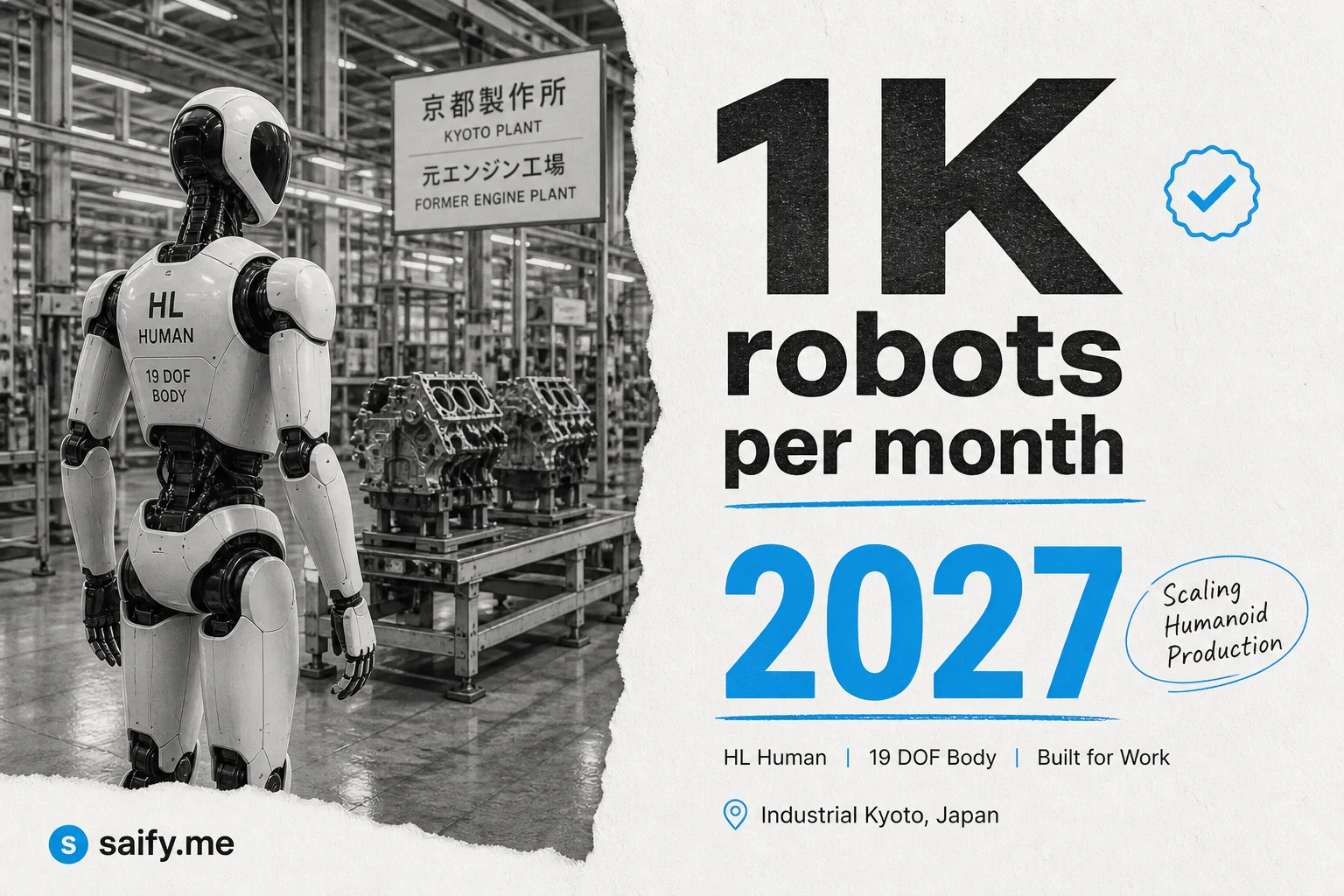
Japan's cheapest on-ramp for humanoids might be a factory that used to build combustion engines.
Mitsubishi Motors joined the humanoid race in August 2026 with a concrete number: up to 1,000 units per month at a Kyoto plant that previously assembled ICE engines. Partner: Highlanders, a University of Tokyo spinout founded in 2023. Target start: early 2027.
That pace puts Mitsubishi in a different conversation than another stage demo.
The MOU and the Kyoto line
Mitsubishi and Highlanders signed a memorandum of understanding to:
- Develop humanoid robots for Mitsubishi manufacturing facilities
- Explore mass production at the Kyoto engine plant
- Use humanoids on Mitsubishi's own lines while building them
CEO Takao Kato called it a challenge to build a new industrial foundation where humans and robots work together, while deepening Mitsubishi's technical and business expertise in humanoid robotics.
First units go to Mitsubishi's own engine lines. Internal deployment doubles as a data-collection run. The robots have somewhere to go whether or not anyone else orders them.
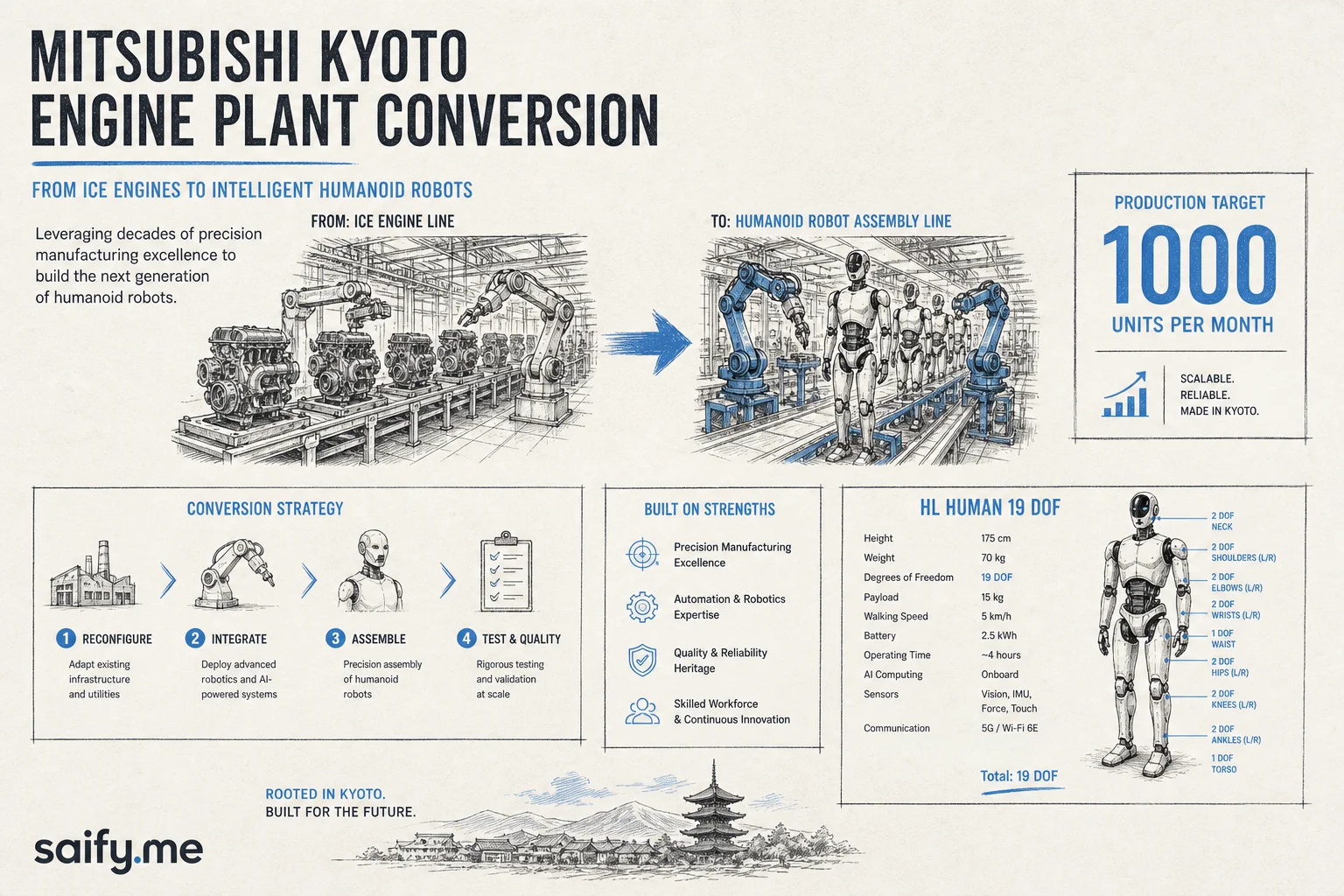
HL Human specs and target workloads
Highlanders' flagship HL Human platform, per industry coverage:
| Feature | Detail |
|---|---|
| Body | 19 degrees of freedom |
| Actuators | High-output electric drives for human-like movement |
| Perception | AI-powered scene understanding |
| Planning | Autonomous motion planning for complex tasks |
| Interaction | Natural-language communication with co-workers |
| Target sectors | Manufacturing, logistics, construction, disaster response |
Highlanders also develops quadruped robots, simulators, and related services. The humanoid is the mass-production bet.
Labor shortages in Japan's industrial base are the obvious driver. Mitsubishi is both builder and first buyer, which solves the cold-start problem most humanoid startups face: factories without orders and orders without proven robots.
Why engine plants are the conversion target
Retooling an ICE engine plant is symbolic and practical.
Japan's automotive industrial base spent decades perfecting precision assembly, supply chains, and quality systems for combustion powertrains. EV transition leaves floor space, skilled labor, and capital equipment searching for new products.
Humanoids reuse:
- Precision assembly culture
- Existing factory management systems
- Domestic supply relationships
- Worker training pipelines
A domestic humanoid startup gets a factory, capital, and a production line instead of another pilot cell in someone else's warehouse.
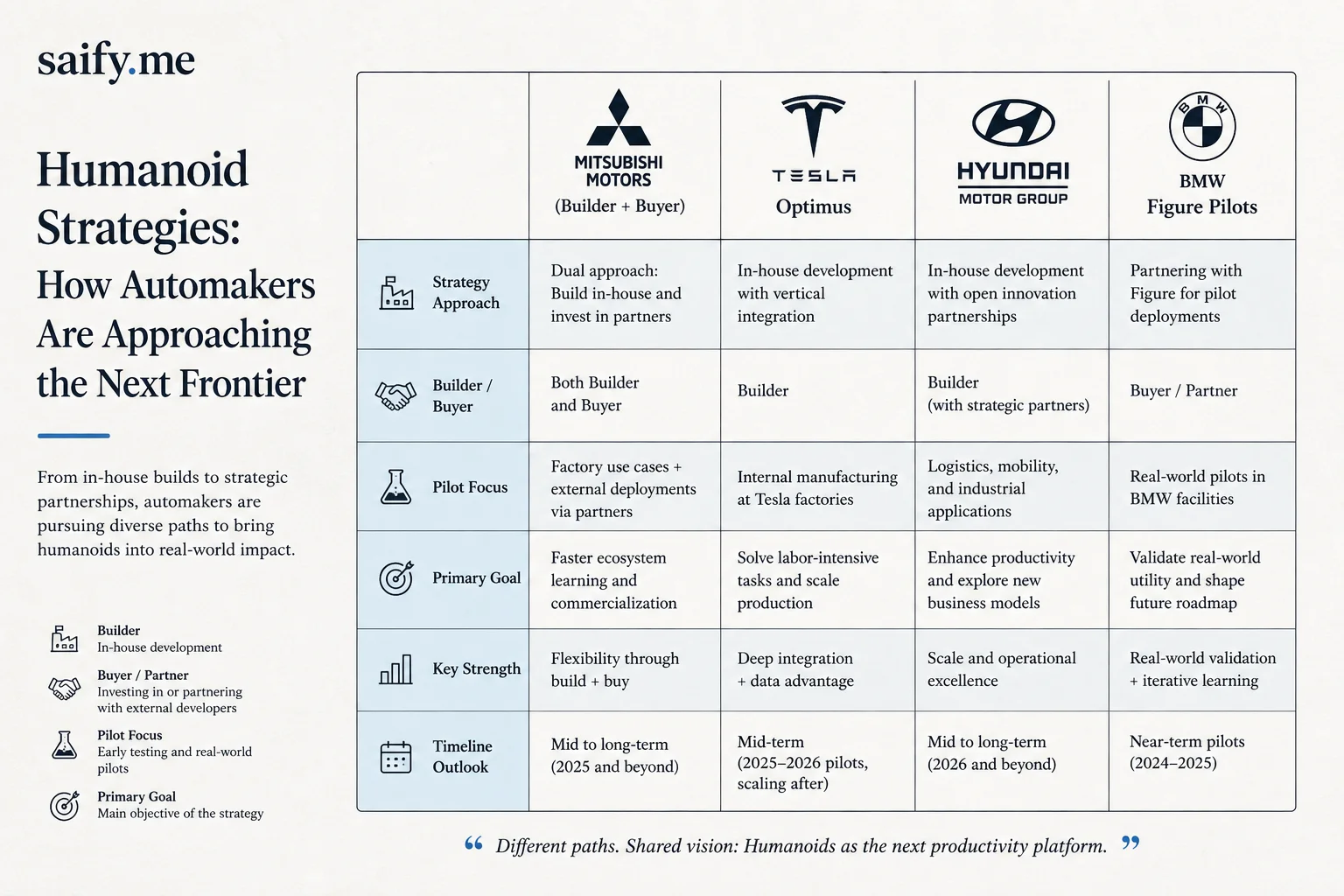
Automaker humanoid convergence
Mitsubishi is not alone. The humanoid space in 2026 features many of the same players as early EVs, but with less product diversity:
| Automaker | Humanoid angle |
|---|---|
| Mitsubishi + Highlanders | Mass production at engine plant, 1K/month target |
| Tesla | Optimus development tied to manufacturing |
| Hyundai | Boston Dynamics ownership |
| BMW | Figure pilots at Spartanburg |
| Mercedes-Benz | Apptronik Apollo pilots |
Electrek's coverage notes the humanoid race lacks the early EV variety (think i-MiEV vs LEAF vs Model S). Everyone is building basically the same shape. Differentiation will come from ops data, manufacturing scale, and who survives the hype cycle.
Builder-plus-buyer as a strategy pattern
Mitsubishi's structure is worth copying in other physical AI categories:
- Internal customer guarantees deployment volume
- Shared factory lowers unit costs early
- Data flywheel from real line work, not lab teleop only
- Export option if external demand appears
If you have pitched AI automation to SMEs, you know the "who pays for the pilot?" problem. Mitsubishi answered it by being the pilot.
Questions before calling this a win
1,000 units per month is a target, not a shipped metric. Before treating this as settled:
| Question | Why it matters |
|---|---|
| What tasks on engine lines are actually autonomous? | Scope vs teleop |
| Yield and rework rates at volume? | Manufacturing reality |
| Safety certification for shared floors? | Same fenceless debate as Agility |
| Highlanders software maturity? | 2023 founding date is recent |
| Export controls and component sourcing? | Japan-U.S. policy context |
Early 2027 is aggressive for a startup-OEM pair. Aggressive timelines in robotics often slip. Still, the infrastructure commitment (plant, MOU, public volume target) is harder to fake than a keynote walk.
The bottom line
Mitsubishi is converting legacy manufacturing capacity into humanoid mass production while deploying the robots on its own lines first. That is the clearest "old factory, new robot" story in the August 2026 cycle.
If you are evaluating physical AI for industrial ops and want help separating volume targets from deployable workflows, book a free call. I map automation roadmaps with the same ROI skepticism I use for agent projects.