
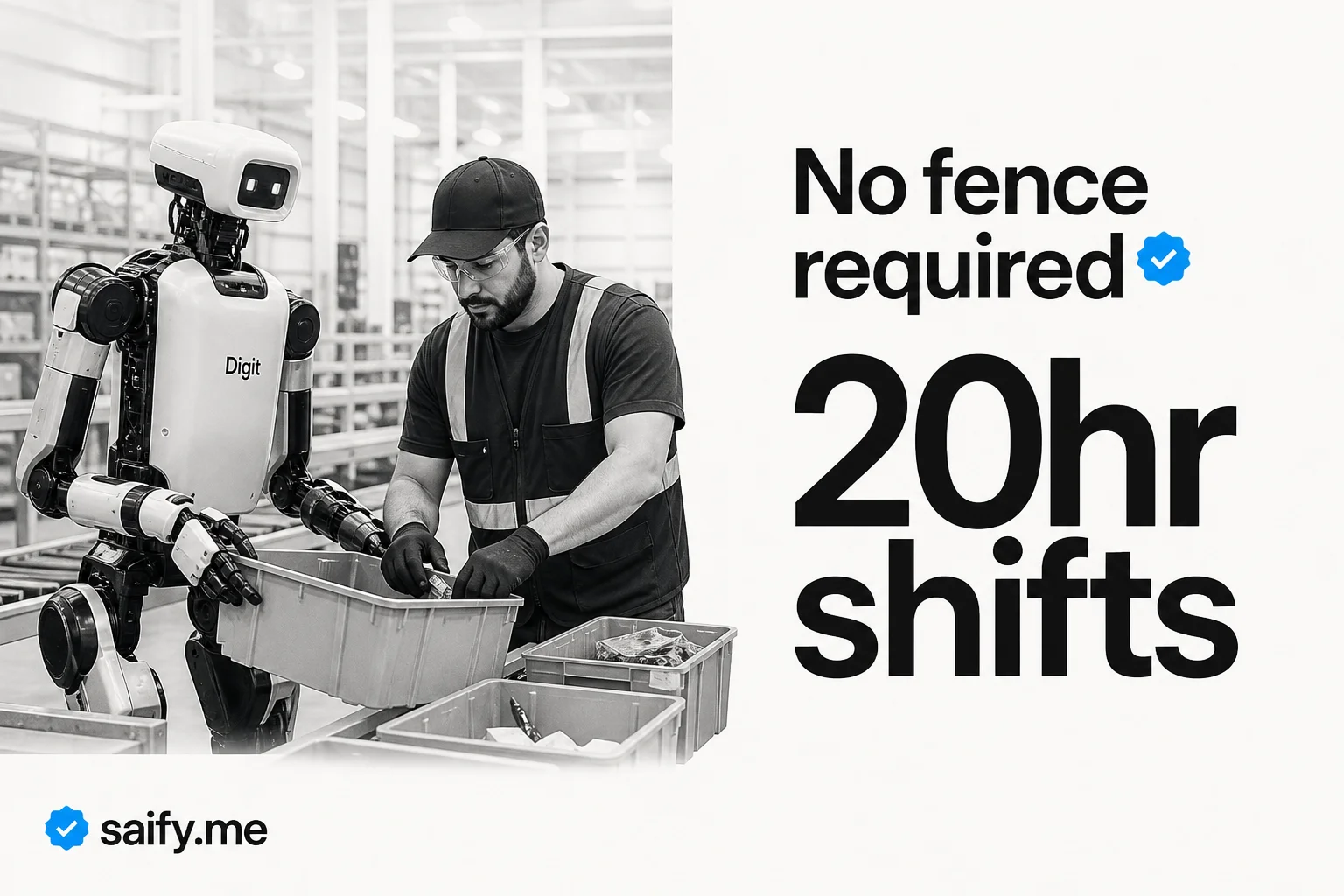
The barrier around factory humanoids was never the robot. It was the yellow fence.
Agility Robotics says Digit V5 can work shoulder-to-shoulder with people without safety fencing, the cage that keeps most humanoid pilots penned in demo cells. First customer units ship in December 2026.
That is a harder step than another warehouse reel. Figure's robots at BMW Spartanburg and Apptronik's Apollo pilots at Mercedes-Benz and Jabil are already judged on production-floor basics: long shifts, repeatability, and safety in spaces built for humans. Agility is going after the next constraint: no barrier at all.
What fenceless actually requires
Industrial humanoids in pilot cells sit behind barriers because regulators and plant safety teams need predictable separation. Removing the fence means the perception and control stack must handle:
| Requirement | Why it matters |
|---|---|
| People tracking | Humans move unpredictably near loads |
| Balance recovery | Trip recovery without dropping payload |
| Shared floor layout | No dedicated cage footprint |
| Liability clarity | Who owns a near-miss event? |
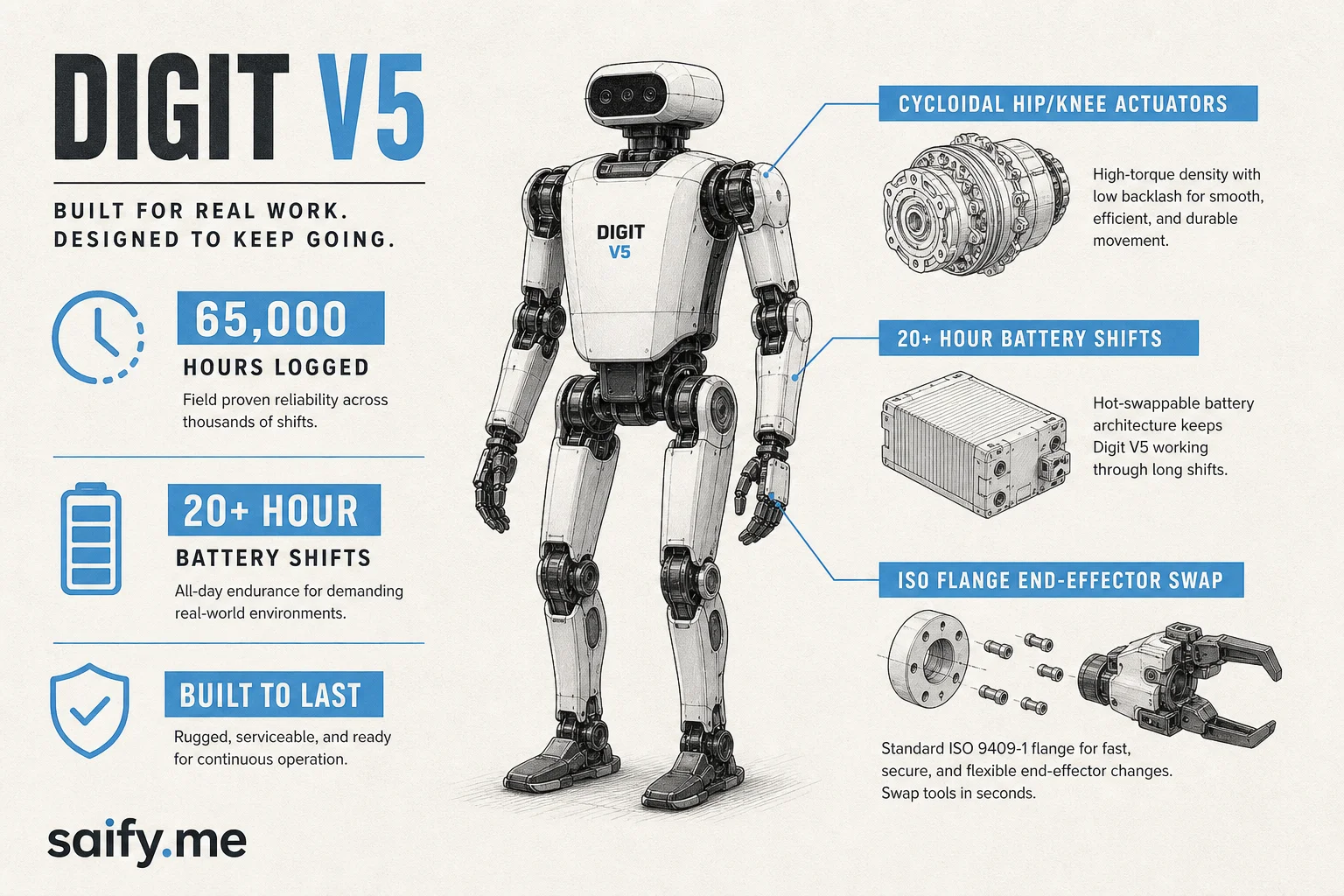
Agility points to cameras, sensors, and software that track people, plus cycloidal actuators in the hips and knees that let Digit recover without dropping its load or falling over.
Digit has logged over 65,000 hours across nine sites, generating real-world data to improve AI and robot performance, per Agility's public materials cited in industry coverage.
Battery math that changes fleet sizing
Agility specs the battery for more than 20 hours of work per day. One machine covering three shifts instead of three machines covering one shift each is not a minor efficiency gain. It changes:
- Charging infrastructure planning
- Capital expense per productive hour
- Spare robot inventory
- Maintenance windows
If you have sized voice agent fleets or GPU inference clusters, you know how shift coverage multiplies hardware counts. Humanoids have the same ops math, with heavier boxes.
Tooling and end-effector swaps
Digit V5 uses an ISO-standard flange that accepts a broad range of end-effectors. Agility has demoed manual gripper changes and autonomous tool swaps.
That matters for factories running mixed SKUs. A humanoid that can only hold one gripper is a very expensive fixed automation line. Swap-capable end-effectors push the platform toward general-purpose claims that buyers actually need.
SPAC capital and December ship date
Agility is going public through a $2.5B SPAC that raised over $620M for product development and expansion, per prior Rundown Robotics coverage.
December 2026 is the stated first-customer ship window for V5. That timeline puts Agility in direct comparison with:
- Figure at BMW and other automotive lines
- Apptronik Apollo at Mercedes-Benz and Jabil
- 1X and other humanoid vendors chasing fenceless claims
The competitive filter is no longer "can it walk on stage." It is "can it work next to my line operators without a cage."
What plant safety teams should ask
If a client asked me whether to approve a fenceless humanoid pilot, I would run this checklist:
| Question | Why |
|---|---|
| What is the certified safety case without fencing? | Regulatory sign-off |
| Near-miss logging and stop criteria? | Audit trail |
| Payload drop policy on balance events? | Product damage vs human safety |
| Teleop fallback availability? | Edge cases |
| Insurance and liability allocation? | Real contracts |
Fenceless is not fenceless because marketing said so. It is fenceless because a safety file says so.
Comparison to fenced pilots today
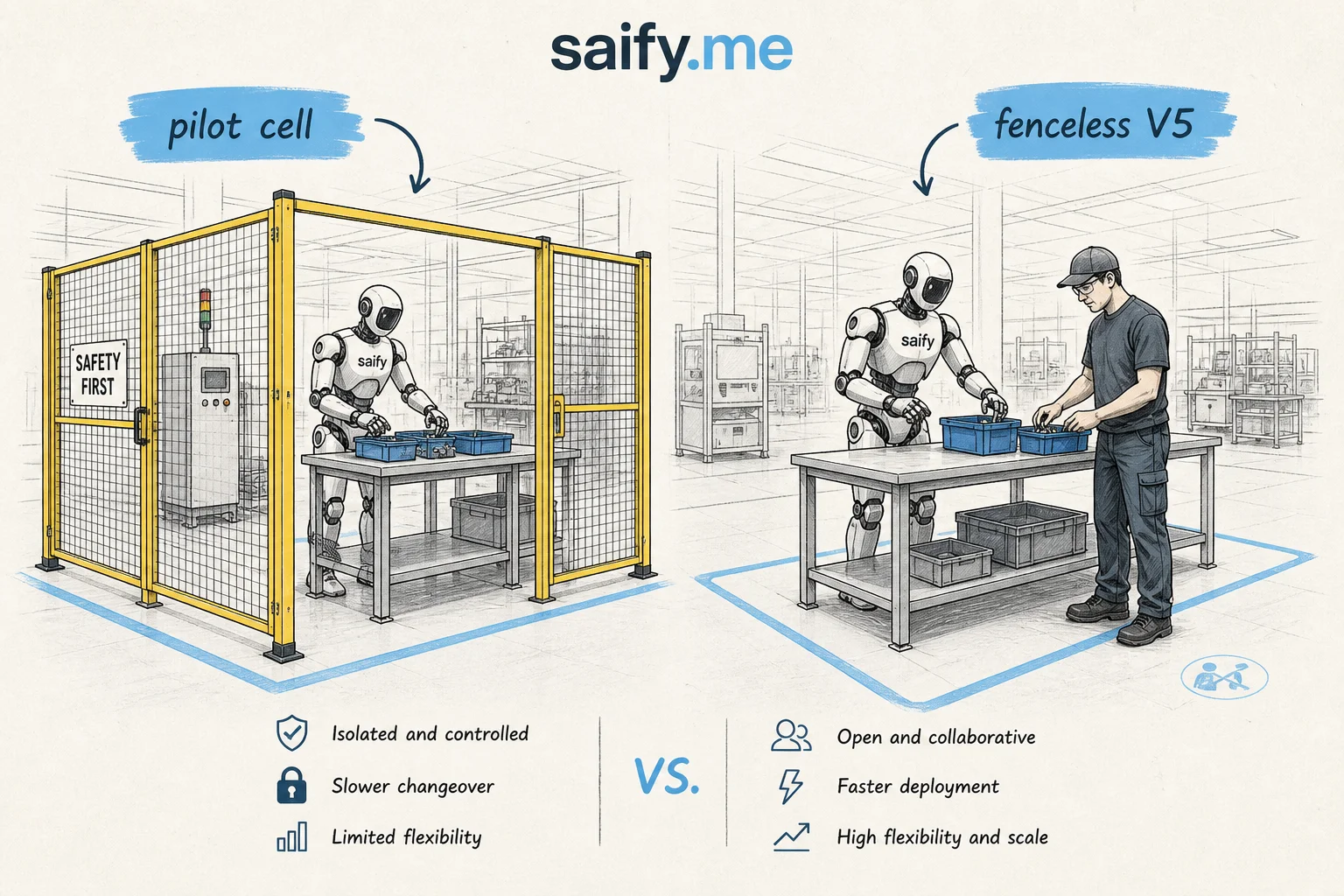
Most humanoid deployments in 2026 still look like pilot cells: dedicated zone, barrier, trained operators nearby, limited SKU mix. That is the right first step. It is also a ceiling.
Open-floor work is where labor substitution math gets interesting. A cage eats floor space. A cage also signals "this is not ready yet." Removing it is a product maturity signal, not just an engineering one.
The bottom line
Digit V5 targets the harder factory step: working safely in spaces built for people, with no yellow fence to hide behind. December 2026 shipments will be the first proof point.
If you are evaluating physical AI for manufacturing ops and want help separating pilot theater from deployable floor plans, book a free call. I map automation ROI with the same skepticism I apply to agent demos.