
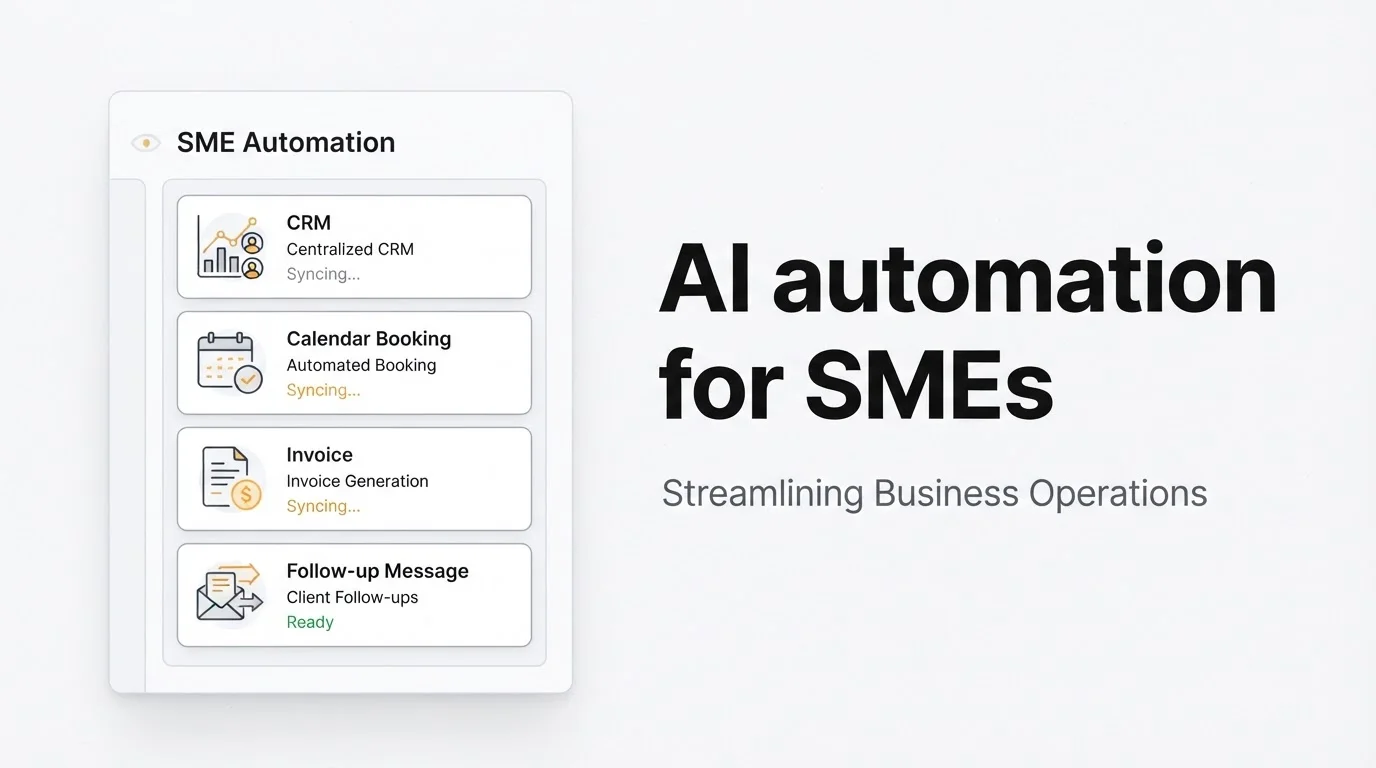
You do not need an "AI transformation." You need five hours a week back, twelve times over.
The SMEs getting results are not buying platform megaprojects. They pick one repetitive process, wire it into tools they already use (n8n, GoHighLevel, HubSpot, QuickBooks), measure hours saved, then do the next one. Below are ten automations I keep shipping for US and global operators. Each one is scoped to weeks, not quarters.
Time ranges are realistic for a typical service or local business. Your volume changes the math. Run the worked example at the end with your own numbers before you spend.
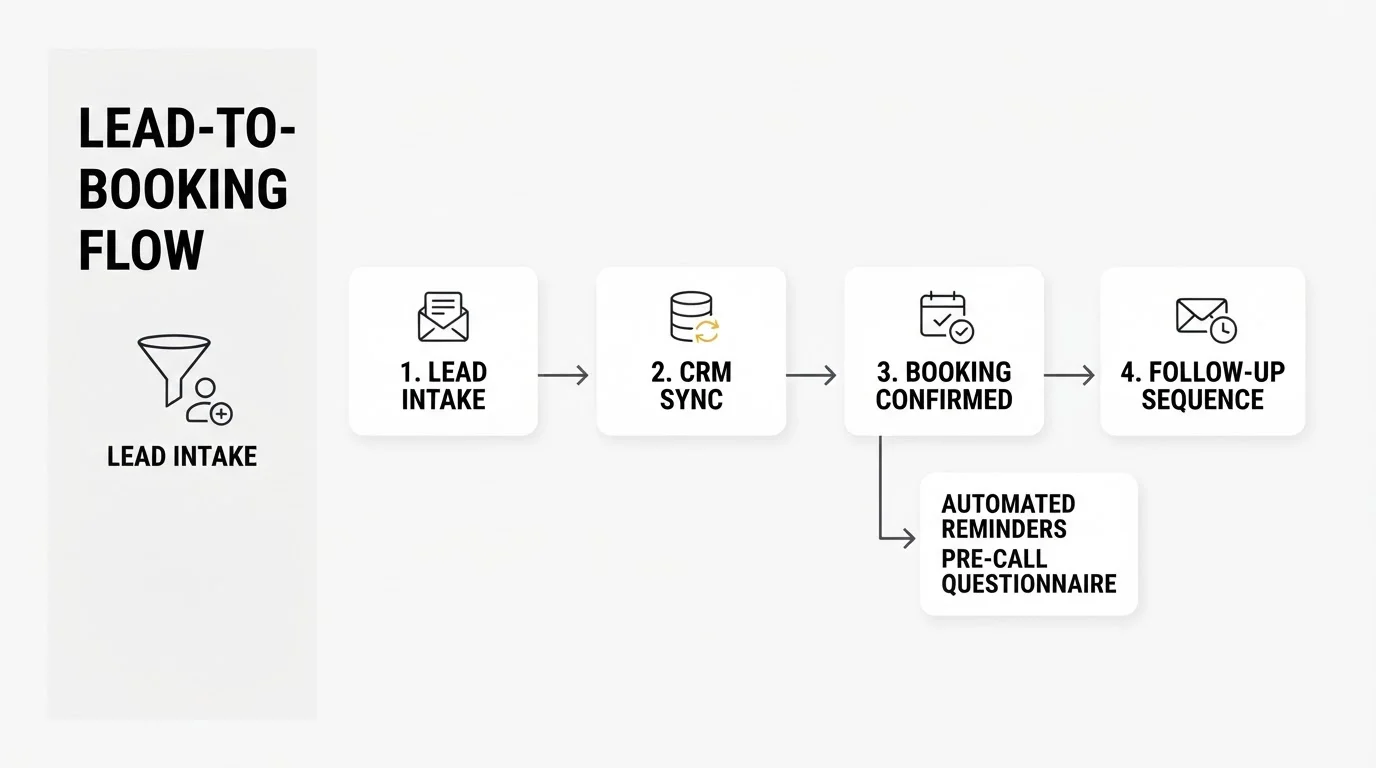
1. Lead intake into the CRM
Every form, ad lead, missed-call text-back, and website chat should create or update a contact automatically. No "I'll enter it later."
What ships: webhook or native GHL form → contact + opportunity → owner assignment → first SMS or email within minutes.
Typical save: 3–5 hours per salesperson per week, plus a pipeline managers can finally trust.
Stack tip: keep GHL as the system of record; use n8n when you need retries, Slack VIP alerts, or a second CRM write.
2. After-hours follow-ups
Leads that arrive at 9pm used to die until morning. A short qualify sequence asks intent, budget band, and preferred time, then either books or parks the lead in a nurture lane.
What ships: inbound message → AI qualify (2–3 questions) → hot lead task for closer → cold lead drip.
Typical save: first response from hours to under 2 minutes; conversion lift depends on your close rate, but the leak is usually obvious once you log overnight volume.
3. Booking and reschedule
Customers want a slot, not a promise. Connect the bot or voice agent to a live calendar. Confirmations and reschedules update the same record.
What ships: offer real availability → create event → confirmation message → reminder 24h before with confirm / reschedule buttons.
Typical save: front desk recovers 5–10 hours weekly on phone tag; no-show rate often drops once reminders are consistent.
4. CRM activity sync from chat and calls
If the conversation lives only in a phone, your CRM is fiction. Sync transcripts, summaries, and outcomes into the contact timeline.
What ships: WhatsApp / SMS / voice webhook → summary + next step → GHL note / task → stage move when booked or lost.
Typical save: managers stop chasing "what happened with that lead?" and reps stop double-entering notes.
5. Invoice and bill alerts
AI reads supplier invoices (PDF, photo, email attachment), extracts vendor, totals, tax, and due date, posts into accounting or a review queue, and alerts on anomalies.
What ships: inbox watch → extract → QuickBooks / Xero draft → Slack or email if total jumps >20% vs last bill.
Typical save: 10–20 staff hours monthly at a few hundred invoices; fewer reconciliation surprises.
Official extraction patterns are well documented in products like Google Document AI and OpenAI PDF / file inputs. The hard part is your chart of accounts mapping, not the model demo.
6. Quote drafts from a price sheet
Trading companies and contractors lose deals when the first usable quote takes two days. Pull SKU or package pricing, apply margin rules, spit a branded PDF for human approval.
What ships: request form or email → price lookup → draft quote → owner approval → send.
Typical save: turnaround from days to same hour; revenue impact beats the hours saved when you are in a competitive bid market.
7. Inbox triage for shared addresses
info@ and support@ are sorting taxes. Classify by type and urgency, draft routine replies for one-click send, route the rest, flag anything that smells like legal or refund risk.
What ships: Gmail / Outlook watch → label + draft → assign owner → escalate VIP domains.
Typical save: response times drop from half a day to minutes on the routine 60–70%.
8. Review and social reply drafts
Google reviews and Instagram DMs are purchase intent that goes cold overnight. AI drafts personalized replies; humans approve before post, especially on negatives.
What ships: new review webhook → draft reply → approval queue → post. Same idea for common "do you deliver to…?" DMs with a handoff to WhatsApp or booking.
Typical save: 1–2 hours weekly of writing, plus a profile that no longer looks abandoned.
9. Client onboarding packs
New client triggers the same ritual: welcome email, contract template, document checklist, Drive folder, CRM stage. Automation runs the sequence and politely chases missing docs.
What ships: won deal → generate docs → collect uploads → notify AM when complete.
Typical save: first-week admin almost disappears; clients feel a sharper kickoff.
10. Weekly ops report
Pull CRM pipeline, ad spend, and booking counts into one template with a short AI commentary on what changed. Deliver Monday 8am. No more Friday night spreadsheet archaeology.
What ships: scheduled n8n → query sources → fill template → email / Slack.
Typical save: half a day to a full day per month for agencies and multi-location operators.
Worked example: run the math yourself
Take a mid-size service business: 200 supplier invoices / month, 120 inbound leads / month, 3 salespeople.
| Workflow | Rough monthly hours recovered | Notes |
|---|---|---|
| Invoice extract (#5) | ~30–35 | ~10 min saved × 200 |
| CRM intake + chase (#1–2) | ~40–50 | entry + faster first touch |
| Booking reminders (#3) | ~15–20 | phone tag + fewer no-shows (time only) |
| Total | ~85–105 | before revenue lift from speed |
If fully loaded staff time is $40/hour, that is roughly $3,400–$4,200 / month of capacity, plus whatever faster quotes and overnight replies convert. Build cost for three workflows is usually a one-time project plus small LLM / API run costs. Whether payback is 2 months or 5 depends on your wages and close rates. The point is you can spreadsheet this before you buy.
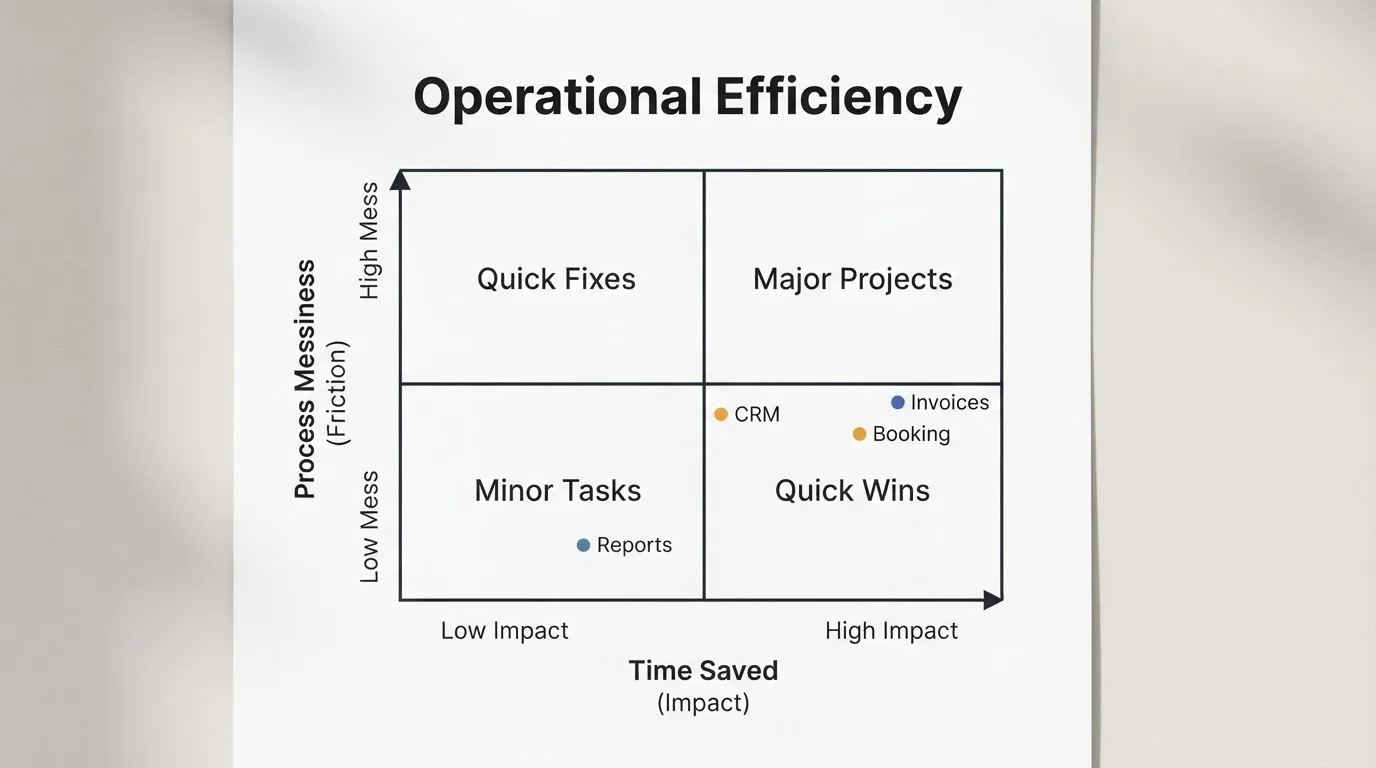
How to prioritize (two questions)
Score each candidate:
- How much does it cost you today? Hours × wage, plus revenue leaking from slow response.
- How messy is the process? Clean digital inputs automate fast. Exception-heavy judgment work automates slowly or badly.
Your first project should be high cost and relatively clean.
| Business type | Start here | Pair next |
|---|---|---|
| Sales-driven | CRM intake + follow-up (#1–2) | Booking (#3) |
| Ops-heavy | Invoices (#5) | Onboarding packs (#9) |
| Message-heavy | Booking + reminders (#3) | Inbox triage (#7) |
Notice what all ten share: none require your team to learn a new daily app. Automation should live inside GHL, the calendar, and the inbox you already open. If a proposal starts with "first migrate everything to our platform," you are being sold a platform, not a workflow.
Compare orchestration options in my deeper stack post: n8n vs Make vs custom.
Boring prerequisites that decide success
Three things matter more than model brand:
API access. Modern CRMs, calendars, and accounting tools integrate. Desktop-only software needs a workaround (or a different first project).
One source of truth. Three price lists produce three confident wrong quotes. Consolidate before you automate.
Exception path. Automate the routine 90%. Route the weird 10% to a human with context. Builds that skip this step show up in screenshots of angry customers.
Also worth reading: n8n workflow templates for patterns you can adapt, and WhatsApp Cloud API docs if messaging is your channel.
Deploy one, not twelve
Playbook that works:
- Pick the single process where hours or leads visibly disappear.
- Automate it end to end with logging and human escalation.
- Run beside the manual process for two weeks.
- Measure hours saved and error rate.
- Reinvest confidence in the next workflow.
Most of the items above take two to four weeks each when scoped tightly. Teams that follow the sequence usually have three or four workflows live within six months. Each one ships faster because integrations and lessons accumulate.
If you want help choosing the first cut, book a free discovery call. Bring volumes (leads/week, invoices/month, channels) and the tools you already pay for. We will leave with one workflow and a pass/fail metric, not a 40-slide roadmap.