
Anthropic wants IPO investors to picture Claude in hospitals and wet labs, not just in GitHub pull requests.
The Wall Street Journal reported in August 2026 that Anthropic is meeting prospective investors ahead of a September or early October listing target, pitching healthcare and biology as a way to "mitigate some of the negative sentiment around AI." That pitch lands the same week the company's own blog post admits its flagship model still cannot run professional drug research.
The gap between investor story and product reality is the whole story.
The IPO backdrop
Anthropic confidentially filed for an IPO in June 2026 after a $65 billion Series H round that valued the company at roughly $965 billion post-money. Late 2026 is the public debut window most analysts cite.
Healthcare is not a side quest. It is a reputational hedge and a revenue diversification play at the exact moment coding agents face commoditization pressure from open weights and cheaper inference.
Products already in market:
| Surface | Audience | What it does |
|---|---|---|
| Claude for Healthcare | Providers, payers | Clinical workflow assistants |
| Claude for Life Sciences | Pharma, biotech | Research and pipeline tooling |
| Claude Science | Researchers | Desktop workbench with connectors and HPC |
| Gates Foundation partnership | Global health | $200M in grants, credits, and technical support |
I covered the workbench layer in Claude Science's launch. The August 2026 investor angle is about narrative: AI that saves lives, not AI that steals jobs.
What actually changed on August 7, 2026
Five days before the investor-meeting headlines, Anthropic published an update to Fable 5 biology safeguards.
The headline number: biology-related fallbacks dropped about 85% across product surfaces. Fallbacks are when the system routes your query to a less capable model after a safety classifier fires.
In practice:
- Fewer false positives on everyday health questions
- Healthcare professionals get more Fable 5 support on clinical interpretation tasks
- Educational biology questions see far fewer unnecessary downgrades
That is real progress for clinicians using Claude for chart summaries, patient education drafts, and lab context. I have clients in regulated industries who care about this because fallback models silently change behavior and citation quality.
What did not change: professional R&D is still gated
The same August 7 post is explicit about the ceiling.
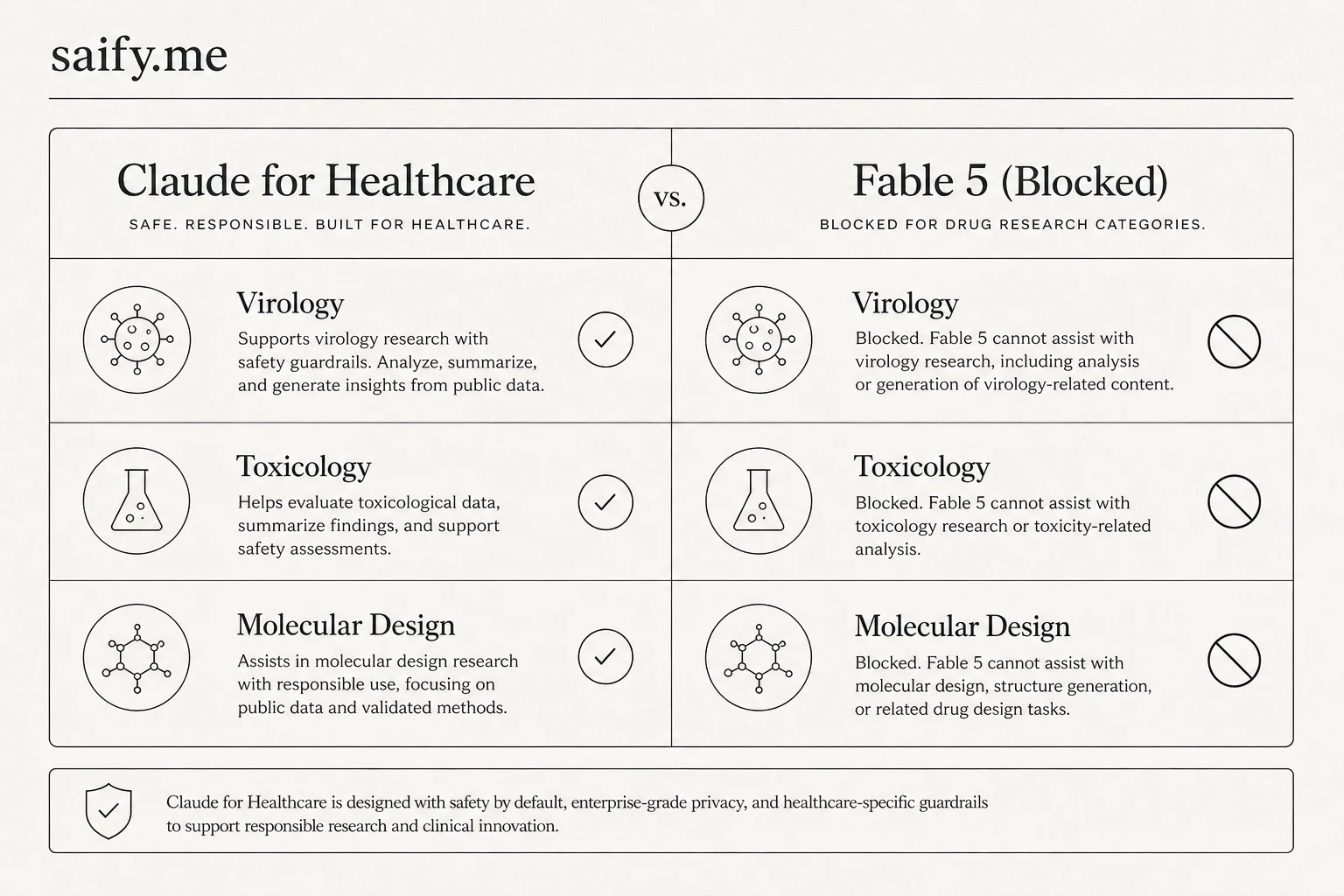
Fable 5 still falls back to Opus 5 for requests Anthropic classifies as dual-use, including:
- Virology
- Toxicology
- Molecular design
- Professional biology research and drug development
Anthropic's own words: the model can provide "significant uplift" to someone attempting to develop a biological weapon. So frontier biology capabilities stay locked behind classifiers, not product tiers.
At the June 2026 Fable 5 launch, Anthropic said it intended to create a trusted access pathway for professional researchers. As of August 7, no timeline exists.
That is the tension in the investor pitch. You can demo Claude Science at a pharma launch event. You cannot yet hand a virology team unrestricted Fable 5 for molecular design without automatic downgrade.
Why investors still like the healthcare story
Despite the safeguard gap, the commercial logic is strong:
1. Defensible enterprise contracts. Hospital systems and pharma R&D budgets are sticky. Coding tool spend competes with every open-weight release. Clinical workflow software competes with compliance moats.
2. Partnership signal. The Gates Foundation partnership commits $200 million over four years across global health, life sciences, education, and economic mobility. That is beneficial deployment capital, not just logo collection.
3. Public opinion framing. AI backlash clusters around job loss and deepfakes. Vaccine logistics, pre-eclampsia detection, and clinician decision support are easier stories for a roadshow deck.
MedCity News quoted Bristol Myers Squibb's chief data officer saying the company runs small and large molecule candidates through AI screening before wet labs, targeting 30% cycle time cuts. Whether every pharma buyer sees that ROI is another question. The pipeline anecdotes exist for the S-1.
What builders in healthcare should do now
If you ship clinical or life-science software on Claude:
Map fallback behavior in prod. Log when models downgrade. Your app may think it is on Fable 5 while the API silently routes to Opus 5. Test virology and molecular design prompts in staging and read the actual model field in responses.
Do not confuse workbench with frontier access. Claude Science is a client with connectors and provenance. It does not bypass biology classifiers on dual-use categories.
Plan for trusted-access programs. Anthropic's stated direction is tiered professional biology access with auditing. If your roadmap needs unrestricted frontier biology, budget legal review and an Anthropic partnership conversation, not just API keys.
Separate investor narrative from your compliance packet. Your hospital legal team will not care about IPO timing. They care about hallucination rates, audit logs, and whether outputs are marked as AI-generated. Anthropic's watermarking rollout matters more to them than valuation slides.
The honest summary
Anthropic's healthcare pitch is both forward-looking disclosure and aspirational framing. Clinical surfaces got measurably better in August 2026. Frontier drug R&D on the best model still does not.
For applied AI engineers, the lesson is familiar: read the safeguard changelog, not the keynote. If you are wiring Claude into regulated workflows and want a second opinion on fallback risk and audit design, book a free discovery call.