
OpenAI's longest-serving business operator is walking out the door right as the company lines up a landmark IPO.
Brad Lightcap, who spent eight years building finance, legal, people, partnerships, and go-to-market at OpenAI, posted on August 11, 2026 that he is leaving to "start something new." He will stay for a few weeks to help with the transition.
If you sell into enterprises that standardize on ChatGPT, this is not background noise. It is a signal about how unstable the commercial layer still is at the frontier labs.
What Lightcap actually built
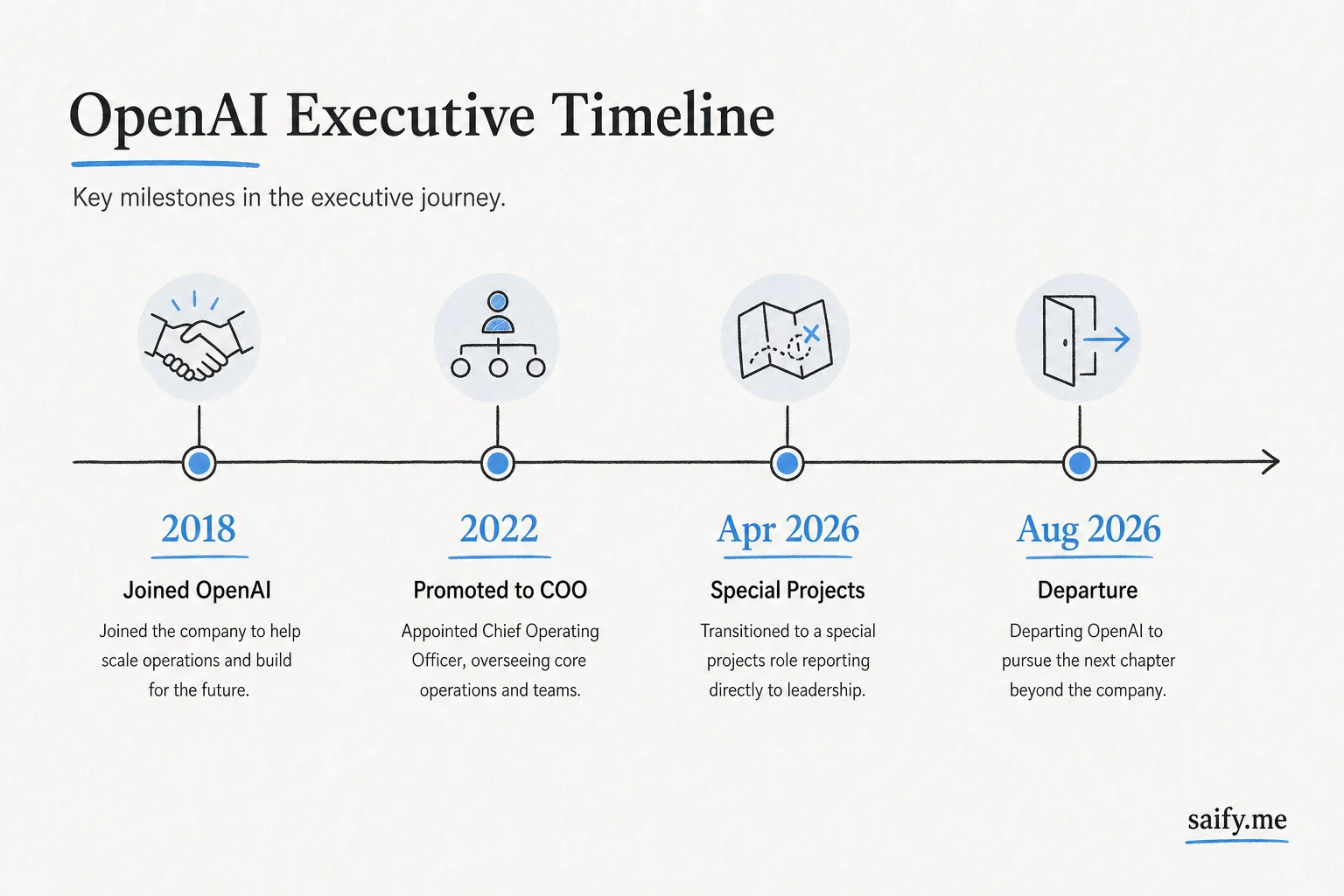
Lightcap joined OpenAI in 2018, back when the company was still mostly a research shop with a nonprofit parent. He was CFO for four years, then COO from 2022 through early 2026.
In his farewell note, he said he had the privilege of building the first versions of most operations teams: Finance, Legal, People, CorpSec, GTM, Gov, Partnerships, and more. That is not vanity. OpenAI's enterprise contracts, Azure distribution, and API commercialization all ran through structures he helped stand up.
Prior to OpenAI, he worked with CEO Sam Altman at Y Combinator. The Altman connection matters. Lightcap was not a random hire from Big Tech. He was part of the founding commercial brain trust.
| Period | Role | What shifted |
|---|---|---|
| 2018 to ~2022 | CFO | Capital, cost discipline, early partnerships |
| 2022 to Apr 2026 | COO | Business operations, infrastructure, GTM scale |
| Apr to Aug 2026 | Special projects | Major partnerships, next-horizon bets |
| Aug 11, 2026 | Departure | "Start something new" (details undisclosed) |
The role shuffle before the exit
Lightcap's exit did not come out of nowhere. OpenAI has been rotating senior leaders for over a year.
In April 2026, Lightcap officially stepped down as COO and moved to special projects. CNBC reported that Denise Dresser, chief revenue officer, took over most of his responsibilities at that point.
Earlier in 2026, Lightcap had already narrowed his enterprise product scope while keeping commercial functions. Barret Zoph briefly took enterprise product before his own departure. The org chart reads like a live migration, not a settled hierarchy.
In July 2026, Fidji Simo, who led AGI development as OpenAI's No. 2 executive, also announced she would step down. Other recent exits include Bill Peebles (Sora) and Kevin Weil (OpenAI for Science), per TechCrunch.
What Lightcap said about the next chapter
The internal memo Lightcap shared publicly is worth reading closely. Two lines stand out for builders:
Over the last few months, I've been focused on the next horizon and what would stand in the way of mission success. I believe there are a few important new things the world will need to get right as we enter this next period.
He did not name a company or a product. He framed the move as mission-aligned, not adversarial. Still, "a few important new things the world will need to get right" sounds like infrastructure, governance, or deployment gaps rather than another chat wrapper.
Given his track record, a new venture in AI commercialization, enterprise trust, or capital markets would surprise nobody.
Why this matters if you are not on OpenAI's cap table
Three practical takeaways for applied AI engineers and operators:
1. Enterprise continuity risk is real. When the person who built your vendor's contract desk leaves during IPO season, account teams may still perform, but escalation paths and strategic partnership deals can slow. If you have a ChatGPT Enterprise renewal in Q4 2026, document owners on both sides now.
2. IPO prep often causes executive churn, not prevents it. Public markets want a clean story. Internal reorgs and departures can be feature, not bug, as roles get re-scoped for S-1 narrative. That does not make your integration project less fragile.
3. Watch who replaces the operator class. Dresser absorbing COO scope suggests revenue leadership is the through-line OpenAI wants investors to see. Research and product vision may get more centralized under Altman and a thinner senior bench.
I do not read this as OpenAI collapsing. Revenue and usage are enormous. I read it as the company still inventing its adult governance in public.
How I would hedge a ChatGPT-heavy stack today
None of this means you should rip out OpenAI tomorrow. It means you should stop treating frontier lab org charts as stable platforms.
Concrete moves I recommend in client audits:
- Dual-vendor inference for non-critical paths (same prompt, second provider on failover)
- Portable agent harnesses (MCP, skills files, eval suites) that do not assume one API schema
- Contract clauses for leadership-change notification on strategic accounts
- Internal runbooks that name technical owners, not just account managers
If your team is betting a product roadmap on a single lab's roadmap, book a free discovery call. I help operators map agent stacks that survive vendor drama without a full rewrite.