
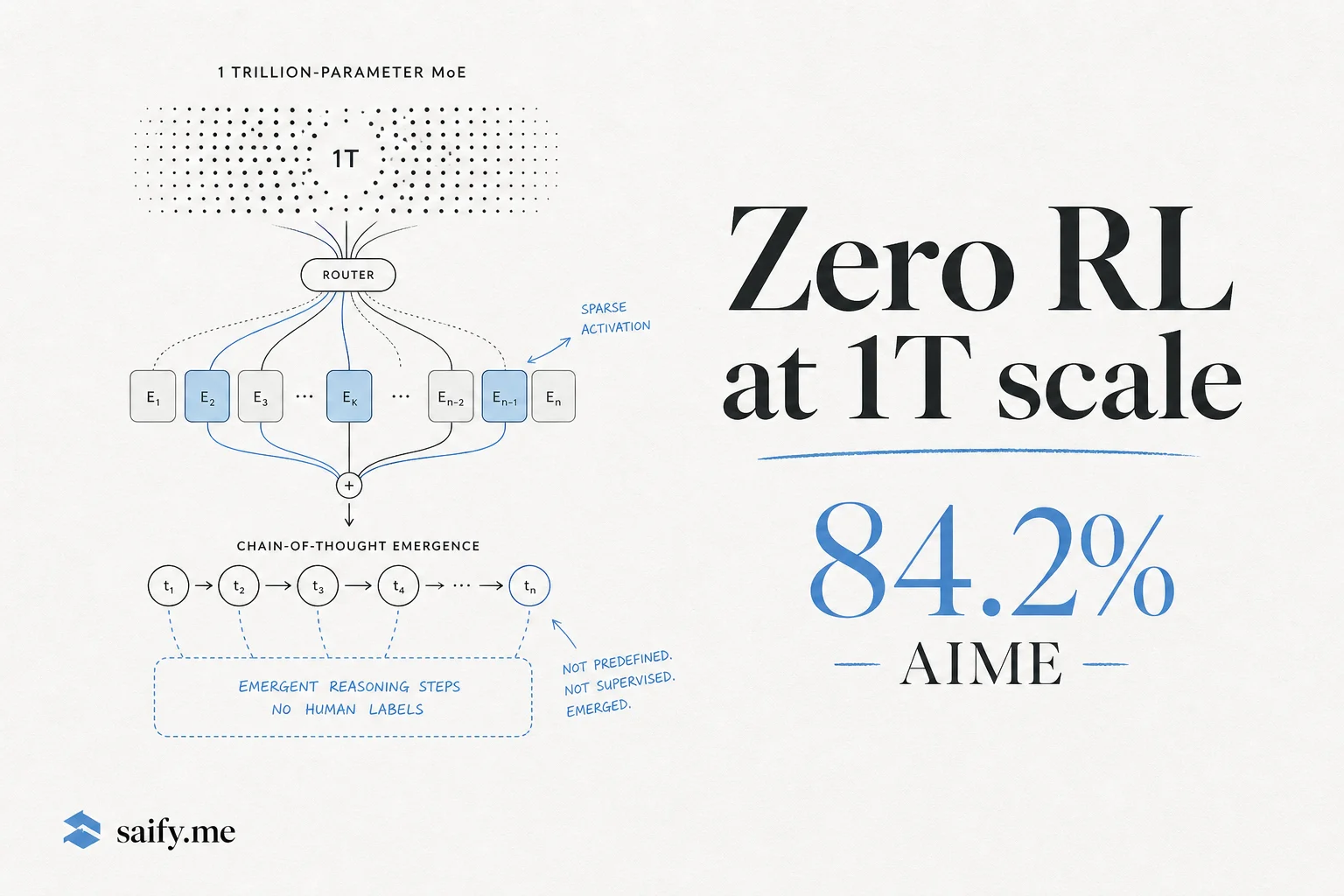
Most "zero RL" papers stop at models small enough to fit on a friendly cluster slide. Ant Group's InclusionAI team asked what happens when you push reinforcement learning with verifiable rewards and no human chain-of-thought labels all the way to one trillion parameters.
The answer landed July 14, 2026 as Ring-Zero: Scaling Zero RL to a Trillion Parameters for Emergent Reasoning. The trained model, Ring-2.5-1T-Zero, is not a consumer chatbot. It is evidence that scale changes what emerges when you skip imitation learning on human reasoning traces.
I evaluate models for client agent stacks. Ring-Zero is the paper I would send to a CTO who still assumes you need expensive human CoT datasets to ship a reasoner.
Zero RL in plain language
Traditional reasoning training often looks like:
- Collect human-written chain-of-thought examples
- Supervised fine-tune the base model to imitate them
- Maybe add RL on top
Zero RL (RLVR without human annotations) skips step 1 and 2. You start from a pretrained base and apply RL with verifiable rewards: math answers that check automatically, code that runs, proofs that parse. The model invents its own reasoning strategies because reward signal comes from outcomes, not human phrasing.
Guo et al.'s "zero RL" line showed this works on smaller scales. Ring-Zero asks: what breaks, what stabilizes, and what emerges at 1T?
What Ant actually trained
Ring-2.5-1T-Zero sits in Ant's Ring family:
| Milestone | Notes |
|---|---|
| Ring-1T-preview (Sep 2025) | First open-source trillion-parameter thinking model |
| Ring-2.5-1T (Feb 2026) | Hybrid linear-attention, up to 1M context |
| Ring-2.6-1T (May 2026) | MIT license, async RL, adaptive reasoning intensity |
| Ring-2.5-1T-Zero (Jul 2026) | Zero human annotation RL at 1T |
The July paper documents algorithmic and systems plumbing to keep trillion-scale zero RL stable:
- Clipped importance sampling
- Training-inference ratio correction
- Mixed-precision control
Without those fixes, naive scaling produced poor readability, token redundancy, and shallow reasoning depth. Sound familiar if you have run RL on messy agent harnesses at smaller scale.
Three findings that validate scaling
The authors frame three results as evidence for the bitter lesson at 1T:
- Sample efficiency and ceilings rise when parameters scale to 1T
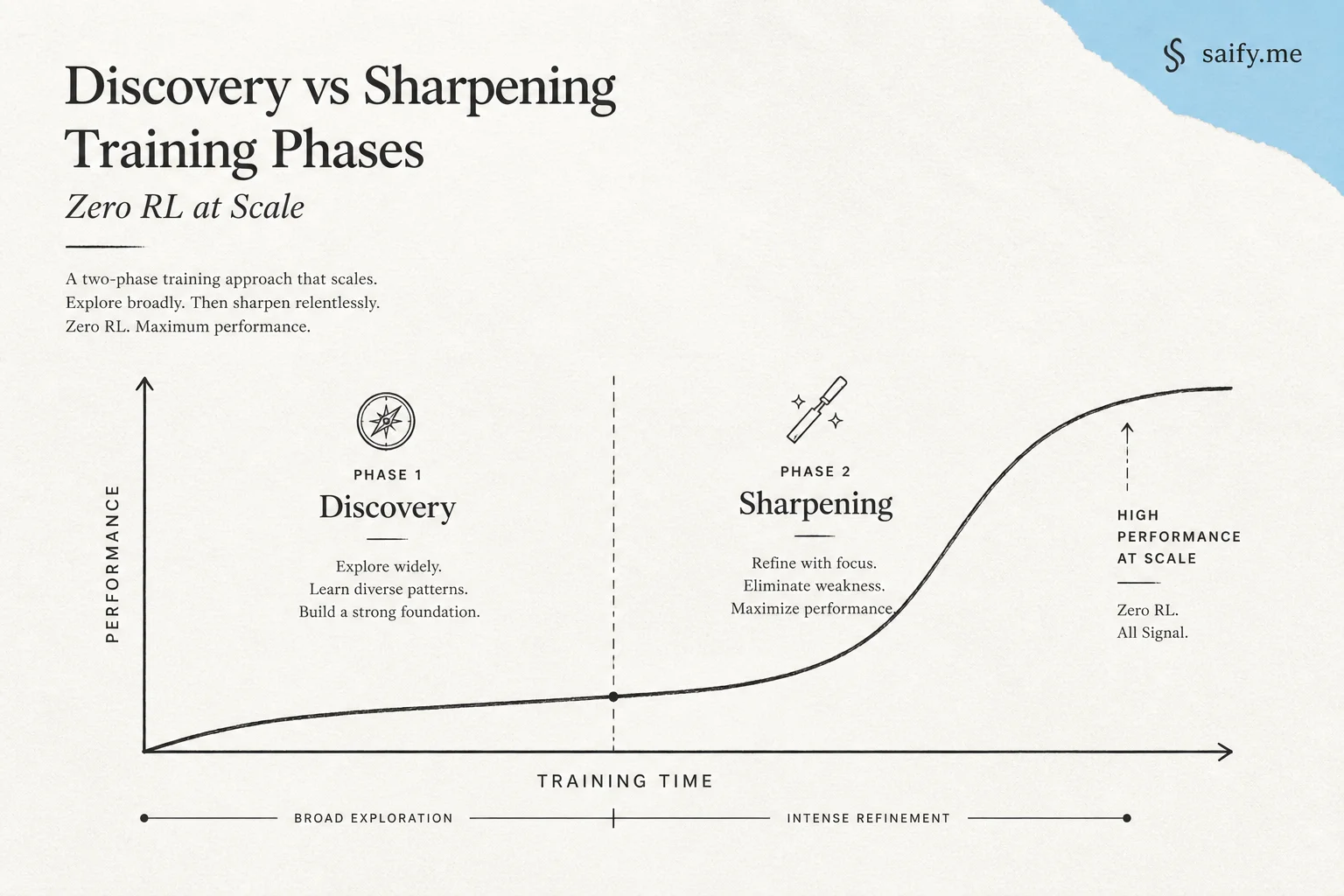
- Training moves through a discovery phase then a sharpening phase sequentially
- Advanced cognitive behaviors emerge without hand-crafted heuristics
On seven math benchmarks (AIME 2024/2025/2026, HMMT, IMOAnswerBench series), Ring-2.5-1T-Zero posts competitive scores. TechTimes cited 84.2% on AIME 2026 from first-stage RL alone, before second-stage refinement.
Competitive, not dominant everywhere, matters for honest eval. The paper also introduces a chain-of-thought quality framework beyond final-answer accuracy: comprehensibility, reproducibility, and efficiency. Ring-2.5-1T-Zero wins on structured, concise traces in their framework even when headline accuracy ties.
Five behaviors nobody explicitly programmed
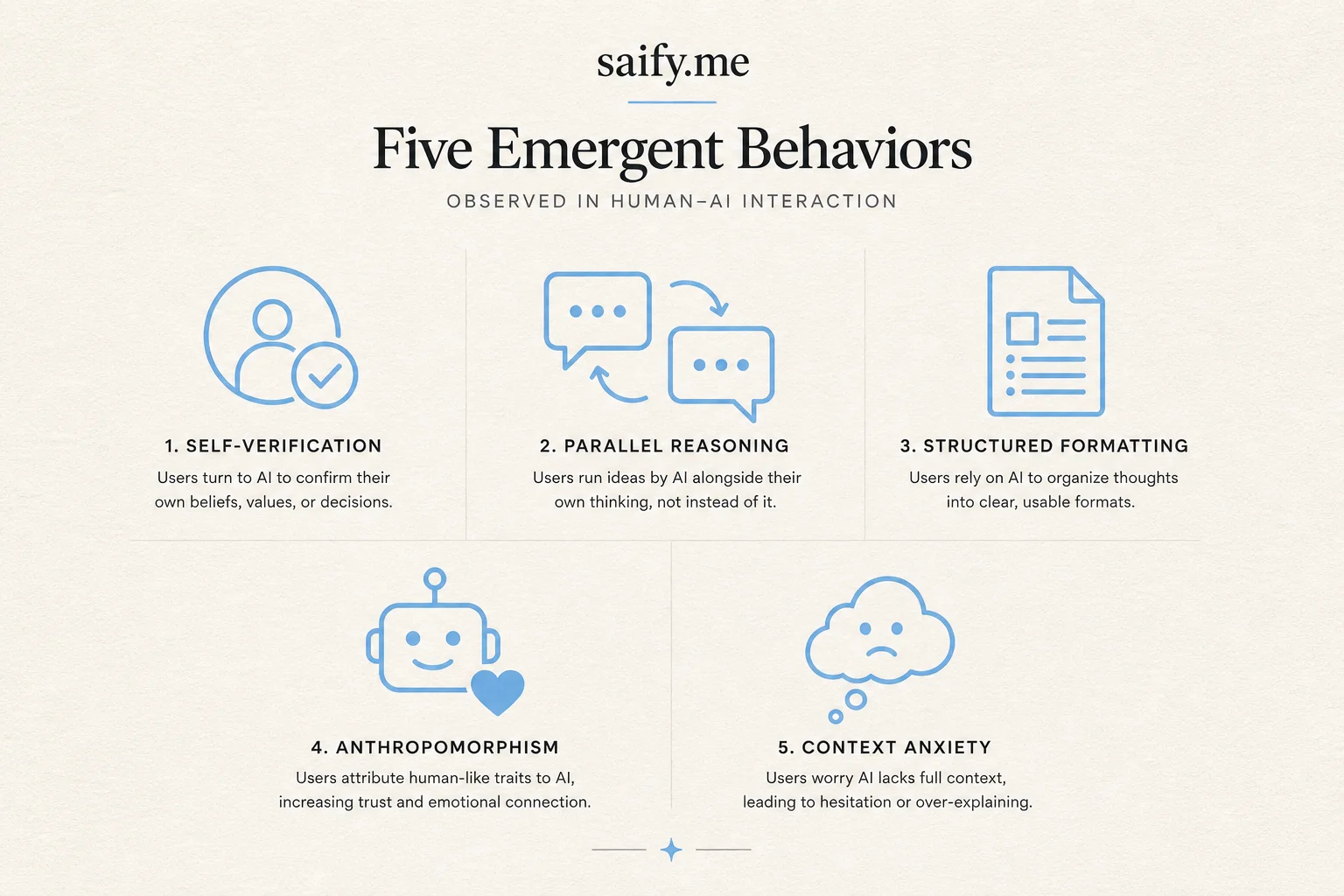
When zero RL scales, InclusionAI documents five emergent behaviors:
| Behavior | What it looks like |
|---|---|
| Self-verification | Model checks its own intermediate steps |
| Parallel reasoning | Multiple solution paths explored concurrently |
| Structured formatting | Consistent headings, labels, organized traces |
| Anthropomorphism | Narrative framing of its own reasoning |
| Context anxiety | Model actively manages compute/token budget mid-reasoning |
Context anxiety is the weird one. The model behaves as if it is aware of remaining context budget and adjusts reasoning depth in real time. That is not a loss term you sketch on a whiteboard Tuesday morning. It appeared from scale + RLVR.
Hand-crafted CoT templates become redundant when the model invents verification and structure on its own. That shifts economic leverage toward compute and reward design, not label farms.
What the paper still omits (read skeptically)
AI Weekly's sober take is worth keeping:
- "Competitive" without named baselines on every row is a different signal than clean SOTA sweeps
- Total training compute, token count, and base-model provenance are thin in public summaries
- Emergent behavior lists are observations, not settled science until independently replicated
Ring-2.6-1T (MIT license on Hugging Face since May 2026) reports higher vendor benchmarks (95.83 AIME 2026, 88.27 GPQA Diamond). Ring-2.5-1T-Zero is the science release about training dynamics, not necessarily the weights you deploy tomorrow.
Why applied teams should care
Even if you never serve Ant's checkpoints:
- Reward engineering beats label collection at the frontier. If your domain has verifiable outcomes (tests pass, SQL returns rows, invoices match), zero RL patterns deserve a pilot.
- Reasoning intensity knobs (Ring-2.6's adaptive modes, Inkling's thinking effort) pair naturally with agent routers. Spend depth where stakes are high.
- Open Ring weights under MIT for Ring-2.6 mean Chinese lab trillion-parameter reasoning is not locked behind a single API. Eval on your harness, not press releases.
Related reading on long-context reasoners: Kimi K3 architecture and million-context coding models.
What I would test on a client eval bench
If InclusionAI or a host exposes Ring-2.5-1T-Zero APIs:
- Agentic coding tasks with verifiable unit tests (reward shape matches training bias)
- Multi-step tool loops where self-verification might reduce bad commits
- Token budget stress to see if context anxiety translates to cheaper production traces
If not available, treat Ring-Zero as a training recipe paper. Ask your fine-tune vendor whether RLVR at your model size skips human CoT collection for your verifiable domain.
Bottom line
Ant proved trillion-parameter zero RL is trainable with modern systems work, not just a thought experiment. The behaviors that emerged (especially self-verification and context budgeting) are the kind of capabilities you previously bought with human label pipelines.
Open weights in the Ring line mean you can verify claims on your own tasks instead of trusting leaderboard screenshots.
Evaluating reasoning models for a production agent or private fine-tune? Book a free discovery call.