
Ecommerce CRO talks about carts, COD, and BNPL. Your site sells a consultation, a treatment slot, or a project kickoff. Different conversion. Same discipline: measure the leak, fix the highest-friction step, remeasure.
I work on Next.js lead sites for service operators. The pattern I see is predictable. Ads and SEO bring people in. The hero asks for trust without proving anything. The form wants seven fields before a human says hello. Mobile LCP is three-plus seconds. Chat pops over the only button that mattered. Then someone blames "traffic quality."
What CRO means when there is no cart
Direct answer: on a service lead site, conversion is a booked call, a qualified form submit, or a chat that creates a CRM contact with next-step intent. Optimize for that outcome on the money pages (/, /services, /book), not for newsletter signups or homepage bounce vanity.
| Ecommerce habit | Service lead-site equivalent |
|---|---|
| Add to cart → checkout | Book CTA → calendar or short form → CRM |
| COD / Apple Pay trust | Visible phone, address, reviews, license or credentials |
| Guest checkout | Minimal fields; optional account never required |
| Cart abandonment email | Missed-call text-back and Day 1 / 3 follow-up |
| Product reviews | Case snippets, before/after, named testimonials near CTA |
If your stack is still fighting WordPress plugins for every experiment, read WordPress to Next.js for lead sites. Speed and form wiring are half of CRO once you leave the page-builder tax behind.
Useful baselines while you set goals:
The five levers that move booked calls
I run these in order for most clients. Not because five is magic. Because each one is measurable in a week if you have Analytics and CRM timestamps.
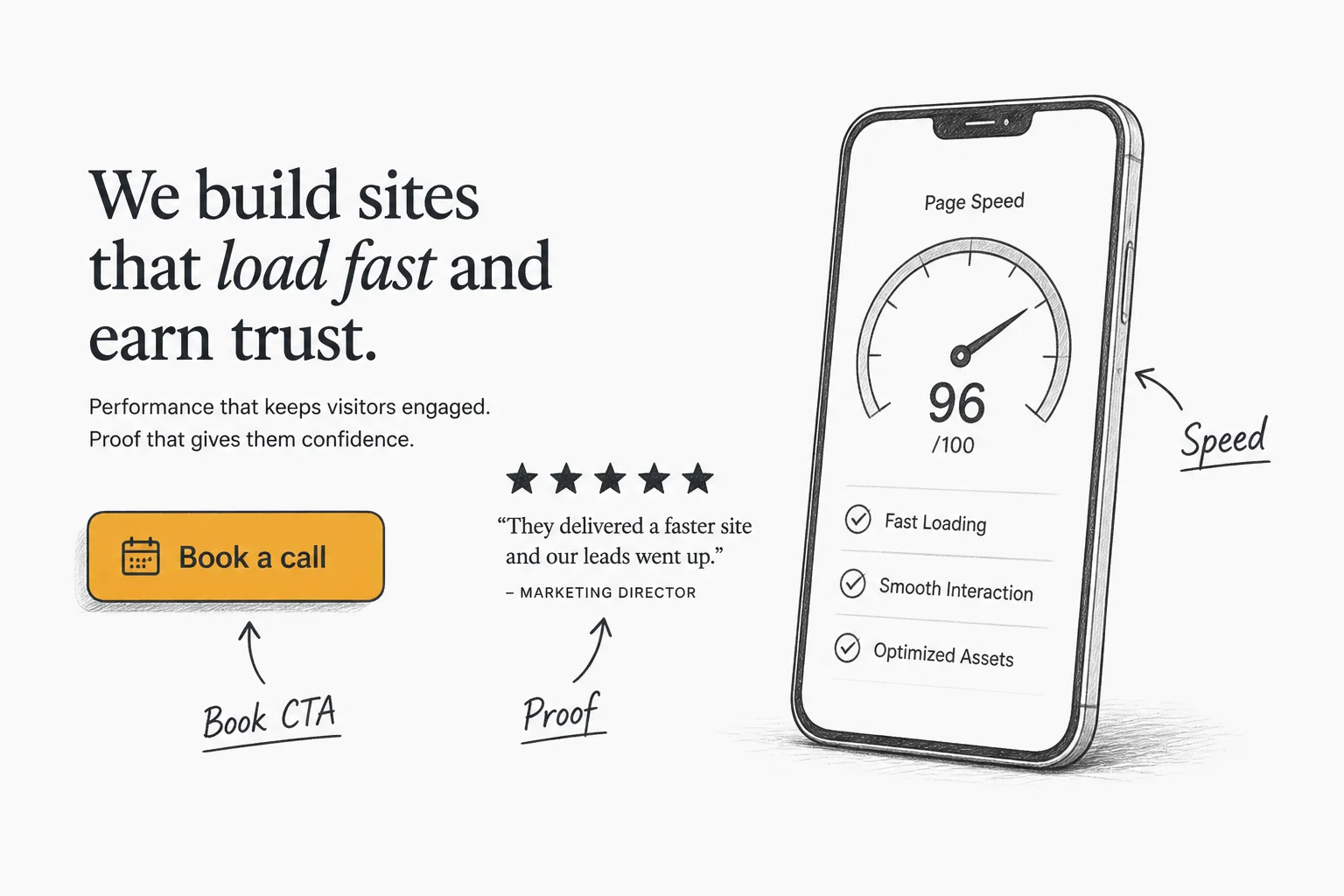
1. One primary Book CTA above the fold
Hero job: brand, one promise, one action. Secondary "Learn more" is fine. Three competing CTAs ("Chat", "Call", "Get quote", "Watch video") is how you get zero of them.
On mobile, the Book control should stay reachable without hunting. Sticky bottom bar works when it does not cover content. Sticky chat that eats the Book button fails the same CRO test every time.
Measure: clicks on primary CTA ÷ sessions on money pages. If that ratio is tiny, the problem is clarity or trust, not your CRM.
2. Proof within one scroll of the ask
Service buyers are skeptical. They want evidence that other humans paid you and survived. Put one specific proof block near the Book CTA: named client, outcome number, review screenshot, or credential. Generic "trusted by 500+ clients" without a face or number is wallpaper.
UAE ecommerce posts obsess over trade license and local phone. Same idea for you: show a real number, a real location or service area, and reviews that mention the service you sell. Instagram screenshots beat anonymous star widgets if they look like real customers.
3. Speed as conversion, not a developer hobby
I aim for LCP under ~2.5s on a mid-range phone for / and /book. When we miss, it is almost always a fat hero image, a chat script, or a font stack that blocks paint.
On Next.js I control this in one codebase: next/image, static or edge-friendly pages, and third-party scripts that load after the Book CTA is interactive. Every 100ms you shave on mobile is quiet CRO. Visitors do not email you "your site felt slow." They bounce.
4. Form friction you can count in fields
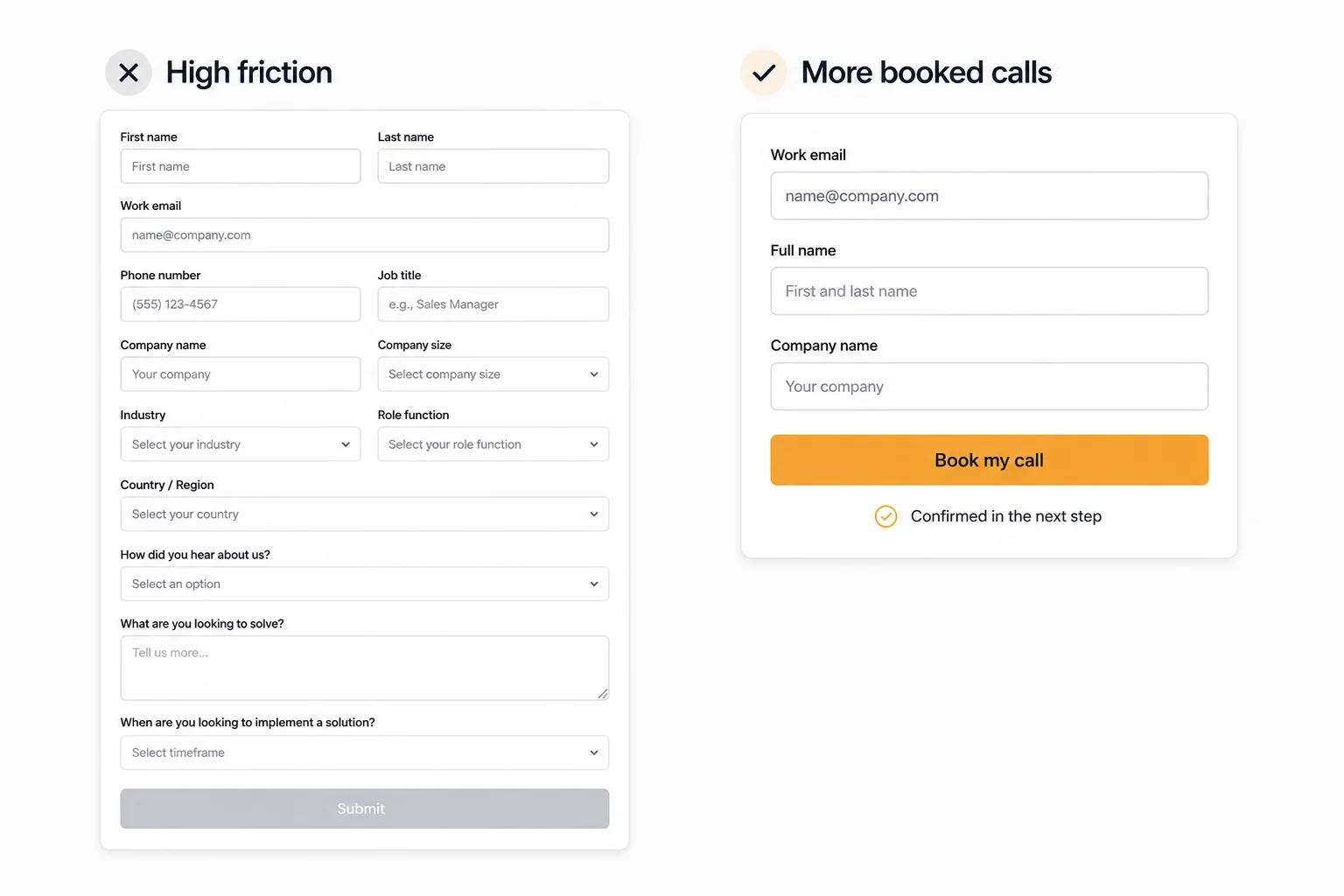
Every extra required field is a filter. Sometimes you want that filter. Usually you do not, not on first contact.
My default for a discovery call form:
- Name
- Phone or email (pick the channel you actually answer)
- One qualifier (service interest or budget band)
- Optional note
Everything else can wait for the call or a short bot flow. If sales insists on ten fields, A/B a short form against the long one for two weeks. I have watched "complete lead quality" drop while booked meetings rise, which is the trade you wanted all along.
Wire the submit to your CRM with a timestamp and source. No spreadsheet paste. For automation choices after the form lands, n8n vs Make vs custom is the stack decision I use with founders.
5. AI chat as assist, not a second homepage
Chat helps CRO when it removes questions that block booking: hours, pricing ranges you approve, what happens on the call, whether you serve their city. Chat hurts when it delays the page, invents answers, or never creates a CRM row.
Rules I ship:
- Ground answers in your docs (services, FAQs, policies)
- Offer a calendar link or book tool after 1 to 2 clarifiers
- Escalate complaints and edge cases to a human with transcript attached
- Do not cover the primary Book button on mobile
That is the same philosophy as an AI receptionist, just on-site. Clinics and dentists get the deeper voice version in AI receptionist for clinics and dentists. On a marketing site, start with grounded web chat plus form. Add voice when missed calls are the bigger leak.
A simple measurement loop (no agency theater)
Run this for 30 days before you buy another CRO SaaS.
- Pick one money page and one primary conversion event (calendar booked or form → CRM "qualified").
- Baseline: conversion rate, median time to first reply, mobile LCP.
- Change one lever (CTA copy, form fields, hero weight, or chat behavior).
- Hold for enough traffic to trust the direction (often 2 to 4 weeks at local volumes).
- Keep the winner. Log the loser. Move to the next lever.
| Metric | How to pull it | Why it matters |
|---|---|---|
| Book / form CVR | Analytics goal ÷ page sessions | Core CRO number |
| CTA click rate | Event on primary button | Separates "didn't see it" from "didn't trust it" |
| Mobile LCP | CrUX or field data | Speed tax on paid traffic |
| Median first reply | CRM timestamps | Post-submit CRO; slow reply wastes the form win |
| Chat → meeting | Bot booked or handoff tagged | Proves assist vs decoration |
If you cannot measure first reply in the CRM, fix logging before you redesign the hero. Pretty pages with silent leads are not optimized. They are expensive.
What I skip (on purpose)
I skip exit-intent discount popups on consultative services. I skip fake scarcity ("3 slots left today!") unless it is true and tied to a real calendar. I skip forcing account creation before someone can ask for a quote. Those tactics come from cart funnels. Your buyer is deciding whether to talk to a human.
I also skip "full redesign" as the first CRO move. Redesigns feel productive. Field reduction and LCP cuts usually pay faster.
How this ties to the rest of the funnel
On-page CRO gets the lead created. Ops automation keeps it alive. If forms convert but nobody replies for six hours, you optimized the wrong half. Score the leak with the ops automation audit checklist, then automate follow-up and missed-call recovery.
Stack sketch I like for service brands:
- Fast Next.js lead site with one clear Book path
- Form / chat → GoHighLevel, HubSpot, or your CRM via webhook
- n8n or Make only where the CRM native tools stop
- Optional voice or WhatsApp receptionist when after-hours volume justifies it
Product docs worth bookmarking:
Bottom line
CRO for service lead sites is boring on purpose: one Book CTA, proof beside the ask, mobile speed under 2.5s LCP, short forms, and chat that books instead of blocking. Steal ecommerce rigor (measure, change one thing, remeasure). Leave the cart tactics on the cart sites.
If you want a second pair of eyes on a money page and the CRM path behind it, book a free discovery call on cal.com/saifyxpro. Bring your last 30 days of form count and booked meetings. We will pick one lever, not twelve.