
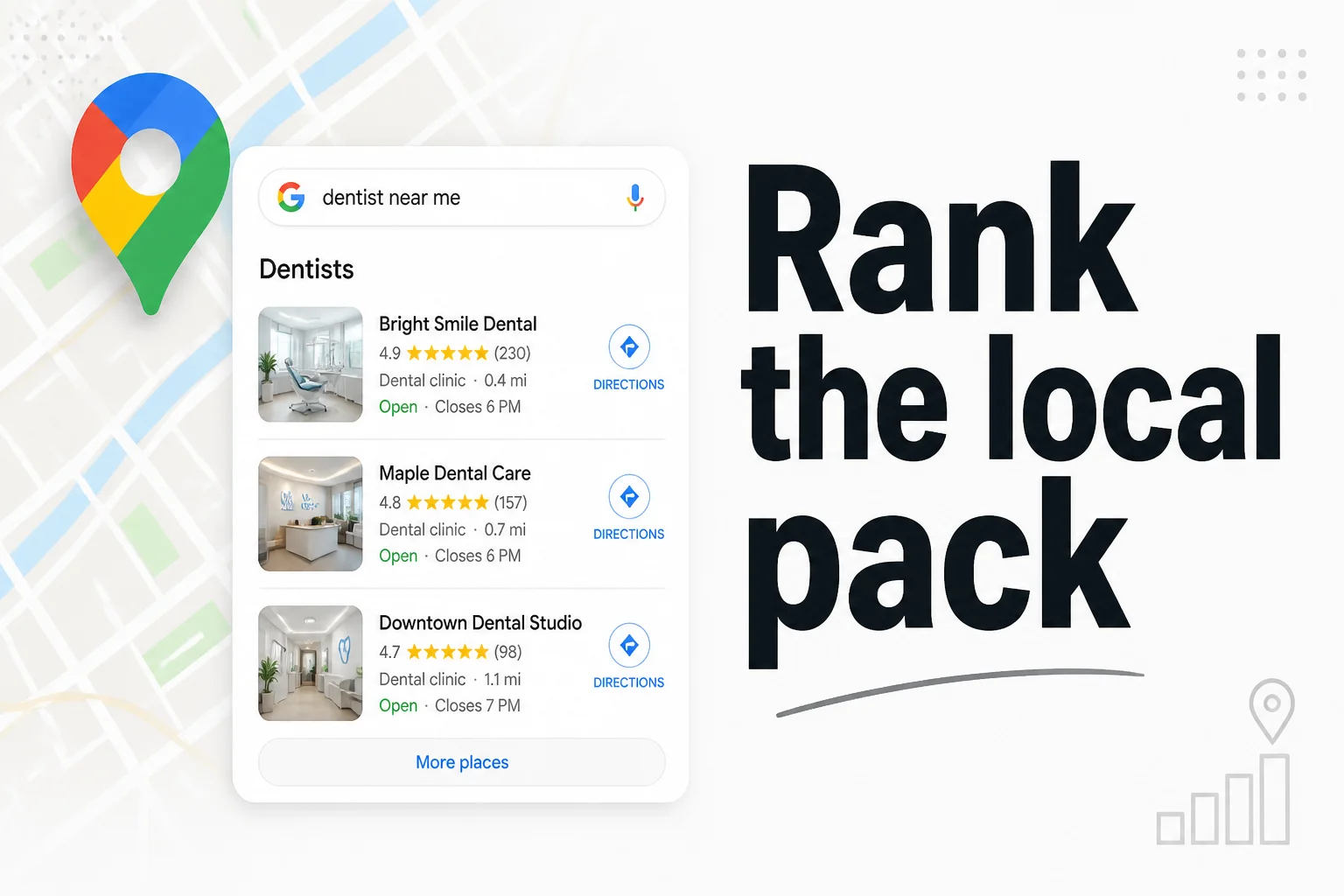
Most local service businesses do not lose Maps to a genius SEO agency. They lose to a cleaner Google Business Profile, fresher reviews, and a website that loads before the patient hangs up.
I build Next.js lead sites and AI ops for clinics, dentists, and trades. Local pack work shows up in almost every discovery call, so this is the checklist I actually run. It works in Houston, Manchester, Dubai, or wherever your buyers search "near me." Geography changes citation directories. The ranking physics do not.
A useful way to think about it: GBP is your storefront window on Google. The website is the room behind the door. Ranking without conversion is a vanity metric. Conversion without ranking means you overpay for ads. You want both.
What Google says it ranks on
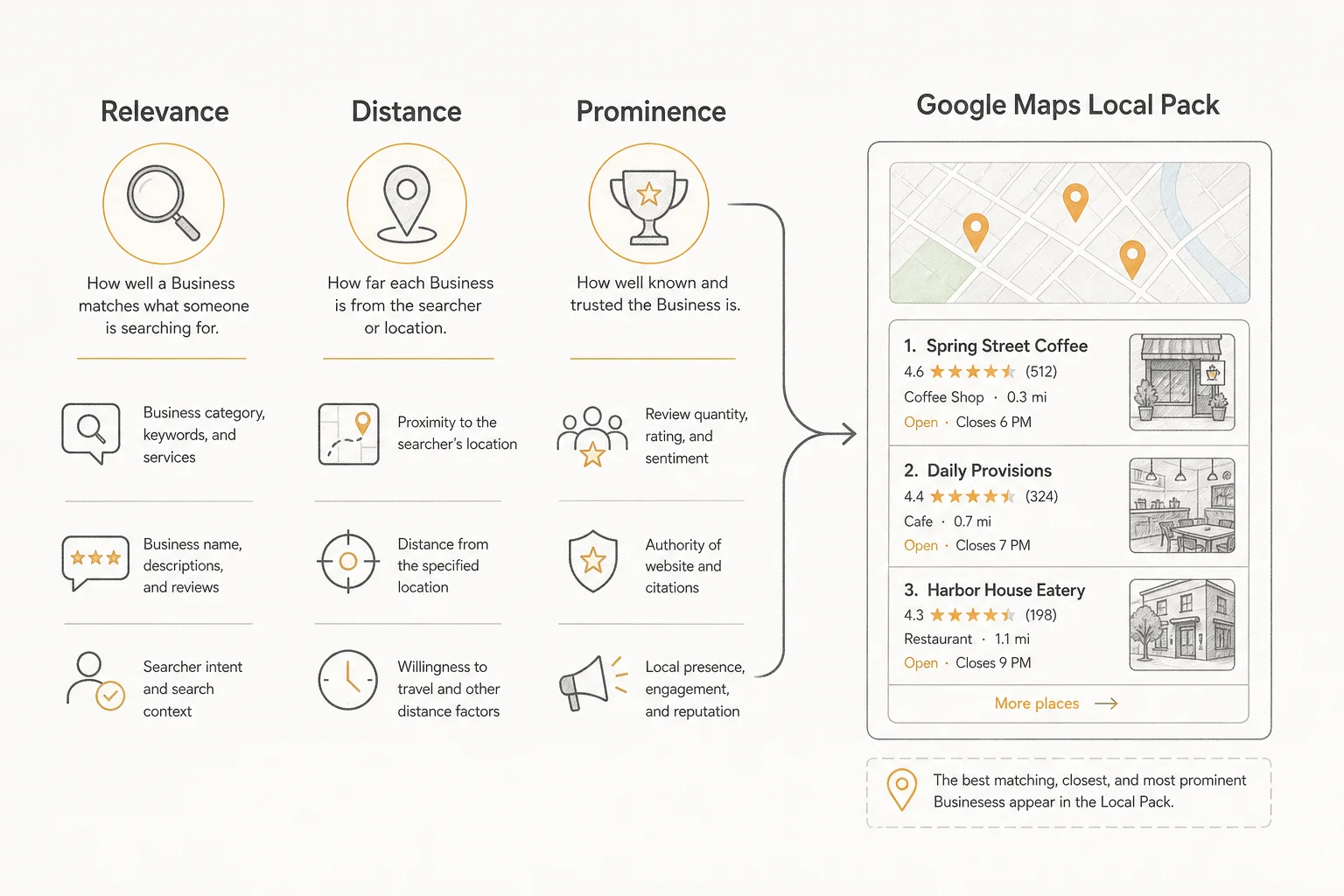
Direct answer: Google's own help docs say local results are mainly based on relevance, distance, and prominence. You cannot pay for a better Maps rank. You can make your profile match the query, keep NAP honest, and look like a known business.
Read the source, not a recycled "2026 UAE local SEO" brochure:
Industry surveys (BrightLocal and others) keep ranking GBP signals, reviews, and on-page factors at the top of the local pack stack. Treat survey weights as operator consensus, not Google's secret formula.
The local pack math in plain English
| Pillar | What it means | What you actually do |
|---|---|---|
| Relevance | Does this business match the query? | Primary category, services, website pages that talk about the same services |
| Distance | How far from the searcher? | Accurate pin, honest service area, no fake downtown addresses |
| Prominence | How known / trusted is this place? | Review volume + recency, citations, links, engagement |
If your competitor is closer and has the same category, you fight on prominence and conversion. If your category is wrong, you are not even in the fight.
GBP checklist (do this before you rewrite the blog)
Categories and identity
- Pick the most specific primary category that is still true ("Dentist" beats "Medical clinic" if you are a dental practice).
- Add accurate secondary categories for services you actually sell. Do not keyword-stuff unrelated ones. Google's guidelines are clear: categories describe what the business is, not every attribute it has.
- One profile per location. Duplicate listings create messy Maps results and suspension risk.
- Name, address, phone must match the real-world signage and the website footer. No keyword stuffing in the business name.
Completeness that converts (and helps relevance)
- Hours including lunch closures and holidays.
- Services with short descriptions and price ranges where you are comfortable publishing them.
- 20+ real photos of the space, team, and work. Then add a few each month so the profile looks alive.
- Messaging and booking links if you can answer. A Maps click that dies in voicemail is wasted prominence.
- Weekly posts are not a ranking silver bullet, but a profile that went quiet for a year looks dormant. Keep a light cadence.
Reviews as a system, not a wish
Google weights how many reviews you have, how recent they are, and overall sentiment. Owner replies show you are present.
Build a boring system:
- After a completed visit or job, send SMS or WhatsApp with a direct GBP review link
- Ask within 24 to 48 hours while the visit is fresh
- Never gate or filter. That violates Google's review policies and will bite you
- Reply to every review within a week. Mention something specific
Dentists and clinics: pair this with after-hours coverage so the caller who found you on Maps can still book. I wrote the ops side in AI receptionist patterns for clinics and dentists.
Review velocity targets (practical, not magical)
| Where you are now | 90-day goal | Focus |
|---|---|---|
| Under 15 reviews | Get to 40+ with steady weekly asks | Process first, not ads |
| 15 to 50, but quiet for 6+ months | Restart weekly flow; reply to backlog | Recency signal |
| 100+, star rating under 4.3 | Fix ops complaints; keep asking happy patients | Sentiment + replies |
| 200+ and active | Maintain 4 to 8 new reviews / month | Do not go dormant |
Track asks sent vs reviews received. If you send 40 asks and get 2 reviews, your timing or link is wrong. Usually the link is not a direct GBP review URL, or staff asks too early (before the visit felt finished).
NAP and citations without the directory spam
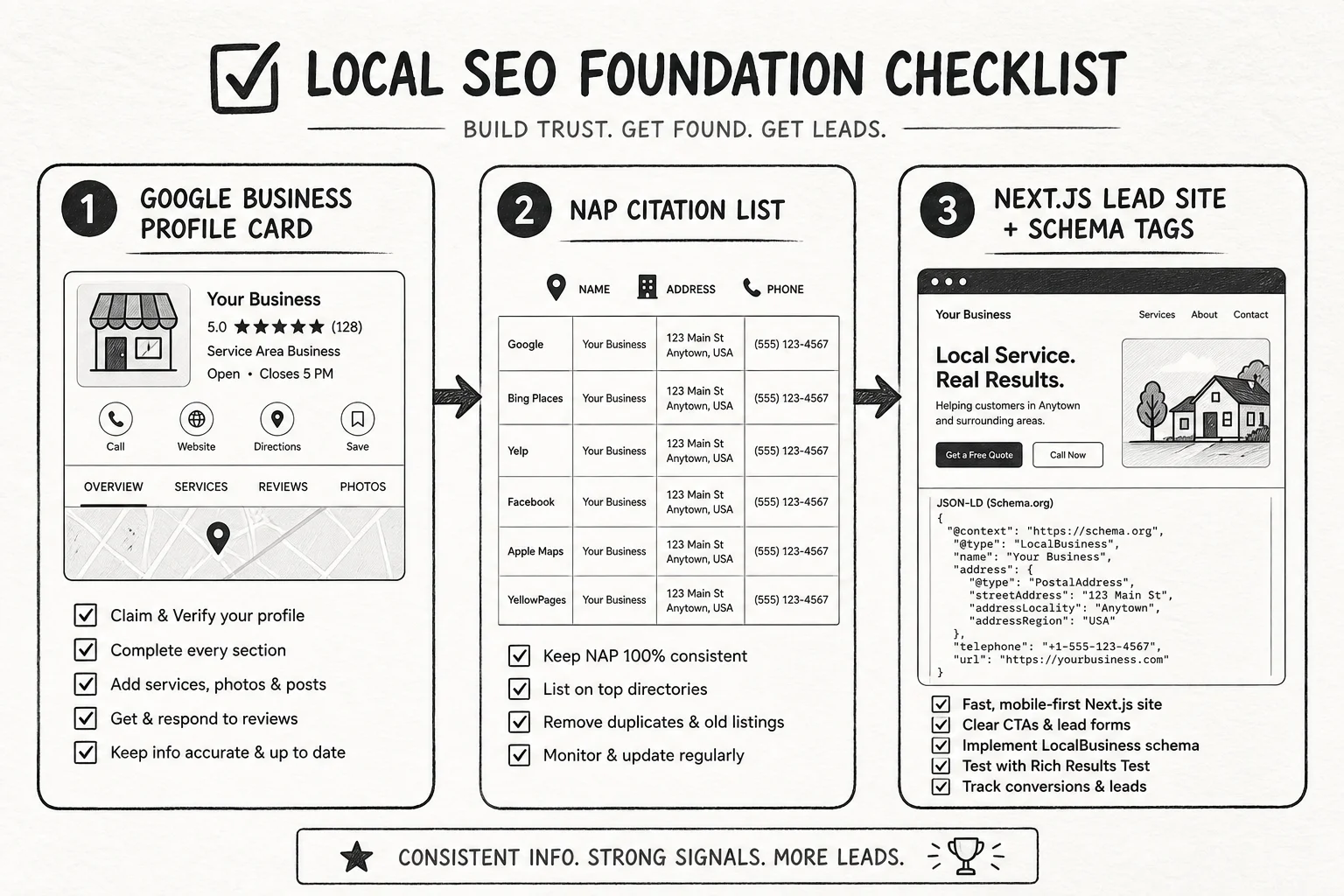
NAP means name, address, phone. Inconsistent NAP across the web makes Google less confident you are one business.
Do this:
- Publish one canonical NAP block on the site (footer + contact page)
- Match GBP exactly (suite numbers, punctuation, local vs toll-free)
- Fix the big directories in your market first (Apple Maps, Bing Places, Yelp, industry boards, chamber, insurance directories for clinics)
- Stop buying 500 junk citations. Consistency on the high-trust ones beats volume of garbage
Service-area businesses (trades that go to the customer): set a honest service area and do not invent a storefront pin in a nicer neighborhood. Suspensions are expensive.
The website piece people skip (and where Next.js helps)
Maps gets you the click. The site closes the call or booking. A four-second mobile load with a jumping chat widget burns the lead you just ranked for.
What I want on a local lead site in 2026:
- Matching NAP and hours in the footer and contact page
- Service pages that match GBP categories ("emergency dental," "crown and bridge," "water heater repair") with unique copy, not spun city pages
- LocalBusiness / Dentist / MedicalClinic schema (or the closest type) with address, geo, openingHours, sameAs
- FAQ blocks that answer the questions people ask on GBP Q&A and on the phone
- Core Web Vitals that pass on a mid-range phone, especially LCP on money pages
- Forms that post to your CRM webhook in seconds (see AI lead generation systems)
This is why I push operators off bloated WordPress stacks for lead sites. Speed, schema, and CRM hooks live in one codebase. The migration rationale is in WordPress to Next.js for lead sites.
Useful technical refs:
{
  "@context": "https://schema.org",
  "@type": "Dentist",
  "name": "Example Family Dental",
  "url": "https://example.com",
  "telephone": "+1-555-0100",
  "address": {
    "@type": "PostalAddress",
    "streetAddress": "123 Main St",
    "addressLocality": "Austin",
    "addressRegion": "TX",
    "postalCode": "78701",
    "addressCountry": "US"
  },
  "openingHoursSpecification": [{
    "@type": "OpeningHoursSpecification",
    "dayOfWeek": ["Monday", "Tuesday", "Wednesday", "Thursday", "Friday"],
    "opens": "08:00",
    "closes": "17:00"
  }]
}
Validate with Google's rich results tools before you celebrate. Wrong @type or mismatched NAP does not help.
30-day local SEO sprint (operators, not agencies)
Week 1 is hygiene. Claim and verify GBP. Fix categories. Align NAP on site and top directories. Upload real photos. Turn on messaging if you can staff it.
Week 2 is reviews and replies. Stand up the post-visit request flow. Reply to the backlog. Clean fake or off-topic Q&A answers.
Week 3 is on-page. Publish or rewrite two service pages that match how people search. Add schema. Kill broken booking links.
Week 4 is measurement. Track Maps insights (calls, direction requests, website clicks), form submits, and missed calls. If Maps traffic is up but bookings are flat, the problem is intake, not ranking.
If you are buying "guaranteed #1 on Maps" packages, stop. Pack ranking is competitive, location-bound, and query-specific. Anyone selling a guarantee is selling theater.
What I would ignore (or deprioritize)
- Geo-keyword spam in the business name
- Fake review pods
- Mass citation blasts from random SEO tools
- Thin "service in [neighborhood]" pages with the same paragraph swapped for city names
- Obsessing over GBP description keyword density while categories and reviews are wrong
Spend the hours on primary category, review velocity, NAP truth, and a site that converts the Maps click.
How this ties to AI search (briefly)
People still use Maps. They also ask ChatGPT-style tools "best dentist near X." Those systems lean on the same public signals: clear entity info, reviews, and pages that answer questions without fluff. Structured data and FAQ sections help machines cite you. Thin location spam does not.
I am not promising an "AI SEO package." I am saying: make the business legible. Same work that helps the local pack helps answer engines.
Soft next step
If you want a second set of eyes on GBP plus a lead site that does not fight your CRM, book a free call. Bring your Maps insights screenshot and your top three service queries. We can tell in one session whether you have a ranking problem, an intake problem, or both.