
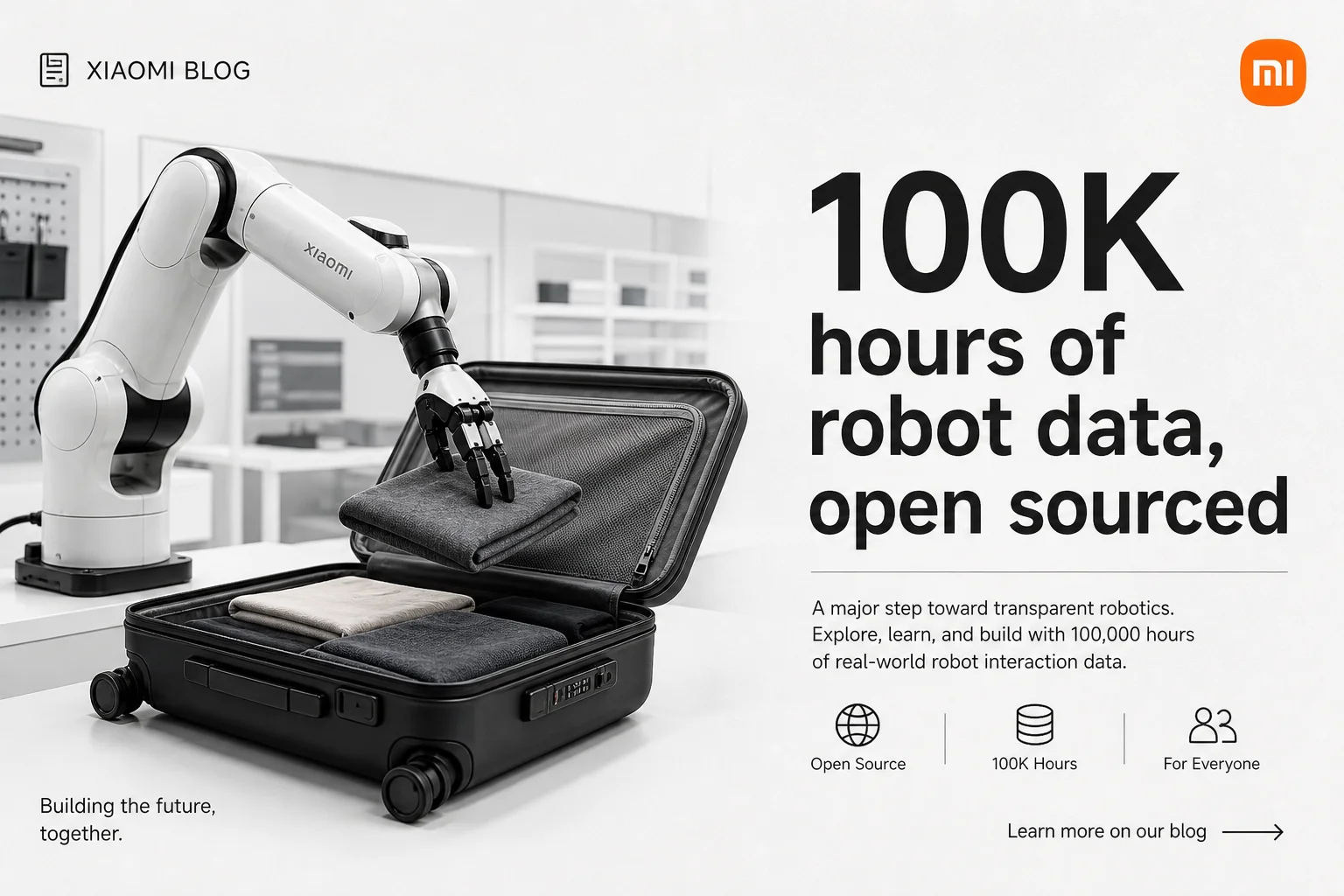
Robot foundation models hit the same wall language models solved a decade ago: not enough data at scale. Teleoperating a real arm is slow, expensive, and repetitive. You get narrow rooms, narrow tasks, and narrow generalization.
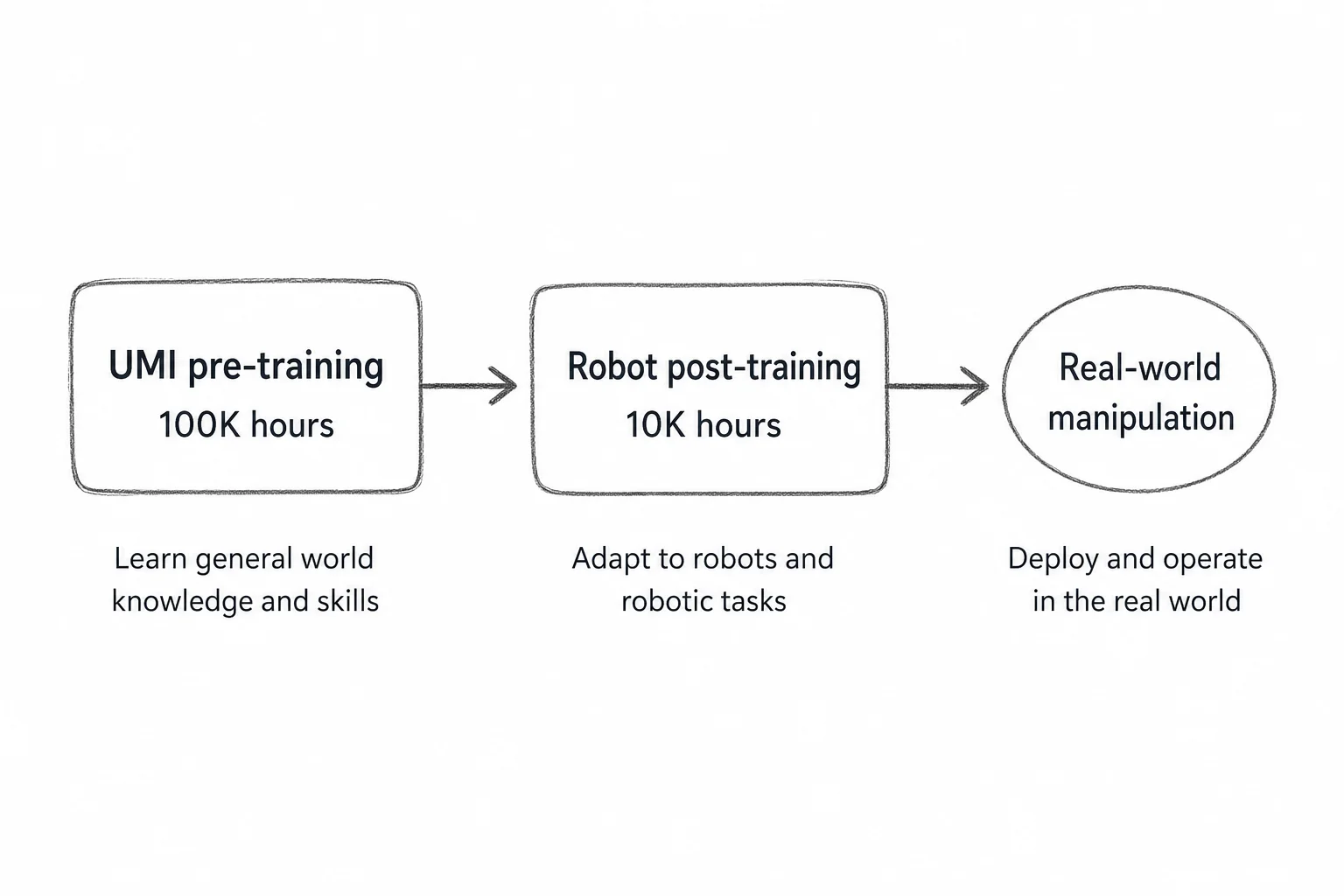
Xiaomi-Robotics-1 (XR-1) takes a different path. Pretrain on 100,000+ hours of embodiment-free Universal Manipulation Interface (UMI) trajectories across 1,700+ scenarios. Post-train on 10,000+ hours of cross-embodiment robot data. Then open-source the weights, inference stack, and benchmark code on Hugging Face and GitHub under Apache 2.0.
That release landed the same week The Rundown Robotics digest flagged it. If you ship applied AI, this is the kind of checkpoint worth downloading before you wire another brittle pick-and-place demo.
What XR-1 is (and is not)
XR-1 is a vision-language-action (VLA) model for mobile manipulation. It reads camera frames, parses natural-language instructions, and outputs actions for a robot body.
It is not a plug-and-play API like a chat model. You still need hardware, safety rails, calibration, and eval gates. Xiaomi is clear about that in the technical report (arXiv:2607.15330). What changed in August 2026 is that the full post-training and deployment pipeline is public, not just a paper teaser.
The training recipe mirrors LLMs in two stages:
| Stage | Data | Goal |
|---|---|---|
| Pre-training | 100K+ hours UMI (handheld grippers, no robot) | Learn general action generation from scene state transitions |
| Post-training | 10K+ hours cross-embodiment robot data | Align to real arms, mobile bases, and imperative instructions |
The UMI trick that breaks the data bottleneck
UMI (Universal Manipulation Interface) lets humans record manipulation in the wild with a portable gripper. No robot required during capture. Xiaomi scaled that to household, commercial, industrial, and outdoor scenes.
The hard part at 100K hours is labeling. Manual annotation does not scale. Xiaomi built an auto-labeling pipeline:
- Split long videos into fixed-length clips.
- Run a strong vision-language model on each clip.
- Describe gripper and object state transitions in language.
The model learns: "backpack goes from open to zipped," not just pixel deltas. That is the physical intuition layer, independent of any specific robot morphology.
Scaling behavior that actually transfers
Most robotics papers show sim curves that die in a real kitchen. Xiaomi's claim is stronger: pre-training scaling transfers through post-training to unseen real environments.
On the project page they report:
- Validation action error drops steadily as data and model size grow during pre-training.
- Real-robot success in unseen rooms rises with stronger pre-trained checkpoints.
- No saturation signal yet at the scales they tested.
Simulation benchmarks (July 2026 leaderboards) back part of that story:
| Benchmark | XR-1 (reported) | Previous best | Relative gain |
|---|---|---|---|
| RoboCasa365 | 57.4% | 46.6% | +23.2% |
| RoboDojo | 13.93 | 8.80 | +58.3% |
| RoboCasa | 74.5 | 72.6 | +2.6% |
| VLABench | 59.1 | 53.2 | +11.1% |
Treat these as a map, not a verdict, until you reproduce on your hardware.
New tasks from under 10 hours of demos
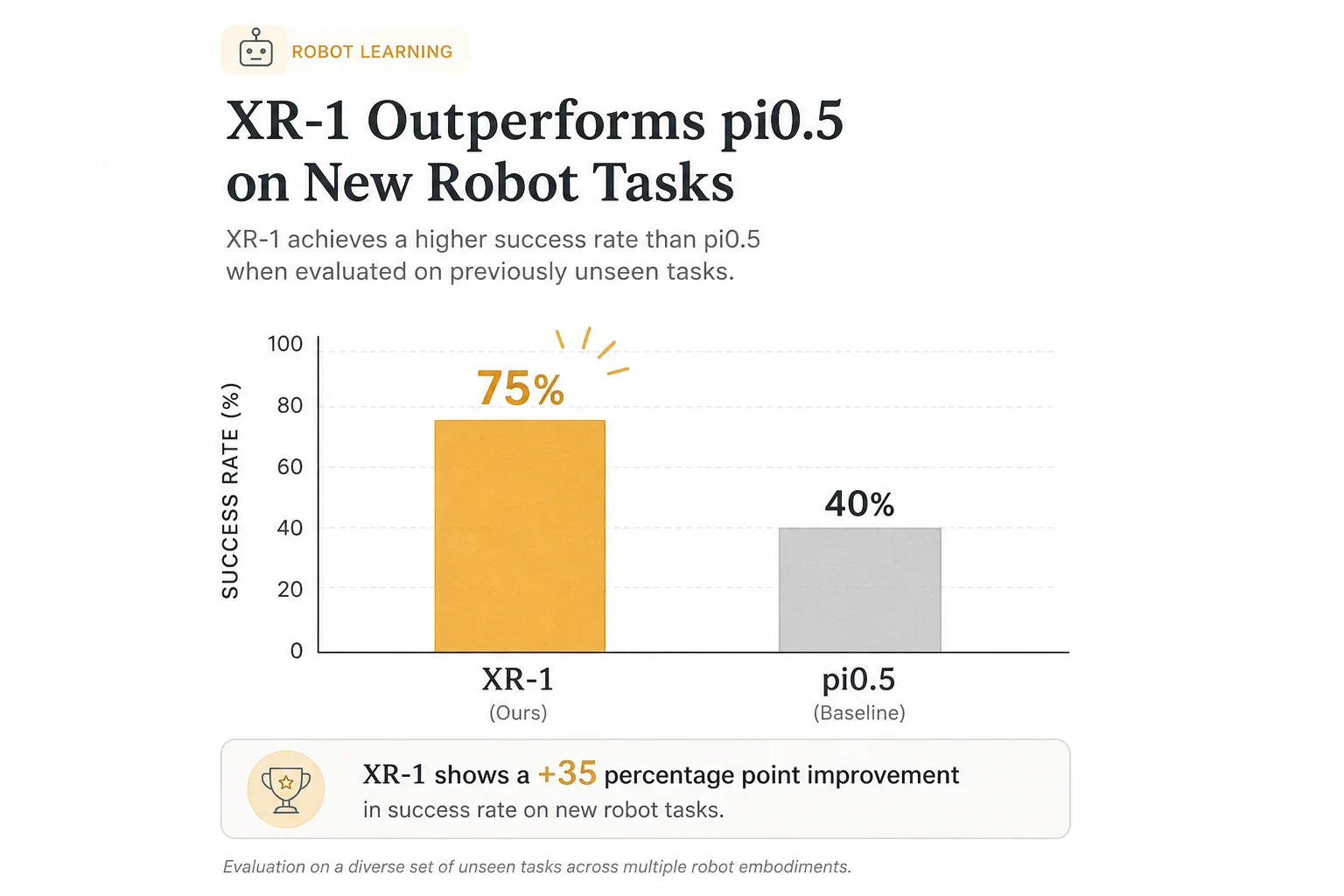
Where XR-1 gets practical for builders is efficient adaptation. Xiaomi reports four dexterous tasks with an average of under 10 hours of demonstrations each:
| Task | XR-1 success | π0.5 baseline |
|---|---|---|
| Phone packing | 70% | 30% |
| Printer refilling | 70% | 20% |
| Laundry loading | 80% | 40% |
| Box packing | 80% | 70% |
| Overall | 75% | 40% |
Raise the budget to under 40 hours per task and overall success hits 85% versus 53% for π0.5. If you have been pricing robot fine-tunes in weeks of teleop, that ratio matters.
What shipped on GitHub and Hugging Face
The August 3, 2026 release includes:
- Post-training, inference, and benchmark evaluation code
- Checkpoints (5B class) on Hugging Face
- Apache 2.0 license (commercial fine-tune friendly)
- Pinned
transformers4.57.1 stack, optimized for consumer GPUs per the README
TechNode reported the open-source drop on August 5. The model was teased in July as an out-of-the-box controller. The code catch-up is what makes it actionable for labs that are not Xiaomi.
How I'd evaluate XR-1 this month
Skip the leaderboard screenshots. Run tests that map to product risk:
- Unseen room generalization: same instruction, three rooms you did not train in. Log grasp failures and collision near-misses.
- Instruction drift: paraphrase the same task five ways. Note where language alignment breaks.
- Long-horizon stability: the project page shows 10+ minute suitcase packing. Time your own multi-step jobs.
- Latency on your GPU: VLA inference plus control loop frequency. Real-time beats benchmark accuracy if you cannot replan.
Write failures down. Those become acceptance criteria before you promise a client a "general purpose" manipulator.
Where this fits the open robotics stack
XR-1 sits next to other 2026 open releases: academic UMI tooling, π-family baselines, and simulation suites like RoboCasa365. The difference is data scale plus full pipeline disclosure.
For applied AI teams the split looks like:
| Need | Lean toward |
|---|---|
| Fast product demo on managed hardware | Vendor SDK + closed policies |
| Research fine-tune, on-prem eval | Open VLAs (XR-1, π0.5, etc.) |
| Production deployment | Your harness, safety, and regression suite regardless of checkpoint |
Do not rip out a working cell because a 5B repo trended on Hacker News. Do ask whether your roadmap assumes teleop-only data collection when 100K-hour UMI corpora are now public.
What to watch next
- Community fine-tunes on non-Xiaomi arms (embodiment gap is where papers lie)
- Distilled variants that fit 24GB cards without sacrificing long-horizon stability
- Comparison runs against closed programs from Figure, 1X, and Tesla Optimus stacks (different access, same buyer questions)
- Integration into ROS2 / LeRobot-style harnesses versus raw inference scripts
If you are wiring manipulation into ops (kitting, inspection, mobile fetch), the checkpoint is worth a weekend eval. The scaling curves are the story. The open weights are the invitation.
Need help scoping a robot policy eval or integration harness? Book a free discovery call.