
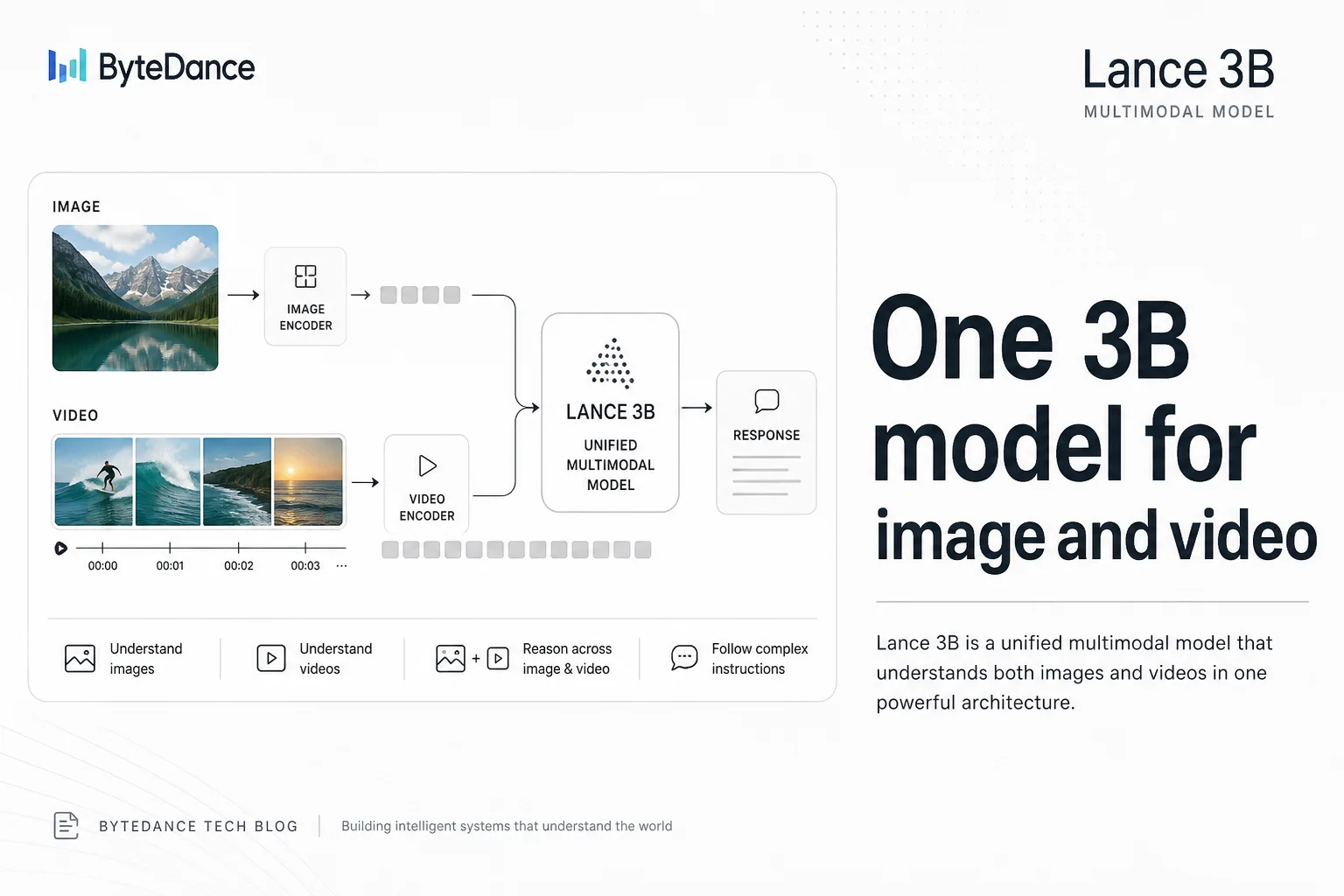
Most open multimodal stacks still split the problem in two. One model understands images. Another generates them. A third handles video. You glue them together with brittle pipelines and pray the character's shirt stays the same color across hops.
ByteDance Lance is a different bet: one native unified framework for image and video understanding, generation, and editing, at 3B active parameters, Apache 2.0 licensed, trained from scratch on a budget of 128 A100 GPUs. The team is upfront that it is a research artifact, not a polished product. That honesty makes it more interesting, not less.
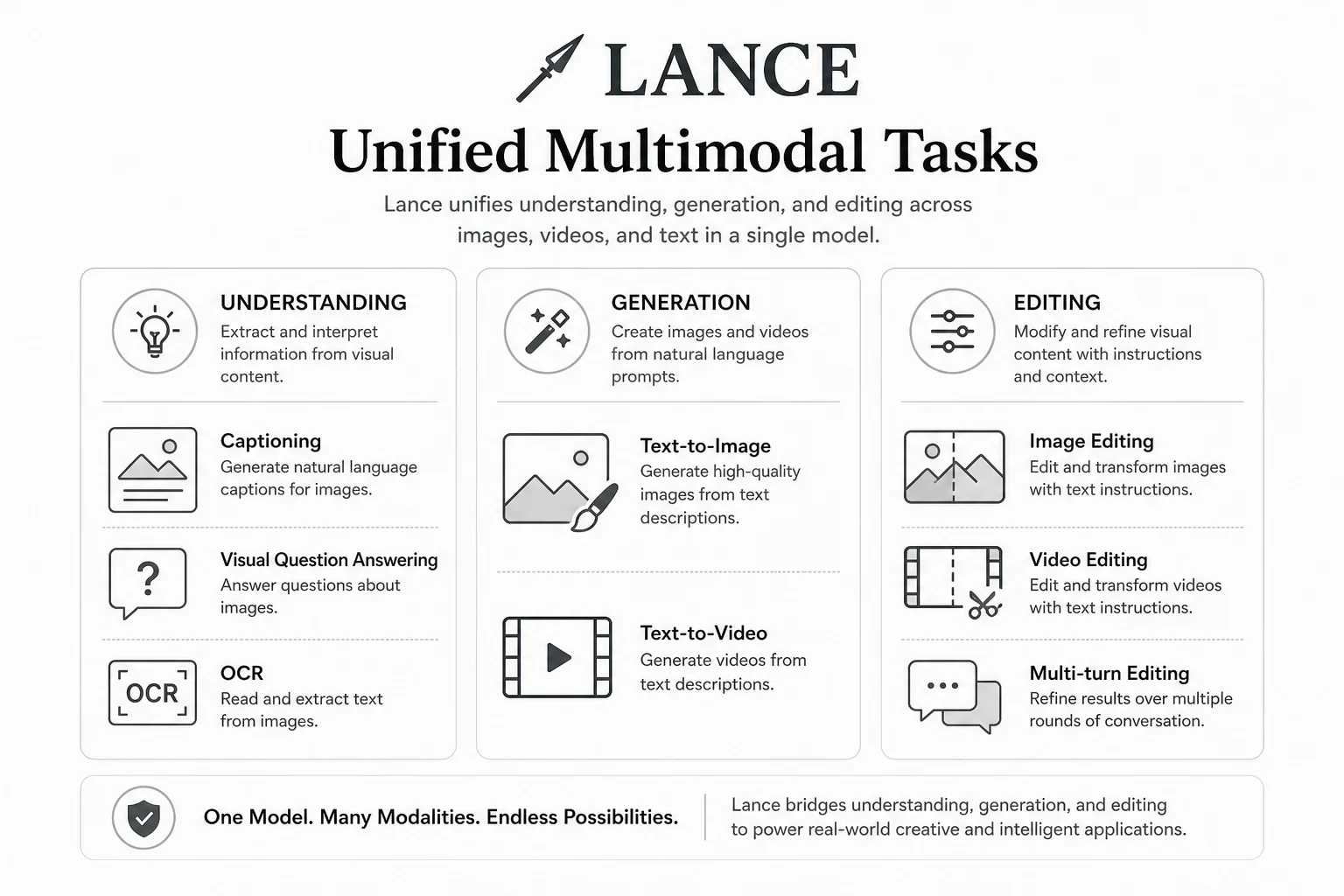
What Lance actually unifies
Lance ships six task families under one architecture:
- Understanding: captioning, VQA, OCR, visual grounding, video QA
- Generation: text-to-image, text-to-video, image-to-video, subject-driven generation
- Editing: image edit, video edit, multi-turn consistent edits
The paper (arXiv:2605.18678) describes a dual-stream mixture-of-experts design with decoupled pathways for understanding versus generation. Text flows through Qwen2.5-VL embeddings. Visual semantics use a ViT encoder. Generation latents use a Wan2.2 3D causal VAE with spatial and temporal downsampling.
Outputs organize into three families: text (X2T), images (X2I), and video (X2V). Supported CLI tasks include t2i, t2v, i2v, image_edit, video_edit, x2t_image, and x2t_video.
| Task bucket | Examples | Why one stack matters |
|---|---|---|
| X2T | Caption, VQA, OCR | Same weights that generate also read |
| X2I | t2i, image edit | Edit memory carries into the next turn |
| X2V | t2v, i2v, video edit | No handoff to a separate video model |
Benchmarks worth taking seriously (and where to squint)
ByteDance reports competitive numbers at the 3B scale across unified-model leaderboards. I have not reproduced these locally yet. Treat them as a map, not a verdict.
| Benchmark | Lance (reported) | Context |
|---|---|---|
| GenEval (image gen) | 0.90 | Top among unified models in their table |
| DPG-Bench | 84.67 | Matches larger unified stacks |
| VBench total (video gen) | 85.11 | Beats some generation-only models |
| GEdit-Bench avg | 7.30 | Strong on image editing |
| MVBench (video understanding) | 62.0 | Ahead of Show-o2 7B in their comparison |
The relative weakness they call out: text modification in edits. If your product needs precise on-screen typography changes, plan a human review gate.
Training recipe, per the repo:
- Pre-training: ~1B image-text pairs + 140M video-text pairs (~1.5T tokens). Encoders frozen; backbone learns base alignment.
- Continual training: staged multi-task recipe across understanding, generation, and editing objectives.
- Post-training: task-specific tuning with the caveats you'd expect from a research release.
Hardware and how to run it
This is not a "run on your MacBook Air" model. The Hugging Face weights and GitHub repo recommend 40GB+ VRAM, Python 3.10+, CUDA 12.4+.
Example text-to-video at 480p:
bash inference_lance.sh \
  --TASK_NAME t2v \
  --MODEL_PATH downloads/Lance_3B_Video \
  --RESOLUTION video_480p \
  --NUM_FRAMES 121 \
  --VIDEO_HEIGHT 480 \
  --VIDEO_WIDTH 848 \
  --SAVE_PATH_GEN results/t2v
Before you run anything, configure the MODEL_PATH and GPU settings at the top of inference_lance.sh. The team notes that following their recommended prompt format (inference_lance.py task defaults) usually improves generation quality.
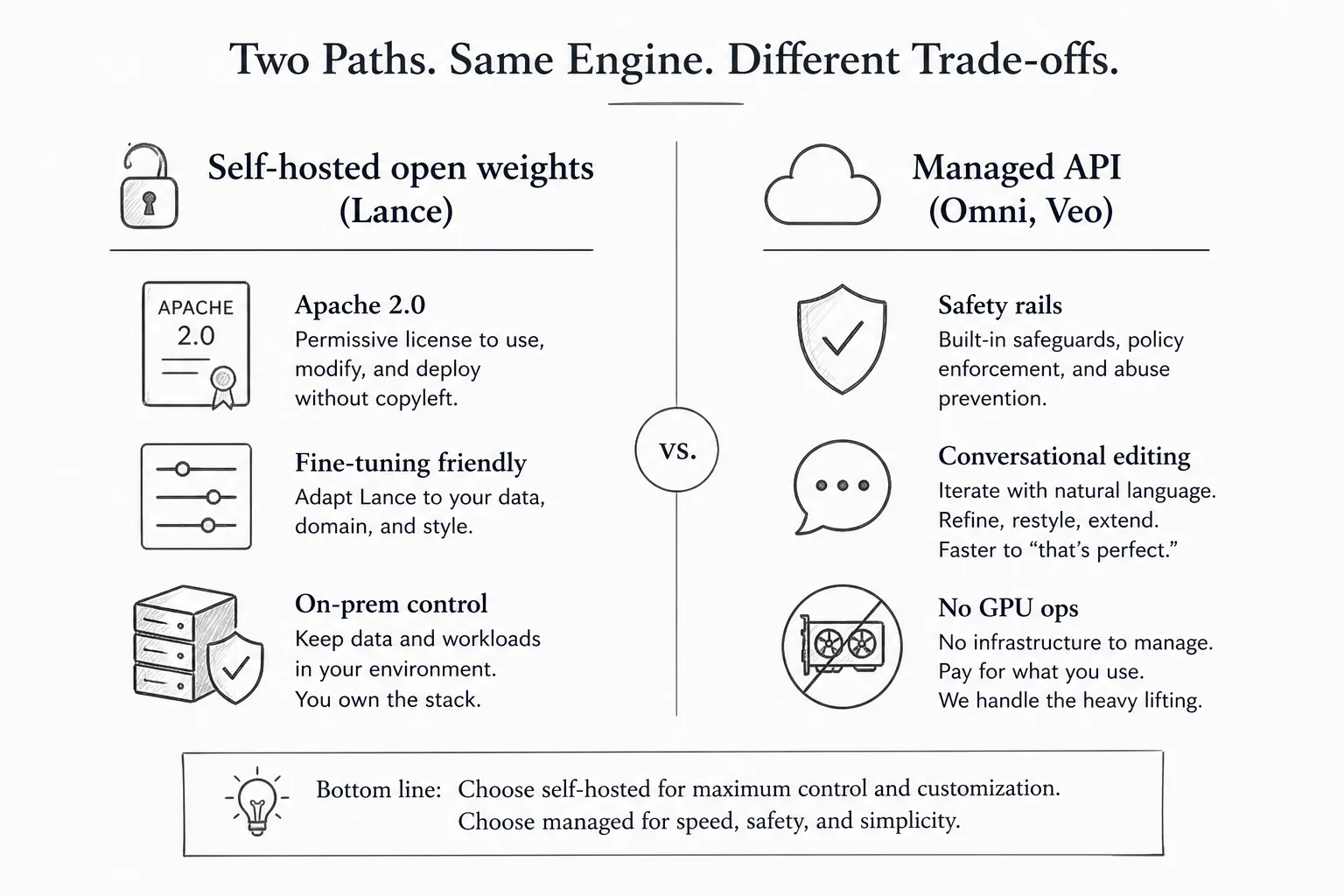
If you are comparing Lance to API-only stacks like Gemini Omni Flash, the trade-off is obvious: Lance is self-hosted research weights with Apache 2.0 freedom. Omni is a managed product with conversational editing and safety rails. Different jobs.
Why 3B and 128 A100s matter for builders
Two numbers in the release are easy to skim past:
- 3B active parameters means unified multimodal is entering a footprint teams can actually fine-tune or host without hyperscale budgets.
- 128 A100 training budget signals the recipe is reproducible by well-funded labs and serious startups, not only trillion-parameter shops.
Apache 2.0 licensing matters commercially. You can fine-tune, redistribute, and ship experiments without negotiating a separate enterprise agreement. For agencies building client demos or product teams prototyping localized Shorts, that lowers the "legal review before we try it" barrier.
The flip side: ByteDance labels Lance a research project. Output quality varies by prompt, resolution, motion complexity, and edit scenario. They are asking for community feedback, not promising Sora-class polish on day one.
How I'd evaluate Lance this week
Skip the Twitter montages. Run four tests that map to real product risk:
- Multi-turn edit consistency: same subject, three sequential edit prompts. Note where identity drifts (hair, clothing, logos).
- Text in frame: ask for a sign with specific words. Compare against their admitted weakness on text modification.
- t2v motion: simple physics (pouring water, rolling ball). Count obvious violations in 10 clips.
- Understanding loop: run
x2t_videoon a generated clip and check whether captions match what you intended.
Write down failure modes. Those become your acceptance criteria if you wire Lance into a pipeline.
Where Lance fits in the May 2026 multimodal wave
This digest landed the same week Google shipped Gemini Omni Flash for conversational video editing and Antigravity 2.0 pushed multi-agent coding desktops. Lance is the open-weight counterweight: unified image + video in one checkpoint you can inspect.
The pattern across all three: multi-turn state beats one-shot generation. Users want to steer, not gamble.
For applied AI teams, the practical split looks like:
| Need | Lean toward |
|---|---|
| Fast consumer creative, Shorts, brand-safe guardrails | Managed APIs (Omni, Veo, etc.) |
| On-prem, fine-tuning, cost control at scale | Open weights (Lance, Wan family, etc.) |
| Agent orchestration over media jobs | Harness + eval gates, regardless of model |
Do not rip out your API stack because a 3B repo hit Hacker News. Do start asking whether your media pipeline assumes separate understanding and generation models when unified checkpoints are catching up.
What to watch next
- Community fine-tunes and smaller distilled variants (3B is already small; distillation could unlock 24GB cards)
- Whether text-edit benchmarks improve in follow-up checkpoints
- Integration paths in ComfyUI / diffusers-style tooling versus raw shell scripts
- How Lance compares to ByteDance's production video products (research release vs consumer app quality)
If you are designing a generative media workflow (API vs self-host, eval gates, human review) and want a second pair of eyes before you commit infra, book a free discovery call. I am happiest when the demo survives contact with your real assets.