
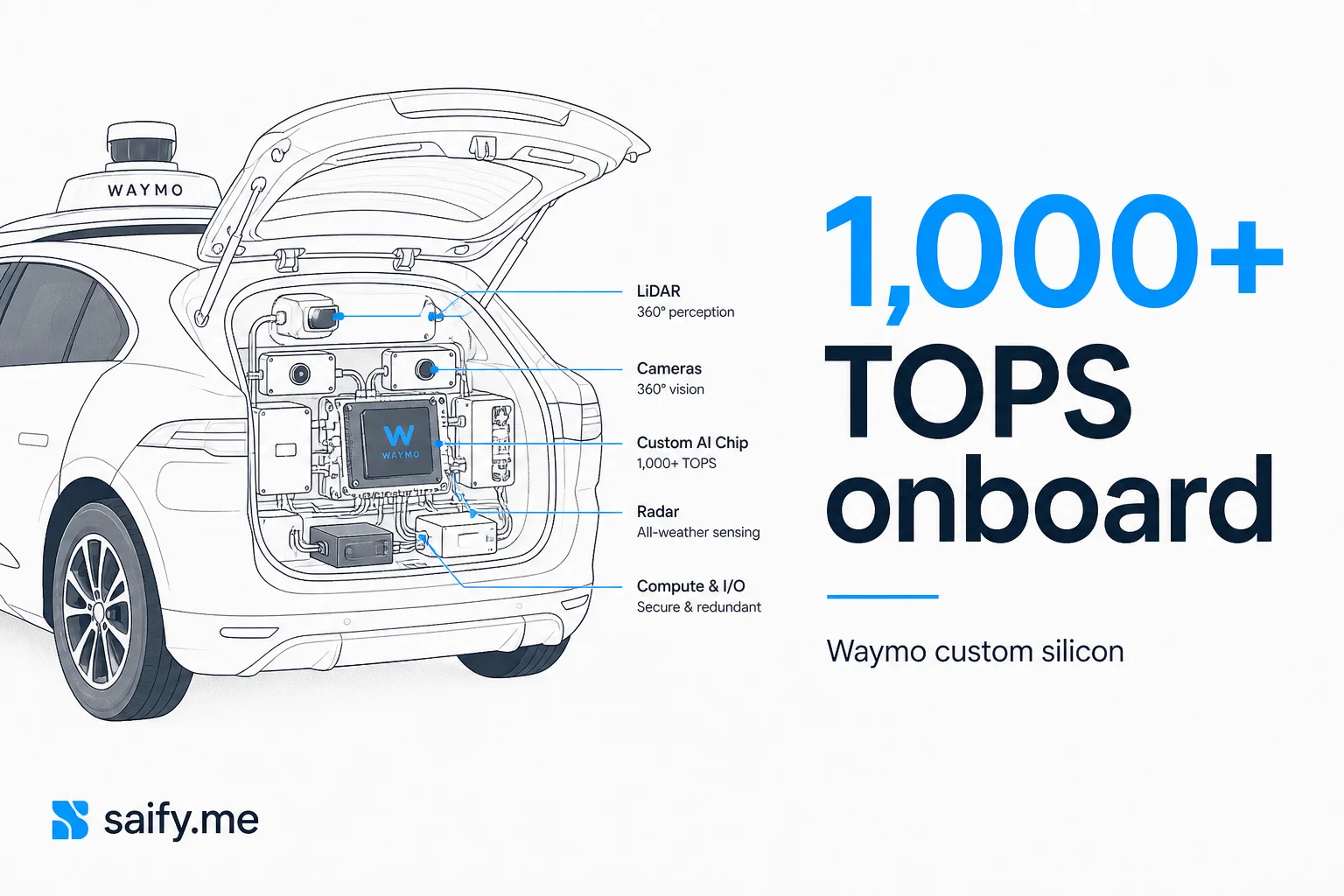
Waymo just opened the trunk.
For the first time, the company shared how it thinks about onboard compute for fully driverless robotaxis: custom 5nm ASICs, heterogeneous GPUs and CPUs, dual redundant engines, and a stack engineered for milliseconds, not batch jobs.
If you ship physical AI anywhere near a vehicle, a warehouse robot, or a drone, this is the reference architecture worth stealing ideas from.
Waymo: A look under our trunkWhy off-the-shelf silicon stops being enough
Driver-assist systems can lean on generic accelerators because a human is still responsible. Waymo's Driver is not driver-assist. It is full autonomy with no human backup.
That changes the math:
| Constraint | Data center ML | Robotaxi edge |
|---|---|---|
| Latency budget | Seconds to minutes | Milliseconds |
| Environment | Climate controlled | Vibration, shock, heat, cold |
| Failure mode | Retry the job | No second driver |
| Sensor load | Preprocessed datasets | 13 high-res cameras + lidar + radar live |
Waymo says it has scaled onboard compute 20x in eight years while cutting "pixels-to-actuation" latency across the stack. That is co-design talk, not a GPU purchase order.
The custom ASIC is a front-end specialist
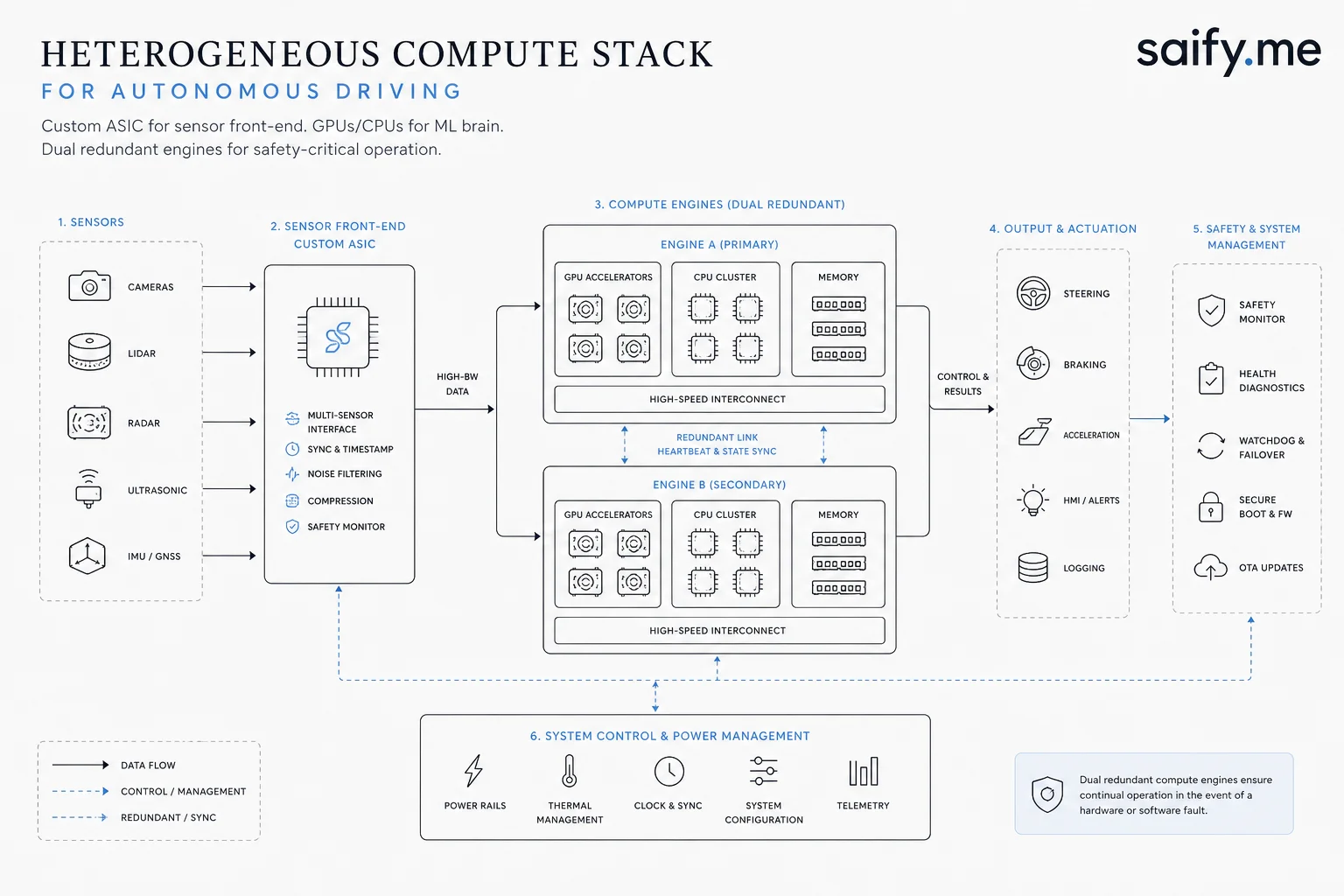
The new chip is not trying to be a general-purpose GPU. It is a sensor front-end ML powerhouse:
- Processes raw lidar, radar, and camera streams in real time
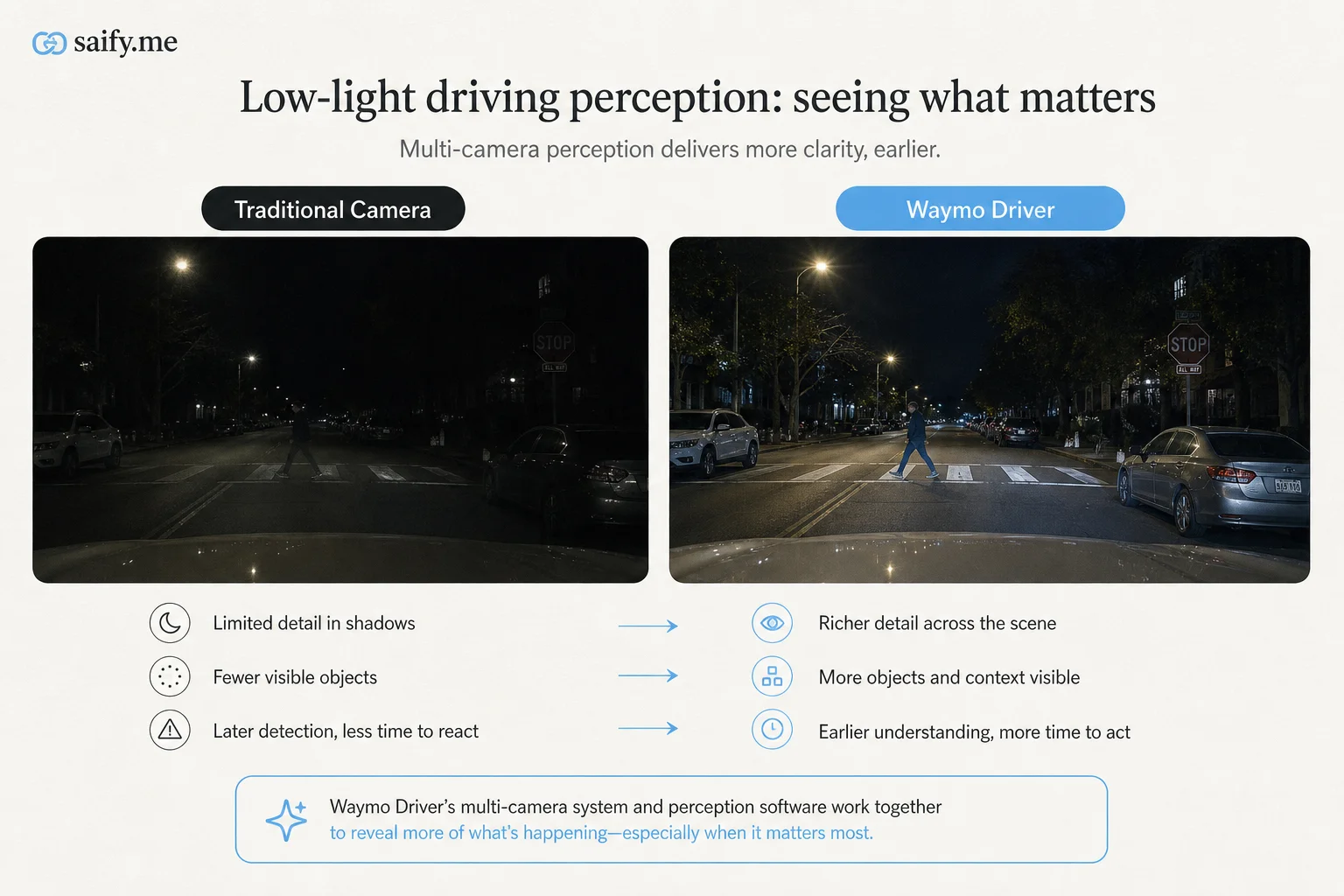
- Runs temporal denoising for better low-light perception
- Feeds a purpose-built inference engine for sensor fusion models
- Delivers 1,000+ TOPS for front-end processing alone
Waymo builds silicon, sensors, and algorithms side by side so it can push quantization, bandwidth efficiency, and model heterogeneity (sparse convolutions through dense transformers) without waiting for a vendor roadmap.
Bloomberg on Waymo's custom robotaxi chipThe sixth-gen Driver ships on the Ojai, a Zeekr-built minivan outfitted in Mesa, Arizona. Custom silicon is not a slide deck item. It is in production vehicles.
Three non-negotiables Waymo keeps repeating
From the blog post, every compute decision maps to:
- Responsive: Ultra-low latency from first pixel to action. Advanced models must decide in milliseconds, entirely onboard.
- Ruggedized: Liquid-cooled hardware that survives Phoenix summers and Midwest winters under constant vibration.
- Redundant: Two independent compute paths. Normally parallel. If one faults, the other takes over.
That third point is the one most AI startups hand-wave. In a robotaxi, "degrade gracefully" is not a log line. It is a passenger safety requirement.
Ridership scale makes silicon economics real
Custom chips are expensive until they are not. Waymo's deployment curve is why the economics start to work:
| Metric | Reported figure |
|---|---|
| Fully autonomous miles | 220M+ |
| California paid driverless trips (May 2024) | ~143K |
| California paid driverless trips (May 2026) | ~1.45M |
| Weekly paid rides (industry reporting) | 500K+ |
I covered Uber's $10B robotaxi marketplace bet in a separate post. Waymo's move is the mirror image: own the stack, not just the app surface.
Partners still matter. Waymo names AMD, Micron, Nvidia, Samsung, Sandisk, Socionext, and TSMC in the blog. Custom ASICs sit on top of a supply chain, not instead of it.
Lessons for applied AI builders
You may not be building robotaxis. The pattern still transfers:
| Waymo choice | Your edge AI equivalent |
|---|---|
| ASIC for sensor front-end | Dedicated NPU / DSP for camera or audio preprocessing |
| Heterogeneous CPU + GPU + custom | Split orchestration from inference |
| Co-design sensors + models | Tune your pipeline to your actual sensors, not Kaggle images |
| Dual redundant compute | Hot standby for voice agents, inspection lines, or drones |
| Latency percentiles, not averages | Measure p99 for control loops, not mean API time |
Most teams I audit still treat inference like a cloud API call. Physical AI is a control system with ML inside it.
My take
Waymo's trunk reveal is the clearest signal yet that robotaxi leaders view compute as strategic infrastructure, not a commodity line item on a BOM.
The 1,000 TOPS number is fun for Twitter. The deeper point is co-design: when you own the full loop from photon to brake pedal, you stop accepting vendor latency you cannot measure.
If you are shipping anything that moves under model control, start measuring pixels-to-actuation (or audio-to-action) end to end. The gap you find will tell you whether you need a better model, a better chip, or a better systems engineer.
Happy to review your edge stack on a discovery call if you are stuck between "it works in the lab" and "it survives Tuesday traffic."