
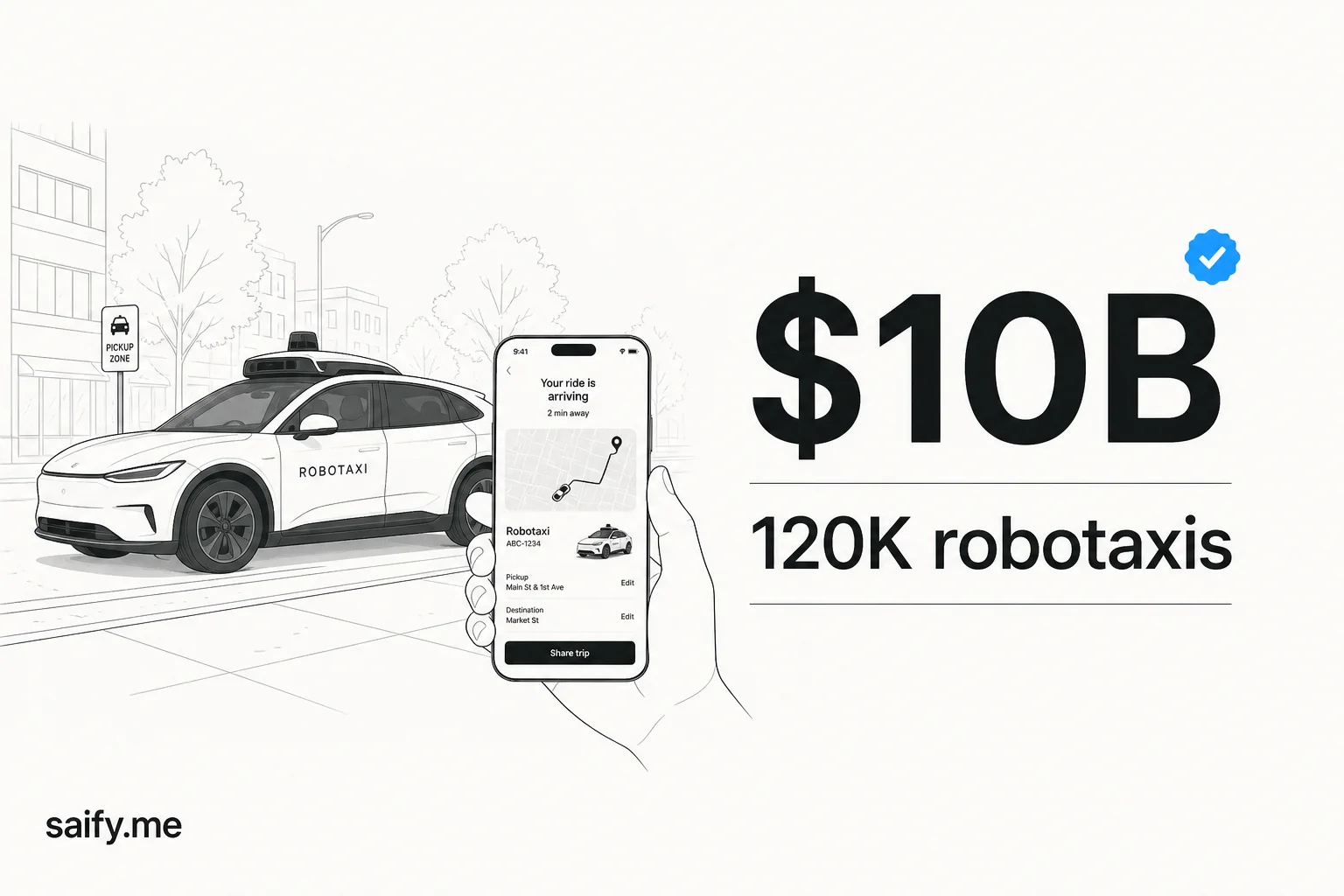
Uber built a $150B business by owning the rider, not the car. In August 2026, CEO Dara Khosrowshahi made that philosophy expensive: more than $10 billion committed to put 120,000 driverless vehicles on the Uber network, with robotaxi service targeted in at least 15 cities by year-end.
The bet is not that Uber will out-engineer Waymo. It is that 200 million app users, dispatch muscle, and fleet ops can keep Uber the default surface even when the vehicle has no steering wheel.
Financial Times on Uber's robotaxi commitmentWhat changed on earnings day
Khosrowshahi framed the spend as coming from strength. Uber reported a record $2.8 billion in Q2 free cash flow, with trailing twelve-month cash generation above $10 billion. That is real money, and it is funding a strategy that looks nothing like the asset-light ride-hail model investors loved for a decade.
The plan splits roughly into two buckets, per reporting from Particle and the Rundown Robotics breakdown:
| Spend bucket | Approximate size | What it buys |
|---|---|---|
| Fleet offtake and hardware | ~$7.5B+ | Dedicated robotaxi vehicles from Lucid, Rivian, Nuro-Lucid stacks, and other partners |
| Equity in AV developers | ~$2.5B+ | Stakes in companies building the driving stack |
| Operating infrastructure | Included | Charging depots, insurance, maintenance, Uber AV Labs |
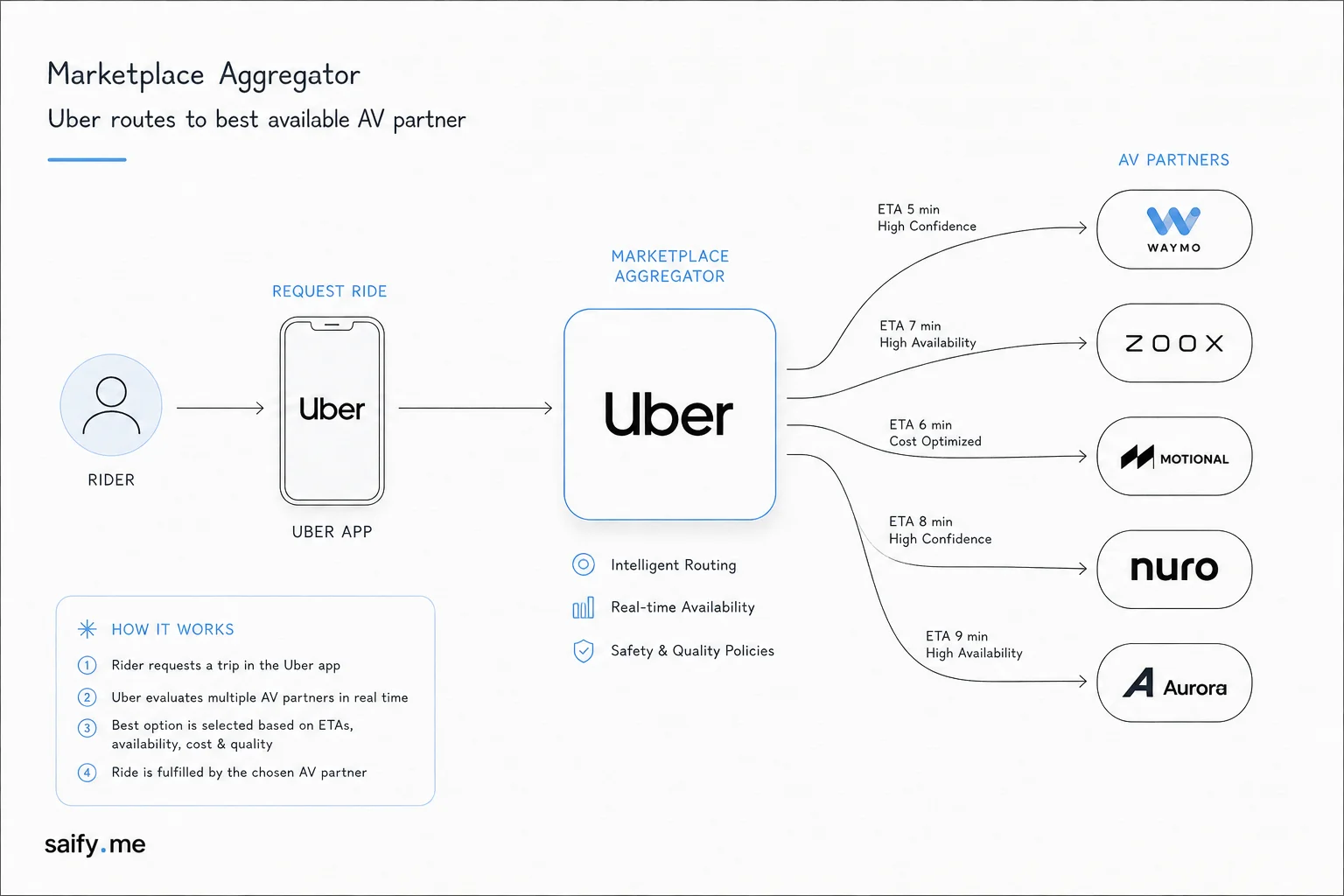
Uber is not reviving the self-driving unit it sold to Aurora in 2020. Instead it wants to be the commercialization layer every AV company plugs into, the same way Android became the default shell for many phone makers.
The partner map is the product
Uber's robotaxi roster reads like a who's who of autonomy:
- Waymo in Austin and Atlanta (for now)
- Nuro plus Lucid Gravity SUVs testing in San Francisco
- Zoox planned for Las Vegas later in 2026
- Wayve with a path toward London after TfL permits
- Lucid and Rivian as dedicated EV platforms, including a marquee deal for at least 35,000 Lucid vehicles
The Lucid-Nuro line matters because it is the closest thing Uber has to a vertically integrated offer without building software in-house. Test vehicles already run in San Francisco and Houston, still with safety drivers, but the offtake numbers are not theoretical.
Smart Cities Dive on Lucid and Rivian fleet plansUber also set up Uber AV Labs and dedicated fast-charging hubs. That is the unglamorous work: where cars charge, who cleans them, how you handle lost phones in a vehicle with no driver to hand them back. Fleet operator Moove raised $250M on the same thesis. Someone has to own the metal, and Uber is volunteering.
Waymo is partner and predator
The tension in this story is Waymo. Uber's biggest AV partner is also the company most likely to make Uber optional.
Three data points from the last few months:
- Phoenix is over. Uber and Waymo quietly ended their nearly three-year pilot. Waymo cars still run in Phoenix, just not through the Uber app.
- Austin and Atlanta exclusivity ends January 2028. Waymo notified Uber it will launch its own consumer app in both cities. Uber says that frees it to bring other AV providers into those markets.
- Waymo scales direct. It operates in 11 U.S. metro areas, delivers more than 500,000 paid rides per week, and runs national ads during World Cup coverage.
Lyft CEO David Risher called his own Waymo deal a "situationship." That is honest. When one side owns the vehicle, the software, and an increasingly strong consumer brand, the aggregator starts looking like a toll booth.
Uber shares were down double digits in 2026 before the earnings call. Part of that is fear that robotaxis erase driver payouts and margins. Khosrowshahi's answer is to become the fleet owner in categories where partners cannot scale alone. That is a strategic pivot, not a tweak.
Why this is not asset-light anymore
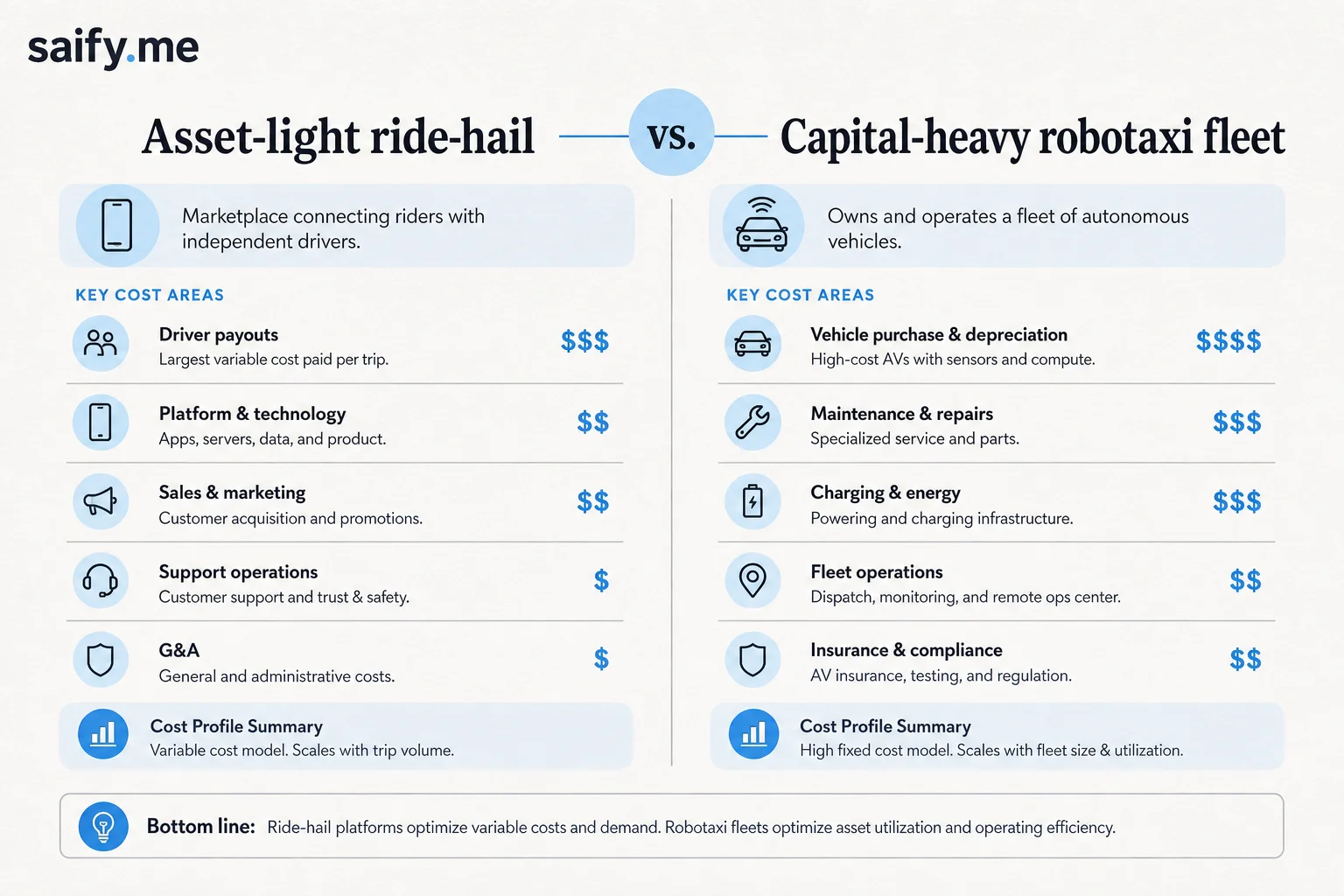
For years Uber's pitch to Wall Street was simple: we are a marketplace, not a car company. Depreciation lived on someone else's balance sheet.
The robotaxi plan breaks that contract:
| Old model | New robotaxi model |
|---|---|
| Drivers supply vehicles | Uber commits billions to offtake |
| Insurance mostly externalized | Uber bundles AV insurance and liability |
| Expansion = more cities on the app | Expansion = depots, chargers, regulatory filings per city |
| Waymo does the hard part | Uber still needs partners to ship on time |
Uber will run a hybrid network early on: human drivers plus AVs with in-vehicle safety supervisors where regulation or reliability require it. That is pragmatic, but it is also expensive. You are paying for two labor models at once.
Management targets 28 cities by 2028, up from seven today. The 120,000 figure is partner commitment, not vehicles on the road this quarter. Production, insurance, and unit economics still have to prove out street by street.
What applied AI builders should watch
I spend most of my week on voice agents, CRM automation, and shipping AI into ops workflows. Robotaxis feel distant until a client asks why their "Uber for X" marketplace will not get disintermediated by the supplier.
Three lessons transfer:
1. Distribution is a moat until it is not. Uber's 200M users are a real advantage. Waymo's direct app push is the counter-move. If you run a marketplace, assume your best supplier will eventually want the customer relationship.
2. Ops eats model quality. The AV stack is half the battle. Charging, cleaning, insurance, and depot robotics (Moove's "nests") are where margins get made or lost. AI products have the same pattern: the model demo is easy, the cron job that keeps credentials fresh is hard.
3. Capital intensity changes who wins. Uber can fund $10B because ride-hail throws off cash. Smaller AV startups need partners with balance sheets. If you are picking vendors for a physical AI deployment, ask who owns the fleet when the pilot ends.
The bottom line
Uber is not trying to beat Waymo at perception. It is trying to stay the default tap when your ride shows up without a driver. That requires billions in vehicles Uber used to avoid, partnerships with companies that may outgrow the app, and a hybrid network that keeps humans in the loop for years.
The rider relationship is still Uber's prize. The open question is whether Waymo and others let them keep it.
If you are mapping autonomy into a real product roadmap (dispatch, fleet ops, or customer-facing apps), book a free discovery call. I help teams ship applied AI without betting the balance sheet on slide-deck robots.