

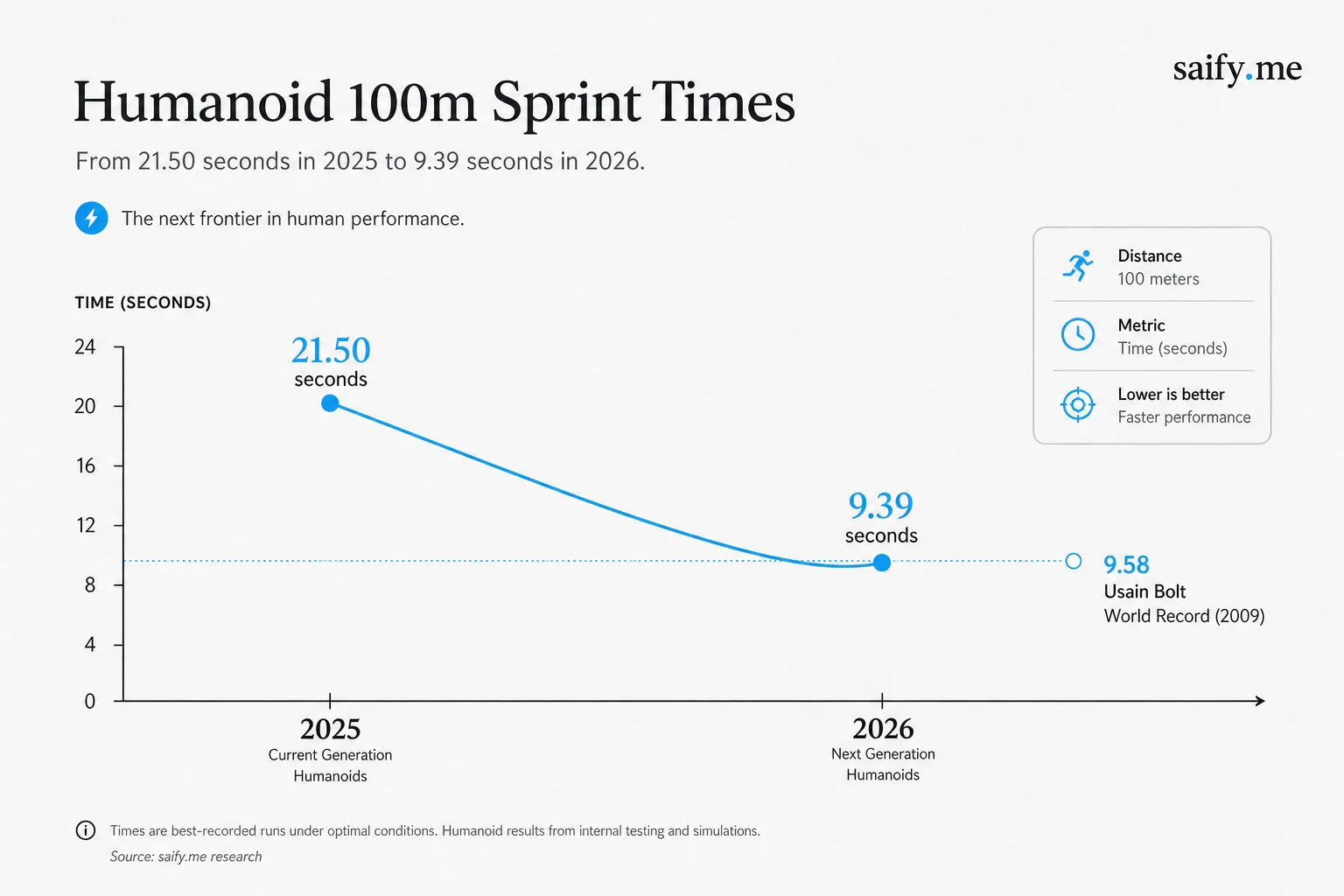
A humanoid robot ran 100 meters in 9.39 seconds at Beijing's World Humanoid Robot Games last week. That is faster than Usain Bolt's 9.58s world record from Berlin 2009.
Then it slammed into the deceleration mat and stumbled into the sidelines.
I watched the clips twice. The speed is real. The finish is a mess. Both facts matter if you are betting on humanoids for warehouses, hotels, or front-of-house work anytime soon.
Reuters on the Beijing sprint resultsWhat actually happened on the track
Per AP's photo coverage and Chinese state media:
| Robot | 100m time | Notes |
|---|---|---|
| Tiangong Ultra | 9.39s | Beat Bolt's 9.58s record on paper |
| Honor Lightning | 9.47s | Second place, also under Bolt's mark |
| Last year's winner | 21.50s | Same event, one year earlier |
The same Tiangong model reportedly ran 38.15s in the 400m, nearly five seconds under Wayde van Niekerk's human world record of 43.03s from Rio 2016.
Not every heat went cleanly. Some runners failed to start or collapsed at the gun. A boxing humanoid folded over the ropes and stayed there until humans hauled it out. The sprint winners had speed. They did not always have grace at the finish line.
The year-over-year jump is the real headline
Motorized legs were always going to beat us in a straight sprint. That was never the interesting part.
What caught my eye is the pace of improvement:
- 2025 winning pace: 21.50s
- 2026 winning pace: 9.39s
- Rough multiplier: about 2.3x faster in one year
That is not a incremental tweak. That is a different class of locomotion control, even if the robots still look like they forgot how to stop.
When I talk to clients about embodied AI, I keep repeating the same line: demo velocity is not deployment velocity. A 9.39s sprint on a closed track tells you the actuators and gait controllers are getting serious. It does not tell you the robot can navigate a hotel lobby with luggage carts, wet floors, and a toddler running sideways.
Spectacle vs utility at the games
This year's games scaled hard:
| Metric | 2026 figure |
|---|---|
| Robots entered | 2,056 |
| Teams | 666 |
| Countries | 16 |
| Events | 51 |
| Events requiring full autonomy | >40% |
| Real-world scenario events | 21 (factories, hotels, emergency response) |
The sprint and soccer clips will get the retweets. The procurement signal is in the utility brackets.
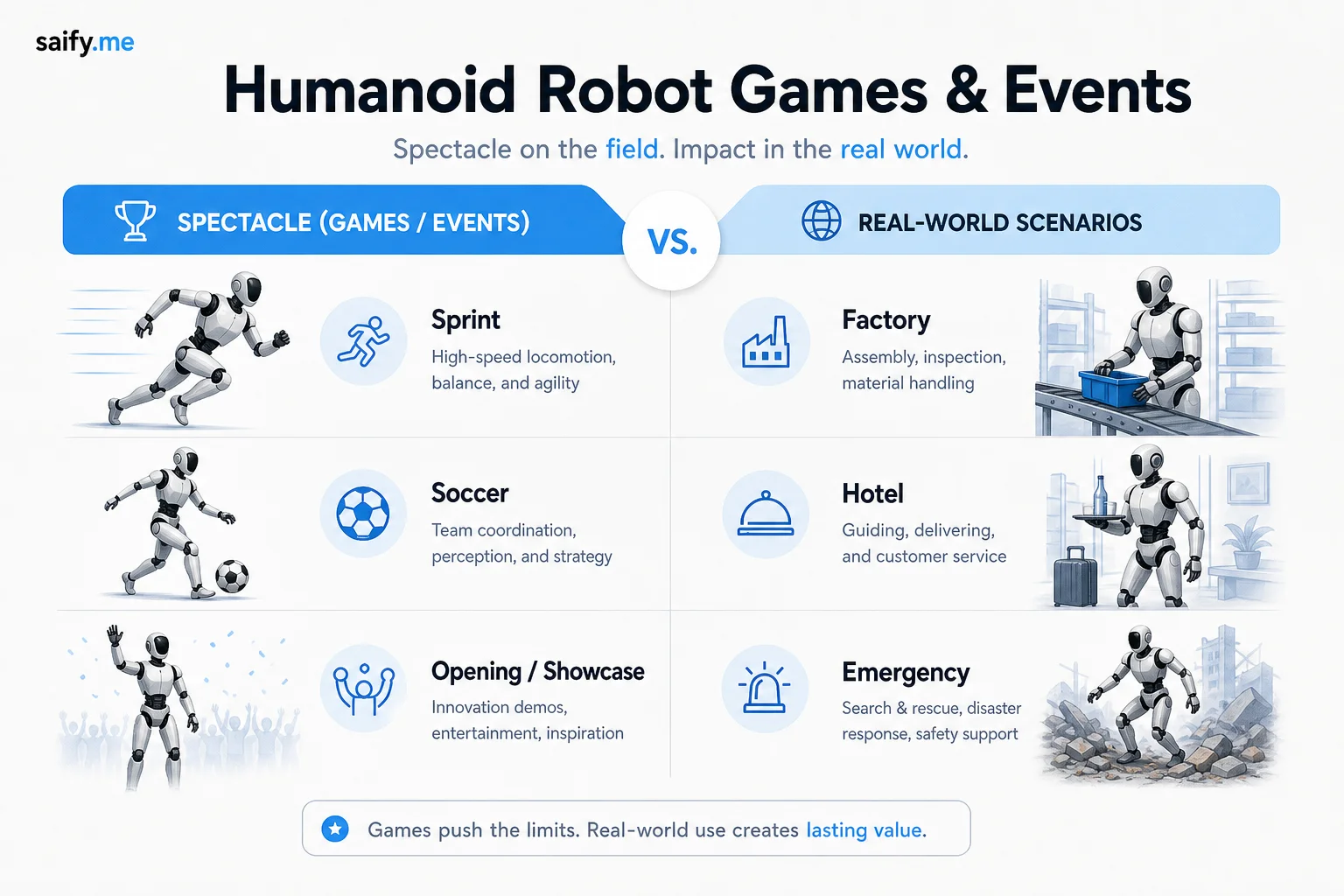
I have written about fenceless factory humanoids and U.S. humanoid supply chain bets before. Beijing adds a useful filter: can the robot finish the task, not just start fast?
Braking is a perfect example. Several sprint finishes ended in collision with mats because deceleration looked like an afterthought. In a factory aisle, that is not a funny clip. That is a safety incident waiting for a root-cause review.
What builders should watch
If you are evaluating humanoids for ops work, ignore the Bolt comparison and ask four boring questions:
- Stop distance: Can it decelerate from full speed without falling or hitting obstacles?
- Autonomy scope: Is the demo teleoperated, scripted, or genuinely closed-loop?
- Task fit: Does your use case look like sprinting, or like the hotel/factory events in the games?
- Recovery: When it falls, how long until it is back in service without a human reset?
The Beijing games are useful because they make the gap visible. Speed on a track is a solved-looking subproblem. Reliable stop, balance, and task completion in clutter is not.
My take
I am not cynical about the 9.39s number. Hardware is moving. Chinese teams are iterating in public at a scale Western demos rarely match.
I am skeptical about headline comparisons to Usain Bolt. Bolt had to slow down, stay upright, and not face-plant into padding. These robots had a dedicated lane and still looked like they borrowed their braking logic from a shopping cart.
The bet that matters is not "can a humanoid outrun a human." It is whether the same platforms can walk, carry, and recover in the 21 utility events that now dominate the games calendar.
If you are scoping embodied AI for a real facility, start there. Book a call if you want help translating vendor sprint videos into an ops checklist that your safety team will actually sign off on.