
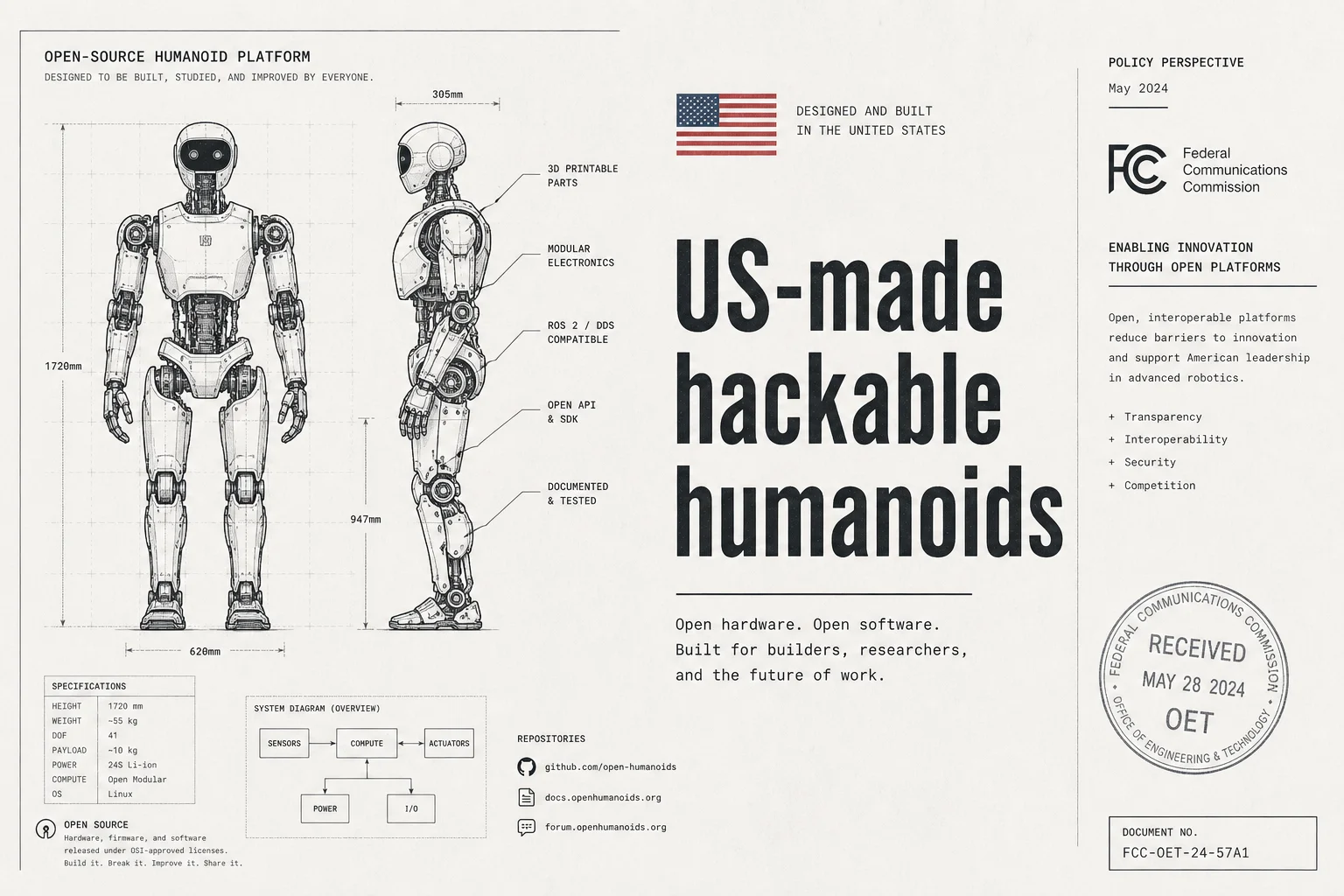
Unitree reset what a humanoid costs. Then Washington moved the goalposts.
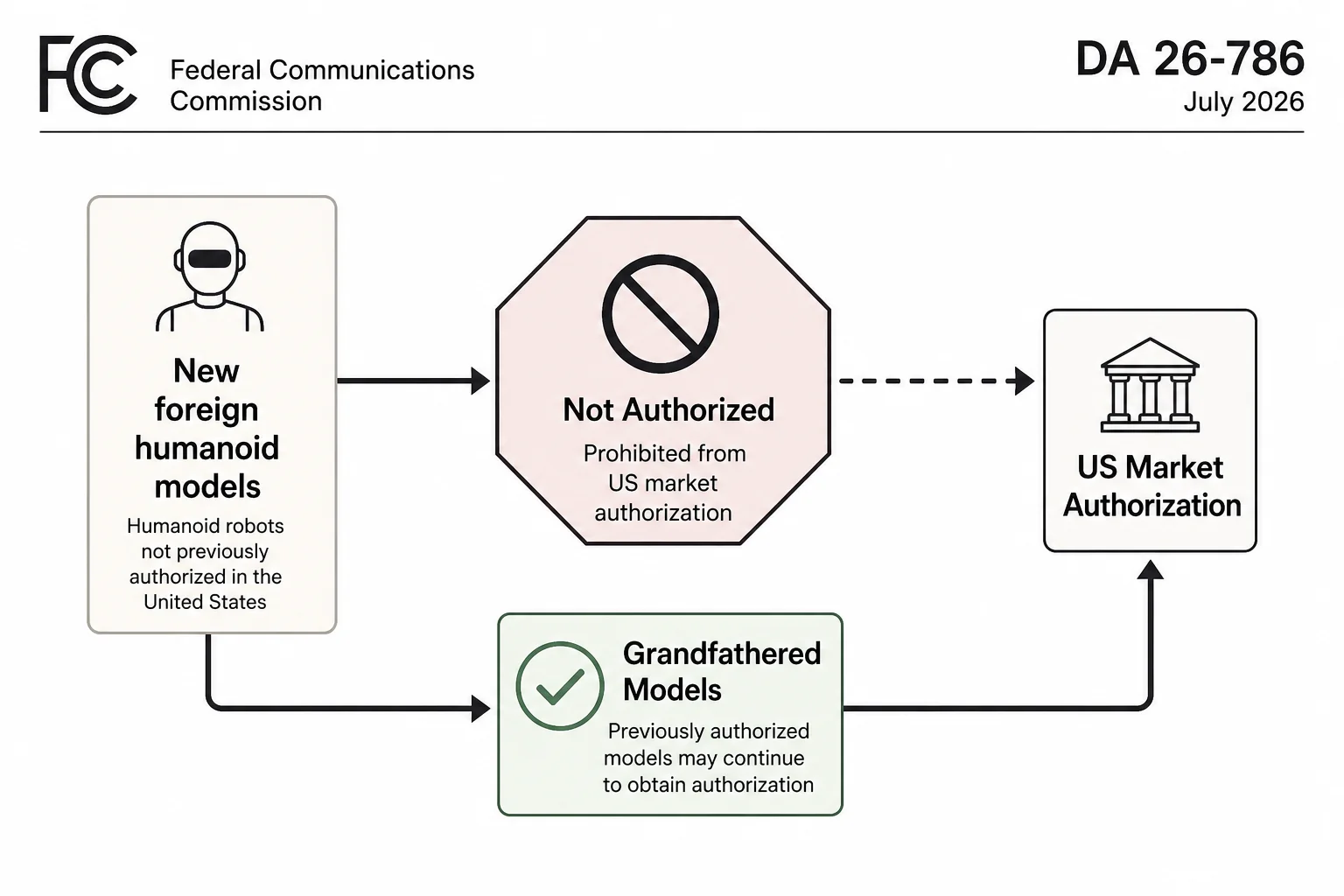
On July 28, 2026, the FCC's Public Safety and Homeland Security Bureau added foreign-produced advanced robotic devices to its Covered List under Public Notice DA 26-786. New models of humanoids, quadrupeds, and mobile robots from foreign production cannot receive the equipment authorization required to import, market, or sell them in the US.
Into that gap stepped Steel Bot, a startup founded by MIT-trained roboticist Randall Briggs. The company says it is building a cheap, US-made, fully programmable biped with root-level access and open designs, targeting shipments to US clients early next year, per Briggs' posts on X surfaced in The Rundown Robotics digest.
What the FCC rule actually does (and does not)
Coverage has been sloppy in headlines. The restriction is not a blanket import ban on every Chinese robot already in a lab.
Per analysis from There's a Robot for That and AI2Work:
| Question | Answer |
|---|---|
| Does it block existing authorized models? | No. Grandfathered FCC authorizations remain valid. |
| Does it target one country? | No. FCC FAQ says the action is country-neutral; production location matters. |
| What is blocked? | New models seeking FCC equipment authorization |
| When effective? | Immediately via the authorization process (July 28, 2026 release) |
| Any escape hatches? | DoW conditional approval; domestic end-product exemptions with BOM thresholds |
Software and firmware permissive changes on grandfathered models may continue through at least January 1, 2029, but hardware changes face tighter scrutiny.
If you are a US university lab that ordered a foreign humanoid last year, you are probably fine. If you planned to import a new foreign model in fall 2026, you need a compliance story.
Why Steel Bot thinks it can win
Briggs' manifesto on X (linked from the digest) promises:
- Root-level control and open-source software
- Modifiable, repairable hardware
- Interchangeable end-effectors
- A waist-split design to reduce complexity and cost
Hartmann Capital describes Steel Bot as "low-cost, open-source, American-made humanoids" where customers own the software stack. 500 Global amplified the stealth exit on LinkedIn, noting the FCC timing accelerates Steel Bot's roadmap.
Briggs' background includes work on the MIT Cheetah robot before founding Steel Bot. The pitch echoes Henry Ford more than Boston Dynamics: standardize the platform, let developers own the application layer.
Quote from the 500 Global post: "We are convinced that a world of open, transparent, widely distributed robots is far safer than a world where a handful of companies control every machine."
I am sympathetic to that as an applied AI engineer. Closed stacks make audits harder. Open hardware plus your own policy harness is how I prefer to ship client automations too.
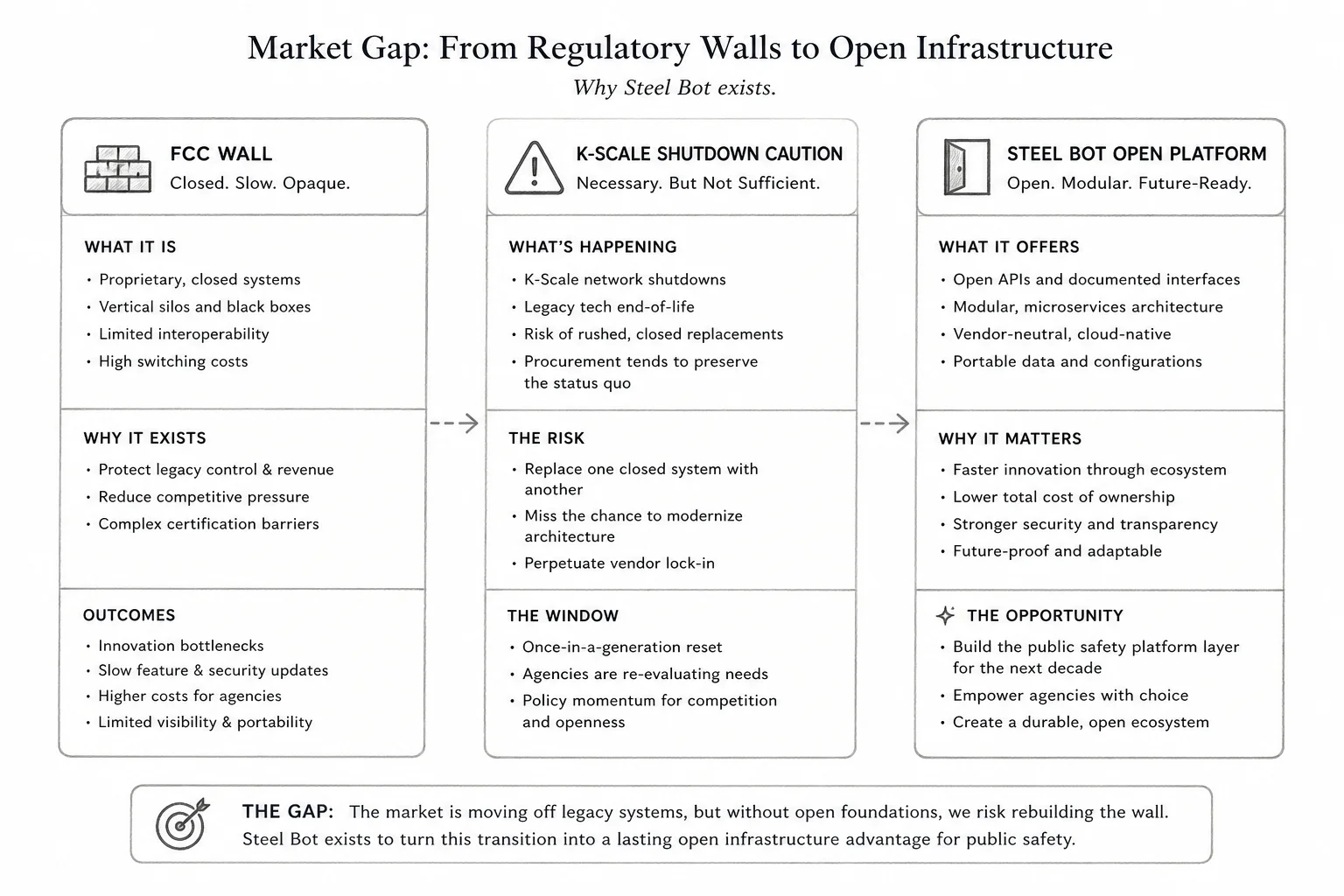
K-Scale already proved demand (and ran out of runway)
The digest reminded readers that K-Scale Labs shipped an $8,999 open-source US humanoid last year, then shut down with about $400K left after acquisition talks with 1X and The Bot Co. failed.
That is the cautionary half of the story:
- Demand exists for hackable, affordable humanoids in the US.
- Unit economics and fundraising still crush small hardware shops.
Steel Bot is betting policy tailwinds plus a simpler mechanical split (waist-down / waist-up) can stretch runway further than K-Scale managed.
The policy frame: security and industrial policy
US policymakers are framing restrictions as national security and as a push to grow a domestic robotics industry. China answered with countermeasures on drones and entities, per NBC coverage of August 2026 trade actions referenced in the digest's quick hits.
Robotics is now trade diplomacy, not just research. That matters if you:
- Source platforms for a university lab
- Build a startup demo on imported hardware
- Pitch enterprise clients who audit supply chains
Domestic end-product exemptions hinge on US-made component value (65% today, rising toward 70% in 2029 per AI2Work's reading). That is a bill-of-materials math problem you can model before you claim "Made in USA."
How this connects to open models (same week as Xiaomi)
The same robotics news cycle that highlighted Steel Bot also covered Xiaomi open-sourcing Robotics-1, a 100K-hour VLA foundation model.
Hardware walls and software openness are moving in opposite directions:
| Layer | Trend |
|---|---|
| US hardware access | Tighter on new foreign humanoids |
| Model weights | More open VLAs and policies (Apache 2.0 releases) |
| Integration | Still your problem |
A US lab might pair a Steel Bot-class body (if it ships) with an open VLA checkpoint. The compliance story gets easier. The integration story does not.
What I would ask before pre-ordering any "US alternative"
If a client asked me to evaluate Steel Bot or similar platforms, I would start here:
- FCC path: equipment authorization timeline, intentional radiator docs, production location proof.
- Repair story: parts, firmware signing, who can swap a knee actuator in 2028.
- Developer access: raw torque commands, sim bridge, ROS2 / LeRobot compatibility.
- Safety and liability: fall detection, estop, insurance for public demos.
- Funding depth: K-Scale died at $400K; what is Steel Bot's runway after stealth?
Briggs says first robots ship early next year. Until units exist, treat it as a roadmap bet, not inventory.
Broader market signals from the same digest
Quick context from The Rundown Robotics quick hits that frame Steel Bot's window:
- Unitree chasing a ~$7.4B Shanghai IPO as Washington tightens restrictions.
- $820M US loan commitment for domestic manufacturing of foreign-controlled components (Office of Strategic Capital).
- Avatar Robotics raising $6.5M for VR teleop warehouse bots (human-in-the-loop as competing pattern).
Humanoids are not one market. They are policy-sensitive platforms, teleop hybrids, and open research artifacts colliding in the same news cycle.
Takeaway for builders
The FCC rule changes procurement, not physics. Foreign platforms still dominate mindshare and price. US open-hardware startups get a regulatory tailwind and a fundraising burden in the same breath.
If you are picking a humanoid stack for applied research:
- Grandfathered foreign units may still be fine in your lab today.
- New foreign models need a compliance review yesterday.
- Open US platforms are emerging, but verify shipments and support, not just manifestos.
I will be watching whether Steel Bot publishes SDK docs and real failure videos before launch. That is how you earn trust in robotics, not with a thread on X.
Need help mapping automation or robotics vendor risk for a US deployment? Book a free discovery call.