
Unitree reset what a humanoid costs. The FCC reset who can sell one in the United States.
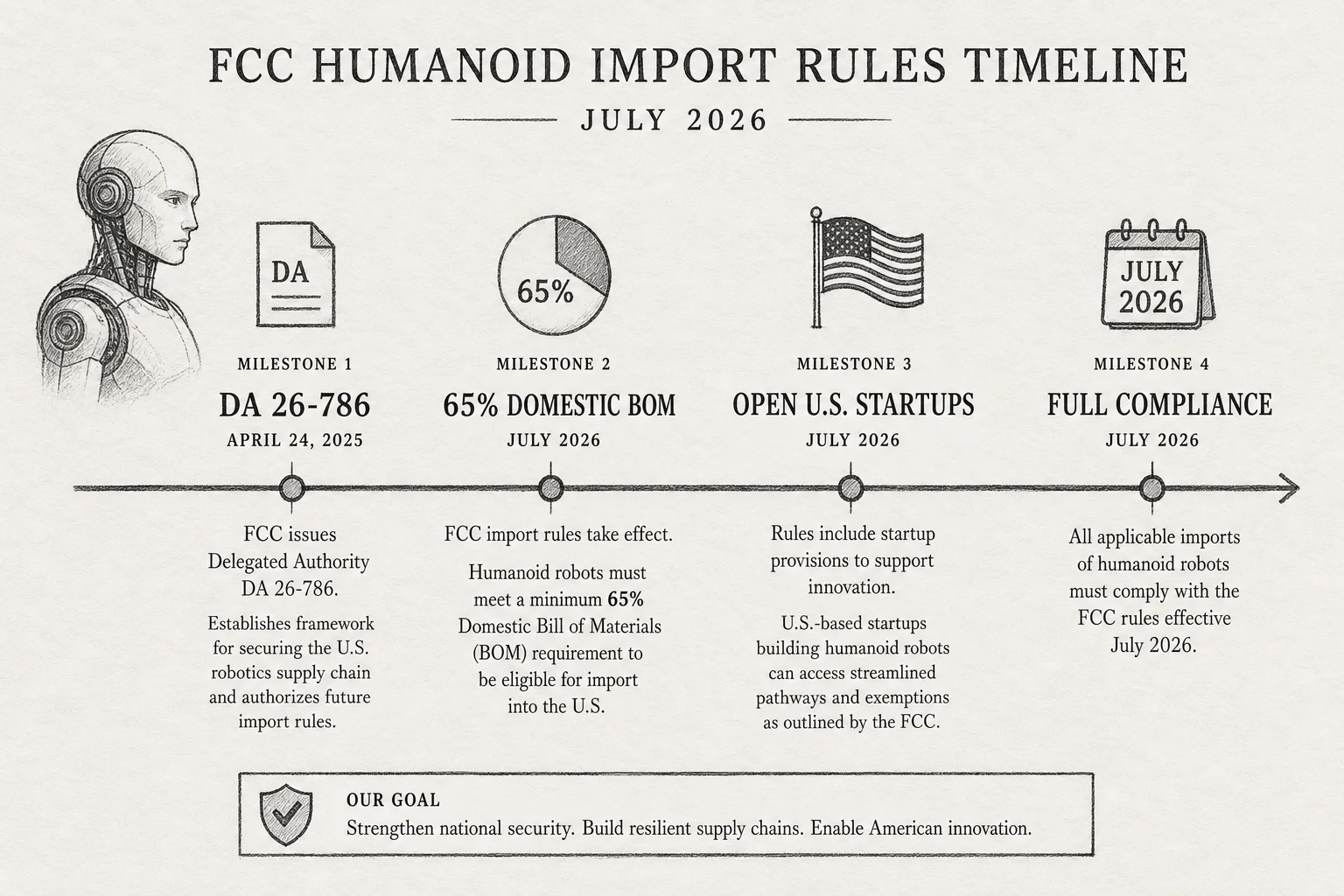
On July 28, 2026, the FCC added foreign-produced advanced robotic devices to its Covered List under Public Notice DA 26-786. New humanoids, quadrupeds, and large AMRs built outside the US cannot get equipment authorization to import, market, or sell unless they win a conditional approval from the Department of War.
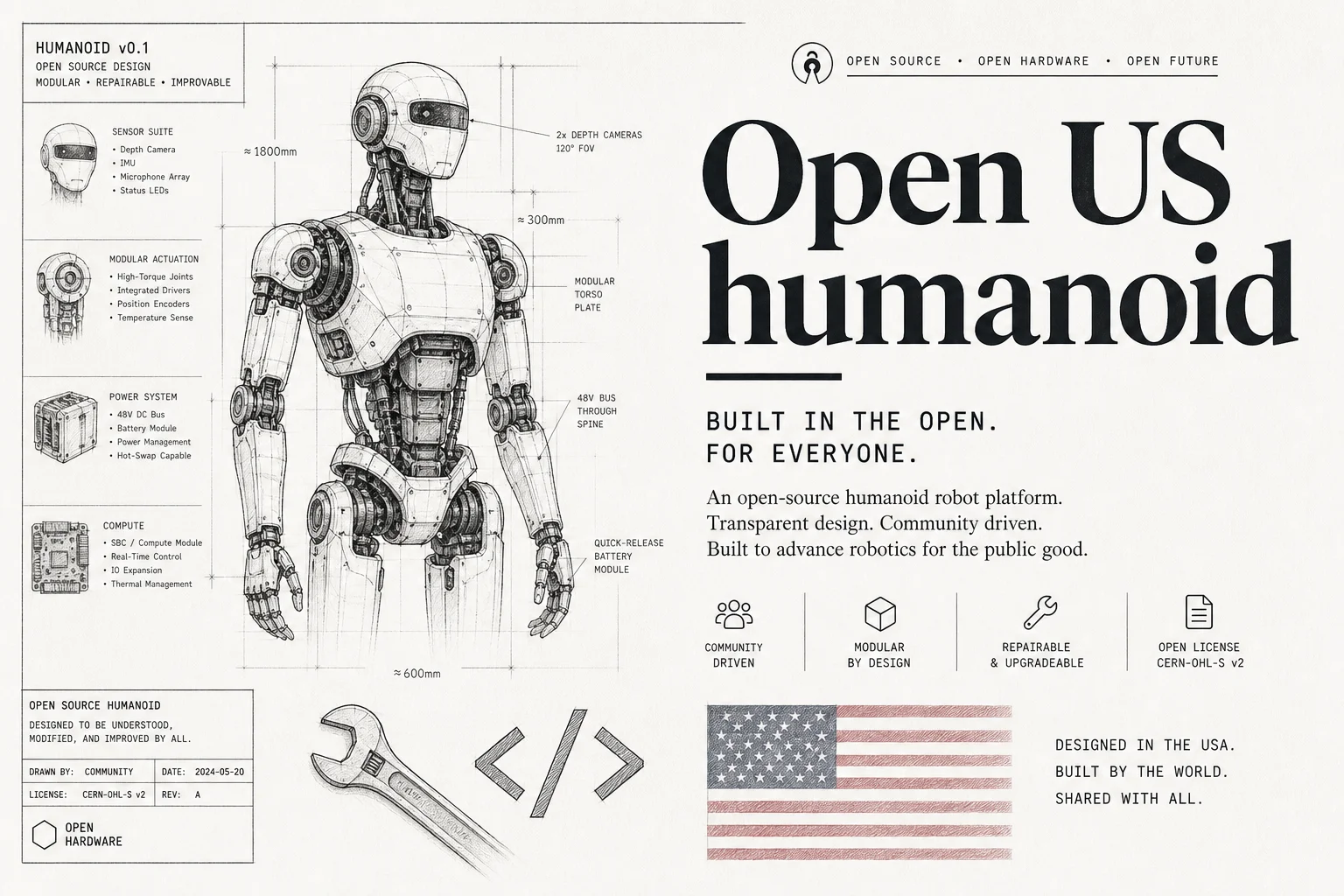
Days later, Steel Bot founder Randall Briggs posted that his startup is accelerating toward US shipments early next year: a cheap, programmable, US-made biped with root access and open designs.
Mondaq summary of FCC Covered List actionWhat the FCC rule actually does
The action is country-neutral on paper. Coverage follows place of production, not brand nationality. A robot built in Europe or Japan hits the same test as one built in China.
"Foreign-produced" means it fails the Buy American domestic end product test in 48 CFR 25.101(a). For items delivered through 2028, that requires US manufacture plus more than 65% domestic component cost.
| Device class | Examples in scope | Weight / connectivity threshold |
|---|---|---|
| Humanoid robots | Bipedal manipulators | Over 4.4 lb, network-connected |
| Quadrupeds | Spot-class platforms | Same |
| AMRs | Warehouse mobile robots | Same |
Existing FCC-authorized models can continue importing and selling. Consumer units already purchased are unaffected. The wall is around new models seeking authorization.
Conditional approval is possible, but for robots only the Department of War (not DHS) can grant it, after a national security determination that a device or class does not pose unacceptable risk.
2026 humanoid import guide (DA 26-786 breakdown)Washington frames this as supply chain and hacking risk. Practically, it is also industrial policy: push researchers and startups toward domestic platforms before the next generation of cheap foreign humanoids floods labs.
Steel Bot's pitch
Briggs, an MIT-trained roboticist, says Steel Bot has been building since December 2025. The manifesto on X promises:
- Root-level control and modifiable designs
- Open-source software stack
- Repairable hardware and interchangeable end effectors
- Waist-split design to reduce complexity and cost
The positioning is explicit: as US restrictions on foreign humanoids tighten, ship a homegrown platform researchers can actually own and hack.
Briggs wrote that "a world of open, transparent, widely distributed robots is far safer than a world where a handful of companies control every machine." That is a values statement, but it is also a go-to-market wedge when closed platforms cost six figures and foreign cheap units face authorization friction.
K-Scale proved demand, not durability
The newsletter context matters. K-Scale Labs shipped an $8,999 open-source US humanoid in 2025, then shut down with roughly $400K left after acquisition talks with 1X and The Bot Co failed.
Demand for affordable hackable humanoids is real. Building a sustainable company on that demand is harder. Steel Bot enters with policy tailwinds and the same capital intensity problem K-Scale could not solve.
Who wins in the new regime
Domestic assemblers with documented component math can still authorize new models.
Researchers with legacy units keep using already-imported foreign bots through at least 2029 thresholds.
Startups like Steel Bot get a narrative and a procurement story for US labs that cannot wait on conditional approvals.
Closed premium vendors (Figure, Boston Dynamics) sell factory contracts where price matters less than uptime and support.
Unitree and other export-focused Chinese makers face the worst combo: IPO ambition in Shanghai and shrinking US authorization path for new SKUs.
The policy does not magically create US manufacturing capacity. It reallocates attention and VC slides toward domestic bill-of-materials work.
Open vs closed in practice
If you run a robotics lab or a startup prototyping manipulation policies, the buying question changed in July 2026:
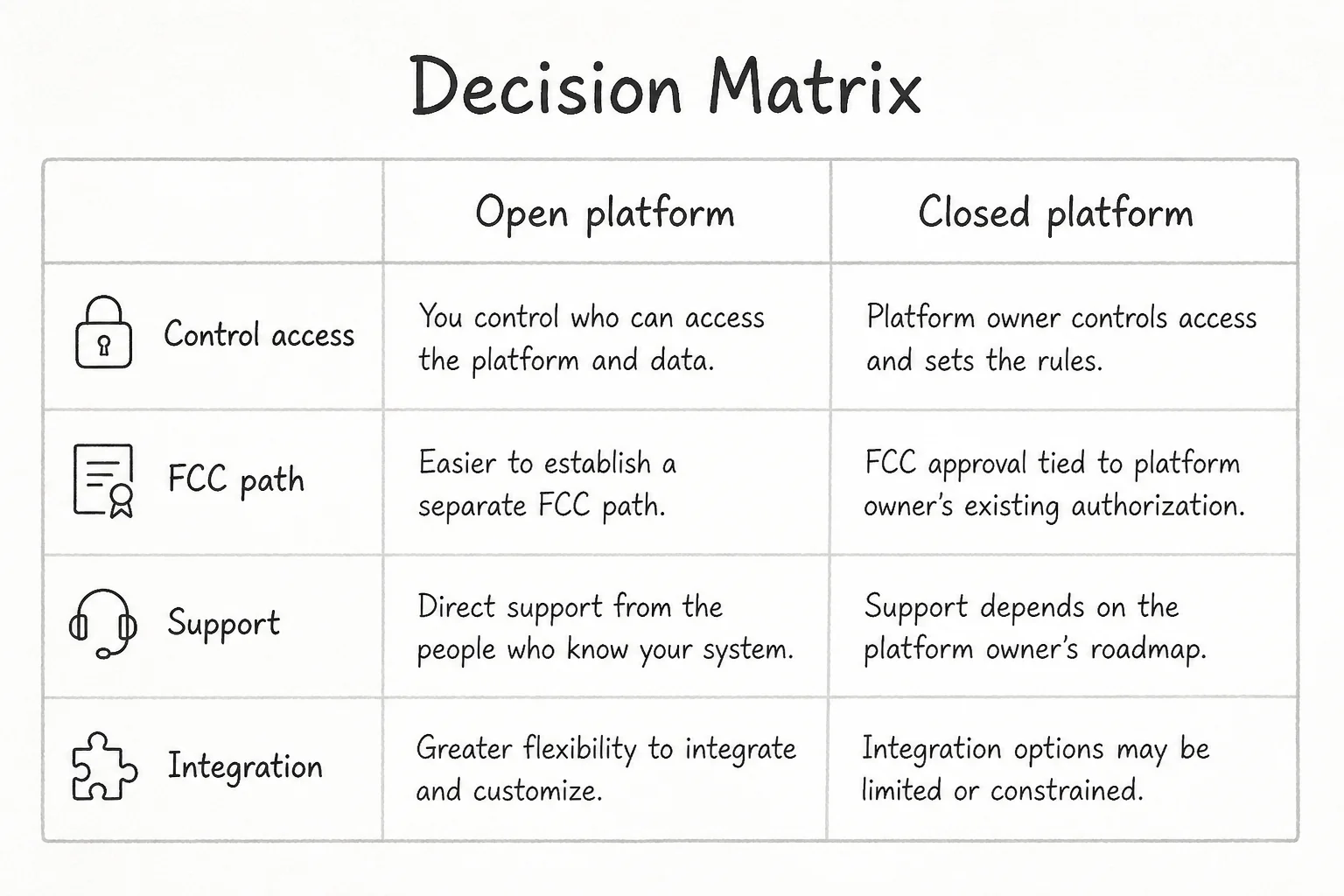
| Question | Open platform (Steel Bot-style) | Closed platform |
|---|---|---|
| Can I change low-level control? | Intended yes | Often no |
| FCC path for new model? | Domestic BOM work | May be easier if US-built |
| Support when it breaks? | Community + vendor | Vendor SLA |
| Time to first demo | Depends on your team | Often faster out of box |
| Long-term vendor risk | Startup mortality | Big-co roadmap shifts |
I would not pick solely on ideology. Pick on authorization path, spare parts, and whether your team can absorb integration work.
Limits and skepticism
- Steel Bot has not published a public price, ship date contract, or mass production partner list beyond "early next year" aspiration.
- Conditional approvals may still allow selected foreign models through DoW review. The ban is not absolute.
- 65% domestic component value is a paperwork and sourcing game large incumbents can optimize faster than seed-stage teams.
- Open hardware does not solve sim-to-real. Policy opens a door; engineering still walks through it.
What I would do this quarter
If you are a US robotics team:
- Inventory which platforms are already authorized vs which future SKUs need new filings.
- Model authorization risk in your five-year hardware roadmap, not just purchase price.
- If you bet on open platforms, budget integration and maintenance like you would for an internal framework team.
If you are a software founder building on humanoids, treat FCC action as forcing function for multi-embodiment code paths. Your VLA stack should not assume one vendor's joint layout forever. Xiaomi-Robotics-1's cross-embodiment post-training is the research direction; Steel Bot is the hardware politics direction.
Bottom line
The FCC did not ban humanoids. It banned easy paths for new foreign-made ones without domestic manufacturing substance or a security exception.
Steel Bot is racing to become the obvious US answer for labs that want root access and cannot wait. Whether they become the answer depends on capital, manufacturing, and the same brutal economics that ended K-Scale's run.
For applied builders, the actionable news is policy-shaped procurement. The robot you buy this year might be the last foreign model your lab can expand on without a fight.
Questions about automation strategy when hardware and regulation move this fast, book a free discovery call.