
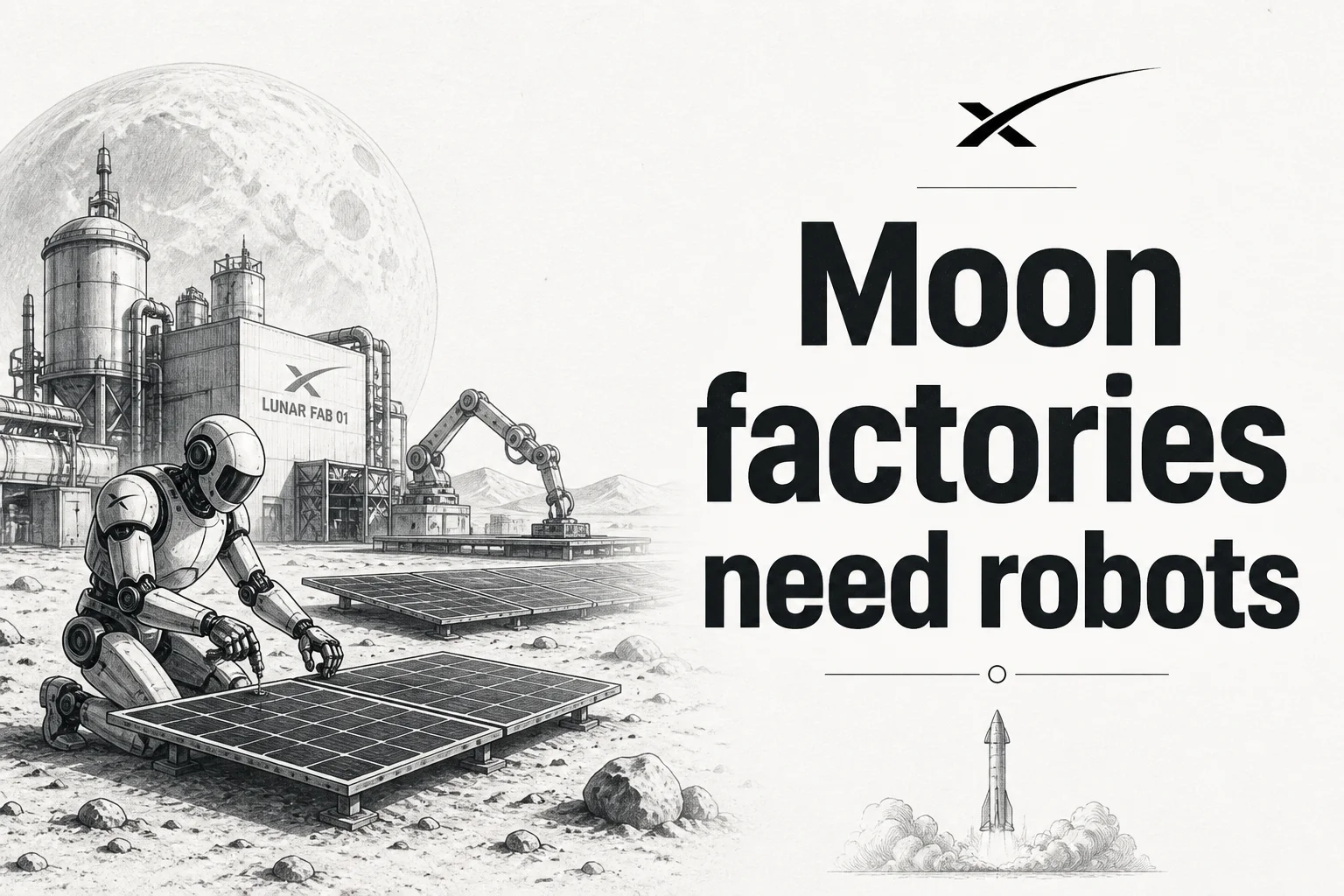
On SpaceX's first quarterly earnings call in August 2026, Elon Musk did not lead with Starship splashdown footage. He talked about factories on the Moon. Humanoids would build them. Solar arrays and radiators would follow. An electromagnetic mass driver on the lunar surface could launch satellites without rockets.
The stock fell more than 5% that day. That reaction is the useful part for builders. SpaceX is now a public anchor customer for a product category that almost nobody sells at scale: general-purpose robots that can do construction work in hostile environments.
Space.com recap of the earnings callWhat Musk actually pitched
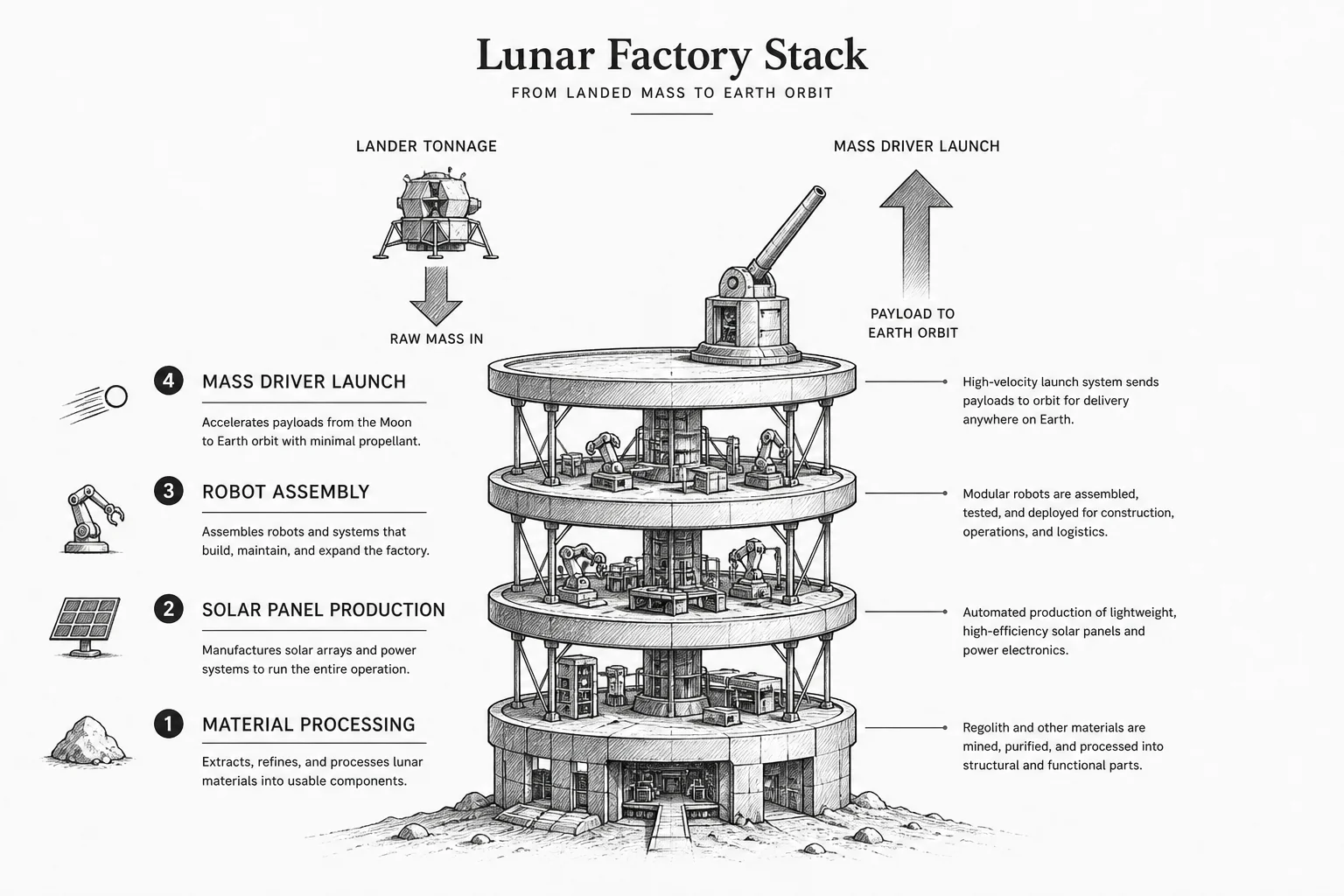
The headline is lunar manufacturing, but the through-line is robotic infrastructure at every layer:
| Layer | Musk's framing | What it assumes |
|---|---|---|
| Orbit | Starlink satellites as autonomous "robots" in space | Fleet ops at million-satellite scale |
| Moon surface | Factories for Starmind AI satellites, solar, radiators | Heavy tonnage landed and assembled remotely |
| Launch | Electromagnetic mass driver on the Moon | Manufacturing precision on regolith |
| Workforce | "The robots will be helpful with that" | Humanoids or equivalent general manipulators |
Musk acknowledged the pitch sounds "super sci-fi" and said it is "going to happen." He also tied terrestrial robotics into the picture, especially Tesla Optimus and manufacturing joint ventures like TERAFAB.
Scientific American on the investor callHe did not attach a deployment date, a capex line item, or a bill of materials for lunar factory robots. That gap between narrative and disclosed spending is what shareholders and engineers will measure for several quarters.
Why Optimus is the implied labor pool
Musk did not name Optimus on the call, but the inference is hard to avoid. He has already said SpaceX could send Optimus units to Mars to prepare for human settlement. Tesla is converting Fremont Model S capacity toward Optimus production and building a larger line at Giga Texas.
Tesla AI and Optimus program pageOn Earth, Optimus is still mostly a learning platform. Reports from early 2026 describe more than 1,000 units across Fremont and Texas doing sorting, parts movement, and basic inspection, with Musk admitting they are "primarily for learning and data collection rather than performing productive tasks."
That is fine for a factory beta. It is not fine for "build a solar array on the Moon."
The economics Musk is selling
The investor story is not "cool robots." It is leverage:
- Land tonnage on the Moon once rockets are cheap enough (Starship narrative).
- Use robots to scale manufacturing without proportional human labor on site.
- Launch intelligence and hardware into space at orders of magnitude above Earth's economy.
Musk floated scaling to "1,000 times the economy of Earth in terms of intelligence launched to space," and maybe "a million times" with a mass accelerator plus on-site power and thermal hardware.
Even if you discount Musk multiples by 99%, the directional claim matters: SpaceX is positioning robotics as the margin engine for off-world industry, not a side project.
The same call reported a $542 million loss from the space segment and more than $1.2 billion from AI operations for the quarter. Lunar factories are a long-horizon bet on robotics ROI, not a near-term earnings fix.
What builders should steal from the pitch
I work on applied AI for businesses on Earth. The Moon factory slide deck still has three lessons that transfer to warehouse bots, delivery robots, and factory automation:
1. Anchor customers define categories. SpaceX publicly needing humanoid-scale labor creates a procurement story for every robotics startup pitching "general purpose worker." Whether the buyer is real or aspirational changes fundraising and roadmap conversations immediately.
2. Environment beats model size. Lunar regolith, vacuum, radiation, and thermal swings are harder than any benchmark. A policy model that packs boxes in Arizona does not qualify as a lunar construction stack without a brutal sim-to-real and hardware qualification path.
3. The handoff problem shows up everywhere. DoorDash pays gig workers to load Dot robots because the last few feet from counter to curb are still human. SpaceX's Moon factories will have the same class of problem at every interface: tool change, fasteners, cable routing, inspection. Musk's mass driver does not remove messy manipulation. It assumes someone solved it upstream.
Competitive landscape on Earth (where robots actually ship)
While Musk talks Moon factories, the humanoid market on Earth is splitting into price tiers:
| Robot | Company | Rough positioning |
|---|---|---|
| Optimus Gen 3 | Tesla | Mass production target, $20K–$30K aspirational |
| Atlas (electric) | Boston Dynamics | Premium industrial, ~$140K+ |
| Figure 02 | Figure AI | BMW factory trials, high six figures est. |
| G1 / R1 | Unitree | Volume play, R1 around $4,900 |
| Open platforms | Steel Bot, K-Scale lineage | Hackable US-made bipeds |
Unitree is chasing a $7.4B IPO valuation in Shanghai while Washington tightens import rules on foreign-made humanoids. That tension (cheap volume overseas vs domestic policy) is the near-term market. Lunar factories are the decade-scale story layered on top.
Honest limits
- No public timeline for lunar robot deployment.
- Optimus commercial sales are targeted late 2027; high-volume scaling is later.
- SpaceX losses in space and AI segments are real today; robotics payback is speculative.
- Mass drivers and million-satellite constellations assume regulatory and capital markets cooperation.
Musk has a track record of timelines that slip. Treat the Moon factory vision as a demand signal and a narrative amplifier, not a procurement schedule.
Bottom line
SpaceX turned its first earnings call into a robotics keynote. Whether you believe the Moon factory timeline or not, the company is now publicly tying its valuation story to humanoid-scale labor in space.
For applied AI engineers, the actionable read is simpler: the biggest rocket company on Earth is arguing that general-purpose robots are strategic infrastructure, not demos. The hard part is still the same work we do in restaurants and warehouses: reliable manipulation, safe handoffs, and economics that survive contact with reality.
If you are shipping automation where robots meet messy physical workflows, book a free discovery call.