
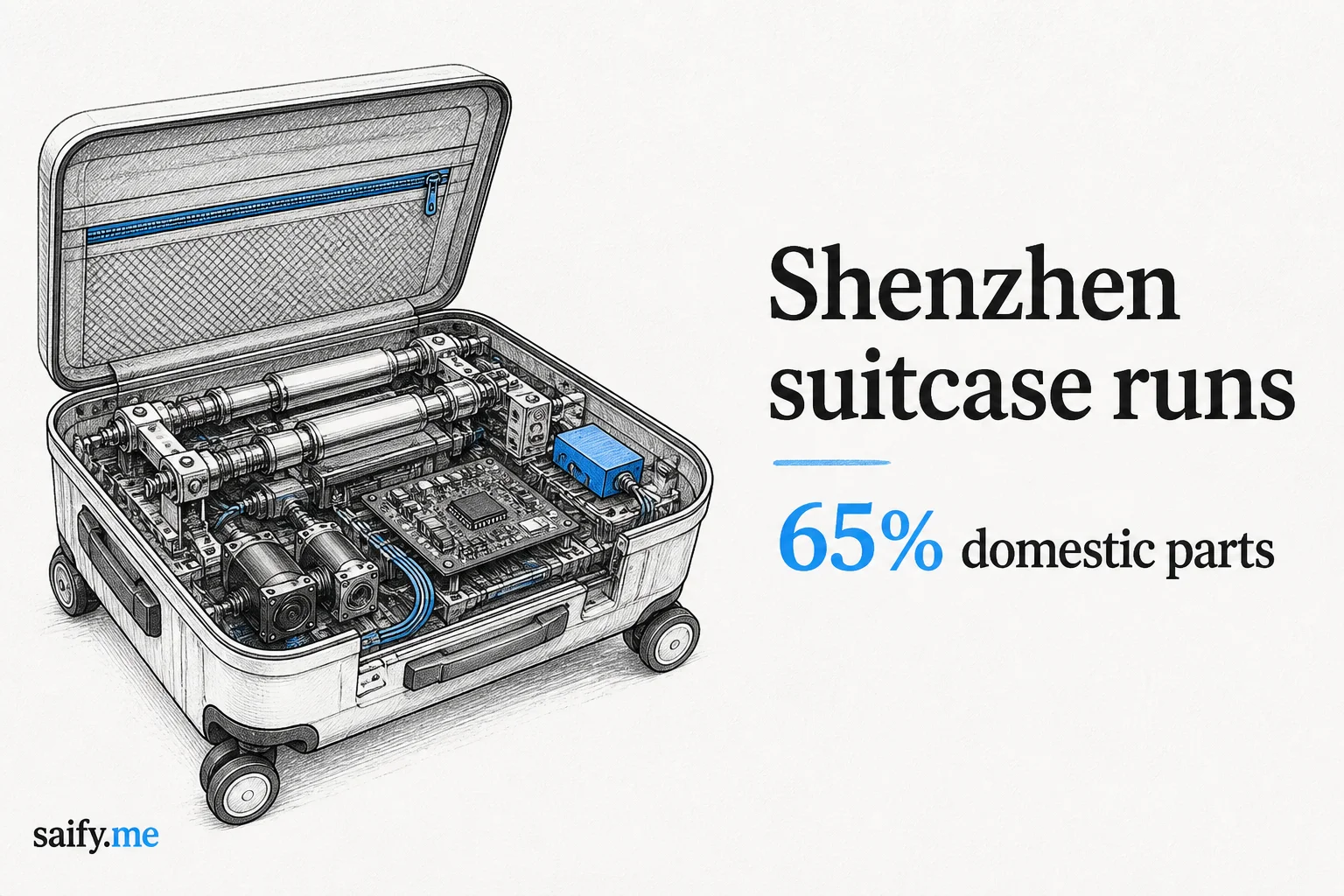
The FCC did not just ban Chinese robots. It exposed how much of America's humanoid boom still runs through Shenzhen.
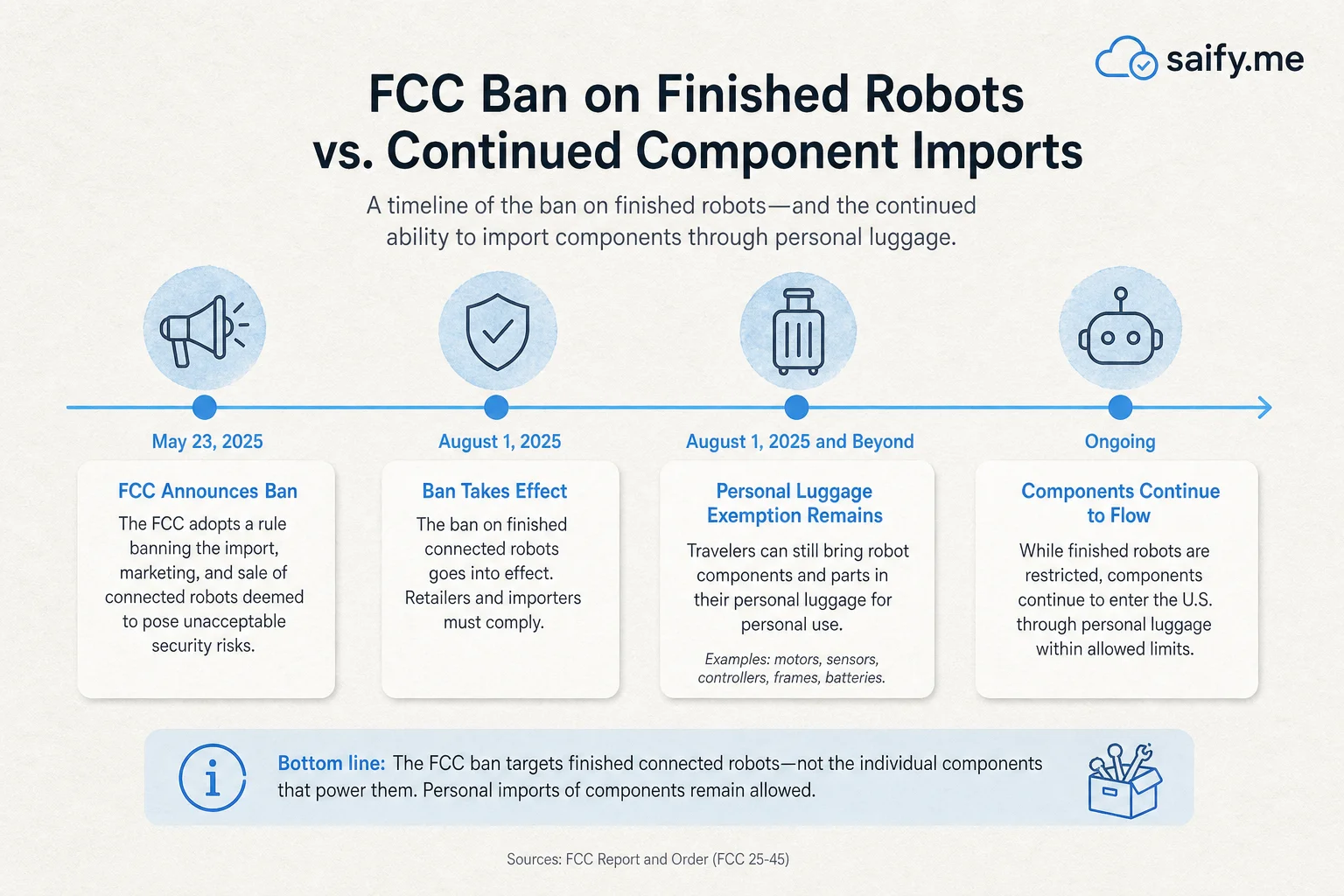
In July 2026, the FCC's Public Safety and Homeland Security Bureau added foreign-produced advanced robotic devices to its Covered List. New models of Chinese humanoids and quadrupeds cannot get the equipment authorization they need to import, market, or sell in the U.S.
FCC Public Notice DA 26-786Startups did not pause R&D. Engineers and investors kept flying to Huaqiangbei, buying actuators and motion boards on the spot, and packing them into hard-shell luggage for the flight home. The Rundown Robotics digest flagged the practice in August. Reporting from The Information, TMT Post, and Rest of World confirms it is now routine.
Policy blocked the robot, not the parts bin
The mismatch is structural. Washington's push targets finished machines and, under broader sourcing rules, eventually demands 65% domestic component value (rising toward 75% by 2029) for covered products to qualify for U.S. sale.
Components are a different category. Reducers, servo motors, LiDAR modules, battery packs, and power electronics still flow through channels the ban does not close.
| Layer | What Washington restricted | What still moves |
|---|---|---|
| Finished humanoids / quadrupeds | New foreign models need FCC authorization | Used or pre-ban inventory |
| Core components | Partially addressed by domestic content rules | Actuators, sensors, controllers via formal and informal import |
| Supply density | N/A | Still concentrated in Shenzhen |
I wrote about the finished-robot side when Steel Bot pitched a U.S. open platform right as the FCC rule landed. This story is the other half: the parts that every platform still needs.
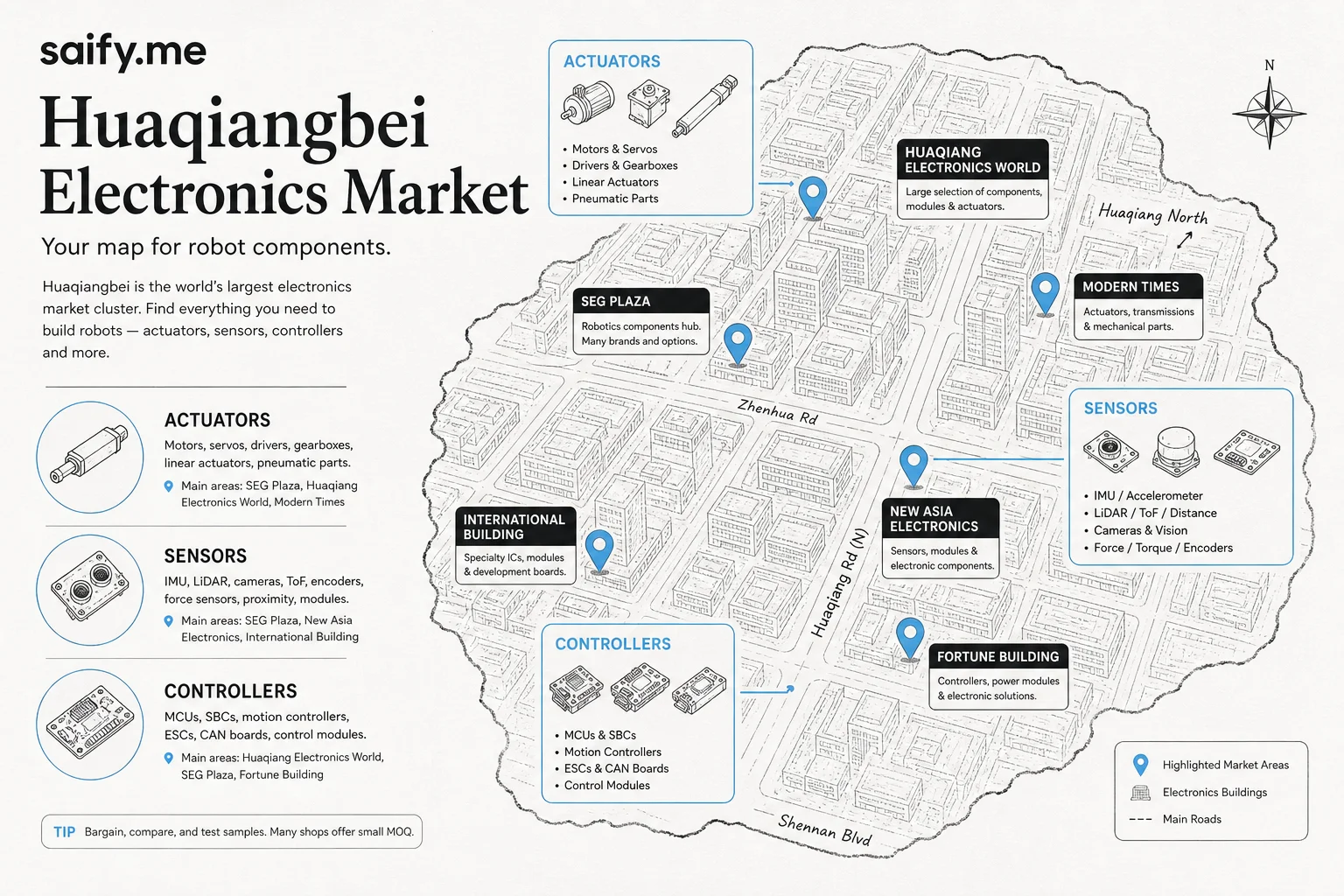
How the suitcase run actually works
The workflow is scrappy by design:
- Fly into Shenzhen Bao'an.
- Walk the multi-level markets in Futian's Huaqiangbei district.
- Buy motors, sensors, and control boards from ground-floor robot shops or component floors above.
- Disassemble larger assemblies if needed to meet airline battery and weight rules.
- Carry everything home on a commercial flight the same day.
One investor told reporters colleagues handed him a shopping list mid-trip. He broke parts down just to fit the suitcase. Others use middlemen who bundle small U.S. orders into production-sized batches at Chinese contract factories.
The practice predates the 2026 restrictions. What changed is the urgency. Formal routes for finished Chinese humanoids narrowed at the same moment U.S. teams are racing to ship prototypes.
Apptronik CEO Jeff Cardenas put the geographic reality bluntly: in China, every supporting factory is within driving distance. American companies that want to compete need something closer to a regional Shenzhen, not just a policy memo.
Why domestic supply is not a switch flip
Brookings fellow Kyle Chan told Rest of World a gradual tariff ramp might cultivate U.S. suppliers better than a broad ban. His concern: startups bear high manufacturing costs before domestic capacity exists.
The numbers back that up for early-stage teams:
- Prototype volumes sit in the hundreds to low thousands of units.
- At that scale, passenger luggage and small consolidated shipments still function.
- At tens of thousands of units, informal channels hit physical and compliance walls.
Some founders already rerouted assembly. Rest of World profiled teams setting up facilities in Canada with Chinese components so finished units would not qualify for U.S. sale under the latest FCC interpretation. That is compliance engineering, not product-market fit.
What this means if you build physical AI
I work on software agents and voice automation more than humanoids, but clients keep asking when hardware catches up. These suitcase runs are the honest answer for 2026.
Security and supply chain are now product requirements. If you demo a U.S.-assembled robot, procurement will ask where every actuator was made. "We carried it from Shenzhen" is a prototype story, not an enterprise one.
Policy and physics run on different clocks. Washington can list a device in weeks. Shenzhen's supplier density took decades. Bans on finished goods do not recreate that density elsewhere by 2027.
The wedge is components, not cosplay nationalism. Agility Robotics welcomed the FCC move as a security step while arguing researchers still need access to tools. The industry wants both restrictions on adversarial finished goods and continued access to parts that have no U.S. substitute yet.
A parallel I see in software
The suitcase story rhymes with how teams bypass IT during AI pilots. Official channels say no. Engineers find a workaround. Leadership celebrates velocity until audit season.
Physical robots just make the workaround literal: a 50-pound case at SFO customs instead of a shadow API key.
What would actually fix the gap
Long term, the fix is boring:
- Domestic actuator and reducer capacity at prototype-friendly MOQs
- Clear component vs finished-product import rules teams can plan around
- Capital for U.S. platforms (Steel Bot, Agility, Apptronik) that can absorb scale when luggage stops working
Short term, expect more Huaqiangbei trips, more Canadian assembly workarounds, and more press releases about "American-made" robots that still depend on Shenzhen silicon and steel.
The bottom line
The FCC can ban a Chinese humanoid faster than a Bay Area startup can qualify a U.S. reducer. Until that gap closes, the suitcase is part of the stack.
If you are scoping a robotics or physical AI project and need a realistic read on policy, supply chain, and what actually ships this year, get in touch. I help teams separate demo hype from deployable architecture.