
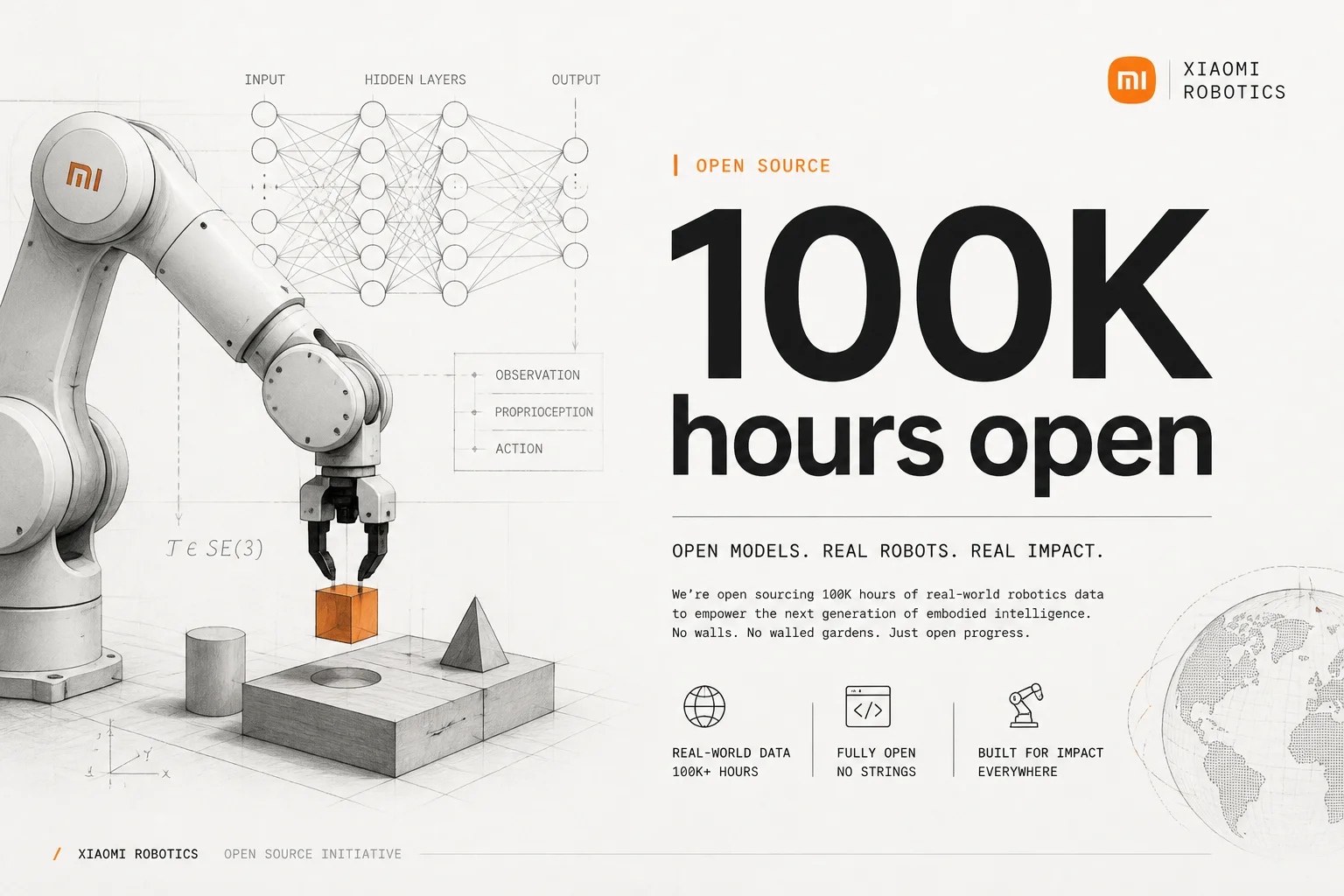
Foundation models in language and vision scale because data, parameters, and compute move together predictably. Robotics has been stuck on data scarcity. Xiaomi's answer is embodiment-free pretraining at a scale most labs cannot afford to collect, then a thinner slice of real-robot alignment.
In August 2026 the company open-sourced Xiaomi-Robotics-1 (XR-1): weights, post-training pipeline, deployment tooling, and evaluation code. The paper reports 100,000+ hours of pretraining trajectories across 1,700+ scenarios, plus 10,000+ hours of cross-embodiment real-robot data for post-training.
Xiaomi Robotics-1 project sitePaper: arXiv:2607.15330
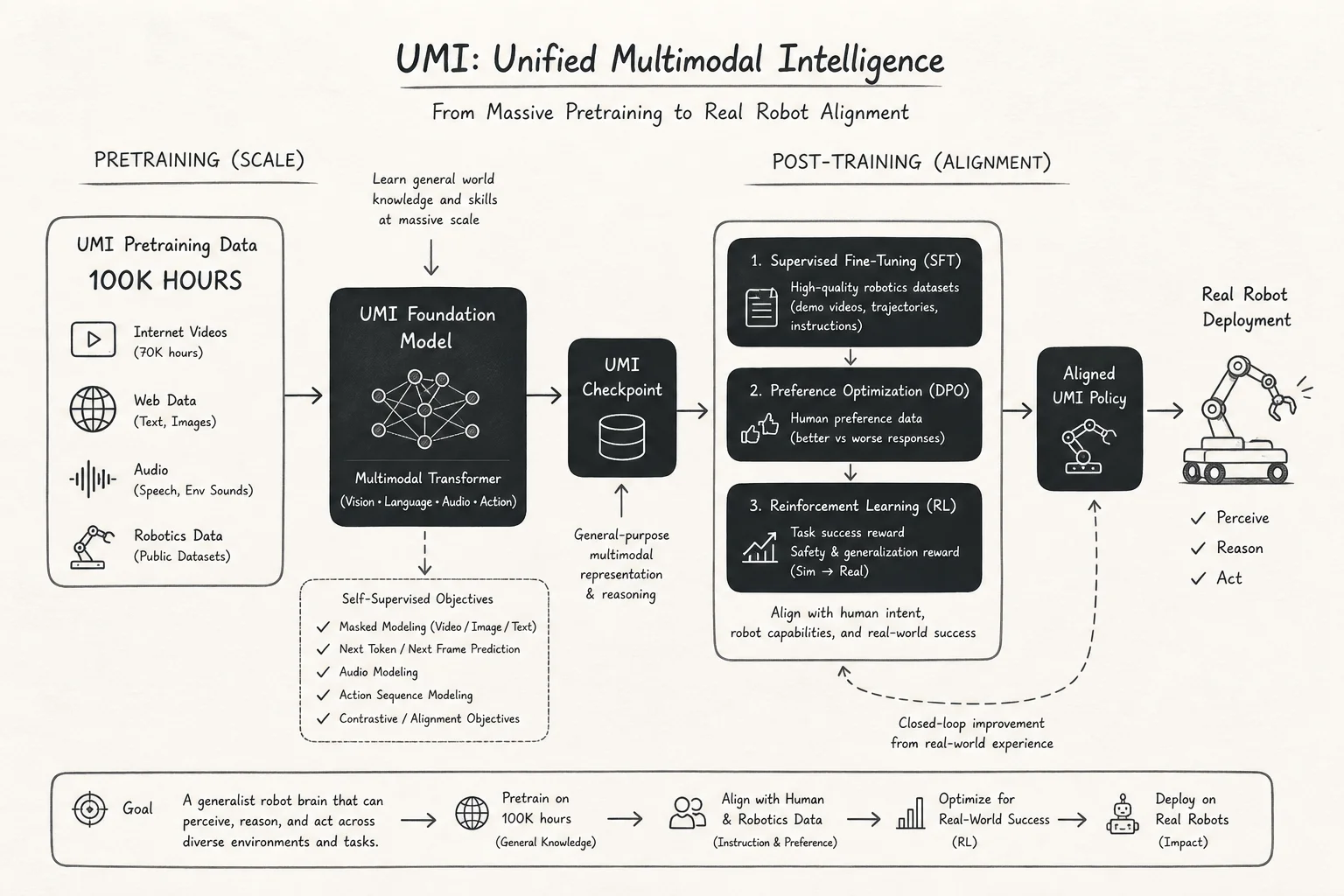
Two-stage training (LLM logic applied to robots)
Xiaomi mirrors the LLM recipe: massive pretrain, smaller alignment stage.
Pretraining uses embodiment-free UMI (universal manipulation interface) trajectories from households, commercial sites, industrial floors, and outdoor scenes. Manual labels at that scale are impossible, so they built an auto-labeling pipeline: fixed-length clips, vision-language model descriptions of gripper and object state transitions, language paired with action generation.
Validation action error drops steadily as data and model size grow. That scaling curve is the headline. Robotics gets a pretrain scaling law story that looks like NLP circa 2020.
Post-training aligns the general action generator to real robots and natural-language instructions. Cross-embodiment datasets mix in-house home data (7,200+ hours: tidying sofas, shoe cabinets, kitchenware), filtered open robot data, and high-quality UMI segments with manual temporal labels.
Result: out-of-the-box mobile manipulation in unseen environments with unseen object instances, with success rates that keep climbing as pretrain scale increases. No saturation signal in their plots yet.
Numbers that matter for practitioners
Efficient adaptation to new tasks
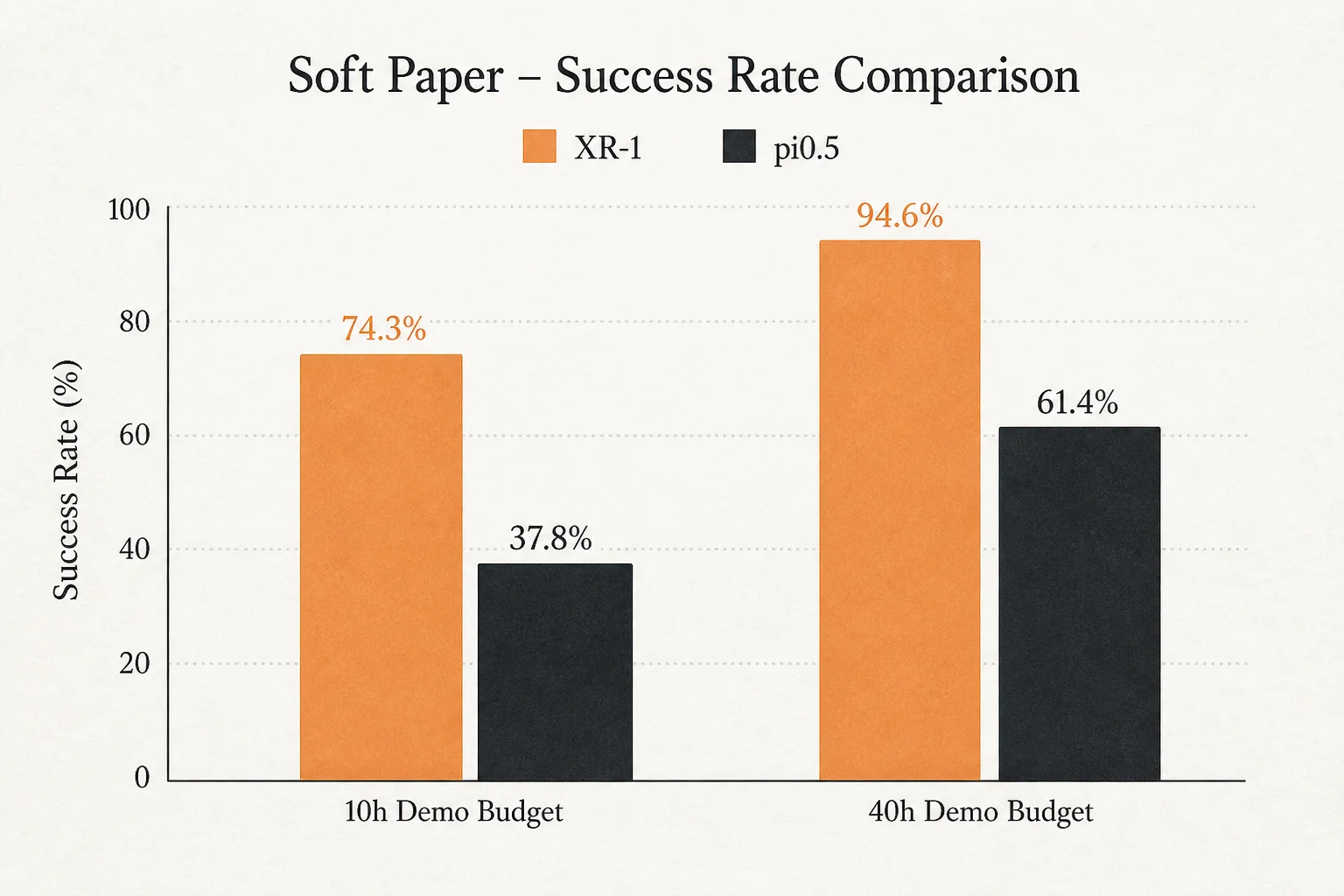
With under 10 hours of demonstrations per task on average, XR-1 reports 75% overall success on phone packing, printer refilling, laundry loading, and box packing. The π0.5 baseline hits 40% at the same budget. Push demos to under 40 hours per task and XR-1 reaches 85% overall vs 53% for π0.5.
| Task | XR-1 (<10 h/task) | π0.5 (<10 h) | XR-1 (<40 h) | π0.5 (<40 h) |
|---|---|---|---|---|
| Phone packing | 70% | 30% | 80% | 40% |
| Printer refilling | 70% | 20% | 60% | 20% |
| Laundry loading | 80% | 40% | 100% | 50% |
| Box packing | 80% | 70% | 100% | 100% |
| Overall | 75% | 40% | 85% | 53% |
That is the business case for open foundation weights: your team spends days fine-tuning, not years building a 100K-hour corpus.
Simulation benchmarks
XR-1 claims state-of-the-art on four mainstream suites:
| Benchmark | XR-1 | Second best | Relative gain |
|---|---|---|---|
| RoboCasa | 74.5% | 72.6% | +2.6% |
| RoboCasa365 | 57.4% | 46.6% | +23.2% |
| VLABench | 59.1% | 53.2% | +11.1% |
| RoboDojo | 13.93 | 8.80 | +58.3% |
RoboDojo is where the margin is widest. Generalization-heavy sims are noisy, but a 58% relative jump is not a rounding error.
What shipped in the open release
The project site and GitHub/Hugging Face bundles include:
- Model weights for XR-1
- Post-training pipeline code
- Deployment tooling
- Benchmark evaluation harness
- Uncut real-robot footage (luggage packing and other tasks)
This is not a weights-only tease. It is training-to-deployment infrastructure, which raises the disclosure bar for better-funded closed programs that publish leaderboard numbers without reproducible stacks.
How this connects to policy and hardware trends
The same week Xiaomi open-sourced XR-1, Washington tightened FCC paths for foreign humanoids and startups like Steel Bot raced to ship US platforms. Software openness and hardware nationalism are moving in parallel.
If you standardize on XR-1 policies, you still need authorized arms and legs. If you standardize on domestic hardware, you still need data-efficient policies. The stack splits cleanly:
- Hardware layer: BOM, authorization, repairability (Steel Bot, Unitree, Figure, etc.)
- Policy layer: VLA / imitation + RL fine-tuning (XR-1, π families, closed corp models)
Open weights make the policy layer cheaper. They do not remove integration work: camera placement, gripper calibration, safety envelopes, sim gaps.
Limits to keep honest
- UMI pretrain is embodiment-free, not magic. Post-training still needs real-robot hours for your embodiment.
- Home-task demos (laundry, tidying) may not transfer to your factory SKU mix without re-collection.
- Leaderboard SOTA in sim does not guarantee warehouse ROI.
- Xiaomi's long-term support, license restrictions, and update cadence matter for production. Read the license before you bet a product roadmap on it.
First teased in July 2026 as an out-of-the-box controller, XR-1 is Xiaomi pushing into the same narrative OpenAI, Google DeepMind, and Figure use for corp models: one brain, many tasks, data scale wins.
What I would test first
If I were advising a robotics startup this month:
- Baseline XR-1 on your top three manipulation tasks with the published post-training recipe before training from scratch.
- Measure demo hours to 80% success, not peak sim scores. Xiaomi's table is the right metric shape.
- Log failure modes where state-transition labels from pretrain mismatch your instruction style (imperative commands vs transition descriptions).
- Plan embodiment drift: if FCC or BOM forces a new arm next year, your fine-tunes should be portable layers, not monoliths.
For software teams building agentic AI on servers, the parallel lesson is familiar: foundation + alignment beats scratch training when data moats exist upstream. Robotics finally has a downloadable moat slice.
Bottom line
Xiaomi-Robotics-1 is not plug-and-play for your warehouse tomorrow. It is a credible open VLA stack with scaling evidence and reproducible training code, which is rare.
The expensive part of robot learning has been collecting and cleaning manipulation data at scale. Open weights and pipelines do not remove integration labor, but they move the bottleneck from "build a 100K-hour corpus" to "collect 10 hours of demos and align."
That shift is why this release matters more than another 2% on RoboCasa.
Building applied AI systems that bridge models and real ops, book a free discovery call.