
ChatGPT knows the public internet up to a training cutoff. It knows nothing about your Monday price sheet, the insurance carriers you dropped last quarter, or the SOP your ops lead rewrote on Friday.
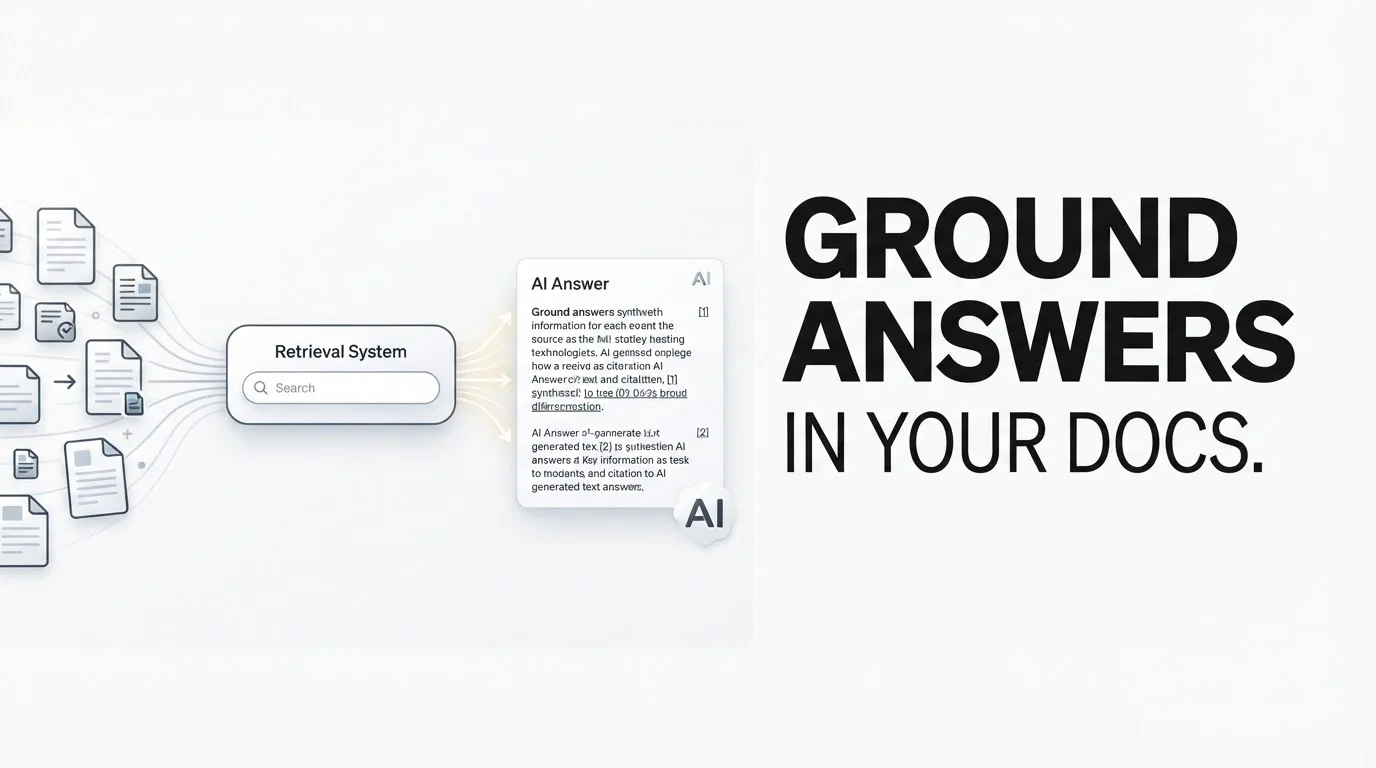
RAG is how you fix that without training a private model from scratch. Retrieval-Augmented Generation means: find the relevant bits of your documents, then let the model answer from those bits. Open book. Grounded. Citeable.
I build RAG into chatbots and voice agents for clinics, local service businesses, and SMB ops teams. Below is the operator version, not the research paper.
What RAG is (and is not)
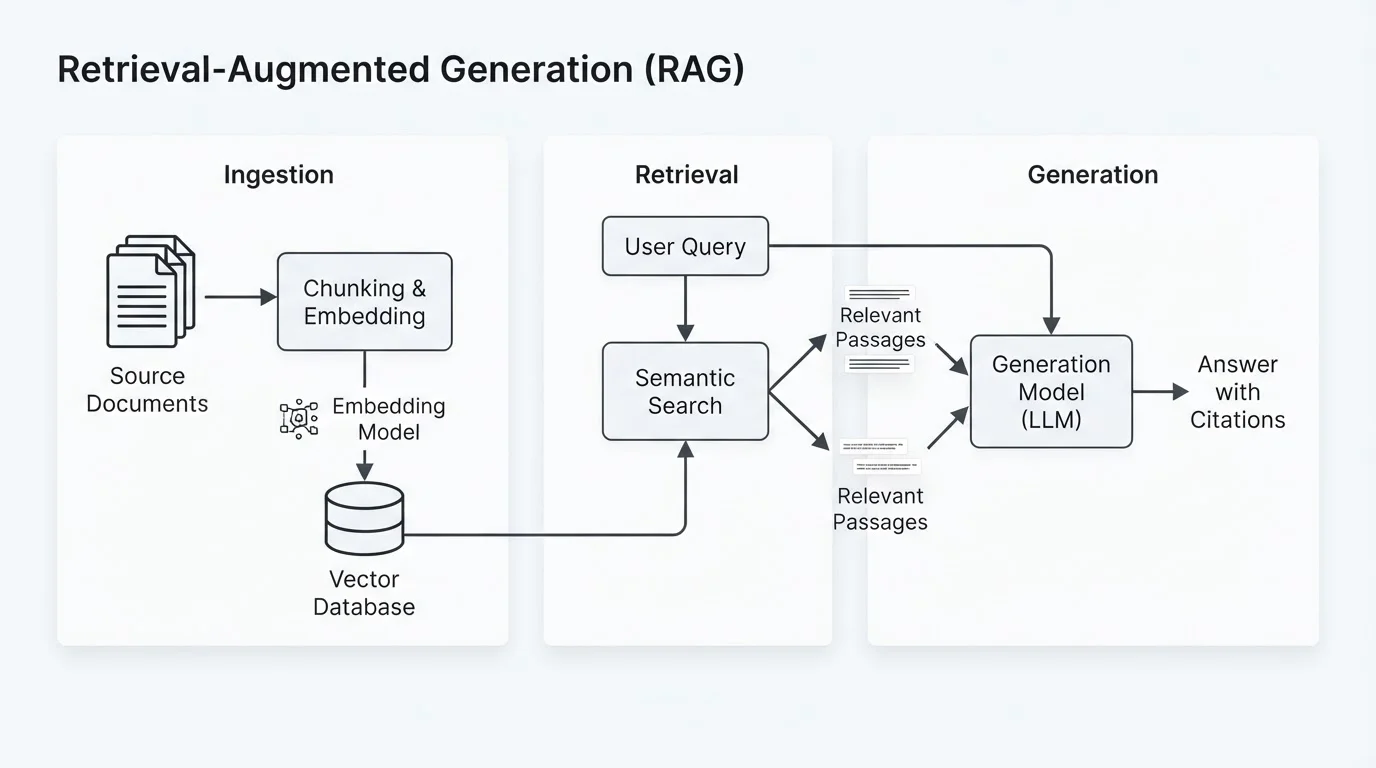
Direct answer: RAG stores your documents in a searchable index. When someone asks a question, the system retrieves a handful of relevant passages, puts them in the model context, and the model composes an answer from them. The knowledge lives in a database you edit. The model supplies language and reasoning.
It is not:
- Fine-tuning your brand voice into the weights (that is a different job)
- A live CRM or inventory query (that is a tool call against a system of record)
- "Upload PDFs into ChatGPT and hope" without evaluation, access control, or refresh pipelines
Useful mental model from the builders who popularize this pattern: treat retrieval as the product. The model is the last mile. Deep dive if you want the research framing: the original RAG paper (Lewis et al.) and vendor primers like Anthropic on contextual retrieval and OpenAI retrieval docs.
Why paste-into-ChatGPT fails for real ops
Public chat products are great for brainstorming. They are a bad system of record for customer-facing answers.
Problems I see when teams "just use ChatGPT":
- No grounding. The model invents a fee schedule that sounds like yours.
- No citations. Nobody can verify which doc the answer came from.
- No permissions. One shared chat sees everything someone pasted last week.
- No refresh. Prices change. The chat history does not.
- Data hygiene. Pasting contracts into a consumer product is a compliance conversation waiting to happen.
RAG does not magically make you compliant. It does give you an architecture where documents stay in a store you control, only a small retrieved slice hits the model, and answers can point at sources. That is the difference between a demo and something a front desk can trust at 9pm.
How the pipeline works (skip the buzzwords)
Production RAG is a pipeline. Quality is decided long before the model speaks.
| Stage | What happens | Where it usually breaks |
|---|---|---|
| Ingestion | Pull PDFs, Docs, Notion, site pages; parse tables and scans | Broken PDFs, stale exports, missing metadata |
| Chunking | Split into passages you can retrieve and cite | Blind character splits that orphan a price from its context |
| Embeddings | Turn chunks into vectors for meaning search | Wrong multilingual model, index/query model mismatch |
| Vector store | Hold embeddings for fast similarity search | Ops complexity vs residency needs |
| Retrieval | Find top passages; often hybrid + rerank | Keyword-only misses, or dense-only misses product codes |
| Generation | Answer only from retrieved text, with citations | Model pads gaps when retrieval failed |
Common stores: pgvector on Postgres you already run, Pinecone managed, Weaviate self-hosted or managed. For many SMBs I start with pgvector because the corpus stays next to the rest of the app data. Pick based on where data may live and who operates it, not a leaderboard screenshot.
RAG vs fine-tuning (pick the right lever)
| Need | Prefer |
|---|---|
| Facts that change (prices, policies, SOPs) | RAG |
| Cite the clause or page behind an answer | RAG |
| Per-user or per-role access to docs | RAG (filter at retrieval) |
| Teach a fixed house tone or output format | Prompting or fine-tuning |
| Tiny, stable knowledge that fits in the system prompt | Just put it in the prompt |
Rule I repeat on calls: fine-tune to change how a model behaves. Retrieve to change what it knows.
When your business needs RAG
You are in RAG territory when:
- Answers depend on documents that change on their own schedule
- Wrong answers cost money or trust (pricing, medical prep, warranty terms)
- Volume is high enough that humans repeating the same explanations is the bottleneck
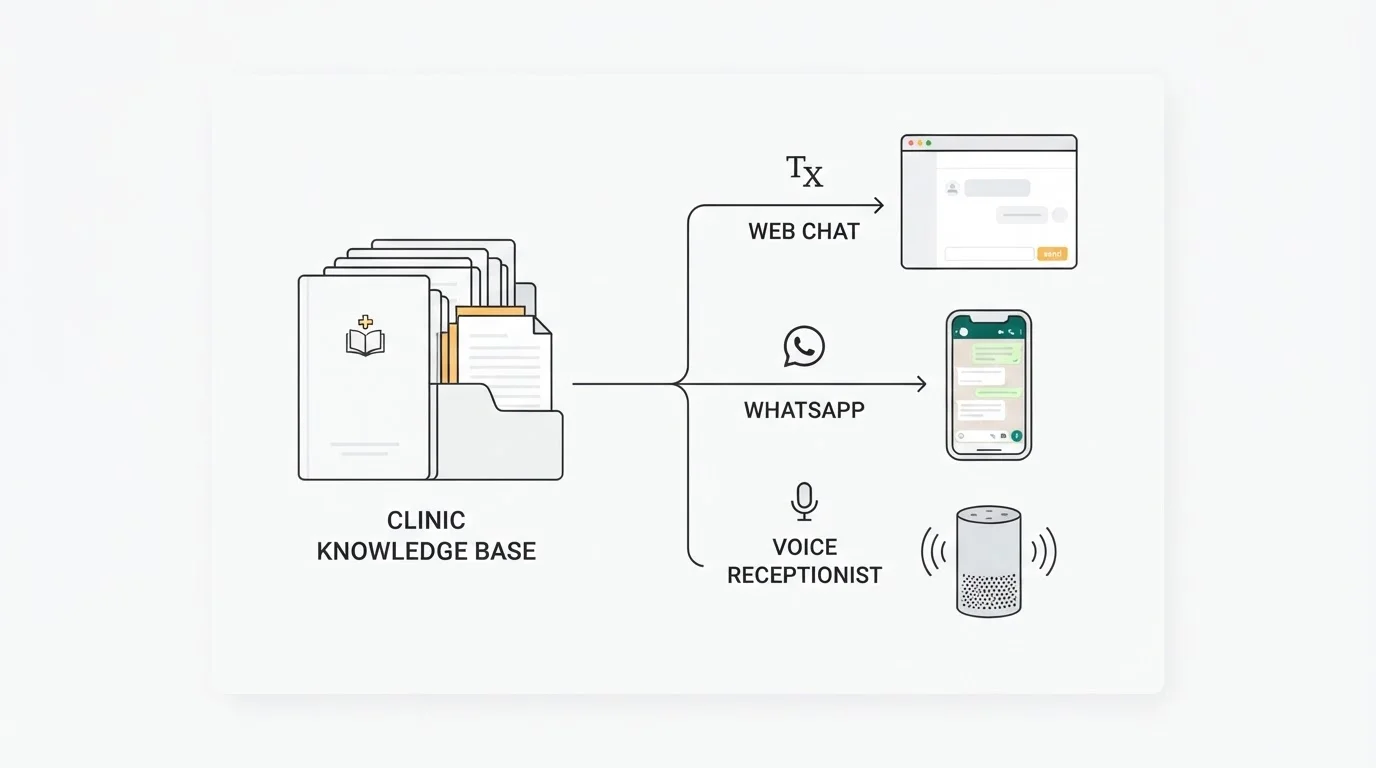
- You want the same knowledge on web chat, WhatsApp, and voice without three separate FAQ silos
Typical SMB shapes:
| Business | Knowledge that belongs in RAG |
|---|---|
| Clinic / dental | Services, insurance list, prep instructions, cancellation policy |
| Contractor / home services | Service areas, packages, warranty language, FAQ from real chats |
| E-commerce | Shipping rules, return policy, product care docs |
| Internal ops | SOPs, onboarding guides, playbooks for the team |
RAG pairs cleanly with chatbots and voice. The bot still needs tools (calendar, CRM) for live facts. RAG handles the unstructured "what do we say about X?" layer. That split is the same one I use in agents vs chatbots.
When NOT to use RAG
Skip the retrieval stack when:
- Knowledge is small and stable. Twenty facts that rarely change belong in the system prompt.
- You need exact numbers from a database. Totals, stock counts, account balances are SQL or API calls, not semantic search over a PDF export from last month.
- You need live transactional status. Order tracking and today's booking slots come from systems of record through integrations, not a periodically indexed doc store.
- The problem is style, not facts. House tone is prompting or fine-tuning.
- A form or rule is enough. If the decision is a clear flowchart, a deterministic path beats a generative answer.
Forcing RAG onto live inventory questions is how you ship a confident, stale bot.
Pitfalls that burn operators
Name these before you buy a "AI knowledge base" SKU.
Retrieval miss into confident answer. The right passage never came back, and the model answered from memory anyway. Guardrail: answer only from retrieved context. Below a similarity threshold, say you do not know and hand off.
Stale index. Document changed in Drive. Index did not. Bot quotes last quarter. Guardrail: reingest on change, keep effective dates in metadata.
Garbage chunking. Tables flattened into noise. Prices separated from units. Guardrail: chunk on headings and clauses, keep overlap, test with real questions.
No evaluation. Demo questions look great. Production phrasing fails. Guardrail: freeze a set of real customer questions with expected source docs. Measure retrieval hit rate and groundedness on a schedule, not once at launch.
Permissions in the prompt. "Do not reveal HR docs" is not access control. Filter at retrieval by role before the model sees anything.
Prompt injection via documents. A pasted PDF tries to hijack instructions. Treat retrieved text as data. Keep tool permissions outside the corpus.
Conflicting sources. Two PDFs disagree. Model silently picks one. Surface the conflict with citations instead of inventing consensus.
How RAG pairs with chatbots, voice, and CRM
Think in layers:
- RAG for policies, product knowledge, SOPs
- Tools for live calendar, CRM, order APIs
- Handoff when confidence drops or the customer asks for a human
A WhatsApp qualify bot might retrieve insurance FAQ via RAG, then call a calendar tool for slots, then upsert the lead in GoHighLevel or HubSpot. Same knowledge base can feed a voice receptionist so phone and chat do not invent different policies. Wiring the CRM side safely is its own job; see connecting AI to your CRM.
Orchestration often lives in n8n: webhook in, retrieve or call model, validate fields, write CRM, dead-letter on failure. The model should not be the only place business rules hide.
A practical build checklist
If you are scoping a first RAG project, insist on:
- Source list with owners (who updates prices and policies)
- Ingestion path that re-runs when docs change
- Chunking rules that respect your document structure
- Hybrid retrieval (vector + keyword) for codes and exact phrases
- "I do not know" + human handoff behavior
- Citations on customer-facing answers where it helps trust
- A 30 to 50 question eval set from real chats or calls
- Logging of retrieved chunks (you will debug retrieval, not vibes)
Timeline reality for SMB scope: a focused knowledge base with chat on one channel often lands in a few weeks if documents are clean. Multi-source ingestion, role-based access, and bilingual corpora take longer. Ask for a fixed-fee scope after looking at your actual files, not a brochure estimate.
Bottom line
RAG is how chatbots and voice agents stop guessing about your business. It is also easy to demo and easy to ship badly. The hard parts are chunking, retrieval quality, freshness, permissions, and honest evaluation. Get those right and your team can trust an answer about a policy clause. Skip them and you have a fluent liability.
If you want help scoping whether RAG, a plain prompt, or a live integration is the right next step, book a free call. Bring two PDFs and five real customer questions. That is enough to see if retrieval will pay for itself.