
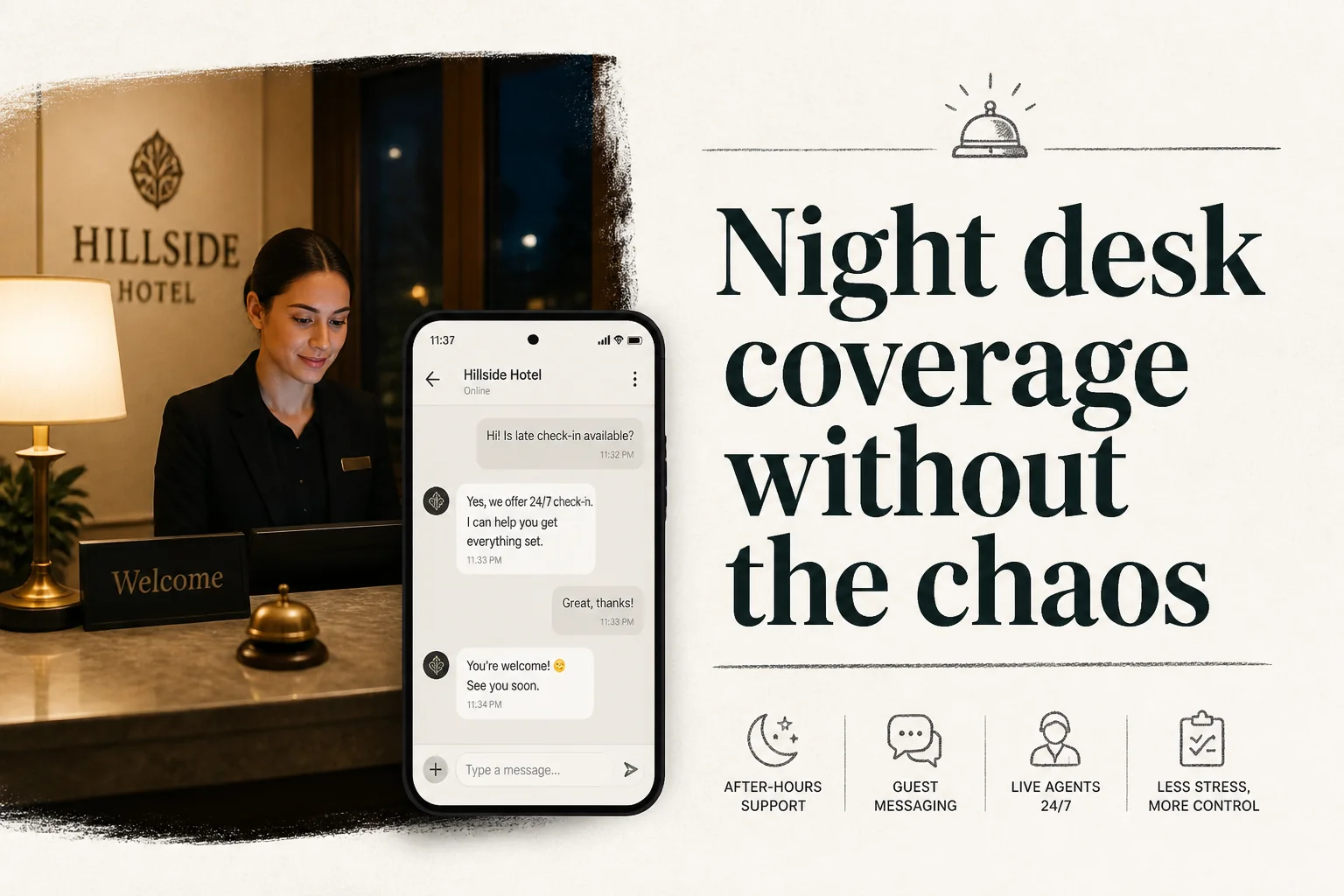
Guests do not care that your night audit is running. They care that nobody answered "is the pool heated?" at 11:40pm.
Hotels already drown in repetitive questions across web chat, WhatsApp, SMS, phone, and booking.com style messaging. Staffing every channel 24/7 with humans is how labor budgets die. Ignoring them is how reviews die. AI chat and voice sit in the middle: own the routine, wake a human for the moments that make or break a stay.
I build guest messaging and missed-call flows for hospitality operators who need coverage without pretending a bot is a concierge with a soul. This is the map I use: what to automate, what to upsell, what the night desk can safely hand to software, and what you should never put on autopilot.
What a hotel AI chatbot is (in practice)
Direct answer: it is a grounded assistant on your guest channels that answers approved facts, takes simple actions (FAQ, booking status, amenity requests, upsell offers), and escalates with full context when judgment, authority, or empathy is the product.
It is not a replacement for guest relations. It is a filter so guest relations stops resetting Wi-Fi passwords at 2am.
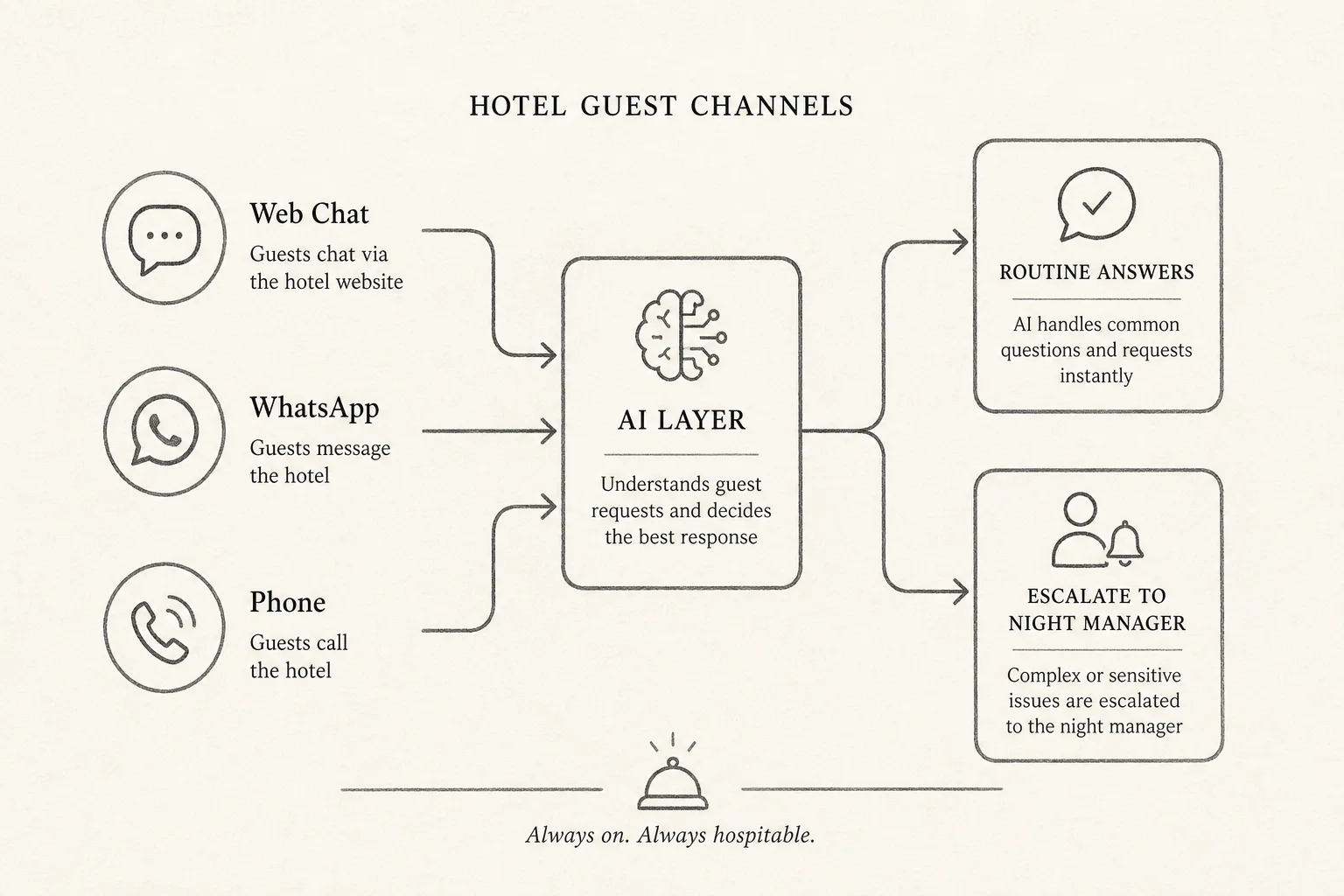
Typical channel set:
| Channel | Role |
|---|---|
| Website chat / booking engine widget | Pre-stay FAQ, rate questions, modify requests |
| WhatsApp / SMS | In-stay asks, reminders, soft upsells (opt-in) |
| Voice | Overflow and after-hours calls to the property number |
| In-room tablet or QR | Same brain, local entry point |
For WhatsApp specifically, treat conversation design as seriously as the PMS hook. I wrote a separate playbook on WhatsApp AI chatbot conversation design. Hotels fail when they bolt a generic FAQ model onto a property and skip handoff rules.
The night desk coverage map
Think in shifts, not in "AI replaces front office."
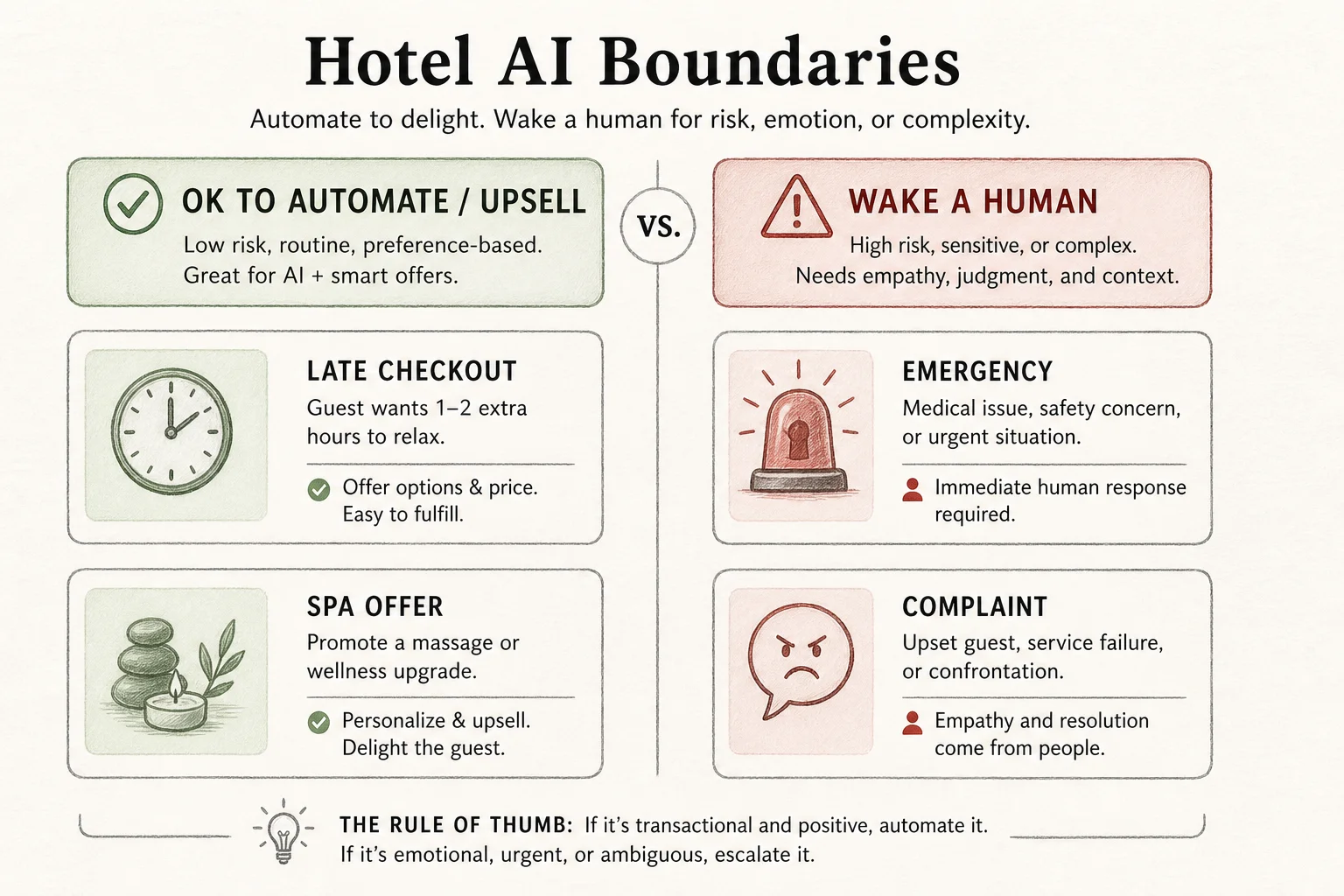
Green: AI owns these overnight
- Check-in / out times, early or late policy as published
- Wi-Fi name and reset steps you documented
- Parking, shuttle hours, gym and pool hours
- Restaurant hours and "are you still serving"
- Towel / toiletry / crib request logged to ops
- "Where is the ice machine" energy questions
- Booking confirmation lookup when identity checks pass
Yellow: AI drafts, human sends or approves
- Comp requests and goodwill gestures
- Rate exceptions
- Room moves for non-emergency reasons
- Anything involving a named VIP profile
Red: wake a human immediately
- Fire, medical, security, harassment
- Accessibility failure (mobile guest stuck, lift issue)
- Angry guest asking for a manager
- Payment disputes mid-stay
- Minor on property with a safety concern
- Press or incident that needs a real spokesperson
Put the red list in the system prompt and in staff SOPs. Then test it. Send "I smell smoke" in staging. If the bot offers spa hours, you are not ready.
Night coverage is a responsibility map, not a model demo. Write green / yellow / red before you pick a vendor.
Booking FAQ that does not invent rates
Pre-stay traffic is full of "do you allow pets," "is breakfast included," "can I modify for Tuesday." Ground the bot in your live rate rules and property facts. If the PMS or booking engine is the source of truth, read from it. Do not let the model average last week's BAR and invent a number.
Safe pre-stay actions:
- Answer policy FAQ from an approved knowledge pack
- Collect modification intent and create a ticket for reservations
- Offer a human callback window for complex changes
- For simple additive upsells (parking, breakfast) with clear SKUs, book when inventory is known
Unsafe: quoting unpublished discounts, promising suites you do not have, or changing names on a reservation without auth checks your brand requires.
Upsell without sounding like a timeshare
Upsell works when it feels like help.
Good moments:
- After a confirmed booking, before arrival: late checkout, airport transfer, welcome amenity
- Mid-stay, afternoon: spa opening, dinner availability, room upgrade if inventory exists
- Checkout eve: extend stay if occupancy allows
Bad moments:
- Mid-complaint
- During a red-list escalation
- Every message, every day (block rates will teach you manners)
Rule of thumb: one relevant offer, easy decline, real availability. Pull upgrade lists from the PMS or a staff-updated sheet via n8n. Never let the model "be creative" with room categories.
Revenue teams care about attachment rate and guest satisfaction together. If NPS drops while upsell revenue climbs, you are extracting, not hosting.
Voice at the property number
Chat does not catch every guest. Older travelers and urgent in-stay issues still call the front desk line.
A practical voice setup for a mid-size property:
- Business hours: ring front desk; after N rings, AI offers FAQ + callback or WhatsApp continue
- Night: AI answers first with a short menu of intents; emergencies jump to duty manager cell
- Transcripts land in the same inbox as chat so morning staff see the overnight story
Cost and tier context for voice vs chat is in AI chatbot and voice cost in 2026. Hotels should budget telephony minutes and PMS integration separately from "the chatbot fee."
CRM and PMS write-back deserve the same fear as any other system of record. Duplicate guest profiles are how loyalty breaks. Use the patterns in connect AI to CRM even when your "CRM" is Opera, Mews, or Cloudbeds plus a marketing tool.
Multilingual guests without a Frankenstein stack
International properties need more than English FAQ. Pick the languages that match arrival mix. Test code-switching. Keep property proper nouns stable (outlet names, package names) so translation does not invent a restaurant.
I prefer one grounded assistant with language detection over five disconnected bots. Handoff should preserve language preference so the human agent knows to reply in French before they open the thread.
Integration minimums (so the bot can act)
FAQ-only is a start. Action needs hooks:
| System | Why |
|---|---|
| PMS | Stay dates, room type, guest preferences, upgrade inventory |
| Dining / spa booker | Real tables and slots, not PDF hours alone |
| Messaging BSP / WhatsApp API | Delivery, templates, quality rating |
| Ops chat (Slack / Teams) | Human wake-ups with context |
Middleware matters. Native "AI for hotels" suites help when they fit your PMS. Custom properties often need n8n or similar between webhook, model, and PMS API so retries and logging are not trapped in a black box.
What NOT to automate (print this)
Hospitality brands get burned when they automate the emotional core of the stay.
Do not fully automate:
- Genuine apology and recovery after a failed stay
- Suites and favors for top-tier loyalty without a human eye
- Security and medical response
- Legal-adjacent promises ("we will refund everything")
- Staff discipline and internal gossip channels (yes, I have seen someone try)
Do automate the repetitive shell around those moments so humans have time when the real thing happens.
Metrics that matter on property
| Metric | Why |
|---|---|
| Containment on green intents | Are routine asks actually resolved? |
| Escalation SLA on red intents | Did a human respond inside the promise? |
| Average first response time overnight | The original pain |
| Upsell attach on eligible stays | Revenue without review damage |
| Review themes mentioning "nobody answered" | Should fall after launch |
Read transcripts every week for the first month. Hotels have edge cases (wedding blocks, crew rates, Hajj or holiday peaks) that no demo dataset includes.
How I would sequence a first property
- Write green / yellow / red lists with the GM and night manager
- Ship FAQ + overnight messaging on one or two channels
- Add missed-call / night voice overflow
- Add approved upsells with inventory checks
- Only then deepen PMS write actions
WhatsApp compliance and template discipline still apply for guest messaging; see WhatsApp Business API automation.
If you run a hotel, boutique group, or hospitality brand and want a coverage map before you buy another "AI concierge" license, book a free call. Bring your night log from last week. That log is the product requirements document.