
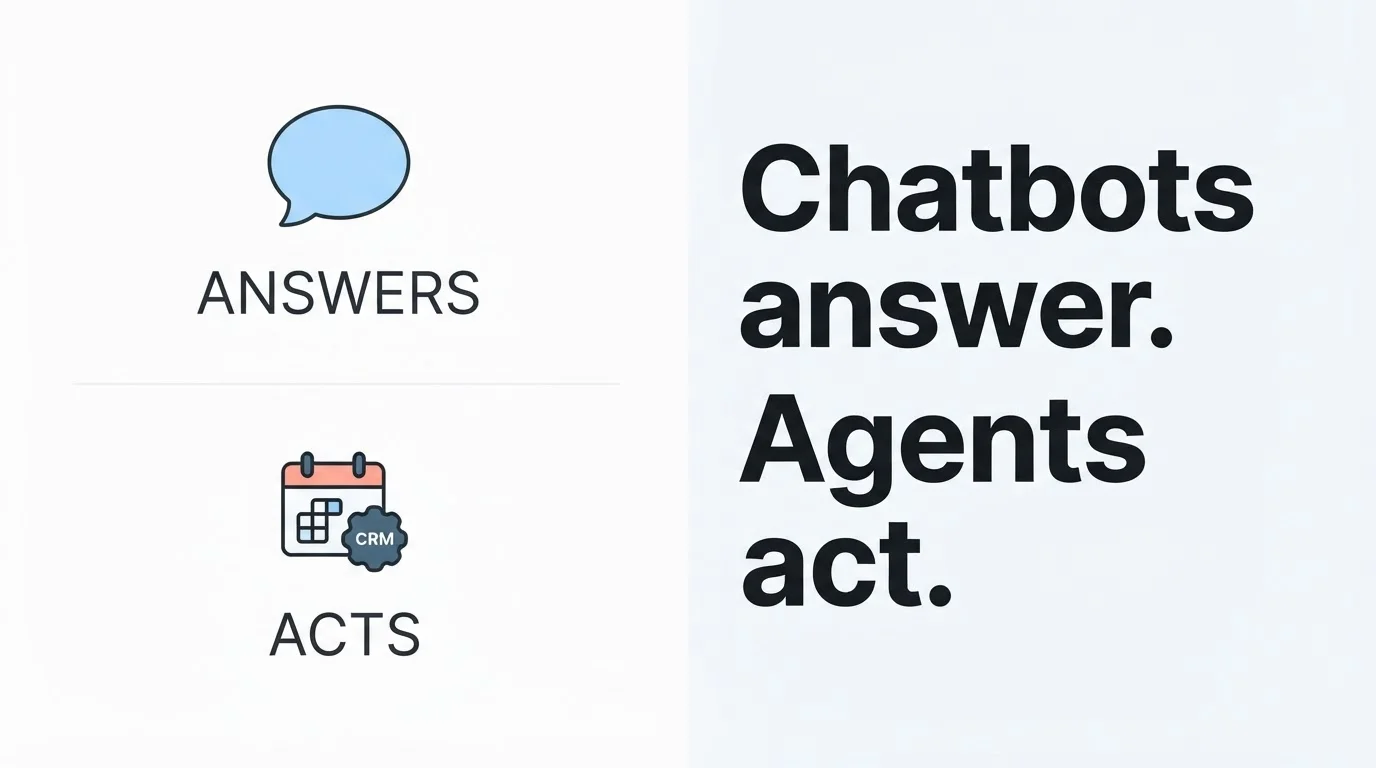
Vendors love the word "agent." It sounds like the bot will run your business while you sleep. Most of what gets sold as an agent is still a chatbot with a prettier chat bubble.
I wire chat and voice into real ops stacks: GoHighLevel, HubSpot, calendars, n8n. The split that actually matters is simple. Does this system only answer, or can it act?
Chatbots answer. Agents act.
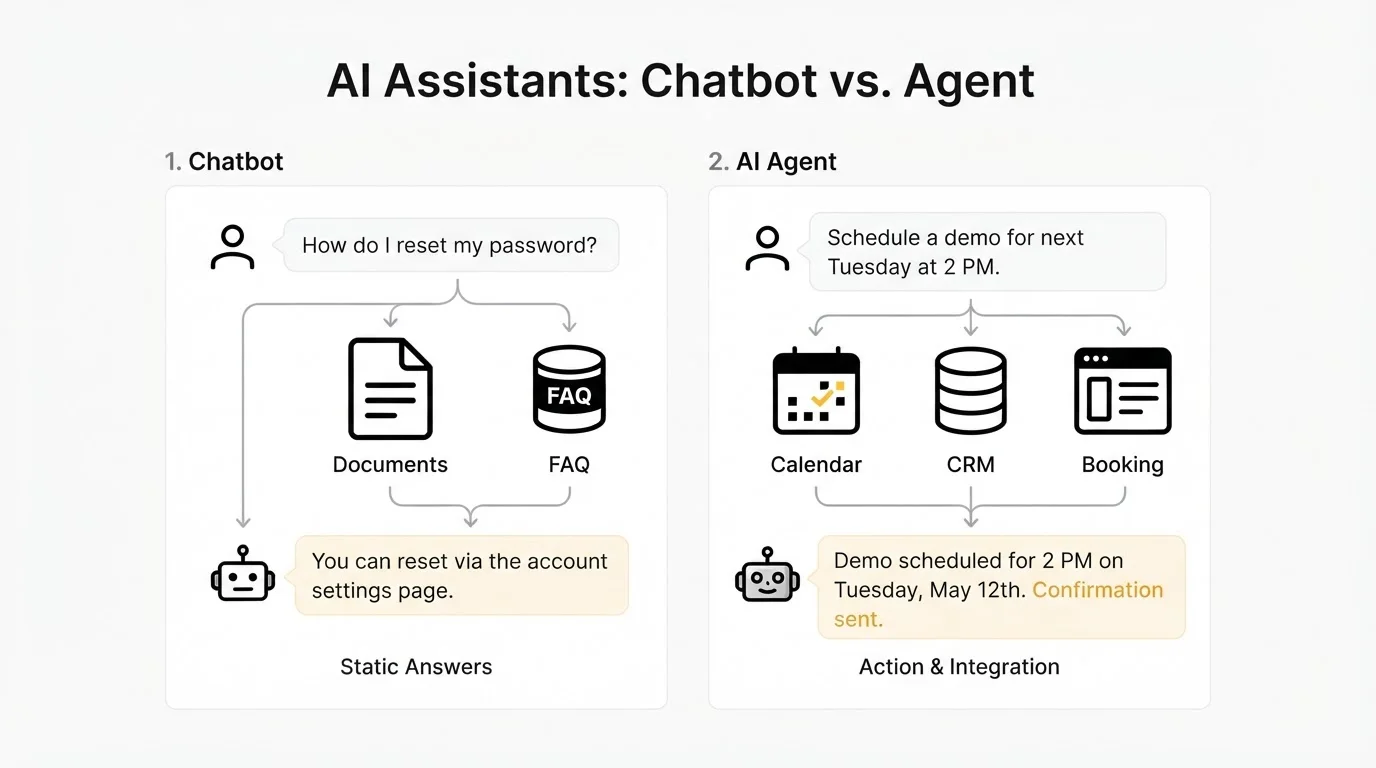
Direct answer: a chatbot responds with text grounded in what you gave it (FAQs, PDFs, site copy). An AI agent can also call tools against live systems, chain steps, and finish work that used to need a human clicking around.
| Chatbot | AI agent | |
|---|---|---|
| Job | Answer questions accurately | Complete outcomes |
| Knowledge | Docs / RAG / prompts | Docs plus live system queries |
| Output | Text (and maybe a handoff) | Text plus actions (book, update, create) |
| Worst failure | Wrong or useless answer | Wrong write: double book, bad CRM row |
| Typical build | Contained, weeks not months | Scales with each integration |
| Good first win | Deflect repetitive Q&A | Kill lookup-and-update grunt work |
If a sales deck never lists concrete tools (calendar check, contact upsert, ticket create), you are shopping for a chatbot. That is fine. Just do not pay agent money for it.
What a solid chatbot actually does
Modern AI chatbots are nothing like the "press 1 for billing" trees from 2019. With retrieval (RAG) and decent prompts, they can explain procedures, list insurance carriers you accept, quote standard bands, and answer in the customer's language at 2am.
What they cannot do, by design, is look at Thursday at 5pm in your calendar and commit a slot. That requires acting: a live query and a write. A chatbot's world ends at the conversation.
Best fit when:
- Most messages are variations of the same 20 to 40 questions
- Staff time dies on repeating the same explanations
- You want a clean escalate-to-human path when confidence drops
- You are not ready to grant write access to CRM or booking software
For clinics and local service businesses, a grounded web or WhatsApp FAQ bot already cuts front-desk noise. Pair it with human handoff and CRM logging even if the bot itself never books. See also my notes on WhatsApp Business API automation and AI receptionists for clinics.
What an agent adds (tools, steps, outcomes)
An agent is a system that can use tools. Given a goal, it picks steps, calls your systems, and handles the results in the same thread.
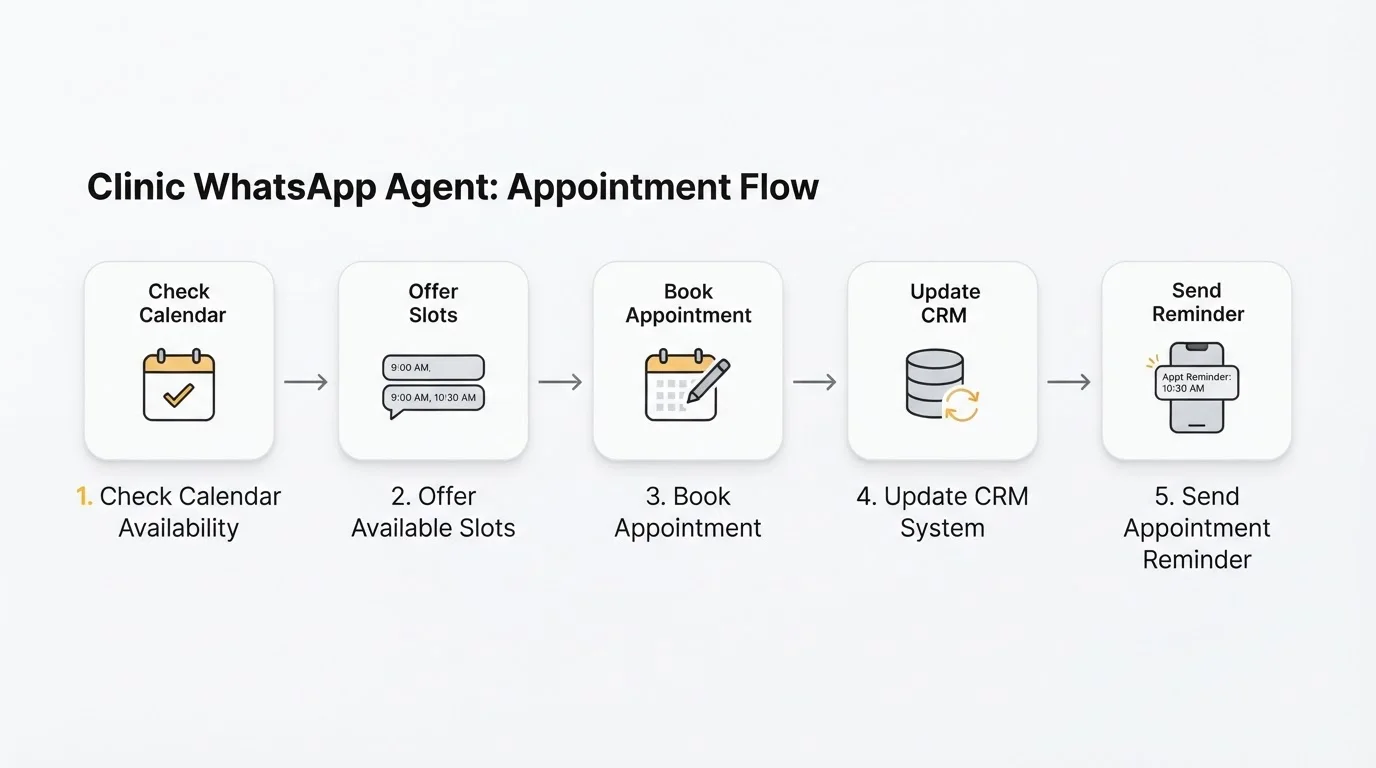
Same clinic, WhatsApp inbound: "I need a cleaning after 5pm this week." An agent can check evening availability, offer open slots, book the chosen one, create or update the patient contact, and schedule a reminder. That is five steps across calendar and CRM. Zero reception keyboard mash for the happy path.
Building blocks that make it real:
Tools and integrations
Each tool is a capability with a contract: check availability, create booking, look up order status, upsert contact. The quality of those integrations is what separates a reliable agent from a liability. Official docs worth bookmarking:
- OpenAI Agents guide
- Anthropic tool use
- n8n integrations when you want orchestration outside the model loop
Multi-step reasoning
Agents chain lookups. Customer identity, then order, then shipment, then a plain-language status with a tracking link. No single canned FAQ covers that path.
RAG still matters
Both chatbots and agents should ground answers in your documents. RAG is the open-book exam: retrieve the policy or price sheet, then answer from it. Agents add tools on top. Without grounding, you get confident fiction about your own business. I go deeper on that pattern in what RAG means for business.
When a chatbot is the right buy
Choose a chatbot when the job is accurate answers at volume:
- Pre-sale questions for an online store
- Service and prep explainers for a clinic or salon
- Policy and hours for a local shop
- HR or internal FAQ for a small team
If conversations mostly end with information, agent tooling is overhead. You pay for failure modes you do not need (bad writes, rate limits, sync loops). Start grounded. Measure where chats stall because the bot cannot act. Then add tools only where the transcript data says they pay off.
When you actually need an agent
Choose an agent when the conversation should end in a completed outcome, not a paragraph.
Signals I look for on discovery calls:
- Customers ask about facts that change minute to minute (availability, stock, order status)
- Staff already do the same lookup-then-update sequence for hours a day
- Leads die because nobody logged them, or they got logged twice
- You want after-hours booking or qualify-and-route without a human online
Examples that earn the agent label:
| Business | Agent job |
|---|---|
| Dental / med spa | Qualify, book live slot, log to CRM, reminder |
| Home services | Capture job details, create lead in GHL, assign owner |
| E-commerce support | Pull order status, open ticket if exception |
| Sales team | Score inbound WhatsApp, upsert HubSpot, task the right rep |
Voice fits the same split. A voice FAQ that only talks is still a chatbot with a phone number. A missed-call agent that texts back, books, and writes CRM is an agent. Cost reality check: AI chatbot and voice cost bands for 2026.
Three maturity stages (same business)
The cleanest way to see the progression is one shop walking through stages. Imagine a US physio clinic.
Stage 1: plain chatbot. Website widget over a fixed FAQ. Hours work. Everything else is awkward. Cheap, fast, limited.
Stage 2: grounded chatbot (RAG). Bot reads treatment pages, insurance list, price schedule, prep instructions. Accurate answers on web and WhatsApp. Unusual cases hand off to reception with the thread attached. Most volume never reaches a human. Front desk already feels lighter.
Stage 3: agent. Same system connects to calendar and patient CRM. It books, reschedules from "can we move Thursday?", updates the record, fires the reminder sequence. Conversations end in outcomes.
Each stage is a real product with a real price. The expensive mistake is stage-three ambitions on stage-one engineering, or buying stage one at stage-three prices.
Honest trade-offs (agents are not "better chatbots")
Agents are more powerful and more demanding.
- Every tool is an integration that must handle errors, retries, and partial failure
- Write permissions need hard limits (what fields can change, what never gets overwritten with blanks)
- You need monitoring after launch: failed tool calls, duplicate bookings, silent CRM rejects
None of that is a reason to avoid agents. It is a reason to build them properly and to distrust anyone who quotes chatbot money for agent scope.
Three misconceptions I still hear weekly:
- "Agents are just better chatbots." Different tools, different risk. Informational traffic gets zero value from write tools and inherits the risk anyway.
- "A chatbot is just ChatGPT on my site." A raw model with no grounding will invent your prices. Trust comes from retrieval, guardrails, and handoff design.
- "Agents replace my team." In practice they absorb lookup-and-update work. Judgment, empathy, and negotiation stay human. Good agents make each person cover more ground.
How to decide in one afternoon
Write down your ten most common customer conversations. For each, ask: does this end with information, or with an action?
| Mix you find | Start here |
|---|---|
| Mostly information | Grounded chatbot + human handoff |
| Mostly action | Agent with a short tool list |
| Mixed | Chatbot first, then add the 1 to 2 tools that show up most in stalled chats |
When vendors pitch you, ask one filter question: "What actions can it take, in which of my systems?" If you get a concrete tool list, you are hearing about an agent. If the answer circles back to how natural the chat feels, you are hearing about a chatbot, whatever the proposal calls it.
Both are worth buying. Only one is worth agent prices.
If you want a second pair of eyes on which stage fits your inbox, book a free call. Bring three real chat transcripts. That is enough to scope honestly.