
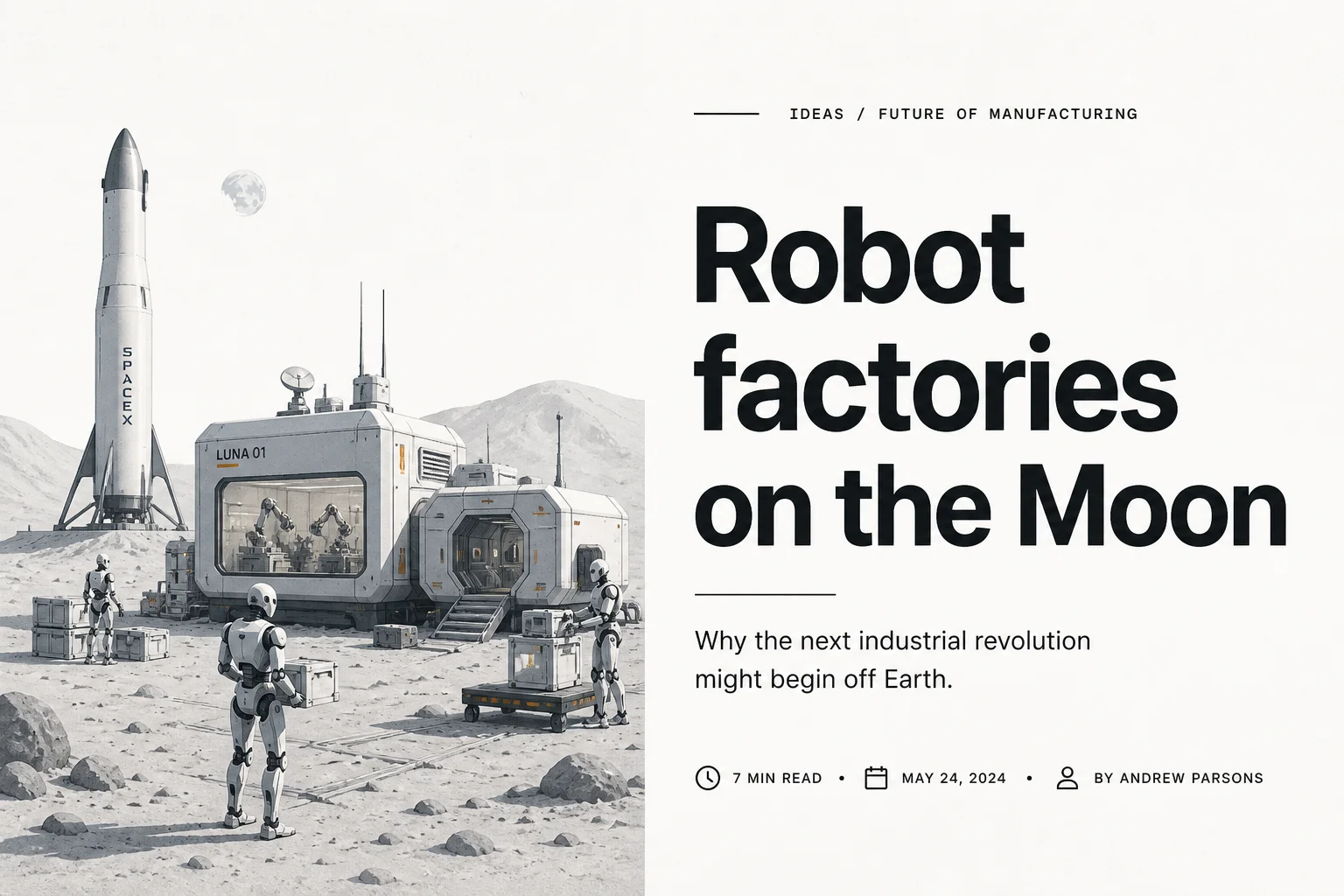
SpaceX's first quarterly earnings call as a public company was supposed to be about Starship cadence and Starlink revenue. Midway through, Elon Musk pivoted to the Moon.
"We are going to land a lot of tonnage on the moon," he said, per Space.com. "We're going to build the factories on the moon. The robots will be helpful with that."
He acknowledged it sounds "super sci-fi" and "totally nuts." SpaceX stock still dropped more than 5% on the session, per Fortune coverage tied to the earnings narrative. Engineers and shareholders are now measuring the distance between lunar robot factories and the next quarter's disclosed spend.
The roadmap in plain language
Musk's lunar manufacturing vision is not new. He outlined a similar arc in February 2026 when SpaceX announced its xAI purchase. The earnings call doubled down for public-market investors.
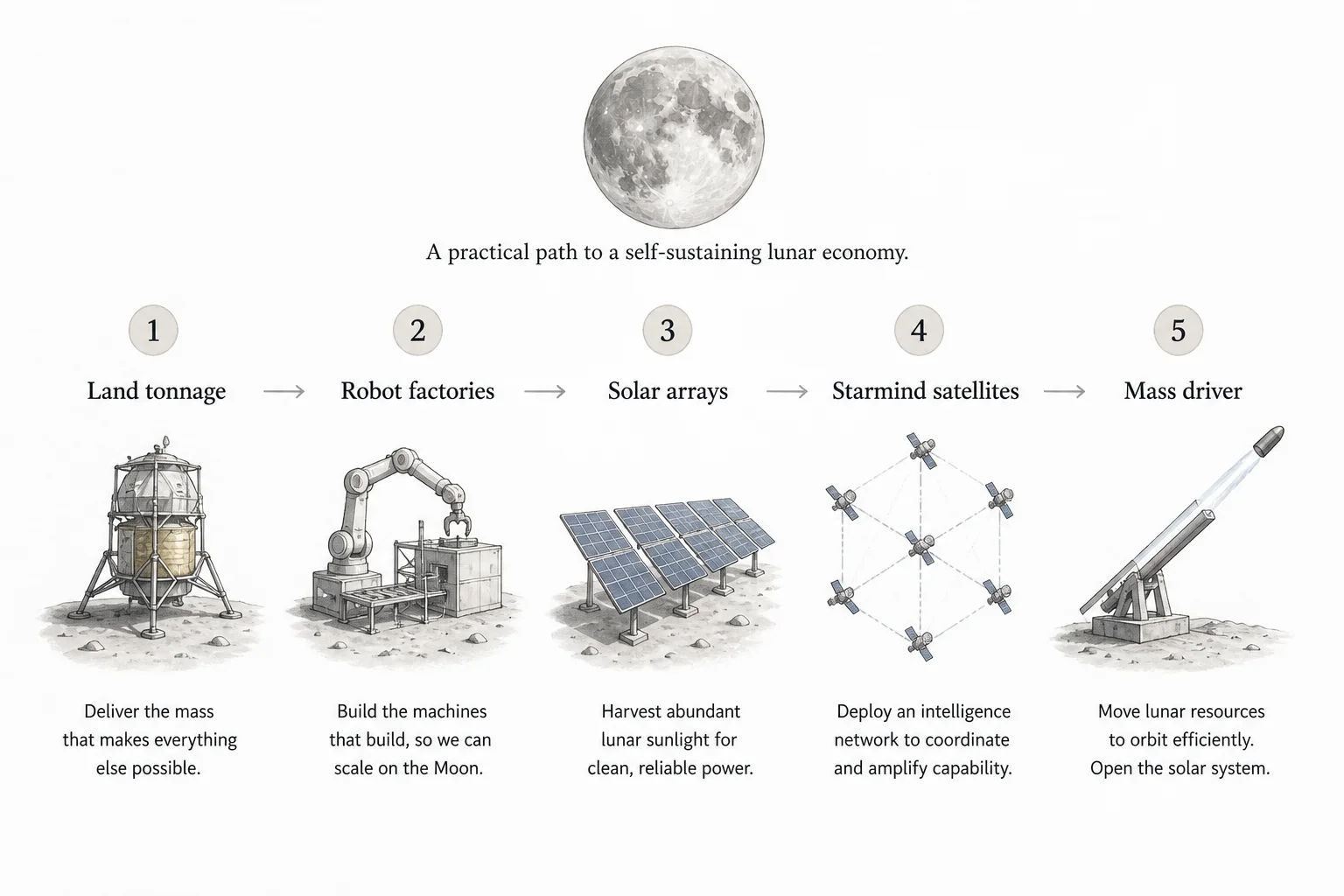
The sequence, as reported across Space.com, Fortune, and Moneycontrol:
- Land heavy tonnage on the lunar surface (Starship-class logistics).
- Build automated factories using robots, not shirt-sleeve human labor.
- Manufacture Starmind AI satellites and supporting infrastructure on the Moon.
- Extract local materials (aluminum, titanium, silicon from regolith) while shipping chips and precision components from Earth, per Fortune's read of investor materials.
- Construct an electromagnetic mass driver to launch cargo without traditional rockets for every kilogram.
Musk tied Starlink satellites to the same theme: autonomous "robots" already operating in orbit as proof that SpaceX can run robotic infrastructure at scale.
Where humanoids enter (and what Musk did not say)
Musk said "robots," not "Optimus" on the call. Press coverage still connects the dots to Tesla Optimus, the humanoid Musk previously cast as early Mars crew.
Space.com notes Musk has talked about launching Optimus units toward Mars to prepare for human settlement. The Moon factory pitch fits the same labor substitution story: radiation, life support, and commute costs make humans expensive for repetitive construction.
What SpaceX did not disclose, per multiple outlets:
- A specific humanoid platform or supplier
- Dollar capex for lunar robotics
- A timeline with milestones
- Which tasks are humanoid-shaped versus wheeled or fixed manipulators
Jim Cantrell, a former SpaceX executive, told reporters Optimus could supply the workforce. That is speculation, not guidance.
TERAFAB and the terrestrial bridge
The Rundown Robotics digest linked Musk's lunar pitch to terrestrial robotics threads:
- Tesla Optimus as the presumed workforce for harsh environments.
- TERAFAB, a joint venture framing, as part of the manufacturing story on Earth.
Even if lunar factories stay a decade out, the call positions SpaceX as a prospective anchor customer for a class of robot nobody mass-produces today: general-purpose builders that work in vacuum, dust, and extreme temperature swings.
That is a demand signal for humanoid startups. It is also a liability if your roadmap assumes near-term Optimus unit economics that are still unproven in a Texas factory, let alone Mare Tranquillitatis.
Why investors pushed back
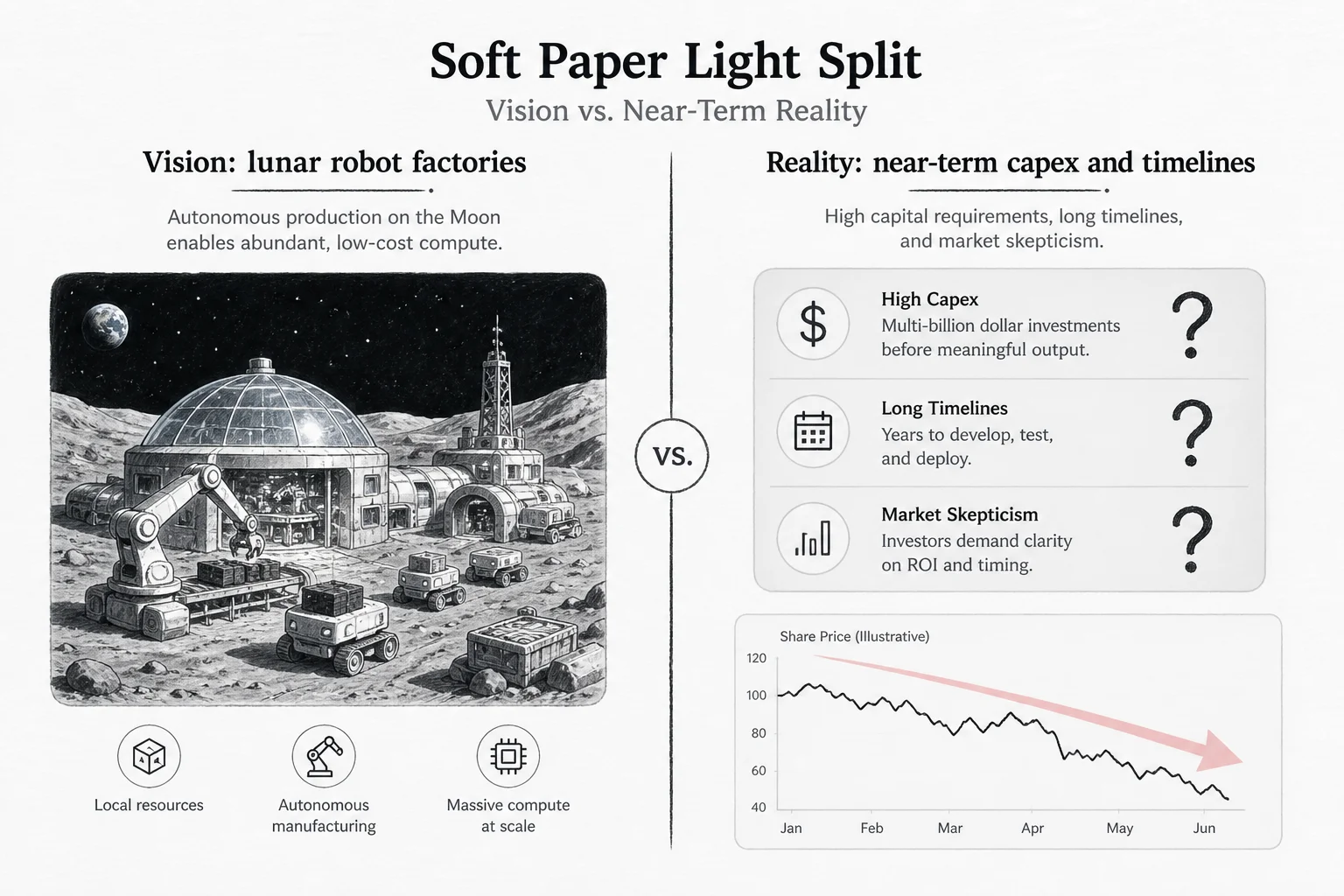
Fortune's headline called the plan "pure insanity." That is editorial color, but the market reaction rhymes with a familiar pattern:
| Bull case | Bear case |
|---|---|
| SpaceX industrializes launch; Moon is the next factory floor | Capex opacity; robotics timeline unbounded |
| Robot labor unlocks mass drivers and AI satellite scale | Optimus not validated for lunar ops |
| Starlink cash funds deep tech bets | Public shareholders discount far-future narratives |
Musk's own framing ("1,000x to maybe 1,000,000x Earth's economy in intelligence launched to space") is aspirational math. Public markets often punish unbounded optionality when near-term margins and Starship execution risks are already on the slide.
For applied AI engineers, the lesson is not "Musk is wrong." It is that narrative scale runs ahead of integration tests. Your clients do the same thing with "agents everywhere" decks. Someone still has to wire the handoff, the power budget, and the maintenance loop.
What would have to be true technically
Lunar robot factories are not one hard problem. They are a stack:
- Reliable heavy logistics to the surface (Starship landing cadence, payload integration).
- Power and thermal (solar arrays, radiators, night survival).
- Regolith processing at useful purity and throughput.
- Precision assembly in dust and vacuum (seals, bearings, electronics).
- Teleoperation latency or autonomy good enough when Earth is multiple seconds away.
- Maintenance without a nearby Best Buy.
Humanoids solve none of those by themselves. They are a bet that a general morphology reduces bespoke tooling for unstructured construction. Maybe. We do not have a 100-hour uncut video of that working on the Moon.
Compare to Xiaomi open-sourcing 100K hours of Earth-bound manipulation data the same week. One release gives you weights and eval code. Musk's call gives you a destination without a Gantt chart.
How I read this as an applied AI engineer
I do not build lunar factories. I do build automation where the last mile is physical and the demo video skips the boring parts.
Three parallels worth stealing for client conversations:
1. Anchor customers shape robot demand
SpaceX as anchor buyer would pull humanoid R&D the way defense primes pull drone platforms. If you sell automation, ask who your anchor workflow is. "Everyone" is not an answer.
2. Orbit-scale PoC ≠ lunar bill of materials
Musk cited Starlink as autonomous robots in space. Fine as analogy. Do not let a client treat a successful API pilot as proof the warehouse retrofit is funded.
3. Disclose the integration budget or pay the discount
Public markets discounted the story because capex and timelines were fuzzy. Private clients do the same when you hand them a model accuracy slide without deployment hours.
What to watch over the next few quarters
- SpaceX disclosure on robotics capex or partnerships (Optimus, industrial arms, or other)
- Starship landing cadence and payload manifests mentioning lunar infrastructure
- NASA Artemis / commercial lunar payload programs that could co-fund early robotics demos
- Terrestrial TERAFAB and Optimus milestones that could de-risk space claims
- Humanoid startups (Steel Bot, Figure, etc.) pitching "SpaceX-class" durability narratives
The Rundown Robotics digest framed the gap well: Musk made SpaceX a prospective customer for robots nobody sells yet. Engineers will track whether any quarter moves from science fiction to testable subsystem.
If you are turning ambitious automation roadmaps into shippable milestones (here on Earth), book a free discovery call.