
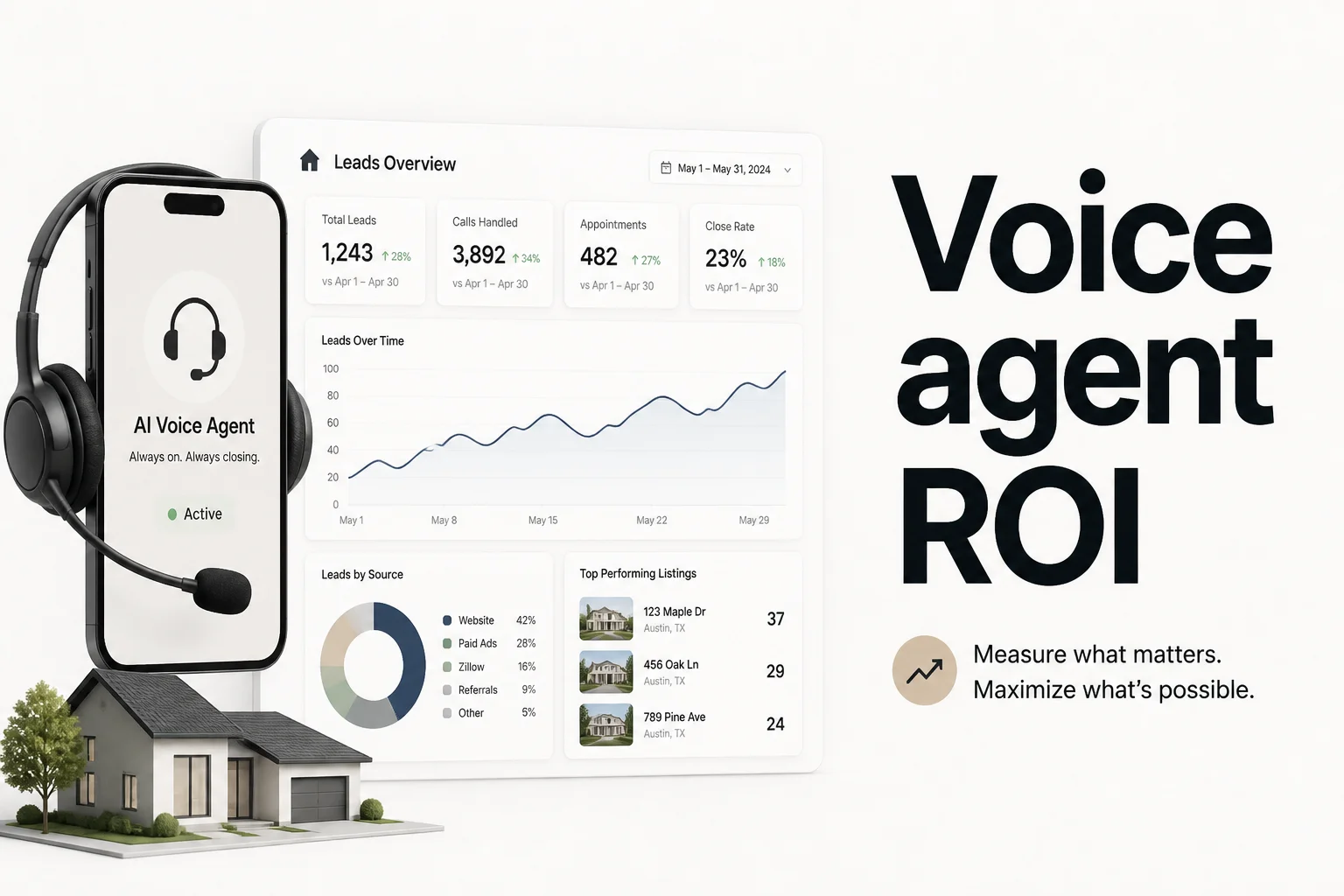
Real estate teams do not lose deals because the AI demo sounded cool. They lose them because a buyer inquired on three portals at 9:40pm and the first human who called back got the showing.
I build voice and CRM automations for operators who care about booked calendars. This post is the ROI worksheet I wish more brokerages ran before they buy a "bilingual voice agent that dials 1,000 leads an hour" pitch.
Outbound blast dialers are a different product with different compliance and brand risk. Here I focus on inbound and missed-call recovery, where the ROI story is cleaner and the buyer already raised their hand.
Speed-to-lead, with the citations cleaned up
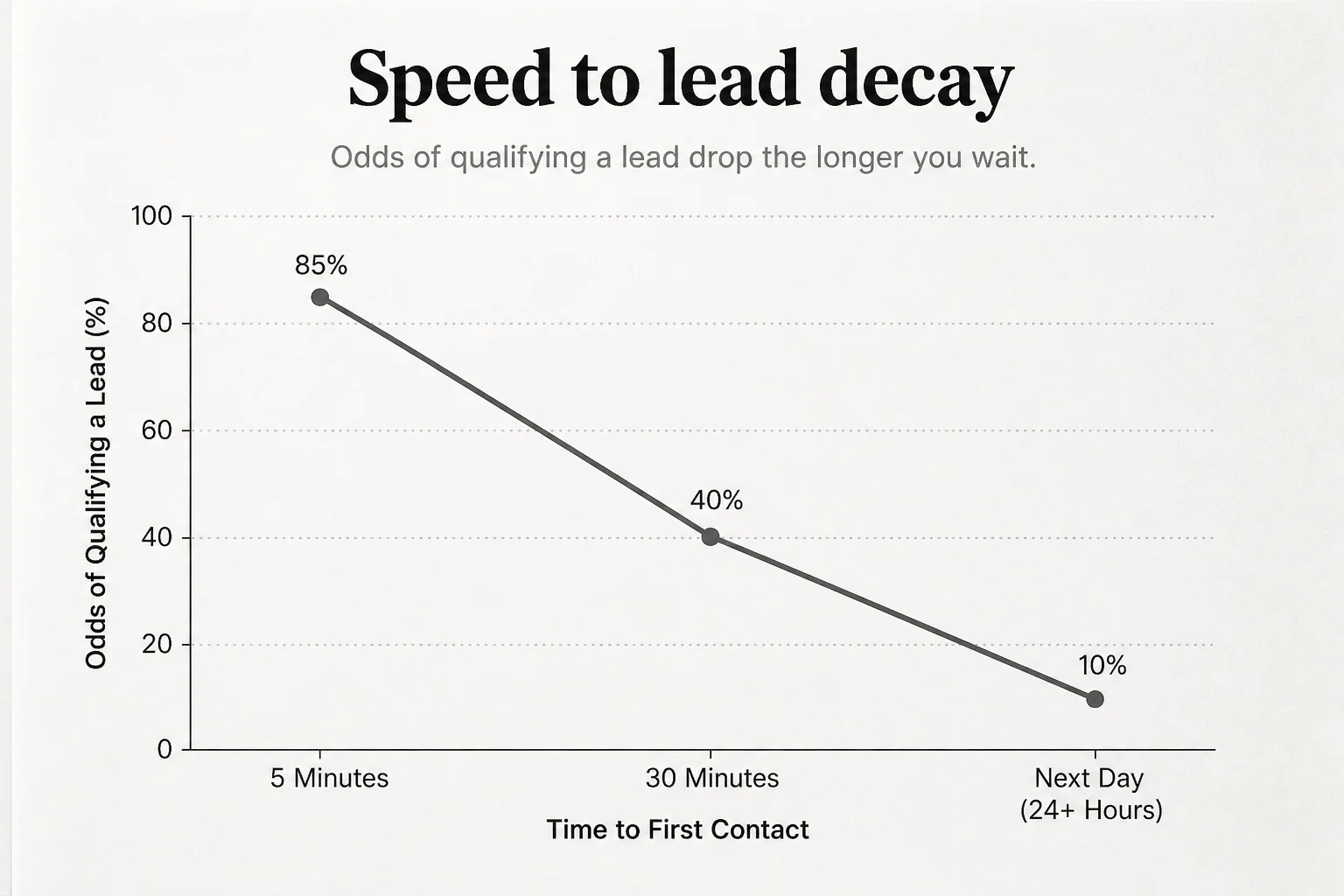
Direct answer: faster first contact qualifies more leads. The numbers you see in sales decks are often mashed together from two different studies.
InsideSales / MIT (2007, Oldroyd): on web leads, contacting at 5 minutes vs 30 minutes showed roughly 100x higher odds of making contact and 21x higher odds of qualifying (meaningful conversation). After about 20 hours, more dials started to hurt.
HBR audit (2011, Oldroyd et al.): across 2,241 US companies, average response among those who replied within 30 days was 42 hours. 23% never responded. In a separate lead analysis, contact within an hour was nearly 7x more likely to qualify than waiting another hour, and 60x vs waiting a day or more.
Useful write-ups that keep the attribution honest:
- Speed to lead statistics 2026 (what the research actually found)
- Speed to lead in real estate (Sierra Interactive)
Caveats I actually say out loud: those studies are old, mixed-industry, and measure qualification, not closed GCI. Portal UX and SMS habits changed. The shape of the curve still matches what brokers feel. The exact multiplier is not a forecast for your Riyadh off-plan launch.
The brokerage leak (where voice actually pays)
| Leak | What happens | Voice agent role |
|---|---|---|
| After-hours inbound | Listing or Google call hits voicemail | Answer, qualify budget/area/timeline, book or queue |
| Busy open house / launch spike | Rings stack, callers hang up | Concurrent answer + CRM log |
| Portal form at night | Email sits until morning standup | Instant call or SMS, then human takeover |
| Seller inquiry | "What is my home worth?" waits | Capture address, intent, book CMA with listing agent |
| Missed transfer | AI talks forever, never escalates | Strict handoff rules to a living closer |
Voice is strongest when the channel is already a phone, or when the lead expects a callback now. Portal shoppers who just typed a form often convert better with an immediate SMS that offers a call. More on multi-channel chase in AI lead generation systems.
A simple ROI model you can fill in
I avoid fake case studies. Plug your own numbers.
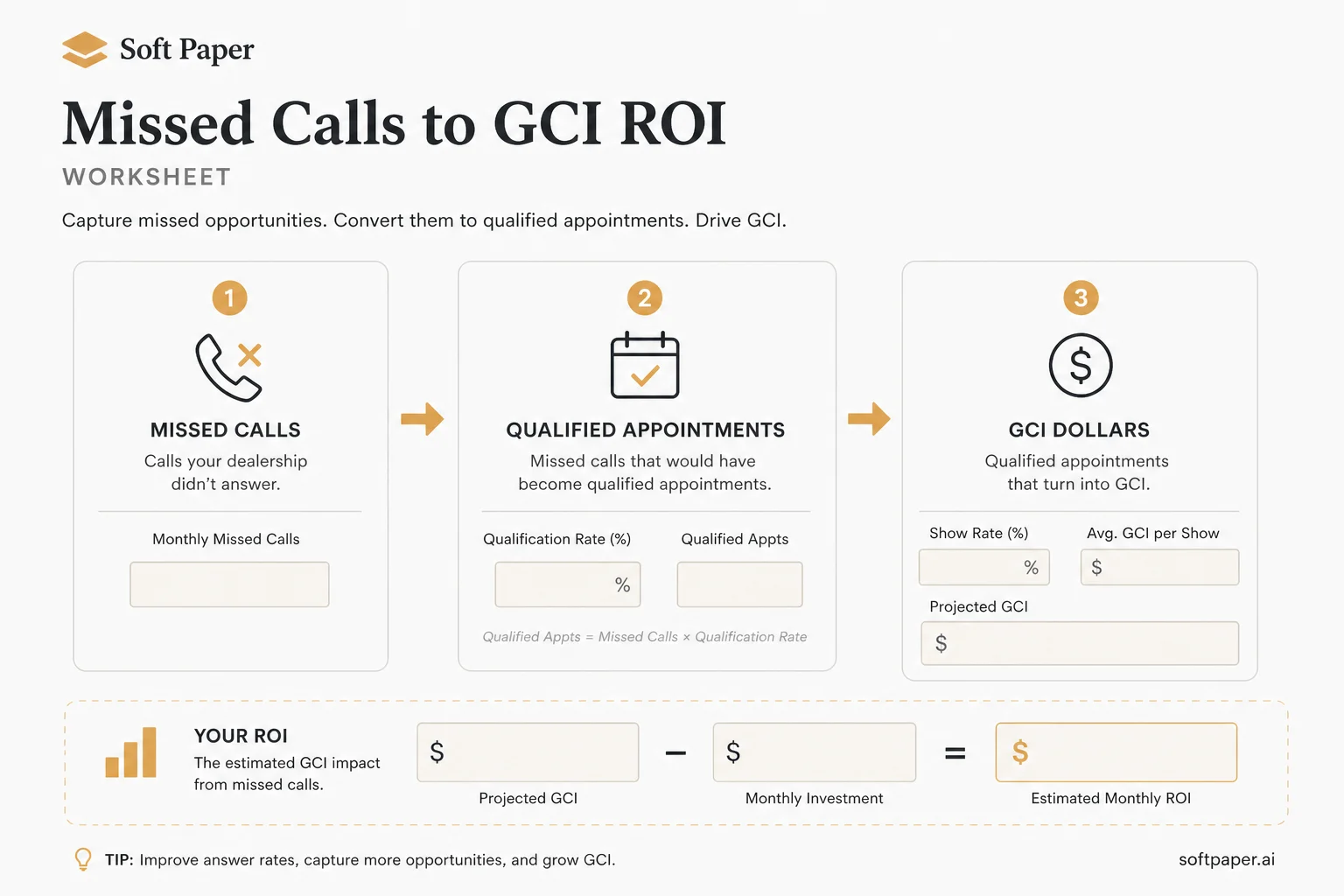
monthly_inbound_calls = 400
miss_rate = 0.25                 # after hours + overflow
missed_calls = 100

reach_rate_with_ai = 0.70        # connected + intent captured
qualified_rate = 0.25            # of reached, worth a human
appointments_per_qualified = 0.40
show_rate = 0.70
close_rate = 0.20
avg_gci_per_deal = 8000          # your market; adjust hard

recovered_deals_per_month =
  missed_calls
  * reach_rate_with_ai
  * qualified_rate
  * appointments_per_qualified
  * show_rate
  * close_rate
# ≈ 100 * 0.7 * 0.25 * 0.4 * 0.7 * 0.2 = 0.98 deals / month

annual_gci_upside ≈ 0.98 * 12 * 8000 ≈ $94k

monthly_stack_cost ≈ setup_amortized + telephony + LLM + monitoring
# example: $400 to $1,500 / mo depending on volume and languages
Even if you cut every rate in half (pessimistic), you still get ~0.25 recovered deals a month. One mid-market close pays for a year of a modest stack. That is the honest pitch. Not "unlimited concurrent calls replace your entire ISA team."
Costs people forget
- Number provisioning, recording storage, compliance review
- Prompt and tool maintenance when inventory and scripts change
- Human escalation coverage (someone still has to take the hot transfer)
- CRM hygiene so the AI does not create duplicate contacts
- Language quality: Gulf Arabic code-switching is a product requirement, not a checkbox
Ballpark for a focused inbound build in my world: a few thousand dollars to stand up, then hundreds to low thousands per month in usage and care. Exact scope only after you know channels, CRM, and languages. Clinics use a similar pattern; see AI receptionist for clinics for the ops framing.
Sample worksheet for a 12-agent team
Assume: 600 portal and web leads/month, humans average 47 minutes to first call on nights and weekends, 18% of leads never get a live touch in 24 hours.
| Scenario | First touch SLA | Est. extra qualified conversations / mo | Notes |
|---|---|---|---|
| Status quo | 30 to 90+ min after hours | Baseline | Voicemail + morning batch dialing |
| SMS-first autoresponse | under 1 min text, call in 15 | +15 to +40 | Cheap; weak if script is generic |
| Voice on missed calls only | under 1 min on ring-no-answer | +20 to +50 | High ROI wedge |
| Full inbound + after-hours voice | under 1 min always | +40 to +80 | Needs tight handoff and CRM |
These ranges are planning fences, not promises. Instrument your own: time-to-first-touch, connect rate, appointment set rate, show rate, GCI by source.
When voice loses to chat or SMS
I will not sell you a phone bot for every lead.
Prefer SMS / WhatsApp / web chat when:
- The lead just submitted a form or portal inquiry (they are already in a typing context)
- Your market treats cold evening calls as spammy
- You cannot staff hot transfers and the voice agent would strand callers in FAQ loops
- Listing data is messy and the agent invents availability (text with verified CRM fields is safer)
- Compliance wants written consent trails more than call audio
Prefer voice when:
- The primary CTA is "Call now" on ads, GBP, or yard signs
- Overflow and after-hours rings are measurable and expensive
- High-intent sellers call about a valuation and hate waiting
- You have a clear transfer path to a licensed agent for negotiation
Most teams I respect run SMS for portal speed + voice for phone overflow. Same CRM, same scoring, different channel. Wiring that into HubSpot, GHL, or Salesforce is the same no-lost-lead idea as automating B2B CRM lead flow (sibling post for the pipeline architecture).
What a good real estate voice agent is allowed to do
Allowed: capture name, phone, email, buy vs sell, area, budget band, timeline, preferred showing windows; book on a calendar the team actually watches; tag source; summarize the call; transfer on "speak to an agent."
Not allowed: invent comps, promise financing, discriminate, or pressure someone into a contract. Keep the agent boring and accurate. Closers close. The bot protects speed.
Tooling I see in the wild:
- GoHighLevel for many indie teams (CRM + calendars + SMS)
- Twilio or similar for telephony
- Salesforce / HubSpot for larger brokerages with existing RevOps
- Inventory feeds that are read-only and frequently refreshed
Docs worth skimming:
A 14-day pilot checklist
Do not roll voice across every ISA on day one. Run a contained pilot.
- Pick one number or overflow path (after-hours main line is ideal).
- Define success metrics: connect rate, appointment set rate, transfer rate, average handle time, complaint count.
- Write a one-page policy: what the agent may say about financing, HOA, and inventory.
- Wire CRM tags so you can filter "touched by voice AI" in reporting.
- Sit a licensed agent on hot transfers for the first two weeks (even evenings, even if on-call pay).
- Review ten full transcripts every other day. Fix lies and loops before you scale minutes.
- Compare against a control week: same lead sources, no voice, SMS-only.
If appointment set rate does not beat the control after fixing the first round of prompt bugs, pause. The channel or the script is wrong. More minutes will not save a bad path.
Decision rule
Ship voice if you can measure missed or slow phone demand and you have a human handoff path. Ship SMS-first if your lead mix is portal forms and your call connect rate is already fine during the day. Ship neither if your CRM is a graveyard of duplicates and nobody owns follow-up. Fix routing first.
If you want help stress-testing the numbers with your call logs and portal sources, book a free call. Bring one month of missed-call count and average GCI. We will decide if voice is an ROI project or a vanity demo.