
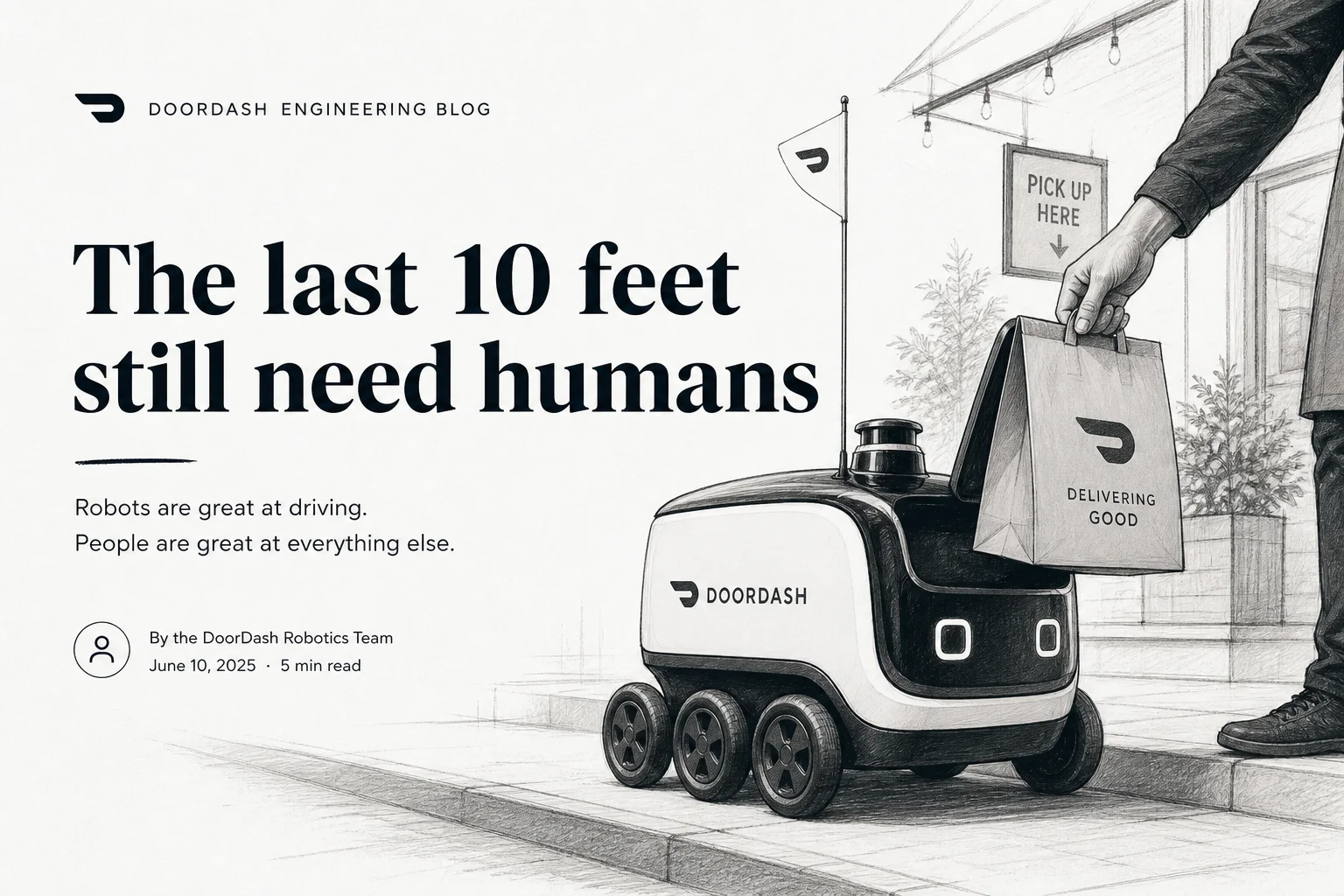
Autonomous delivery looks solved in the pitch deck. Lidar, radar, cameras, 20 mph on mixed terrain. Then someone still has to walk a burrito from the pickup shelf to the curb.
That is where DoorDash Dot sits in August 2026. The robot handles the middle mile. Dashers get paid about $5 for five minutes to fetch the order and load Dot in a Phoenix-area parking lot, per Business Insider. Photos document every step.
If you automate ops for clients, this story should feel familiar. The AI stack works. The messy handoff at the edge does not.
What Dot actually does
Dot is DoorDash Labs' in-house delivery robot, unveiled in late 2025 and scaling in the Phoenix metro in 2026.
| Spec | Detail |
|---|---|
| Size | Roughly baby-stroller scale (about 4'6" tall in NBC footage) |
| Payload | Up to 30 pounds (about six large pizza boxes) |
| Speed | Up to 20 mph |
| Terrain | Roads, sidewalks, and bike lanes (multimodal navigation) |
| Sensors | Lidar, radar, cameras, GPS |
| Range | Designed for roughly 3–5 mile suburban trips |
CEO Tony Xu said on the Q2 2026 earnings call that Dot is running at real scale, not fixed-route demos. Management expects a high single-digit percentage of orders in the largest test market by year-end 2026, per Pulse2 coverage of shareholder letters.
That is meaningful volume. It is also early enough that edge cases still leak to humans.
The $5 loading gig
Devena Bybee, a Dasher in Mesa, Arizona, told Business Insider she drove two miles to a restaurant, picked up an order, and placed it in a waiting Dot. Five minutes, roughly $5, with photo proof at each step.
DoorDash frames it as a limited pilot for rush periods that creates earning opportunities outside traditional deliveries. Dashers remain "the backbone" of the network for a long time, per Q2 shareholder commentary.
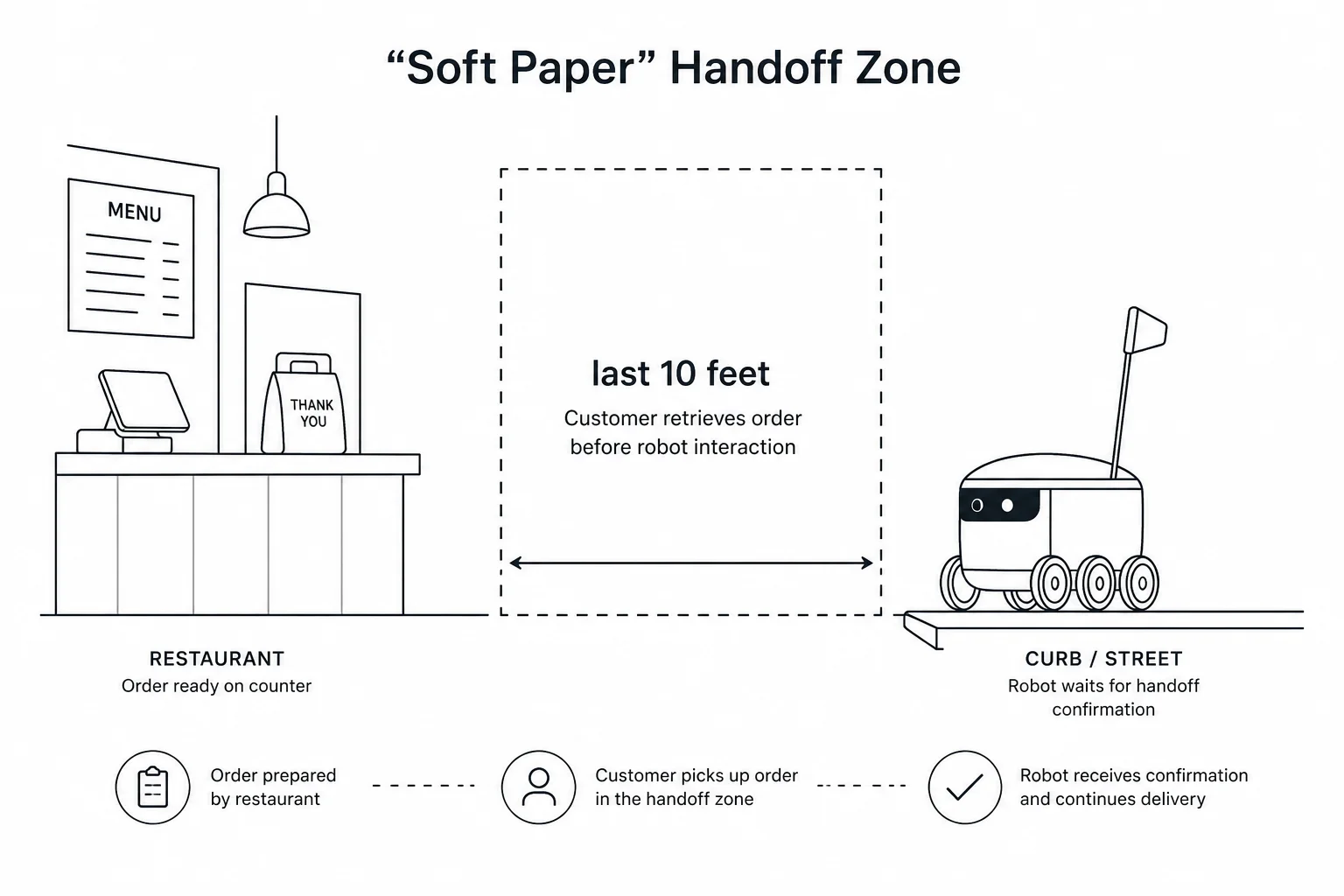
Workers on Facebook groups have posted similar offers in Scottsdale and surrounding cities over the past month. The pattern is consistent: robot cannot enter the restaurant; human bridges the counter-to-curb gap.
This is not a DoorDash-only problem
The same friction shows up elsewhere:
- Waymo + DoorDash: gig workers paid to close robotaxi doors in Atlanta, per CNBC (February 2026).
- Serve / Uber Eats: sidewalk bots still need restaurant staff or couriers at the handoff.
- Drone delivery: FAA Part 135 progress for DoorDash Air does not eliminate the kitchen-side packaging step.
Tony Xu flagged the handoff as a core challenge back in August 2025, shortly before Dot's debut. A year later, the workaround is explicit: pay a human for the last few feet.
Robert Bruno, a labor professor at University of Illinois Urbana-Champaign, noted that outsourcing loading to independent contractors can cost less than pulling a hourly restaurant worker off the line. Multiplied across rush periods, that math matters for DoorDash. It also tells you where margin lives: not in the autonomy stack, but in who absorbs variability.
Why the hard part is not the model
Dot's autonomy problem is genuinely hard. Multimodal routing (road plus sidewalk plus bike lane) is rare. DoorDash claims Dot is the only vehicle doing all three autonomously in their network.
But the Business Insider story is not about navigation failures. It is about pickup geometry:
- Counters, shelves, and heat lamps are not standardized.
- Staff are busy during rush.
- Bags differ in weight and shape.
- Liability for wrong orders still sits with the platform.
Sound like your last RAG deployment? The retriever works. The CRM field mapping breaks when a rep types free text.
Lessons for applied AI shipping
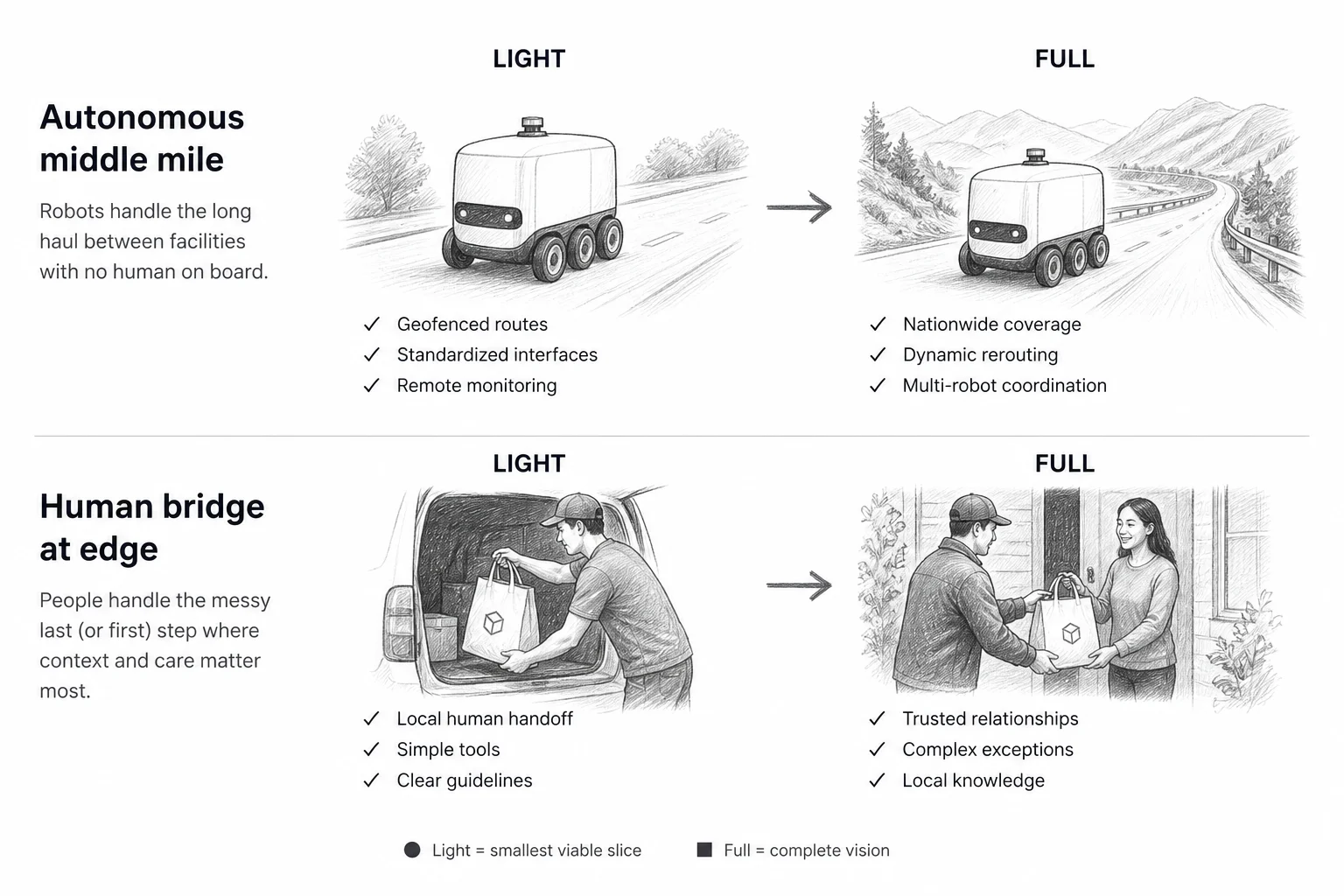
I map DoorDash Dot to client projects in three buckets:
1. Design for the handoff first
If your automation assumes "data arrives clean at the API boundary," you will hire humans anyway. Map the 10 feet before and after your model runs. Who holds the bag? Who clicks approve? Who fixes OCR when the invoice photo is sideways?
2. Price the human bridge honestly
$5 for five minutes is cheap compared to a failed delivery or a one-star review. In ops automation, the equivalent is a human review queue with SLA and cost per ticket. Hide that cost and your ROI slide lies.
3. Multimodal beats single-mode hype
Dot's value is combining modalities under one dispatcher. Your stack might combine voice + WhatsApp + CRM notes. The integration layer (DoorDash's "autonomous delivery platform") is the moat, not any single model call.
4. Scale metrics that matter
DoorDash tracks robots in operation, deliveries per robot per day, and share of orders in test markets. Copy that pattern: automation coverage rate and exceptions per 100 jobs, not demo accuracy alone.
What DoorDash says comes next
Shareholder letters mention parallel investment in DoorDash Air (FAA Part 135 certification) and continued Dasher-centric operations. SmartScale weighing at merchants reduces missing-item errors before handoff. None of that removes humans yet. It narrows where they must intervene.
Ashu Rege, VP of Autonomy, noted in podcast interviews that Dot goes up driveways to doorsteps for single-family homes but will not ride elevators to the 10th floor. The dispatcher filters incompatible addresses to human Dashers. That is good product design: know what the robot cannot do and route accordingly.
What I would tell a founder eyeing "full autonomy"
Start with the handoff diagram on a whiteboard:
Merchant counter → ??? → Autonomous asset → ??? → Customer door
If both ??? boxes are blank, you are not building autonomy. You are building a demo loop.
DoorDash can subsidize $5 gigs at pilot scale. Your startup probably cannot subsidize manual review forever. Either automate the edge, constrain the workflow (locker-only delivery, standardized totes), or accept human cost in the unit economics.
Dot proves the middle mile can scale. The Rundown Robotics digest caught the punchline: for all the lidar and drone hardware, cheap human labor still closes the last gap. That is the story I see in clinic voice agents, warehouse cobots, and "AI receptionists" that secretly forward to a human inbox at 4:58 p.m.
If you are scoping automation and want the handoff mapped before you buy software, book a free discovery call.