
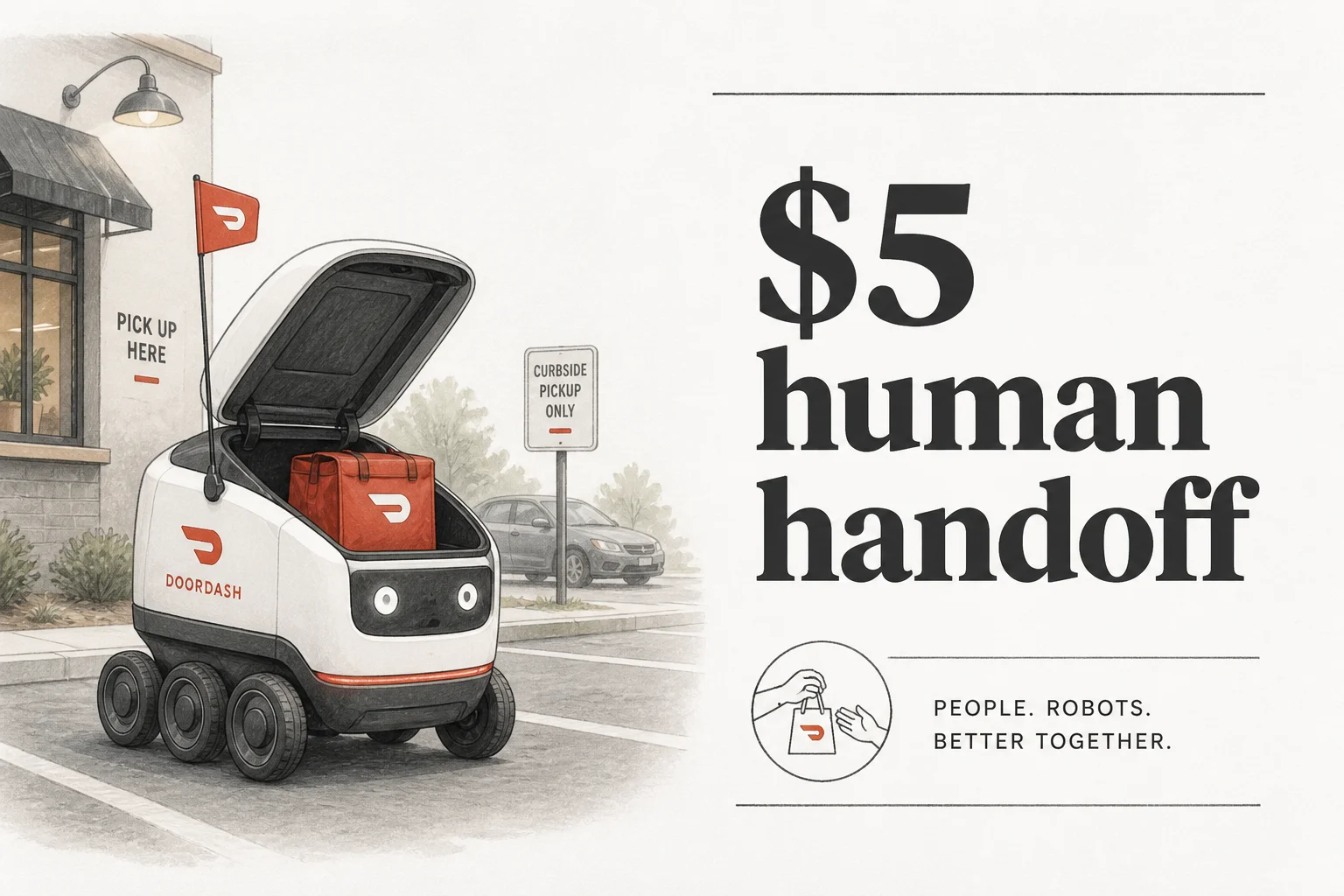
DoorDash's Dot delivery robot can navigate roads and sidewalks at up to 20 mph. It carries roughly 30 pounds, fits six large pizza boxes, and runs on lidar, radar, and cameras. It cannot pick up a bag from a restaurant counter.
So DoorDash pays gig workers about $5 to do exactly that. Drive to the merchant, collect the order, photograph each step, and load Dot in the parking lot. Five minutes of work in the Phoenix pilot, according to Dashers who spoke to Business Insider.
That is not a footnote. It is the whole automation story in one gig offer.
Business Insider on DoorDash robot-loading gigsHow the loading gig works
Devena Bybee, a Dasher in Mesa, Arizona, described the flow in early July 2026:
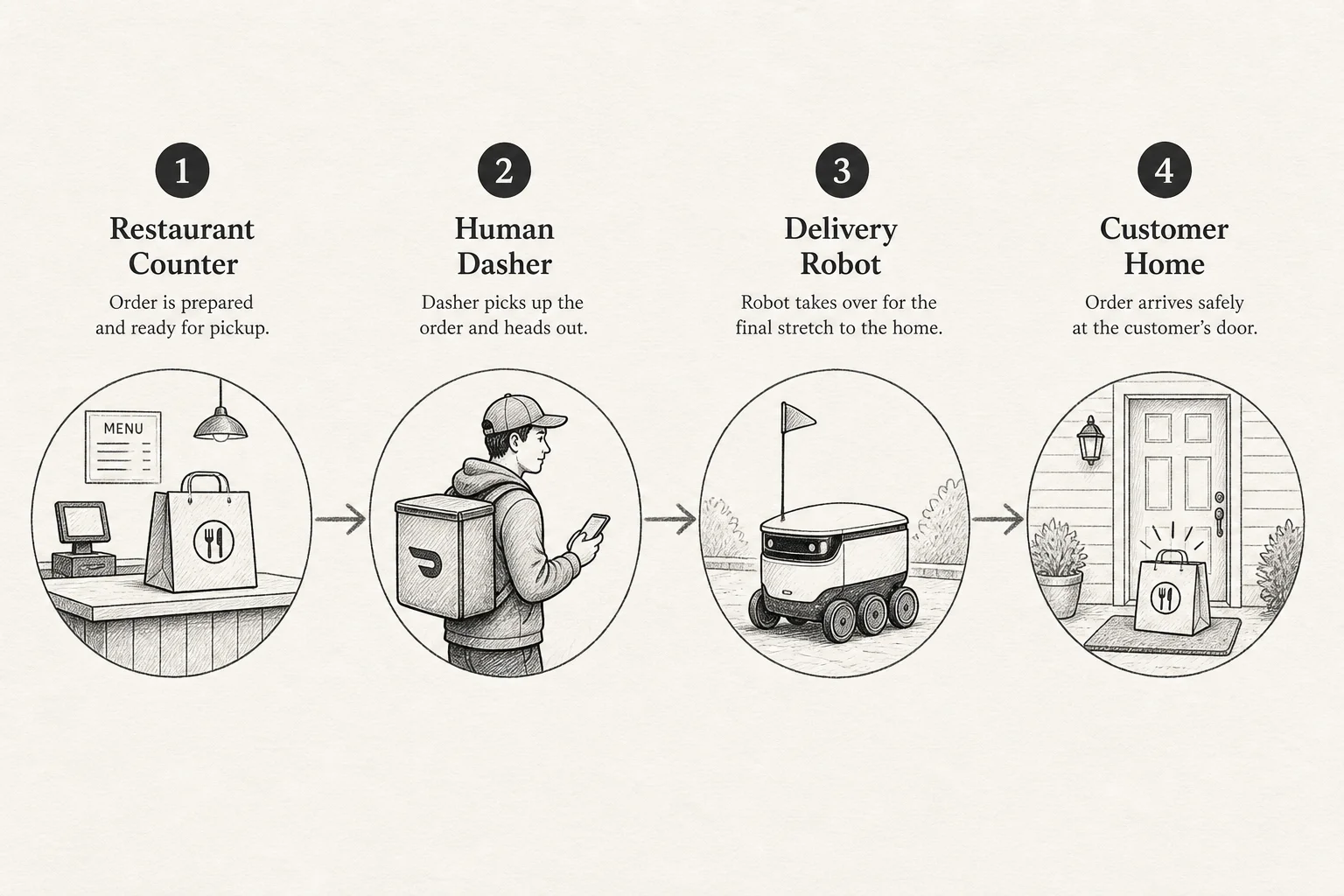
- Accept a robot-loading offer in the DoorDash app.
- Drive roughly two miles to the restaurant.
- Pick up the order at the counter.
- Carry it to Dot waiting in the lot.
- Load the cargo bay and document with photos.
DoorDash paid her about $5. Total time: about five minutes.
Facebook groups for Dashers show similar offers at Burger King in Scottsdale and other Phoenix suburbs. DoorDash calls it a limited pilot to support merchants during busy periods and create "earning opportunities" outside traditional deliveries.
Why the handoff is the bottleneck
CEO Tony Xu flagged this problem before Dot launched. Loading from restaurant to robot is awkward at scale. A merchant getting steady robot volume might want to outsource loading. DoorDash's independent contractors are cheaper per minute than many hourly restaurant staff, especially without benefits.
Robert Bruno, a labor professor at the University of Illinois, told BI that multiplied over a year, "there's probably a real savings" for DoorDash versus paying restaurant workers to load.
That is the gig-economy version of a pattern you see in robotaxis too. Waymo paid DoorDash workers to close robotaxi doors in Atlanta because the vehicle could not finish the job alone. Automation vendors keep solving the middle mile while humans handle the socially messy edges.
| Stage | Dot capability | Human today |
|---|---|---|
| Merchant pickup | Cannot reach counter | Dasher or staff |
| Parking lot load | Waits with bay open | Dasher |
| Road / sidewalk nav | Autonomous up to ~20 mph | None |
| Customer handoff | Secure bay, app unlock | Customer |
The middle row is where lidar budgets go. The first row is where product launches stall.
What Dot was built for
DoorDash unveiled Dot in September 2025 as the first commercial robot designed to move across bike lanes, roads, sidewalks, and driveways for local delivery. It is about one-tenth the size of a car, all-electric, and integrated with DoorDash's Autonomous Delivery Platform, an AI dispatcher that matches orders to cars, drones, or robots based on speed, cost, and location.
DoorDash Dot announcementEarly access started in Tempe and Mesa. By mid-2026, Dot was active across multiple Phoenix suburbs and had launched a pilot in Fremont, California. DoorDash engineers assemble and test robots at a facility on Warm Springs Boulevard in Fremont.
Dot's industrial design is deliberate: googly eyes, friendly proportions, trust-first aesthetics for families receiving food at home. The engineering bet is that suburban three-to-five-mile trips are the sweet spot where a small robot beats a car in congestion and parking pain.
None of that removes the counter pickup problem.
The pattern I see in client work
I spend more time on voice agents and CRM automation than delivery robots, but the failure mode rhymes:
- Teams over-invest in the autonomous core (model, sensors, routing).
- They under-invest in interfaces where humans already work (POS, host stand, loading dock).
- They discover the "last mile" is actually three separate last feet.
DoorDash's workaround is clever operations, not better AI. Pay a human $5 for five minutes instead of waiting for a manipulator that can handle greasy bags, missing sauces, and angry merchants.
For a merchant like Nor, who BI quoted after six months of Dot deliveries, customer satisfaction went up and wait times went down once the robot leg worked. The human loader is invisible to the customer. That is good UX. It is also a cap on margin until loading automates.
FAA drones and the same handoff lesson
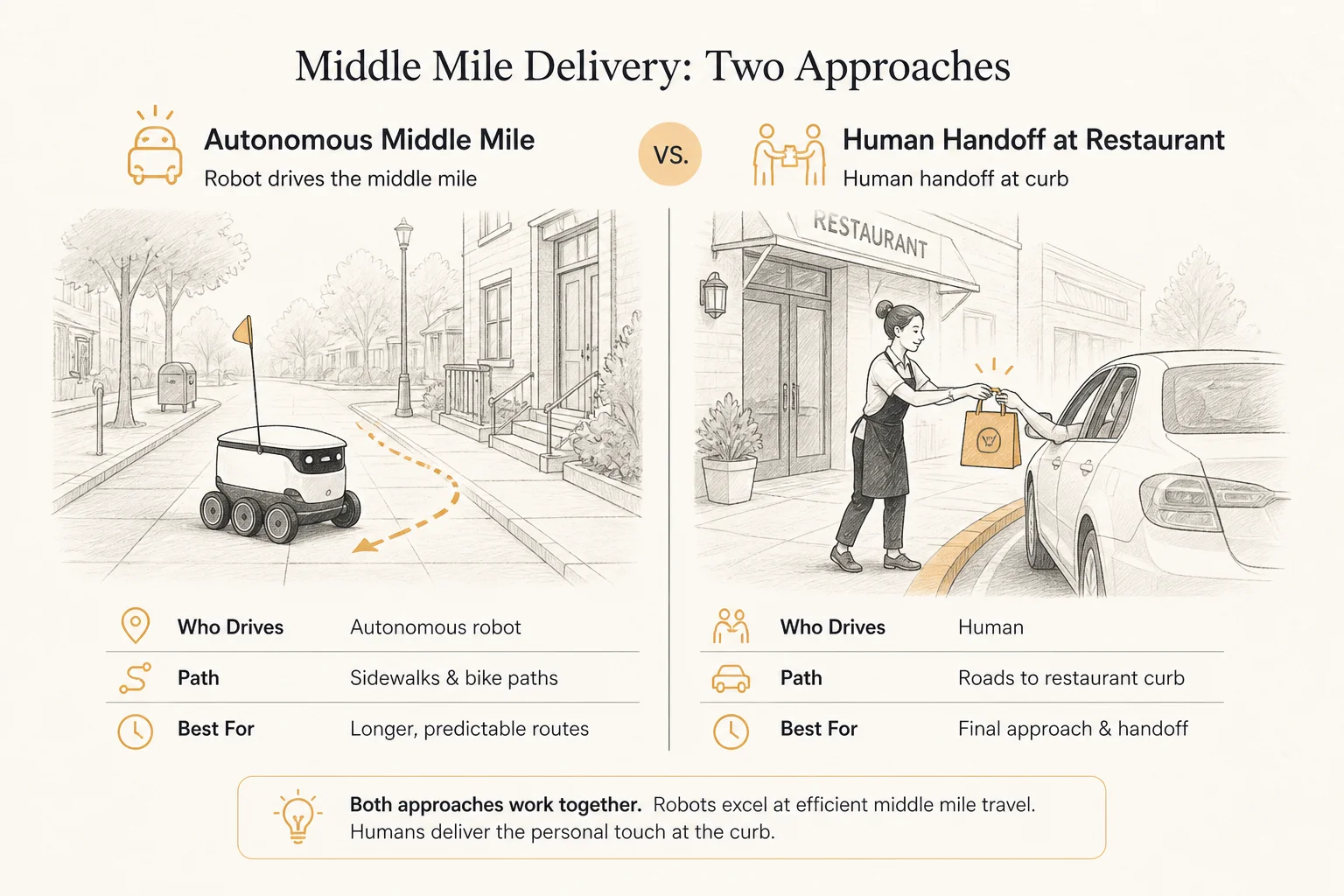
DoorDash also secured FAA clearance for drone delivery in parallel. Drones skip traffic but introduce roof access, weight limits, and weather gates. Dot skips flight regulations but needs curb access and merchant cooperation.
Both paths assume the restaurant interior stays human or heavily retrofitted. Smart scales and AI order checks (DoorDash flags underweight bags) reduce errors before load, but they do not eliminate carrying the bag outside.
If you are evaluating robotics for your own ops, ask where the handoff sits on org charts today. If it is "whoever is free at the counter," a robot in the parking lot does not remove labor. It adds coordination.
What would actually close the gap
Real fixes are boring and expensive:
- Dock at the door with merchant-owned loading (staff time, training, liability).
- Manipulator arms on Dot or a fixed loading station (cost, reliability, food safety).
- Merchant conveyor into a sealed bay (capital expense, floor plan constraints).
- Centralized ghost kitchens designed for robot pickup (rearchitecture, not a feature flag).
DoorDash's pilot suggests they are not betting on manipulators near term. They are betting on gig labor elasticity.
Takeaway for builders
Dot is a serious suburban delivery robot with real miles in Phoenix and Fremont. The Business Insider story is not "automation failed." It is "automation succeeded in the hard navigation problem and bought human help for the manipulation problem."
That is the honest state of field robotics in 2026. Models and sensors got good enough to drive on mixed terrain. Dexterous, cheap, food-safe loading at arbitrary merchants is not there yet.
When you pitch automation to a business owner, lead with the handoff map, not the autonomy demo. If the $5 five-minute gig is still on the critical path, your ROI model needs that line item until it is not.
Want help mapping where automation actually saves hours in ops (including the unglamorous handoffs), book a free discovery call.