
Your team is drowning in messages. The reflex is to post a job ad.
I get why. An extra admin or VA feels like the adult answer. But half of what fills most admin job descriptions today (same FAQs, booking ping-pong, CRM data entry, reminder chasing) is exactly the work voice and chat AI already do well at 11pm.
That does not make hiring wrong. It means the default is gone. Spend ten honest minutes on the cost math before you hire someone to copy-paste for eight hours.
What another admin actually costs
Salary is the number people quote. Fully loaded cost is the one that matters.
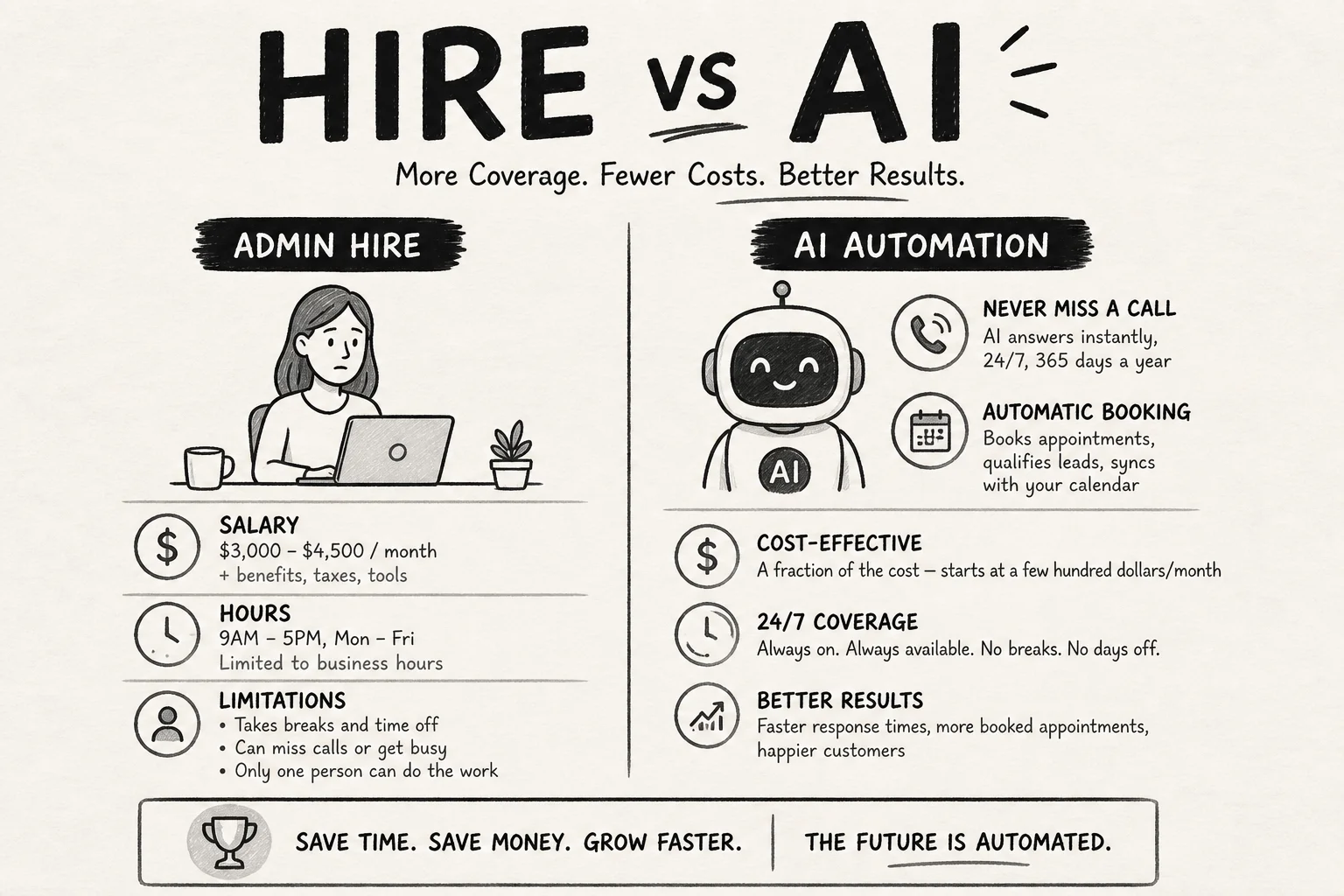
For a US small business, a full-time front-desk or admin hire is rarely "just $18/hour." Add payroll taxes, benefits if you offer them, equipment, training time, PTO coverage, and the manager hours spent supervising. A realistic fully loaded range for many markets is roughly $3,500 to $5,500 per month, before you count turnover restarting the cycle. For context on how employers typically load wages, see BLS occupational wage data.
An offshore VA looks cheaper ($800 to $2,000/month is common). Still one shift. Still needs training. Still cannot answer every missed call while you are with a patient.
| Cost line | Full-time admin (US) | Offshore VA | Focused AI automation |
|---|---|---|---|
| Monthly run rate | ~$3.5k–$5.5k loaded | ~$800–$2k | ~$200–$800 usage + hosting |
| Hours covered | One shift | One shift (timezone dependent) | 24/7 on defined tasks |
| Ramp time | 4–12 weeks productive | 2–6 weeks | Often live in 2–4 weeks |
| Turnover risk | High | Medium | Rebuild if you abandon ownership |
| Judgment / empathy | Strong | Variable | Weak by design |
I am not anti-hire. I am anti paying human rates for work that is a checklist.
What AI can take off an admin's plate
An AI automation is software that finishes defined tasks without a person driving each step. On a typical clinic, contractor, or agency front desk, the reliably automatable pile looks like this:
- Inbound Q&A: grounded answers to the same twenty questions on web chat, SMS, WhatsApp, or phone.
- Scheduling: book, reschedule, and send reminders against a live calendar.
- CRM hygiene: form fills, ad leads, and call captures land as contacts with tags and notes.
- Follow-ups: quote chasers, "still interested?" nudges, and document requests that stop when someone replies.
- Reporting: weekly counts pulled from systems instead of someone's Friday afternoon.
Study any admin role for a week and these five usually eat well over half the hours. That is the half automation competes for.
The stack I use most often for local operators:
- GoHighLevel for CRM, calendars, pipelines, SMS, and Voice AI
- Twilio when you need flexible telephony outside GHL
- n8n for glue between webhooks, docs, and tools that do not talk natively
- Optional WhatsApp via the WhatsApp Cloud API when that is where customers already live
What still needs a human
Judgment, relationships, and exceptions. Pretending otherwise is how AI projects fail loudly.
Keep humans on:
- Negotiations and complaints where tone changes the outcome
- Decisions with incomplete information and real downside
- Anything physical (greeting at the door, cash, deliveries)
- Relationships where continuity is the product
- Novel messes no workflow anticipated
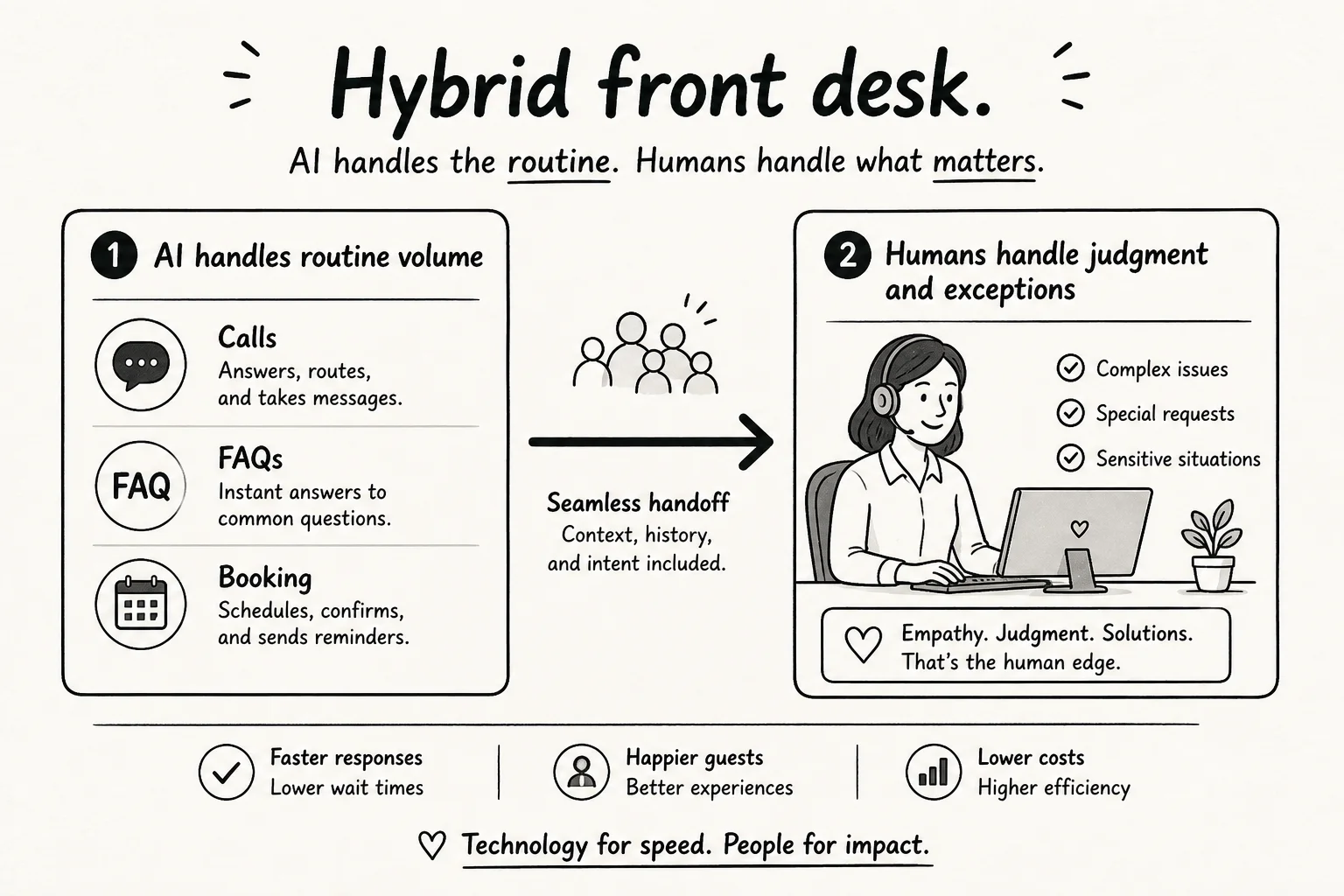
Well-built automation handles the routine majority and routes the weird minority to a person with context attached. The question is never "AI or humans." It is which tasks belong to which.
If a vendor promises a bot that "replaces your whole front desk," ask what happens when a furious caller, a VIP, and a medical edge case hit at once. That answer tells you more than the demo.
A five-question hire-vs-automate test
Score the workload you are hiring for:
- Repetitive? Mostly variations of the same tasks?
- High volume and time-sensitive? Leads go cold if unanswered for hours?
- Rule-based? You could write a checklist, or is it "it depends"?
- Digital? Lives in inbox, phone, CRM, docs (not physical)?
- Recoverable mistakes? Errors are easy to fix, or costly and irreversible?
Four or five yes answers: automate before you hire. One or two: hire. Middle: hybrid below.
The hybrid that usually wins
Sequence, do not substitute.
- Automate the routine volume first (FAQs, booking, CRM entry, reminders). That spike is often what triggered the job ad.
- Reassess headcount after two to four weeks of live traffic. Many teams find the remaining human work fits existing people again.
- When you still hire, hire for judgment and customers, not copy-paste. A clinic that automates booking hires for patient experience. A sales team that automates intake hires a closer.
I call the light version of this a Missed-Call Killer: missed ring → instant SMS or voice capture → CRM contact → calendar or callback task. The fuller version is an inbound AI receptionist on voice + chat with live booking and human handoff. Same idea, different depth.
Risks on each path
Automation risks: a brittle template that dies on real messiness; automating a broken process; nobody internal owns the system after launch. Fixable with proper wiring and an assigned owner.
Hiring risks: months of ramp, one-shift ceiling, turnover, and the quiet failure mode of paying someone to do work software should own until they quit from boredom.
Worst outcome: hire a person for software work, then lose them in month eight and restart the ad.
Speed: which option eases the load first?
Recruitment for a decent admin is often 4–12 weeks from posting to productive. A focused automation (chat FAQ + calendar, or missed-call text-back into GHL) is commonly live in 2–4 weeks and works at full capacity from day one.
Humans adapt to brand-new duties without a rebuild. Automations do what they were built for. That is another argument for hybrid: let software hold the routine floor permanently, and let people provide adaptability.
How to start without betting the business
- List the tasks eating the week and rough hours each.
- Pick one workflow end to end (example: after-hours calls → SMS capture → GHL opportunity → morning callback queue).
- Run it beside the manual process for two weeks. Measure response time and recovered bookings.
- Only then decide whether the leftover work still justifies a hire.
If you want a second set of eyes on that split, book a free discovery call on Cal.com. I will tell you what I would automate first, and what I would still hire for.
Bottom line
Hire for judgment, relationships, and presence. Automate repetitive, rule-based, digital volume, because a system does that work at midnight without PTO.
Make the decision in that order: shrink the routine with AI, then hire for the role that remains. Better systems and better jobs tend to show up together when you stop paying humans to be APIs.