
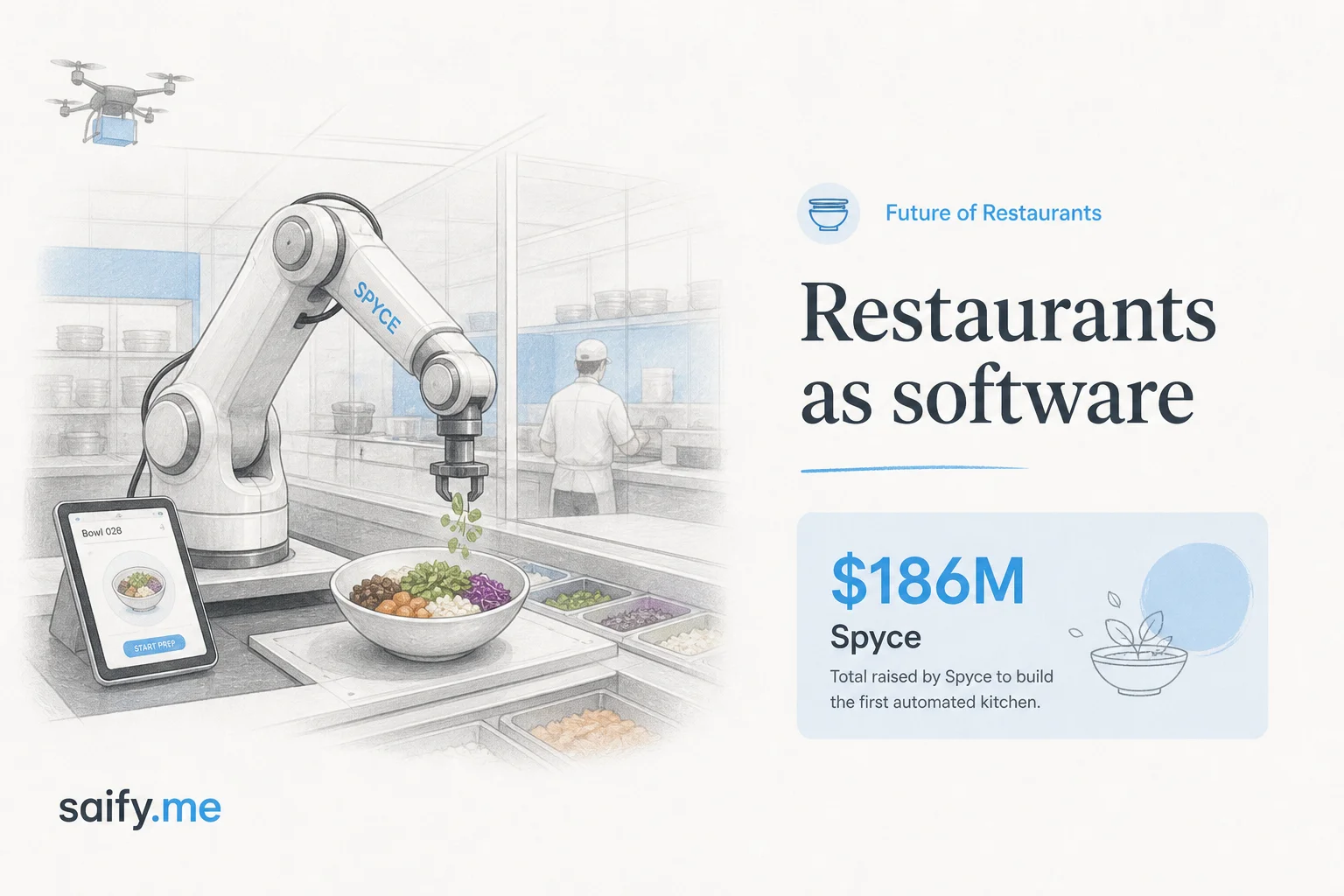
Restaurants are a terrible software business until you own the kitchen, the delivery network, and the brand factory.
Marc Lore's Wonder is testing whether that full stack can work. The company bought Grubhub, acquired meal-kit maker Blue Apron, paid $186.4 million for Sweetgreen's Spyce robotics unit, and is layering AI menu creation plus drone delivery on top. The Wall Street Journal framed it as a gamble on robots, drones, and AI-generated menus in a low-margin industry.
I think the framing is right. Wonder is not opening restaurants. It is building a food operating system.
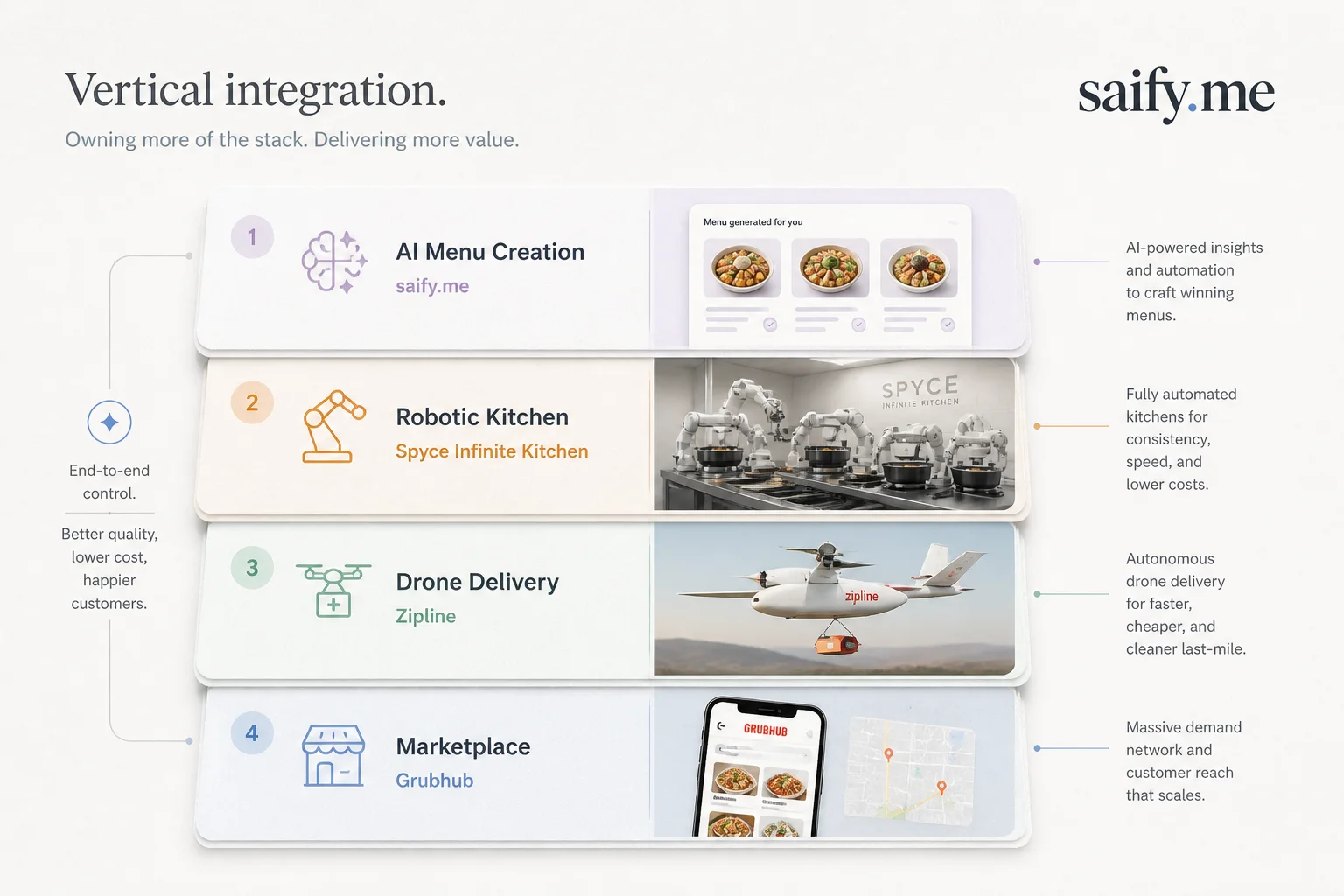
The vertical stack in one picture
Wonder's moves in 2025 and 2026 stack into a single platform:
| Layer | Asset | What it does |
|---|---|---|
| Demand | Grubhub marketplace | Customer acquisition and delivery routing |
| Production | ~120 programmable kitchens (targeting 400+) | Multi-brand cooking from shared real estate |
| Automation | Spyce Infinite Kitchen | Robotic bowl lines, labor reduction |
| Creation | Wonder Create (AI menus) | Spin up brands from prompts |
| Last mile | Zipline drones (Texas, Jan 2027) | Air delivery from select sites |
Sweetgreen sold Spyce for $100 million cash plus $86.4 million in Wonder stock while keeping the right to deploy Infinite Kitchen tech in its own stores. Wonder absorbed roughly 38 Spyce employees, including founders and engineers. Sweetgreen gets liquidity; Wonder gets the robotics team that already proved bowl automation at scale.
Spyce is not a gimmick, it is margin math
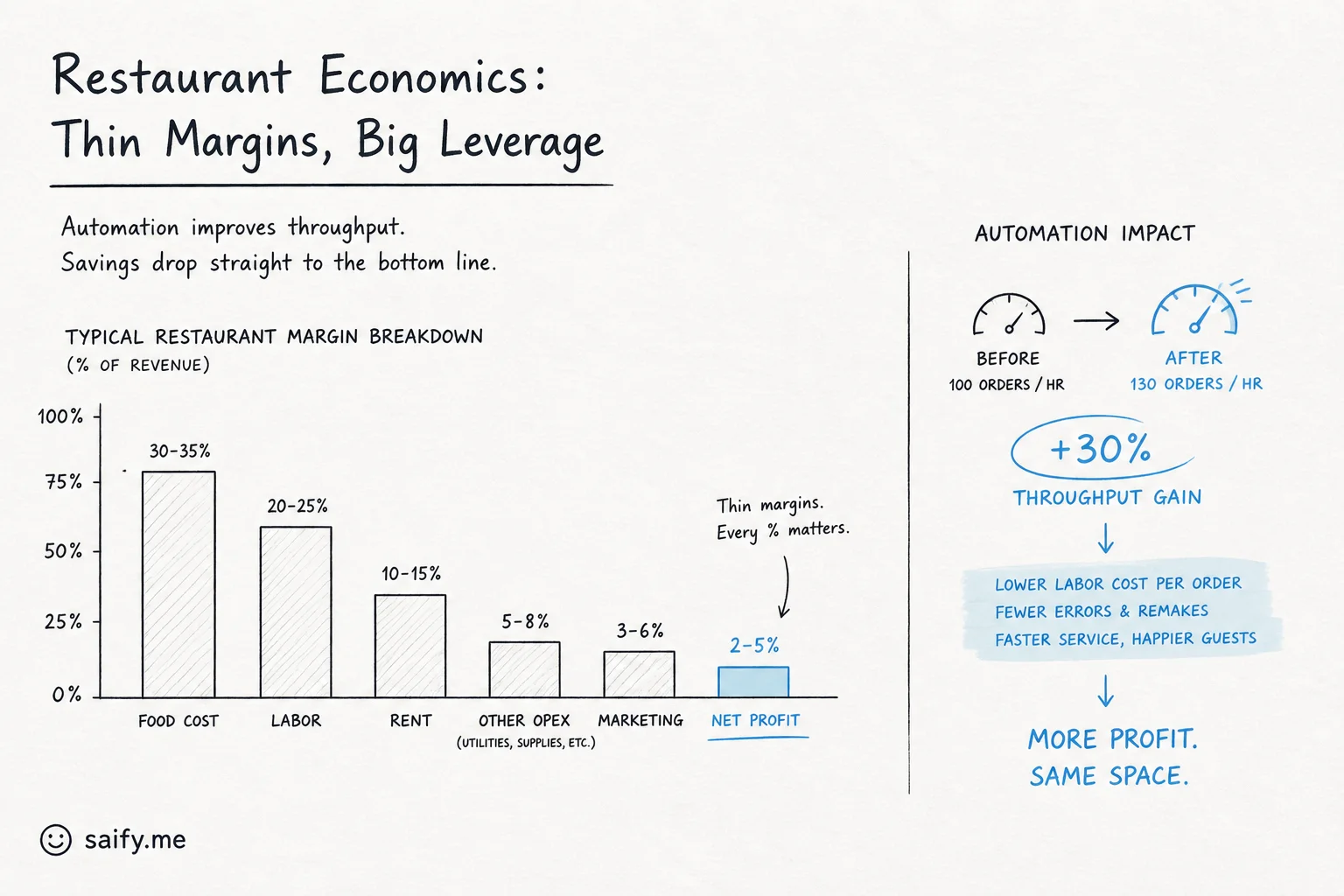
Restaurant margins live and die on labor and consistency. Lore has claimed an automated bowl line can remove roughly 20 points of labor on bowl-centric concepts, with accuracy every time. Whether that number holds at Wonder's multi-cuisine sites is an operational question, but the direction is clear: throughput without proportional headcount.
Sweetgreen's own journey shows how hard that is. After buying Spyce in 2021 for about $70 million, it deployed Infinite Kitchen in 20+ locations, then walked back plans to automate every store. Selling the division does not mean robotics failed. It means capital and focus shifted while Wonder, a buyer with Grubhub demand and ghost-kitchen scale, could run the tech harder.
Wonder also teased an "infinite sauce machine" capable of making a large share of internet recipe sauces on demand. Bowl lines plus sauce automation attack the two messiest repetitive stations in fast casual.
Wonder Create turns brands into prompts
The AI menu tool is the wildest layer and the most on-brand for Lore.
Per TechCrunch's WSJ Tech Live coverage, Wonder Create lets someone type a concept like "fast casual Mexican for Gen Z" and get:
- Name and branding
- Menu descriptions and pricing
- Recipe specs and health information
- Images and publish-ready assets
Lore compared it to spinning up a software SKU. Publish across Wonder locations for about $10 per month per site, with the creator keeping a profit share while Wonder handles production and delivery rails.
The go-to-market hook is influencers. Each creator brings an audience, Wonder avoids buying ads. It is marketplace dynamics applied to restaurant brands.
That only works if kitchen execution is boringly reliable. Robotics is how Lore plans to make 100 concepts out of the same square footage.
Drones are the last-mile bet for Texas heat
Wonder and Zipline announced drone meal delivery from select Texas locations starting January 2027, Dallas first, then statewide expansion.
Drone delivery is not new, but pairing it with a vertically integrated kitchen changes the economics:
- Fixed pickup points at Wonder sites reduce routing chaos
- Food can be timed to drone departure windows
- Suburban Texas sprawl is friendlier to aerial last mile than Manhattan canyons
The risk is regulatory and weather variance, plus customer tolerance for lukewarm fries. Wonder is betting Texas density and Zipline's track record offset that.
Why this is an applied AI story, not just food M&A
I do not implement fryer robots for clients. I do implement ops platforms where AI generates configs and humans handle exceptions. Wonder rhymes with that pattern:
AI generates the SKU. Wonder Create is vibe-coded restaurant branding with guardrails.
Robots handle the happy path. Infinite Kitchen covers repeatable bowl and sauce production.
Humans stay on the edge cases. Lore has said automation increases meals per kitchen hour rather than eliminating staff entirely. That is the honest version of "AI plus ops."
Marketplace owns demand. Grubhub is the distribution API.
If you run a service business, the parallel is an AI that drafts quotes and schedules jobs while your team still owns the tricky installs. Wonder just swapped HVAC for halibut.
What could break the model
Low-margin industries punish stacked bets:
| Risk | Why it hurts Wonder |
|---|---|
| Food quality variance | One bad drone delivery or bowl goes viral |
| Brand dilution | Too many AI-generated concepts feel gimmicky |
| Robotics downtime | Lines stop, Grubhub orders backlog |
| Capital intensity | Grubhub plus Blue Apron plus Spyce plus drones is a lot of burn |
| Regulatory drag | Drones and kitchen automation both face local rules |
Lore has publicly talked about taking Wonder public. Public markets will not accept "software margins" if the P&L still looks like restaurants plus logistics.
What operators should steal
Even if you never order from Wonder, three design patterns are portable:
- Separate brand creation from fulfillment. Let AI or templates spin up front-end variants on a shared backend.
- Automate the station with highest labor share first. Bowls and sauces, not artisan plating.
- Own demand if you can. Wonder bought Grubhub because renting customers on DoorDash is expensive forever.
The bottom line
Wonder is asking whether a food company can behave like a platform: AI spins brands, robots crank throughput, drones shrink delivery radius, Grubhub feeds the funnel. The $186M Spyce price is the down payment on that thesis.
The next proof point is not another press release. It is a Dallas drone meal that arrives hot, on time, from a kitchen running three influencer brands nobody had heard of six months ago.
If you are building AI into operations (hospitality, field service, or multi-brand fulfillment) and want a second pair of eyes on architecture, book a free discovery call.