
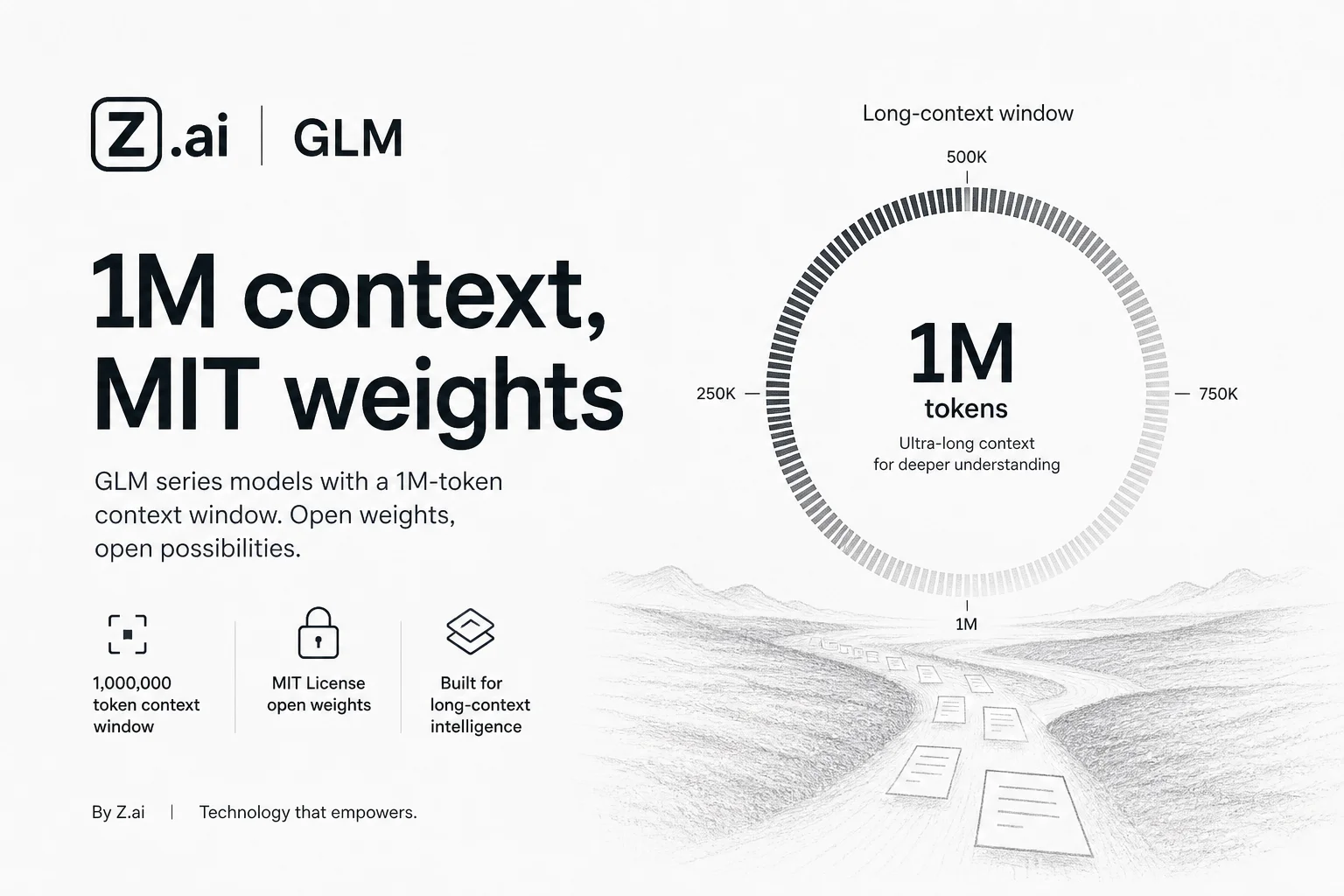
Z.ai (Zhipu AI) shipped GLM-5.2 on June 13, 2026, one day after the US Commerce Department forced Anthropic to pull Claude Fable 5 and Mythos 5 offline worldwide.
The timing was not subtle. Zhipu founder Jie Tang opened the launch by calling sudden restrictions on frontier models "deeply regrettable." Whether you read that as politics or product marketing, the builder takeaway is the same: a million-token MIT model landed the week US export controls rewrote everyone's routing spreadsheet.
NVIDIA NIM model card for GLM-5.2What changed from GLM-5.1
GLM-5.2 is not a patch release. The headline upgrades:
| Feature | GLM-5.1 | GLM-5.2 |
|---|---|---|
| Context window | 200K | 1M tokens |
| Thinking modes | Single setting | High and Max effort |
| Max output | Shorter caps | Up to 131K+ tokens per response |
| License | Open weights | MIT (weights on Hugging Face) |
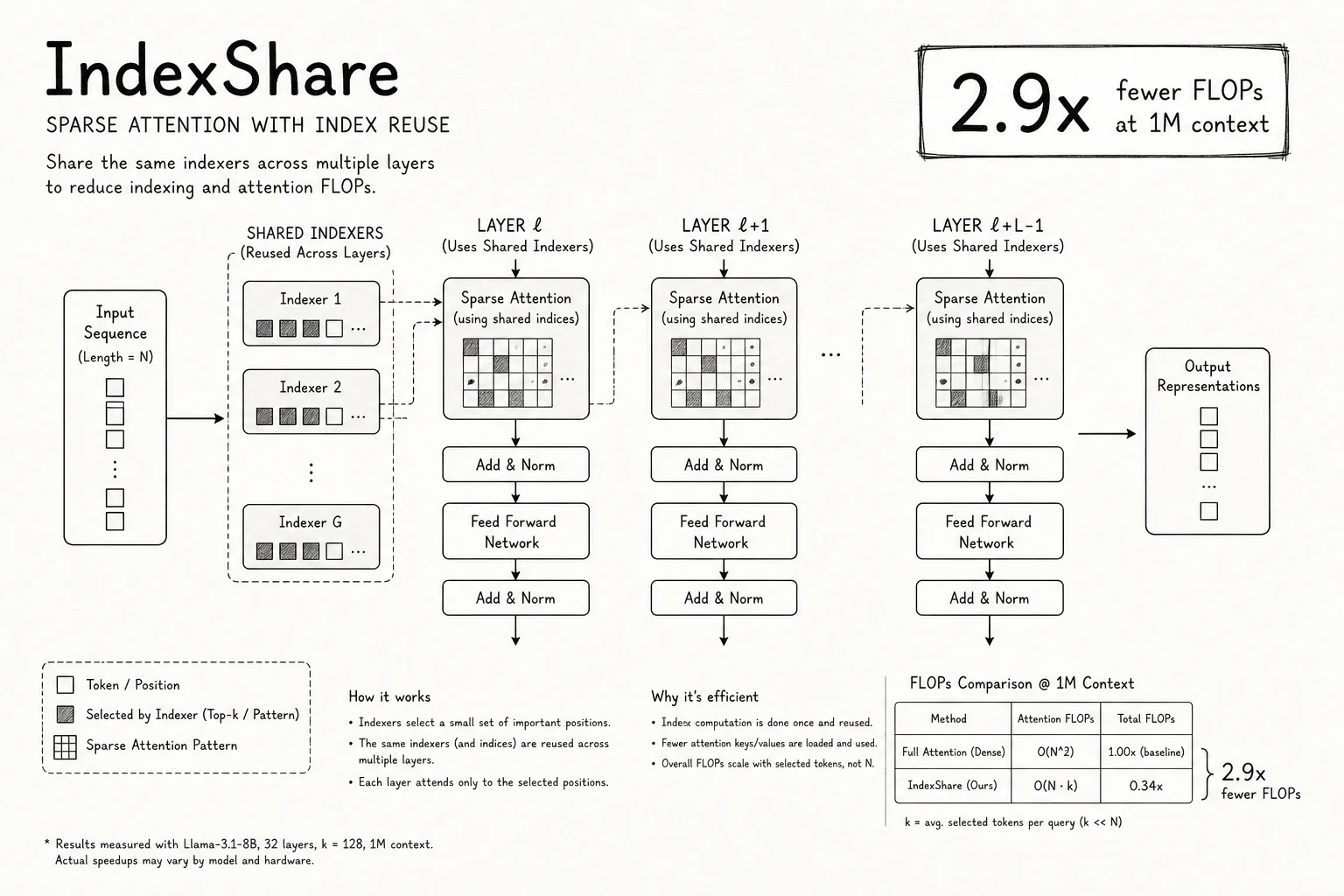
| Architecture note | MoE baseline | IndexShare sparse attention |
IndexShare reuses indexers across sparse attention layers. NVIDIA's model card cites roughly 2.9x lower per-token FLOPs at 1M context versus standard attention at that length. That matters because "1M context" is useless if latency and cost explode linearly.
Model specs at a glance
| Spec | GLM-5.2 |
|---|---|
| Provider | Z.ai / Zhipu AI |
| Total parameters | ~744B (MoE) |
| Active parameters | ~40B per token |
| Experts | 384 (MoE) |
| Context | 1,048,576 tokens |
| Training stack | Huawei Ascend 910B (MindSpore), 28.5T tokens cited |
| Vision | Text-only |
| API pricing (Z.ai docs) | ~$1.40 / $4.40 per M input / output; cached input ~$0.26 |
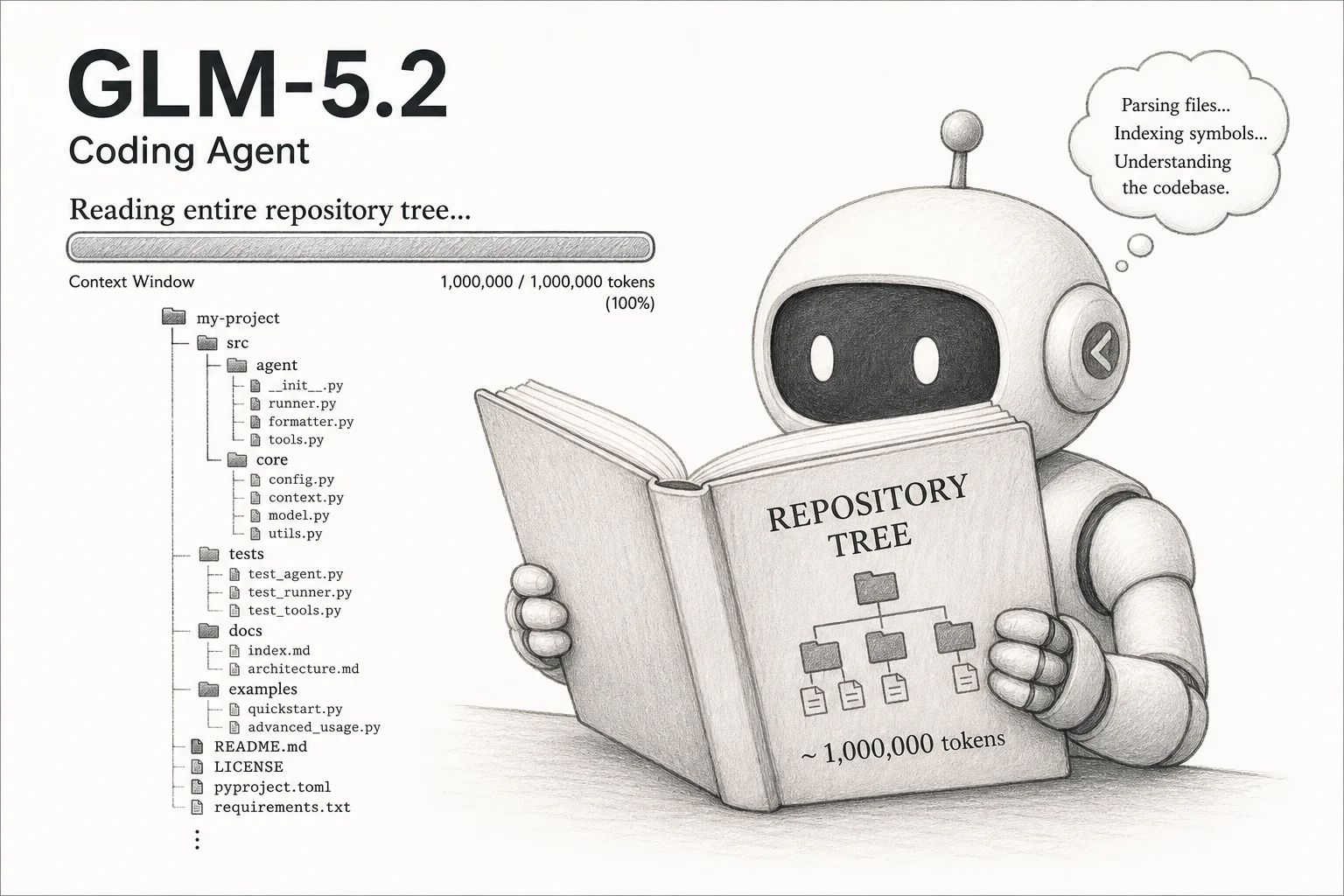
GLM-5.2 targets long-horizon coding and agentic workflows: whole-repo refactors, marathon debugging sessions, multi-file edits without aggressive context truncation.
Benchmark claims (vendor-run)
Z.ai's launch blog and NVIDIA's NIM card list scores across reasoning, coding, and agent benchmarks. Independent harnesses were still catching up when the model dropped.
| Benchmark (reported) | GLM-5.2 (approx.) | Notes |
|---|---|---|
| SWE-bench Pro | ~62.1 | Long-horizon software engineering |
| Terminal-Bench 2.1 | ~81.0 | Shell / terminal automation |
| MCP-Atlas | Competitive with frontier tier | Agent tool use |
| BridgeBench Reasoning | #1 at ~42.8 (Z.ai claim) | Vendor leaderboard |
Compare those to Claude Opus 4.8 and GPT-5.5 only after third-party runs on your harness. Vendor tables are marketing until they are not.
zai-org/glm-5.2 on Hugging FaceWhere to run it today
Access paths mentioned in launch coverage:
- GLM Coding Plan ($10 to $80/month tiers) with automatic upgrade to 5.2
- Eight coding agents on day one (Claude Code, Cline, Roo Code, and others in partner lists)
- Z.ai API and chatbot (mid-June 2026 rollout for standalone token billing)
- Self-host MIT weights when VRAM and ops budget allow
Supported agent integrations matter because long-horizon scores assume a harness, not raw chat completions.
Why 1M context is an ops decision, not a flex
I have seen teams buy 1M context and still feed the model 8K tokens because their RAG pipeline never changed. GLM-5.2 only helps if you re-architect for whole-repo reasoning:
- Stable system prompts at the front of context (KV cache friendly if you reuse prefixes).
- File routing so you do not dump the entire monorepo every turn.
- Exit criteria so Max thinking mode does not run forever on trivial edits.
- Fallback tier when MIT self-hosting is down for maintenance.
That last row connects back to the Fable 5 episode. Open weights reduce vendor lock-in and some policy risk, but you still need runbooks when your cluster misbehaves.
Pricing versus US frontier tiers
Launch coverage repeatedly cited GLM-5.2 at roughly one tenth the cost of comparable US frontier API tiers, bundled into affordable coding subscriptions.
Even if the ratio moves, the direction is clear: specialized long-context coding models are commoditizing fast. My agentic coding model routing post argued cost per task beats hero models. GLM-5.2 is another data point on that curve.
| Scenario | My pick |
|---|---|
| Need MIT weights + 1M context for air-gapped agents | GLM-5.2 self-host |
| Already on GLM Coding Plan | You likely have 5.2 already |
| Highest-stakes security review, US-only vendor | Keep tested Claude / OpenAI tier with failover |
| Export-control shock recovery | Open-weight tier + US API tier in parallel |
What I am watching before I recommend default swaps
- Independent SWE-bench Pro runs on GLM-5.2 with public harness configs.
- IndexShare quality at 800K+ tokens (does retrieval actually hold?)
- Agent partner support beyond launch-week announcements.
- Compliance: MIT weights do not automatically solve data residency; your hosting region still matters.
GLM-5.2 does not erase the need for US frontier models in every stack. It does give builders a credible open-weight answer when policy or pricing makes single-vendor bets feel fragile.
If you want help designing a dual-provider coding agent with GLM-5.2 failover, book a free discovery call.