
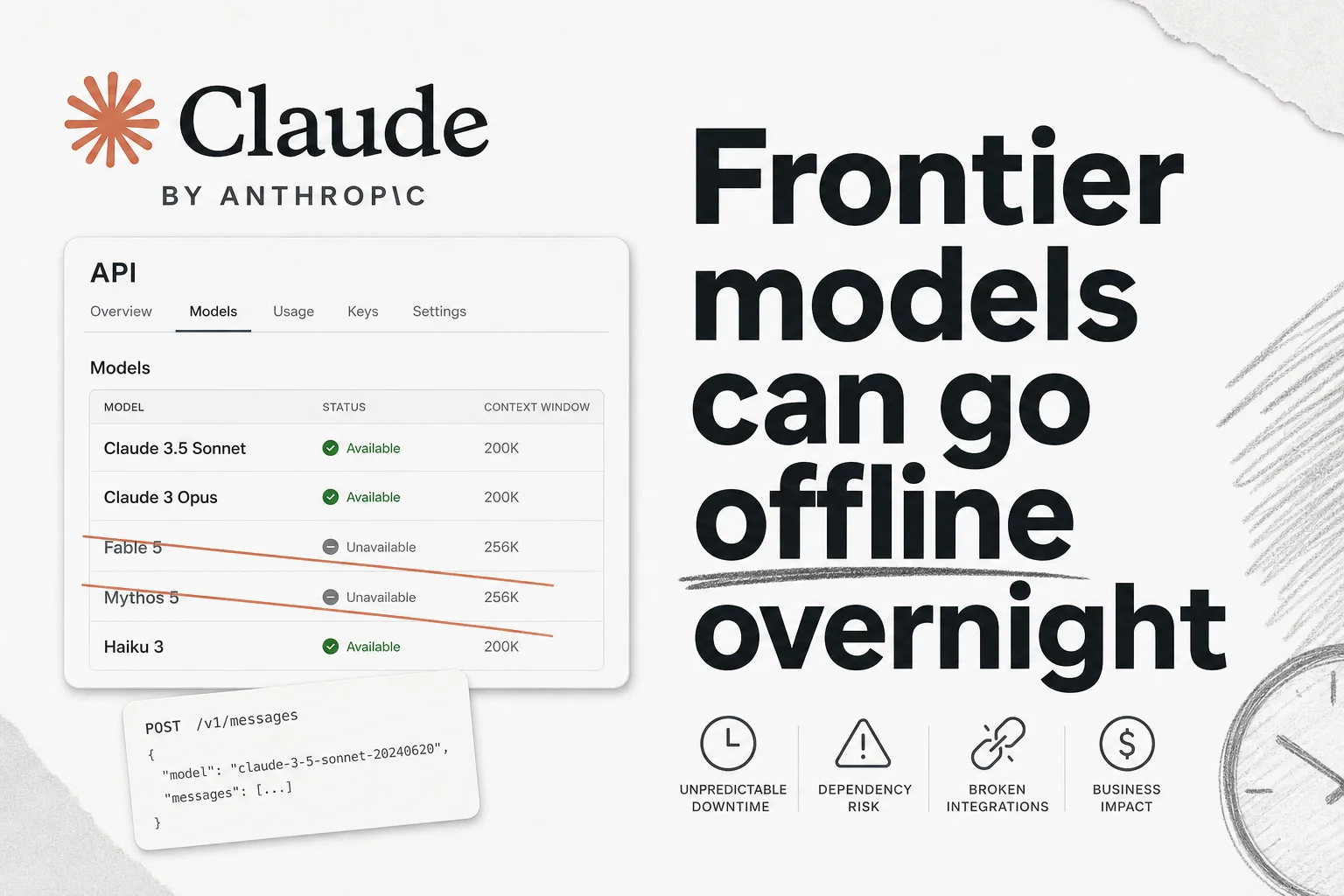
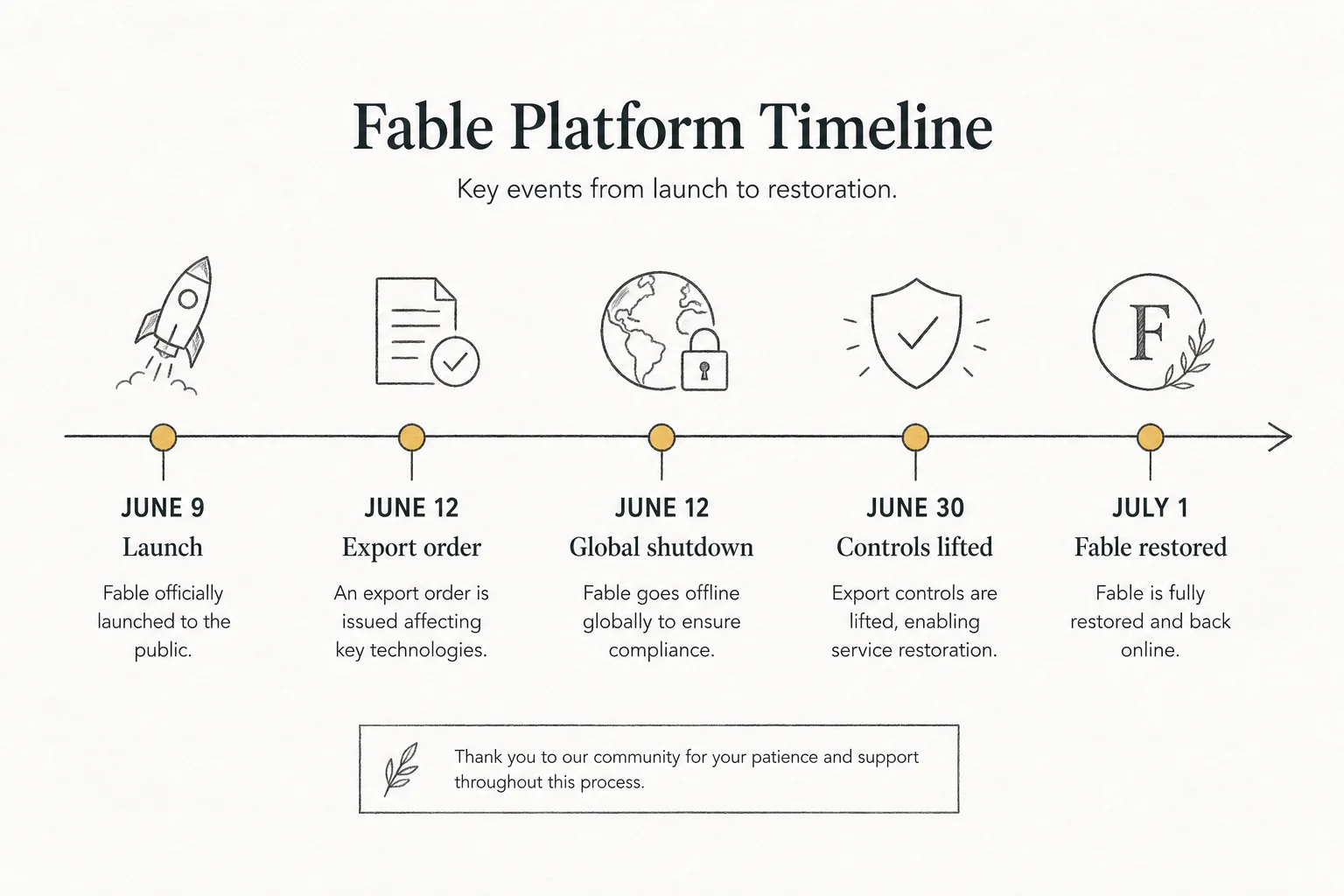
On June 12, 2026, at 5:21 PM ET, Anthropic got a letter from the US government. By evening, Claude Fable 5 and Mythos 5 were offline for every customer on Earth.
That is not a billing outage or a bad deploy. It is the first time I can remember a frontier model getting pulled mid-rollout because export control law met API reality. If your product hard-coded claude-fable-5 as the only brain, you learned a hard lesson that week.
What the order actually required
Export controls usually show up in chip and hardware stories. This one targeted two model SKUs:
| Model | Role | Safeguards |
|---|---|---|
| Claude Fable 5 | General release on Claude Platform, Claude.ai, Claude Code | Strong public safeguards |
| Claude Mythos 5 | Restricted Glasswing cybersecurity partners | Fewer safeguards, defensive use only |
The directive told Anthropic to suspend access for any foreign national, whether they sat in Berlin or in Anthropic's own San Francisco office. Anthropic's public write-up says the letter did not spell out every technical detail, but the company's understanding was that regulators had seen a jailbreak path for Fable 5.
Anthropic reviewed a demonstration where the bypass surfaced minor, previously known software vulnerabilities. The company argued other public models could find similar issues without a special bypass. Regulators still wanted the models offline immediately.
If you cannot verify citizenship at request time, "block foreign nationals only" becomes "block everyone." That is compliance math, not product preference.
What stayed up (and what did not)
During the suspension window:
| Status | Models / surfaces |
|---|---|
| Offline | Claude Fable 5, Claude Mythos 5 |
| Still running | Other Claude tiers (Opus, Sonnet, Haiku families), Claude Code on non-Fable defaults, most enterprise routes |
Alpha Signal's digest framed the practical takeaway well: apps on Sonnet or Opus kept working. Apps pinned to Fable 5 or Mythos 5 needed a swap now, not after a graceful deprecation window.
That distinction matters for agent routers. Many teams treat the newest SKU as default because benchmarks say so. Policy risk is now part of that default choice.
Why nationality checks broke the API model
SaaS inference does not look like shipping a GPU to a foreign buyer. It looks like HTTPS and a bearer token.
Anthropic's compliance path was blunt: no reliable real-time nationality verification, so global cutoff. Reuters and DeepLearning.AI's Batch both reported the same constraint in the days after June 12.
For builders, the lesson is operational:
- Model strings are not stable infrastructure. Treat flagship SKUs like volatile dependencies.
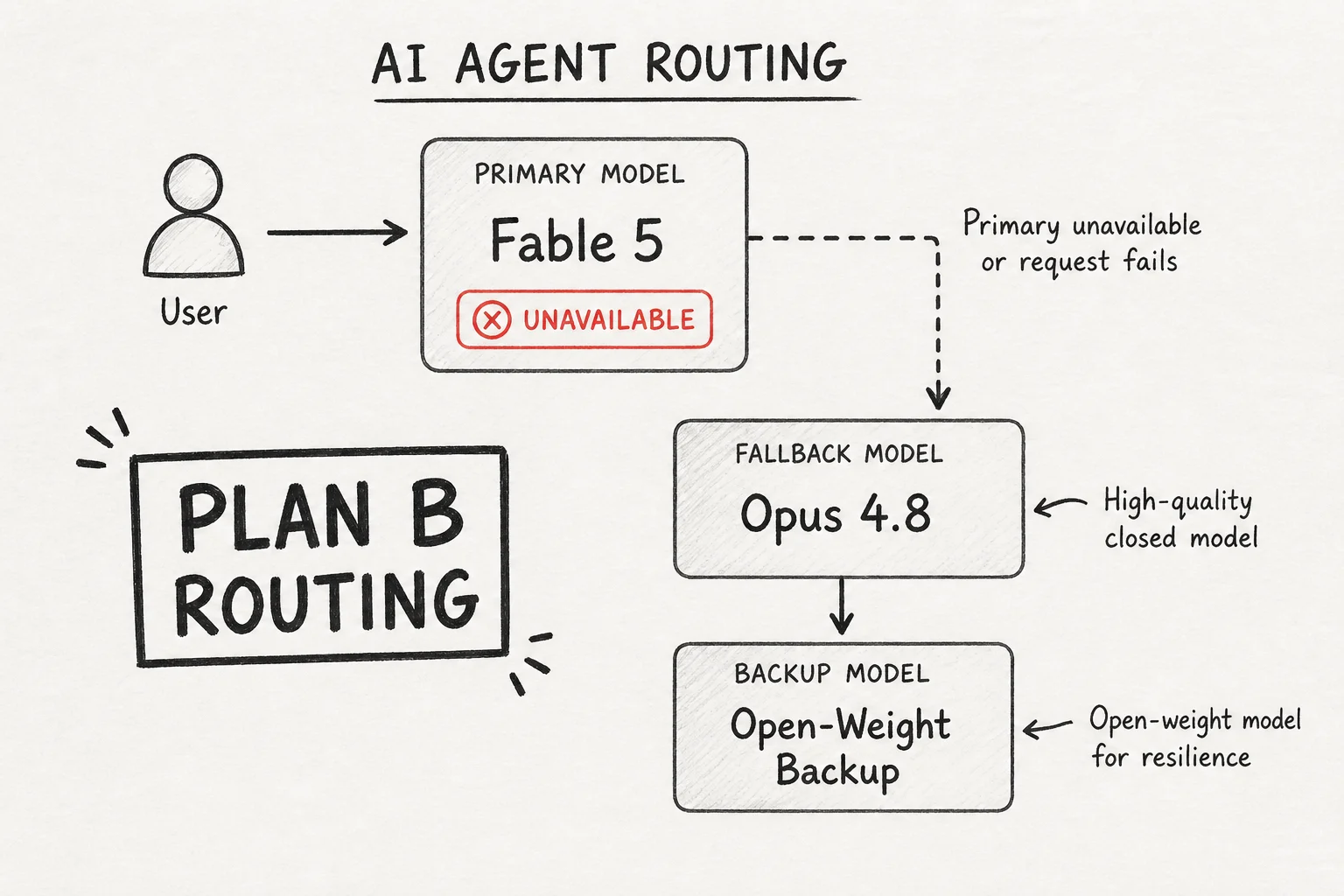
- Keep a fallback tier wired in code, not in a runbook nobody opens at 6 PM Friday.
- Log which model answered each task so you can replay traffic after a forced downgrade.
I have been routing client agents this way since early 2026. The Fable episode is the case study I send when someone asks why we keep two providers in production.
The jailbreak story and the redeploy
Anthropic's June 30 redeployment post adds detail the first letter lacked. Amazon researchers reported a method to bypass Fable 5 safeguards and surface vulnerabilities, including exploit demonstration code in at least one case.
Anthropic worked with the government and partners on a response:
- A new safety classifier targeting the reported bypass behavior
- Blocked requests routed to Claude Opus 4.8 instead of failing silently
- A HackerOne channel for jailbreak reports on the restored models
Fable 5 returned globally on July 1, 2026. Mythos 5 came back for approved US organizations first, with broader Glasswing access still coordinated with regulators.
How I diversify before the next directive
This is not an anti-Anthropic take. I ship Claude in production weekly. It is a reminder that US policy can reach into your inference path faster than your sprint board.
| Layer | What I do |
|---|---|
| Routing | Primary + fallback model IDs per task class (coding, summarization, tool use) |
| Providers | At least two API vendors or one API plus self-hosted open weights for critical flows |
| Config | Feature flags for model strings, not hard-coded constants scattered in agents |
| Evals | Weekly smoke tests on fallback tiers so swaps are boring, not fire drills |
| Contracts | Customer comms that mention third-party model availability without over-promising a single SKU |
When GLM-5.2 and Kimi K2.7 Code dropped the same week with open weights, the timing was impossible to ignore. Open models do not solve every compliance question, but they give you a non-US-hosted escape hatch for some workloads.
What to watch next
Three signals I am tracking:
- Precedent: Will export-control logic spread beyond Mythos-class cyber models?
- Verification: Can any lab actually gate by nationality at API scale without global pauses?
- Routing products: More teams will productize multi-provider failover because of this episode, not because of benchmark FOMO.
If you are planning a single-model agent stack for 2026, walk through a Friday-night disable scenario first. The stack that survives that drill is the one worth shipping.
Need help wiring multi-model routing or open-weight fallbacks into a production agent? Book a free discovery call and we can map it to your actual traffic.