
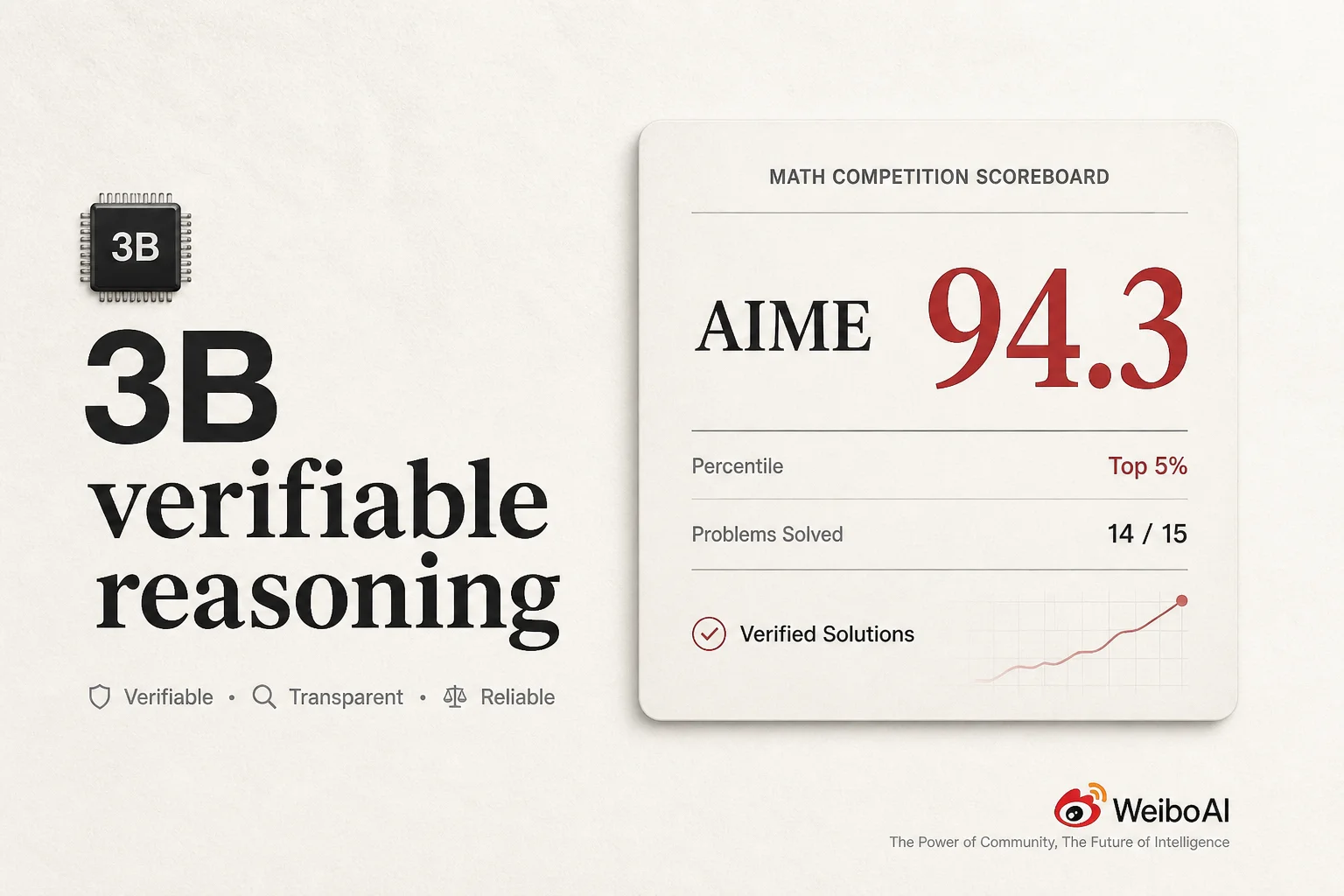
A 3-billion-parameter model tying GLM-5 on AIME26 sounds like engagement bait until you read the fine print. WeiboAI's VibeThinker-3B does not claim general Opus parity. It claims frontier-band performance on verifiable tasks: math, competition code, STEM with checkable answers.
The technical report (arXiv:2606.16140, June 15–16, 2026) is explicit. MIT weights. Built on Qwen2.5-Coder-3B. Trained with an upgraded Spectrum-to-Signal pipeline: curriculum SFT, multi-domain RL (MGPO), offline self-distillation, and instruction RL with rule-based validators.
The scorecard that matters
| Benchmark | VibeThinker-3B | + CLR test-time | DeepSeek V3.2 (671B) | Claude Opus 4.5 |
|---|---|---|---|---|
| AIME26 | 94.3 | 97.1 | 94.2 | 95.1 |
| HMMT25 | 89.3 | 95.4 | 90.2 | 92.9 |
| IMO-AnswerBench | 76.4 | 80.6 | 78.3 | 78.5 |
| LiveCodeBench v6 Pass@1 | 80.2 | n/a | 80.8 | 84.8 |
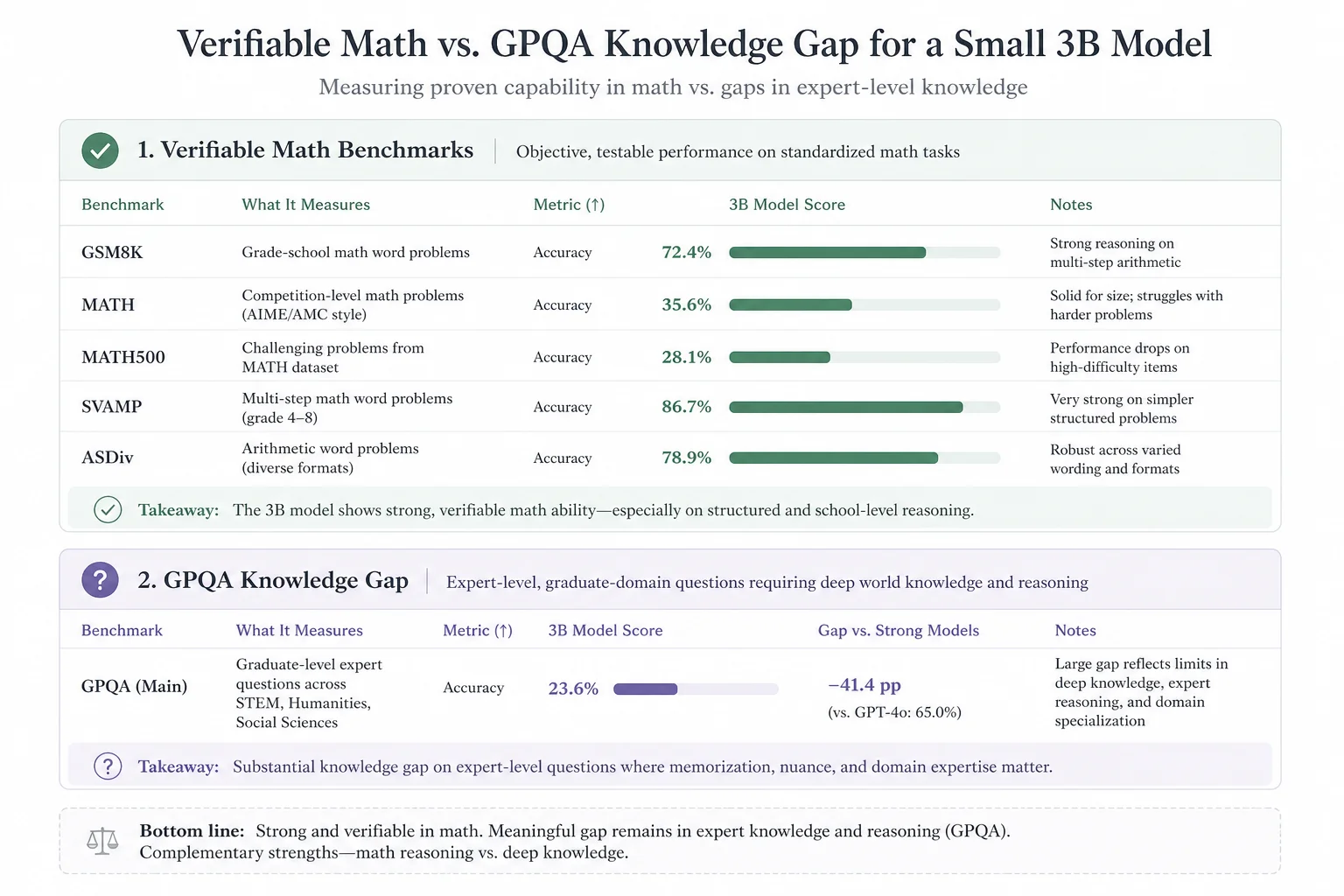
| GPQA-Diamond | 70.2 | 72.9 | 82.4 | 87.0 |
| IFBench | 74.5 | n/a | n/a | 58.0 |
CLR (Claim-Level Reliability Assessment) is test-time scaling for answer-verifiable problems. It buys +2–6 points on math rows without extra parameters. You pay in extra forward passes.
The pattern is consistent: competitive on math and structured code, weak on graduate science knowledge. WeiboAI frames that split as evidence for the Parametric Compression-Coverage Hypothesis. Verifiable reasoning compresses into a small dense core. Broad factual coverage needs parameter volume you cannot RL your way into.
The LeetCode row is the contamination defense
Static benchmarks invite memorization accusations. VibeThinker-3B's stronger signal is LeetCode weekly and biweekly contests from April 25 to May 31, 2026: 123 of 128 first-attempt Python submissions passed (96.1%).
Those contests postdate typical training cutoffs. Execution-verified, one-shot. The model is not merely matching a static distribution. It is solving unseen contest problems under hidden tests.
LiveCodeBench v6 still shows a real gap to frontier (80.2 vs 84.8–87.1 on larger models). Honest marketing would say "matches on many math rows, trails on hardest code panel." The digest headline oversimplifies. The paper does not.
Spectrum-to-Signal in plain language
VibeThinker-1.5B introduced the recipe. VibeThinker-3B scales it:
- SFT diversity: Generate a broad spectrum of solution attempts, then filter for quality
- MGPO RL: MaxEnt-guided policy optimization amplifies correct verifiable signals across math, code, and STEM sequentially
- Long-context preservation: Keep full reasoning trajectories during training (64K recommended at inference, up to 102K output tokens)
- Offline distillation + instruct RL: Consolidate without collapsing instruction-following (IFEval 93.4)
Reported post-training cost for the 1.5B predecessor was about $7,800 versus hundreds of thousands for some frontier RL runs. That economics story matters for teams who want a domain reasoner without a frontier lab budget.
Hardware and inference
| Format | VRAM (approx.) |
|---|---|
| FP16 | ~6.7 GB |
| INT4 GGUF | ~1.7 GB |
Community quants (GGUF, MLX) landed after launch. Recommended inference: vLLM 0.10.1 or SGLang ≥ 0.4.9, temperature 0.6–1.0, max tokens up to 40960, top_p 0.95.
vllm serve WeiboAI/VibeThinker-3B \
  --max-model-len 65536 \
  --tensor-parallel-size 1
No tool-calling or agent-native training. This is an inner-loop reasoner, not a drop-in replacement for Hermes or Claude Code orchestration.
Where to put a 3B verifier in production
Good fits:
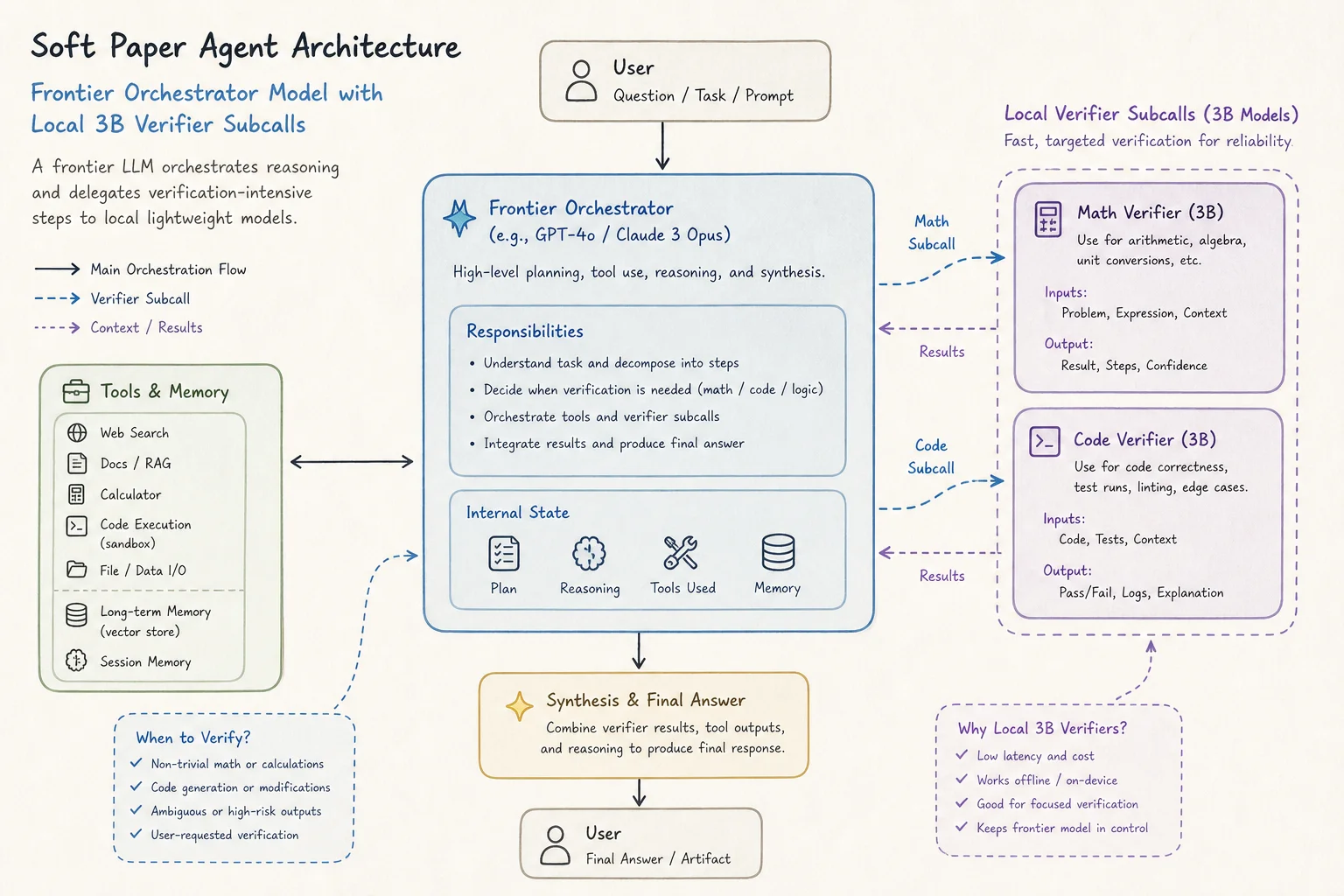
- Math or code steps inside a larger agent where outputs pass unit tests or symbolic checkers
- Edge or local loops that sample many candidates and keep passing ones
- Instruction-following with hard constraints (IFBench strength vs Opus 4.5 at 58.0)
Bad fits:
- Customer-facing general chat (GPQA gap of 15+ points vs frontier)
- Tool-heavy agents needing function calling
- "Replace Opus everywhere" strategies
Architecture pattern that works: frontier model routes and writes prose; VibeThinker-3B runs verifiable subcalls locally at millisecond-scale cost.
Open weights landscape context
VibeThinker-3B shipped days after US export restrictions on some Anthropic models. MIT release without regional limits is part of Zhipu/WeiboAI's open-weight strategy alongside GLM-5.2 and the wider Qwen ecosystem.
Kimi K3 and other models now lead some open leaderboards. VibeThinker-3B remains the practical pick when you want plain MIT licensing and a 3B footprint without custom commercial terms.
Independent reproduction is still thin. Treat self-reported numbers as strong signals, not contracts. Download weights, run your eval suite, watch the GPQA-shaped hole.
Bottom line
VibeThinker-3B is not a hummingbird that out-thought an empire on everything. It is a specialist that compresses verifiable reasoning into 3B parameters with open weights. The lesson for applied teams: separate reasoning you can check from knowledge you must store. Optimize each with different models.
Evaluating small open models for verifier loops in your agent stack? Book a free call. The right inner model often cuts API spend more than another context-window upgrade.