
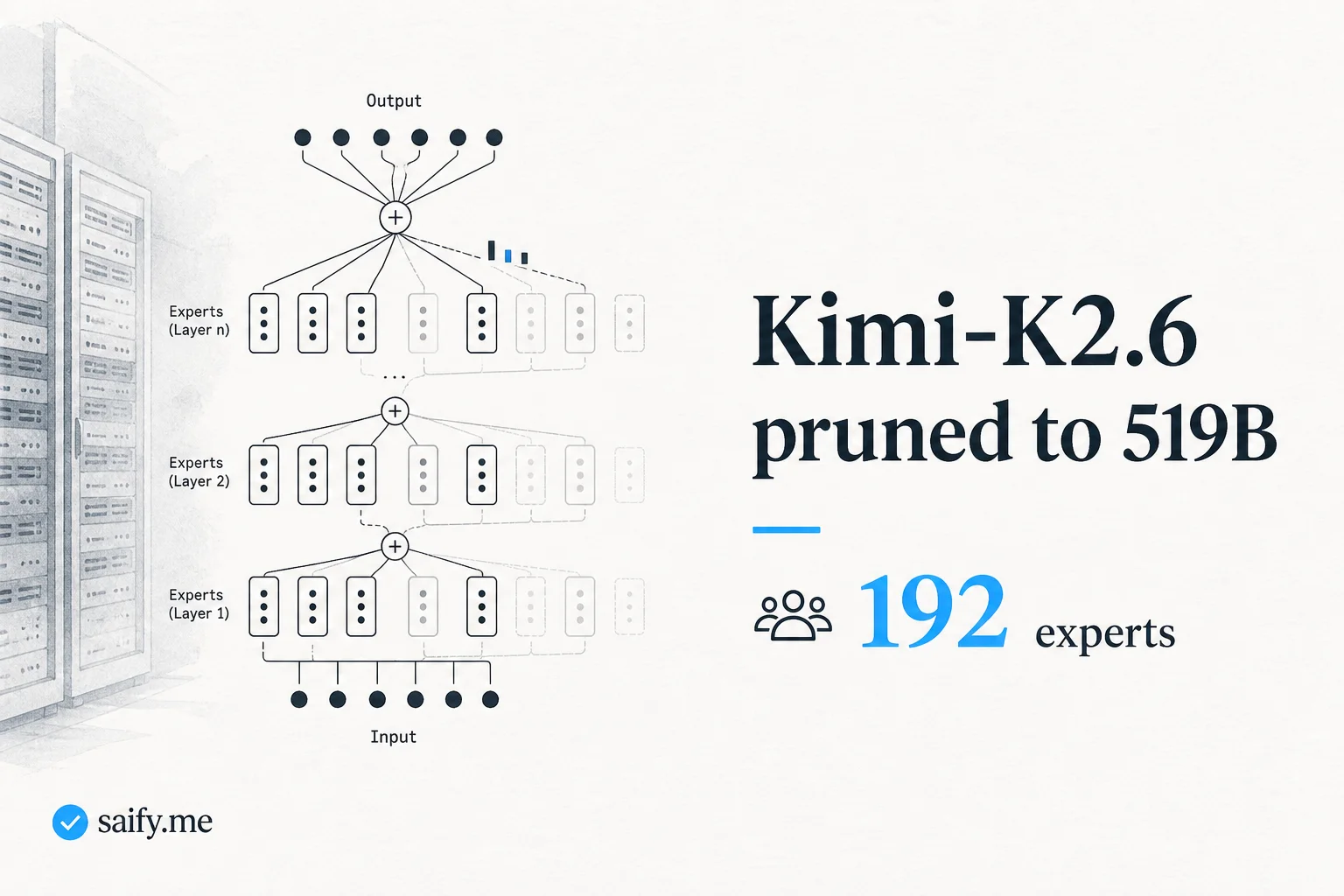
Bigger is not always cheaper to serve. Moonshot's Kimi-K2.6 family already pushes toward trillion-parameter MoE territory with multimodal and tool-use features. The interesting experiment this week is not the base model hype. It is a pruned NVFP4 checkpoint that asks a blunt question: how many experts can you delete before open-ended chat breaks, but structured agent work still wins?
0xSero released Kimi-K2.6-519B-NVFP4, derived from nvidia/Kimi-K2.6-NVFP4 using Cerebras REAP pruning semantics. The model card is refreshingly honest: alpha quality, repetition loops on long creative generation, and solid passes on JSON, Python, math, tool calls, and vision smoke tests.
What got pruned (and what stayed)
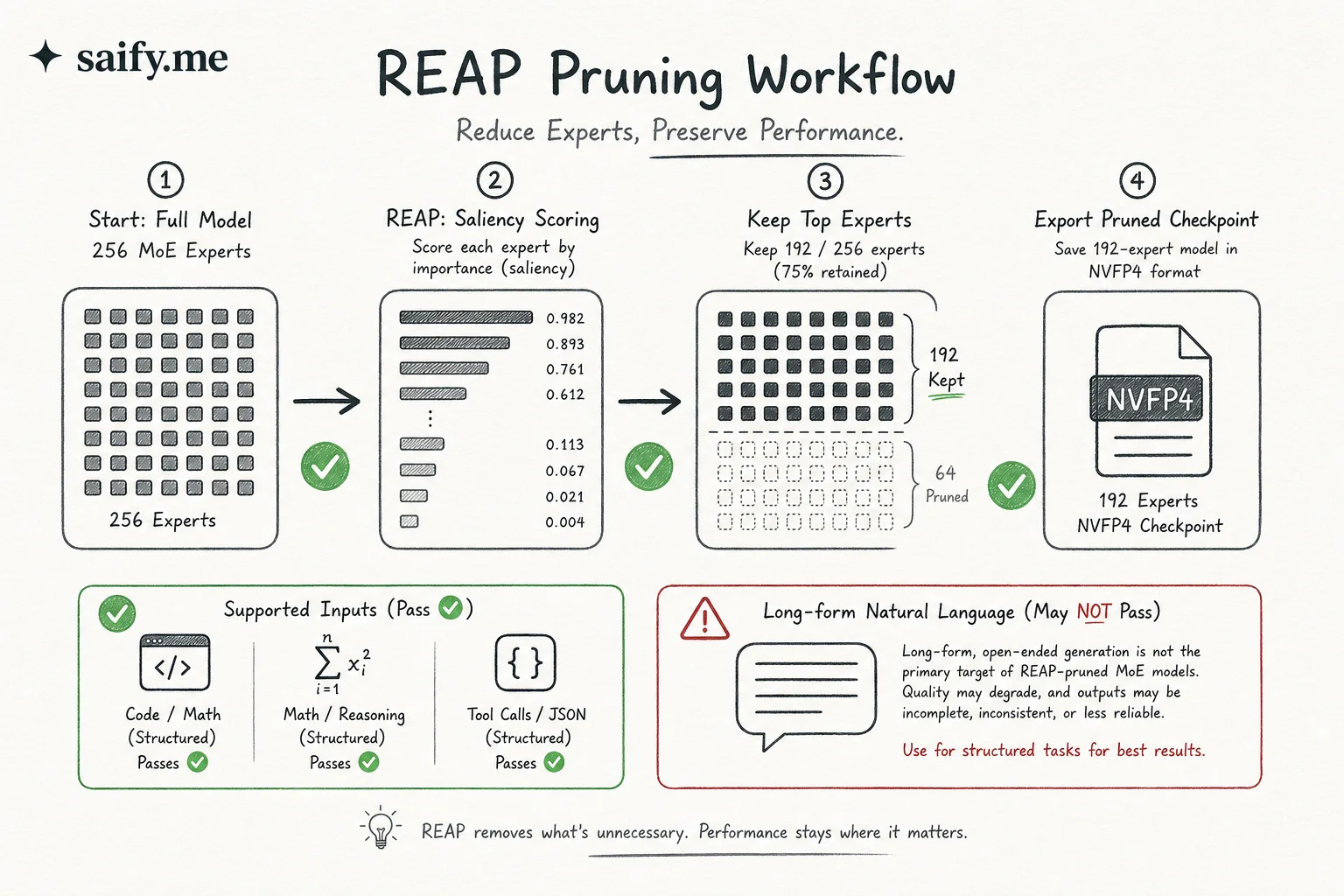
Kimi-K2.6 is a MoE stack. The pruned checkpoint keeps 192 routed experts (down from 256) using REAP saliency scoring on Kimi's calibration set (34.57M prompt tokens in the published notes). Gate weights and e_score_correction_bias rows were audited layer by layer against the source plan.
| Property | Full Kimi-K2.6 NVFP4 (NVIDIA quant) | 0xSero REAP pruned |
|---|---|---|
| MoE experts (routed) | 256 | 192 |
| Tool parser | kimi_k2 | kimi_k2 |
| Vision | Supported | Supported (smoke tested) |
| Open-ended long prose | Expected use case | Unstable (loop attractors) |
| Structured / agentic | Supported | Validated |
The model card's probe table is long: ASCII JSON, Unicode echo, subprocess-tested Python, 128k-250k context stability checks, and tool-call parsing all marked pass. That is the profile of a terminal agent backend, not a creative writing endpoint.
When pruning helps vs hurts
Pruning here is not random quantization noise. REAP ranks expert saliency and drops the lowest contributors while preserving survivor order semantics in the NVFP4 shard rewrite. Vision tensors, projector weights, tokenizer files, and chat templates were carried over intentionally.
Reliable modes (per the card):
- Structured JSON and schema-following outputs
- Tool and function calling with
kimi_k2parsers - Code and math with bounded
max_tokens - Short Q&A and agentic terminal tasks
Known failure mode:
Open-ended or long-form generation can collapse into repetition loops. Mitigations the author documents:
- Keep
max_tokenssane - Default
temperature=0andrepetition_penalty≈1.12 - Stop generation if a loop starts
- Restore pruned experts from the full NVIDIA checkpoint if you need creative prose (memory tradeoff)
If your product is "chat with users for ten paragraphs," use the full model. If your product is "call twelve tools and return JSON," this prune is worth benchmarking.
Serving: SGLang on four Blackwell GPUs
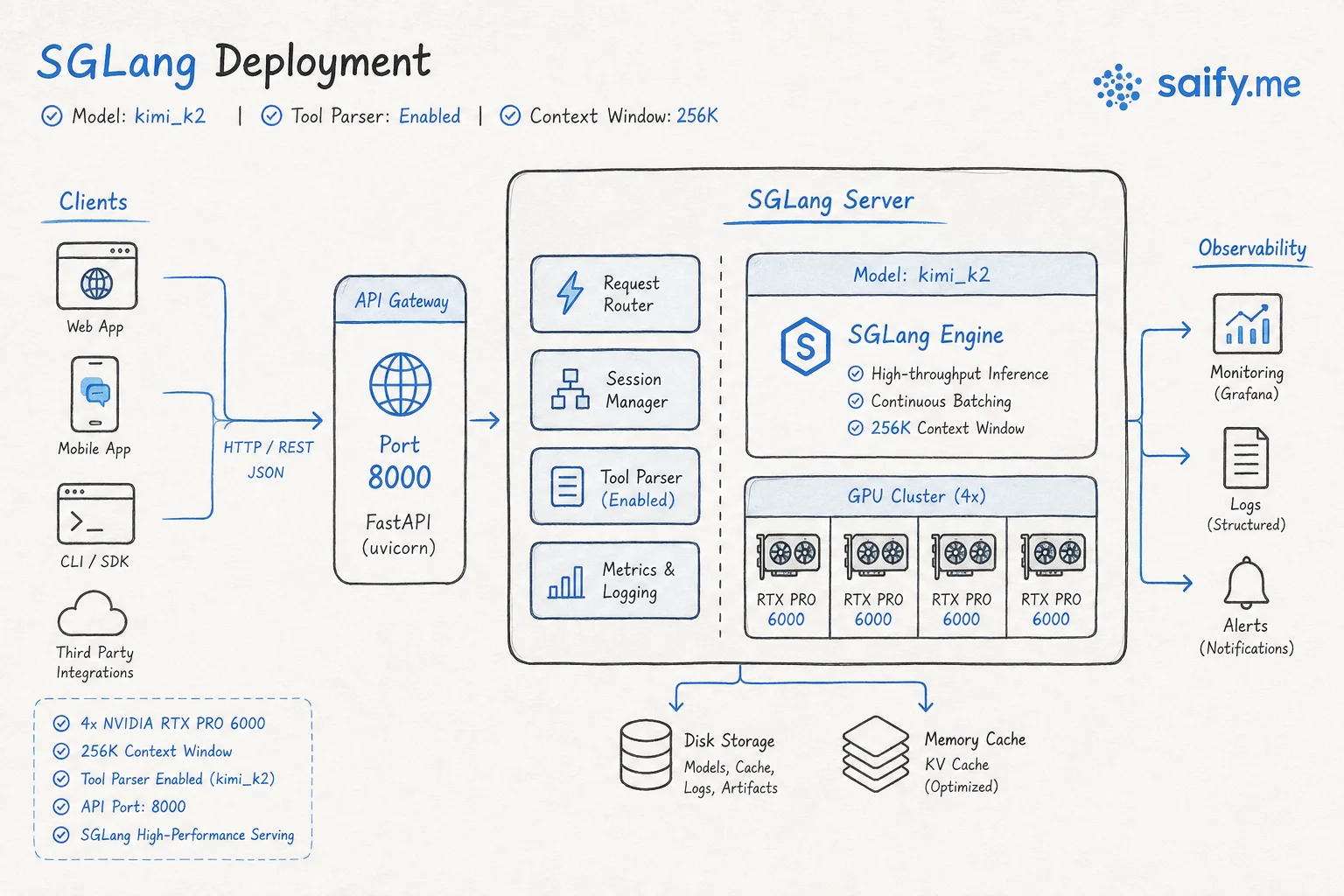
0xSero also ships a minimal Docker deployment: kimi-k2-6-nvfp4-sglang. Verified settings (from the README):
| Setting | Value |
|---|---|
| Engine | SGLang v0.5.12.post1 |
| Quantization | modelopt_fp4 / NVFP4 |
| Context | 262,144 tokens |
| Tensor parallel | 4 |
| GPUs tested | 4x RTX PRO 6000 Blackwell |
| Tool-call parser | kimi_k2 |
| Reasoning parser | kimi_k2 |
Kimi's chat template enables thinking by default. Short answers may land tokens in reasoning_content first. Budget enough max_tokens for the final answer, not just the scratchpad.
vLLM is also documented on the NVIDIA base quant:
python3 -m vllm.entrypoints.openai.api_server \
  --model nvidia/Kimi-K2.6-NVFP4 \
  --tensor-parallel-size 4 \
  --tool-call-parser kimi_k2 \
  --reasoning-parser kimi_k2 \
  --trust-remote-code
Swap the model path to 0xSero/Kimi-K2.6-519B-NVFP4 when you want the pruned weights.
How I would eval before production
Do not trust probe tables alone. Run your tool schema and your worst prompts.
- Tool-call fidelity: 50 real function signatures from your agent. Measure parse success and argument JSON validity.
- Multimodal smoke: If you pass screenshots (UI bugs, PDF pages), test vision+tool chains separately from text-only.
- Context stretch: Replay a 30-turn agent trace. Watch TTFT and memory at 64k, 128k, and your production ceiling.
- Degeneracy watch: Deliberately ask for 4k-token essays. Confirm you hit loops and that your stop heuristics catch them.
- Cost per successful task: Compare pruned vs full NVFP4 on the same agent benchmark (SWE-bench slice, internal ticket resolver, etc.).
FriendliAI and other hosts already list the pruned checkpoint for API inference if you do not want to operate four Blackwell cards yourself.
Practical takeaway
Pruned MoE is a knob for agent economics: fewer active experts, smaller memory footprint, faster inference, as long as you stay inside bounded, structured workloads. 0xSero's checkpoint is an early, transparent experiment with clear guardrails. Treat the repetition-loop warning as a product requirement, not a footnote.
If you are routing models for agentic coding or ops automation and want help designing evals that catch degeneracy before users do, book a free discovery call.