
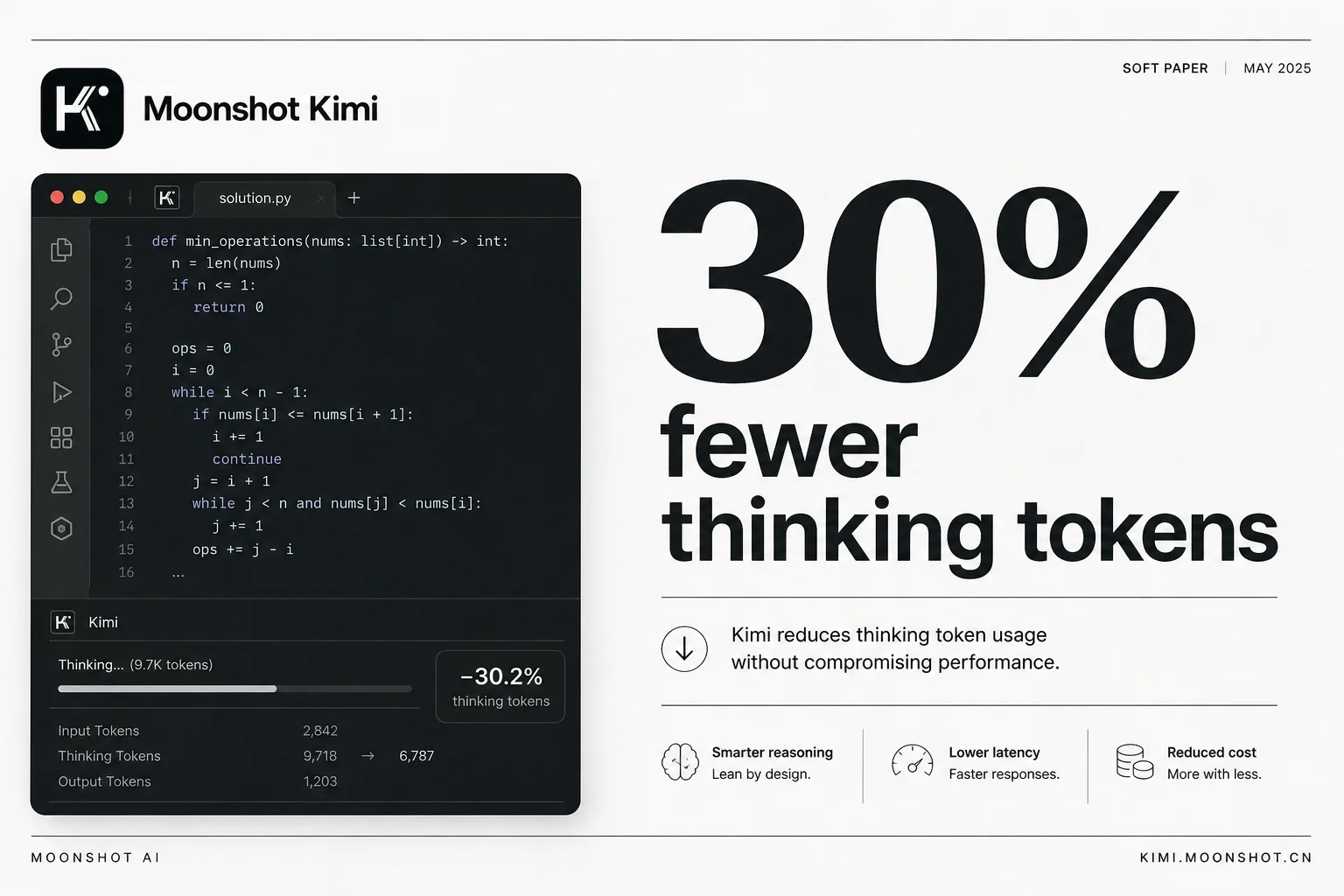
Moonshot AI did not win the June 2026 coding model news cycle with a bigger parameter count. Kimi K2.7 Code is still a 1 trillion parameter MoE with 32B active per token. The win is efficiency: about 30% fewer thinking tokens than K2.6 on the same long-horizon jobs, plus double-digit jumps on Moonshot's coding benches.
That is the trade I want for client agent loops where every reasoning token shows up on the invoice.
Official Kimi K2.7 Code product pageBuilt for agent loops, not chat demos
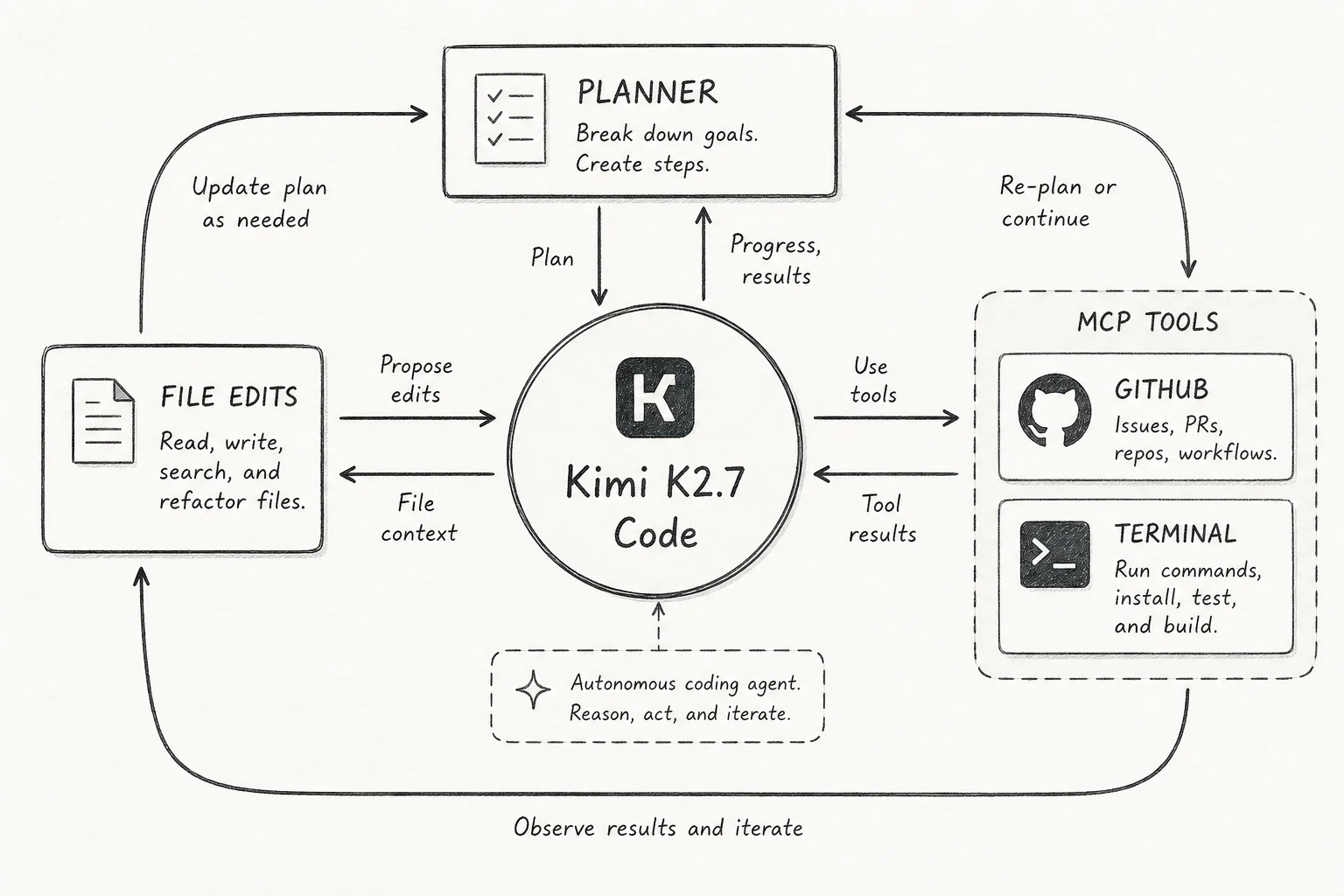
K2.7 Code is not a general assistant rebrand. Moonshot targets long-horizon software engineering: plan a fix, touch multiple files, run tools, read stderr, patch again.
The digest highlighted the real-world shape: bugs that span ten files, not one-shot completions. That matches what I see in production coding agents. Success is end-to-end task completion, not a pretty single-file diff.
| Spec | Kimi K2.7 Code |
|---|---|
| Architecture | MoE, 61 layers, MLA attention |
| Total params | ~1T |
| Active params | 32B per token |
| Context | 256K tokens |
| Vision | MoonViT 400M encoder |
| License | Modified MIT (weights on Hugging Face) |
| Thinking mode | Required (cannot disable) |
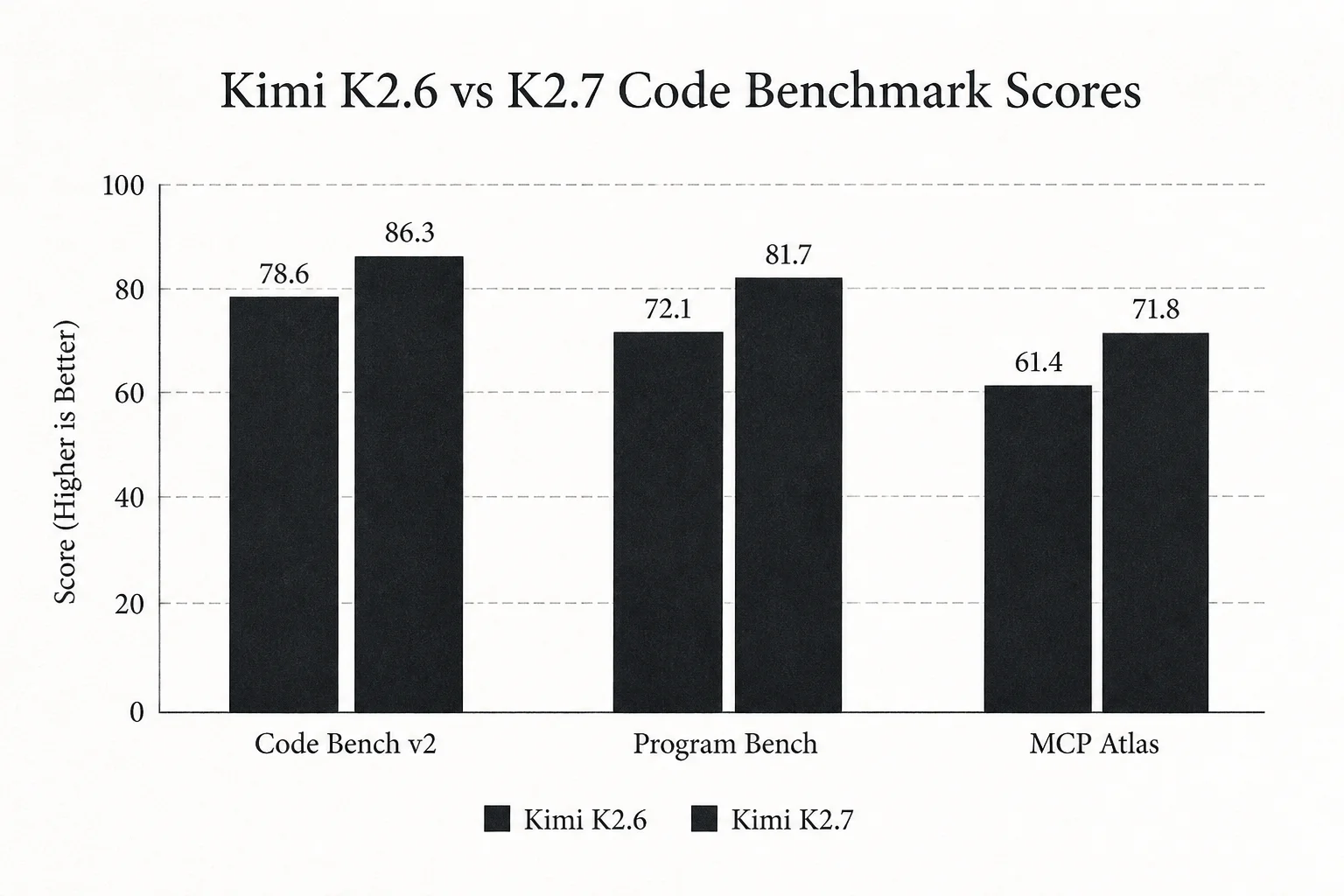
Benchmark table (vendor-run, June 2026)
Moonshot published six rows comparing K2.7 Code to K2.6, GPT-5.5, and Claude Opus 4.8. Treat these as directional until independent harnesses reproduce them.
| Benchmark | K2.6 | K2.7 Code | GPT-5.5 | Opus 4.8 | K2.7 vs K2.6 |
|---|---|---|---|---|---|
| Kimi Code Bench v2 | 50.9 | 62.0 | 69.0 | 67.4 | +21.8% |
| Program Bench | 48.3 | 53.6 | 69.1 | 63.8 | +11.0% |
| MLS Bench Lite | 26.7 | 35.1 | 35.5 | 42.8 | +31.5% |
| Kimi Claw 24/7 Bench | 42.9 | 46.9 | 52.8 | 50.4 | +9.3% |
| MCP Atlas | 69.4 | 76.0 | 79.4 | 81.3 | +9.5% |
| MCP Mark Verified | 72.8 | 81.1 | 92.9 | 76.4 | +11.4% |
Two rows matter most for my work:
- Kimi Code Bench v2 for repo-scale coding quality.
- MCP Mark Verified for tool-using agents (Notion, GitHub, Postgres, Playwright, and similar).
K2.7 Code still trails Opus 4.8 and GPT-5.5 on several rows. The story is better price-performance inside Moonshot's harness, not "beats every closed frontier on everything."
moonshotai/Kimi-K2.7-Code on Hugging FaceAPI pricing and where to run it
Moonshot lists Kimi API pricing at $0.95 / $4.00 per million input / output tokens, with cached input around $0.19 per million on some surfaces. Microsoft Foundry published similar global standard rates when it added K2.7 Code in July 2026.
Access paths:
- Kimi Code (default model in the subscription IDE)
- Kimi API (OpenAI-compatible, model string
kimi-k2.7-code) - Self-host via vLLM, SGLang, or KTransformers (weights ~595 GB on disk per community notes)
curl https://api.moonshot.ai/v1/chat/completions \
  -H "Authorization: Bearer $MOONSHOT_API_KEY" \
  -H "Content-Type: application/json" \
  -d '{
    "model": "kimi-k2.7-code",
    "messages": [{"role": "user", "content": "Plan a multi-file refactor..."}]
  }'
Moonshot warns not to override fixed sampling parameters on the official API, or requests error. Read their deployment guide before you fork temperature knobs.
Why 30% fewer thinking tokens matters in production
Thinking models are great until finance asks why turn 40 of a coding agent costs more than turn 1.
If K2.7 Code really cuts thinking overhead ~30% versus K2.6 at similar task success, that is not a leaderboard flex. It is margin on autonomous loops. Same pattern I wrote about in agentic coding model routing: cost per finished task beats bragging rights.
My routing heuristic after this release:
| Workload | Route |
|---|---|
| High-volume refactors, MCP tool loops | Try K2.7 Code API or self-host |
| Novel architecture, weak eval coverage | Keep a frontier closed model in reserve |
| Client needs data residency / air gap | Self-host Modified MIT weights |
Composer 2.5 still wins some of my Cursor-native workflows because the harness co-evolved with the model. K2.7 Code is the open-weight option I reach for when a client wants API or self-host flexibility without dropping out of agentic coding entirely.
Connection to the Fable 5 shutdown week
K2.7 Code dropped June 12, the same day Anthropic pulled Fable 5 and Mythos 5 globally. Moonshot did not need to say the quiet part out loud. When frontier US SKUs can vanish overnight, open-weight coding models stop looking like hobbyist toys.
I am not replacing Claude everywhere. I am making sure every production agent has a tested second string that is not tied to a single government's export control letter.
What I would test before you switch defaults
- Your harness, not Moonshot's. Run 20 real tickets from your backlog.
- Tool schemas frozen across turns so you measure model quality, not prompt drift.
- Cost per merged PR, not cost per million tokens in isolation.
- Fallback path if API latency spikes during US evening hours.
If those four look good, K2.7 Code belongs in your router next to whatever frontier tier you trust today.
Want help benchmarking K2.7 Code against your repo and MCP tools? Book a free discovery call.