
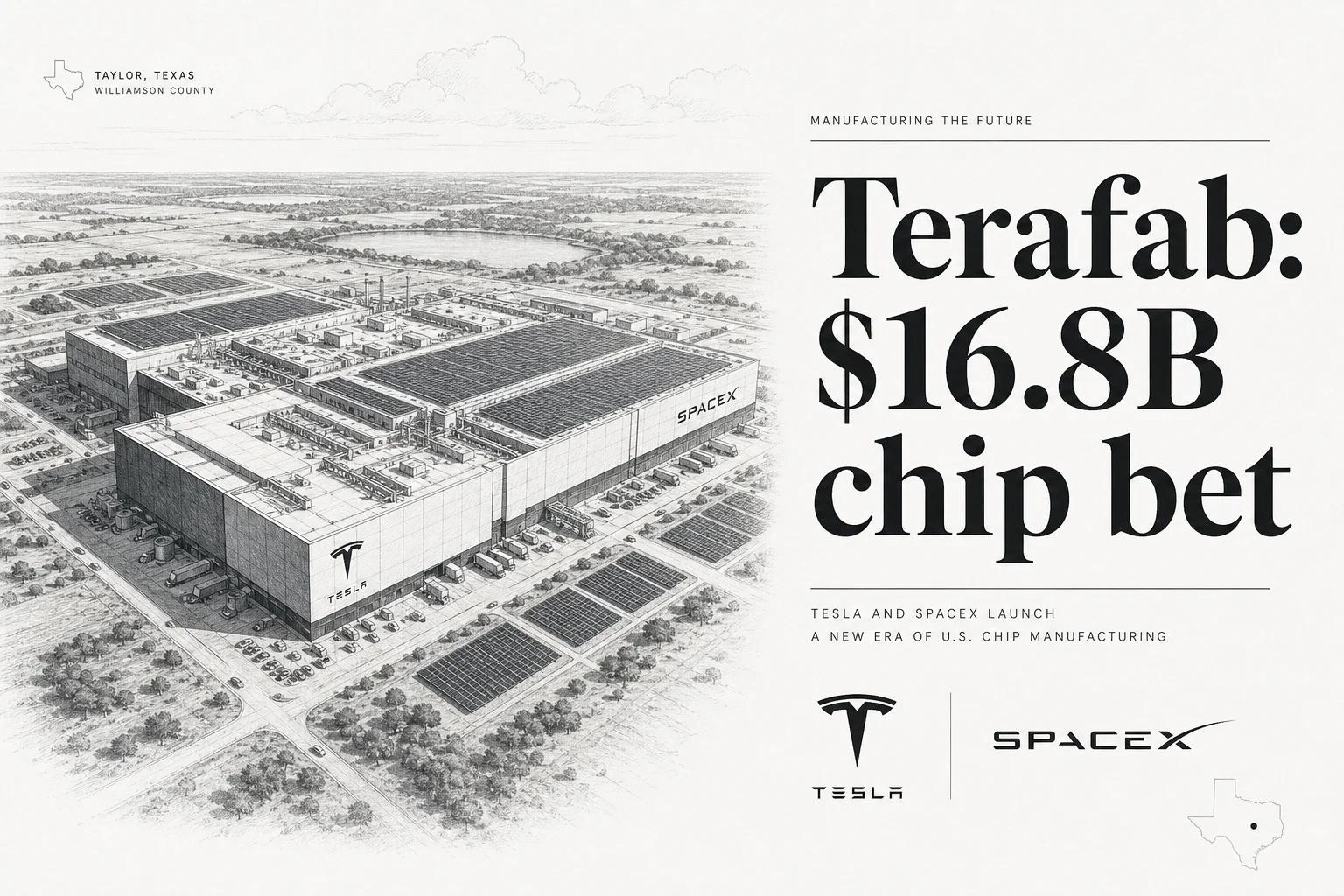
Tesla and SpaceX just put a county on the map. On August 6, 2026, both companies confirmed that Terafab, their jointly planned semiconductor megafactory, will be built in Grimes County, Texas, with an initial investment of $16.8 billion.
Elon Musk called it "the largest and most valuable building on Earth by far." SpaceX says the finished site could span more than 100 million square feet. For scale, Tesla's Gigafactory Texas is roughly 10 million square feet.
I do not run chip fabs. I do run inference for clients who care about latency, uptime, and whether their model bill doubles when traffic spikes. Terafab is not a niche semiconductor story. It is a vertical-integration play for the entire AI stack, from robot edge chips to orbital data-center silicon.
What Terafab is actually building
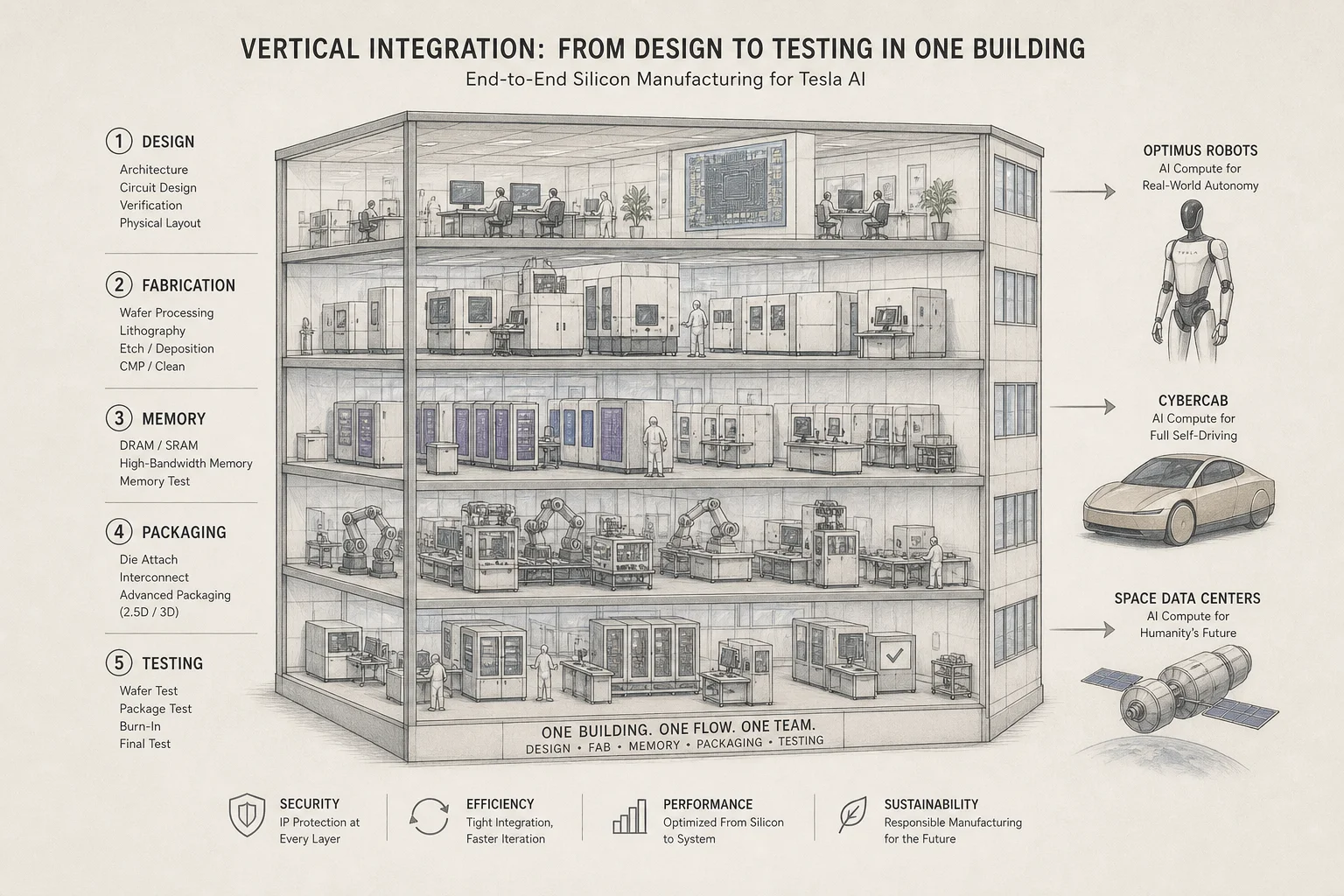
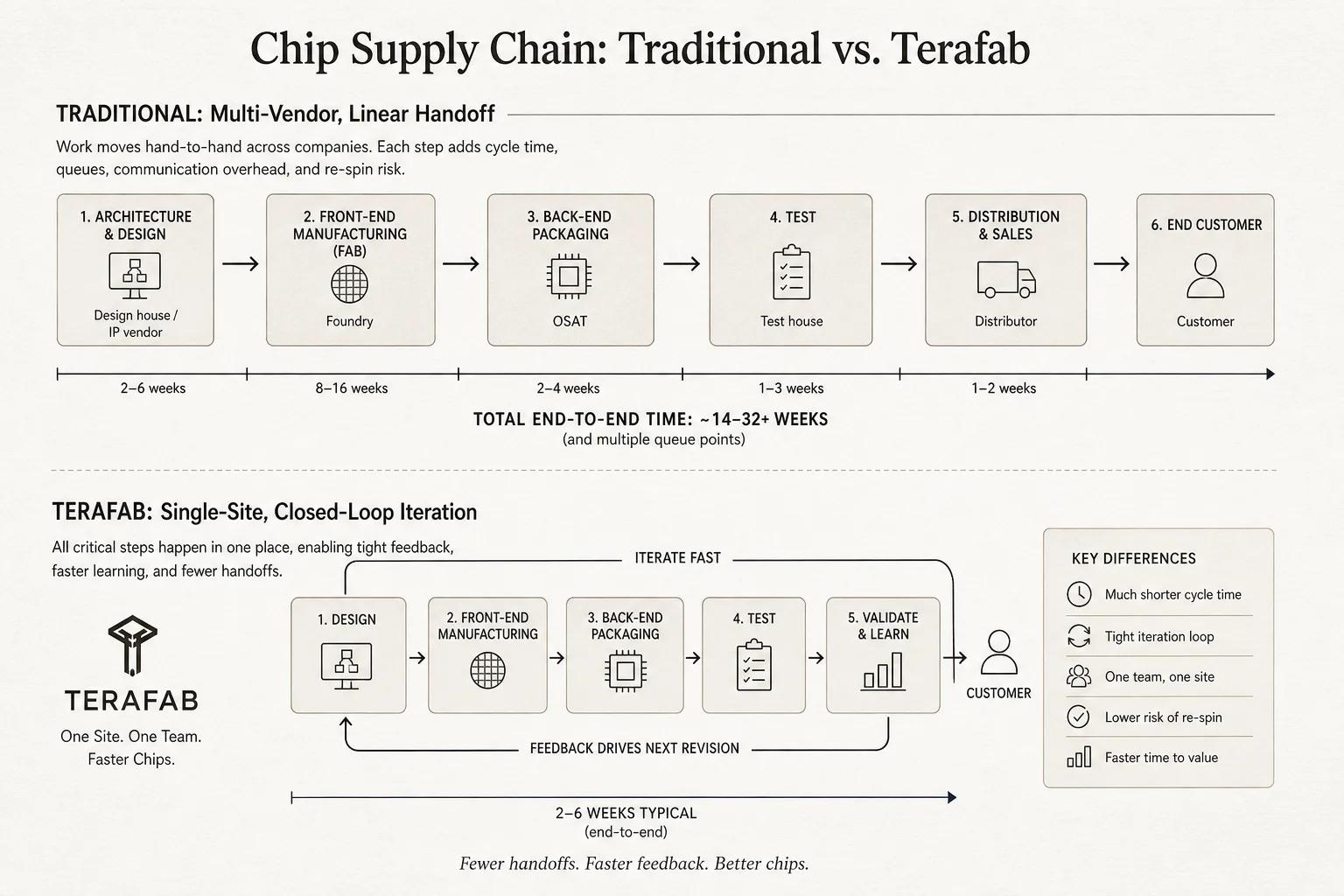
SpaceX's announcement describes a vertically integrated factory that handles logic, memory, packaging, and testing in one location. The pitch is speed: design, fab, package, test, and iterate without shipping wafers across three continents.
| Output target | Intended use |
|---|---|
| AI5 / AI6 chips | Tesla Optimus robots, Cybercab self-driving |
| D3 chips | SpaceX space-based data centers (radiation-hardened) |
| General logic + memory | Edge inference and high-power orbital compute |
| Annual capacity goal | 1+ terawatt of compute per year |
Electrek reports that Intel has signed on to contribute process technology (14A node). Tesla already has Samsung producing its AI5 chip in Taylor, Texas, and signed a $16.5 billion deal for the next-gen AI6 design. Terafab is the long bet on owning the full stack, not just the next contract.
The timeline is staggered, not a single ribbon-cutting:
- Late 2026 / early 2027: Small-batch AI5 production via research fab at Giga Texas North Campus
- Late 2027: First chips from the main Grimes County facility (AI6, D3)
- 2028: Volume production target
Why Musk says they have no choice
The official line from Tesla's post on X is blunt: "Both Tesla & SpaceX will need far more chips than current & future global production can supply."
At the March 2026 reveal, Musk framed the math against global AI compute output. He cited roughly 20 gigawatts per year of current AI chip production worldwide. Terafab targets a terawatt. That is not a rounding error. That is a claim that the existing supply chain cannot serve his companies' ambitions even if every fab runs flat out.
Whether you believe that forecast or not, the strategic logic is familiar. Apple designs its own silicon. Google builds TPUs. Amazon has Graviton and Trainium. If your product roadmap depends on custom inference at scale (robots, cars, satellites), renting TSMC wafers forever is a margin and control problem.
Terafab is Musk's attempt to internalize that margin and shorten the iteration loop.
The numbers keep changing (and that matters)
Headline investment figures for Terafab have shifted several times:
| Announcement | Figure |
|---|---|
| March 2026 teaser | ~$25 billion |
| May 2026 SpaceX filing | $55 billion initial, up to $119 billion full build |
| August 2026 confirmation | $16.8 billion phase one (committed) |
The August number is the first hard capital commitment attached to a specific county and site. It is also the lowest headline so far. Automotive World notes that earlier filings described Terafab as a "general framework" with no binding obligations on either company.
Tax incentives are real, though. Grimes County approved a 100 percent property tax abatement. Texas granted a $30 million Enterprise Fund award. SpaceX made an initial $10 million payment to the county. Land clearing was already underway by mid-August.
So Terafab is more concrete than a keynote slide today. It is still not a finished fab.
Local pushback and infrastructure reality
Grimes County residents have raised concerns about water use, energy demand, and transparency. Terafab will sit on the Gibbons Creek Reservoir, which previously cooled a coal plant that shut down in 2018. SpaceX says it will draw from the reservoir rather than local groundwater.
Power is the harder constraint. Full-scale AI chip manufacturing needs gigawatts. US grid capacity is not infinite. Jon Peddie Research notes the project may run on natural gas rather than solar, despite Tesla's clean-energy business.
For anyone building AI products on rented cloud GPUs, this is the backdrop to your inference bill. Chip supply, power availability, and fab geography are becoming strategic variables, not someone else's procurement problem.
What Terafab means for applied AI (even if you are not Musk)
You probably will not buy Terafab chips next year. But three second-order effects are worth tracking:
1. Custom silicon keeps winning. General-purpose GPUs are the default today. Terafab doubles down on chips optimized for specific workloads: edge inference in vehicles and robots, radiation-hardened compute in orbit. That pattern will show up in smaller verticals too. If your workload is stable and high-volume, dedicated silicon eventually beats rented H100 hours.
2. Vertical integration raises the ceiling for agents. Musk's stated targets (Optimus, Cybercab, orbital data centers) all need low-latency, high-volume inference outside a datacenter. The same economics apply when you deploy voice agents, vision models on edge devices, or on-prem RAG for regulated clients. Whoever controls the chip stack controls the unit economics.
3. Supply risk is a product decision. If your AI feature depends on a single cloud provider's GPU allocation, you inherit their fab lead times and pricing power. Terafab is an extreme version of companies refusing to accept that dependency. Smaller teams should at least model multi-provider inference and know their failover path.
Relevant reading:
- Terafab overview (Wikipedia)
- Data Center Dynamics on the Grimes County site
- My take on inference economics: specialized models and agentic coding costs
Skepticism is fair
A 100-million-square-foot chip plant is easy to announce and brutally hard to operate. Intel's own leading-edge nodes have slipped timelines. Semiconductor equipment depreciates fast. Utilization has to be high from day one or the cash burn gets ugly.
Musk also has a track record of renders that outpace production (see: Robovan in the Terafab promo imagery with no confirmed ship date).
Still, there is a county, a site, permits moving, tax deals signed, and earth movers on the ground. That is further than most "we will build a fab" press releases get.
The bottom line
Terafab is Tesla and SpaceX betting $16.8 billion (phase one) that the AI era needs a vertically integrated American chip supply chain they control. The targets are not laptops. They are robots, autonomous vehicles, and compute in space.
For the rest of us, the lesson is simpler: inference is infrastructure now. Whoever owns the fab owns the margin, the iteration speed, and eventually the default platform for physical AI.
Watch the 2027 small-batch dates. If those slip, it is still a story. If they hit, the competitive map for edge AI changes fast.
Trying to scope inference costs or edge deployment for a real product? Book a free discovery call and we can sanity-check the stack before you commit to hardware or cloud spend you cannot unwind.