
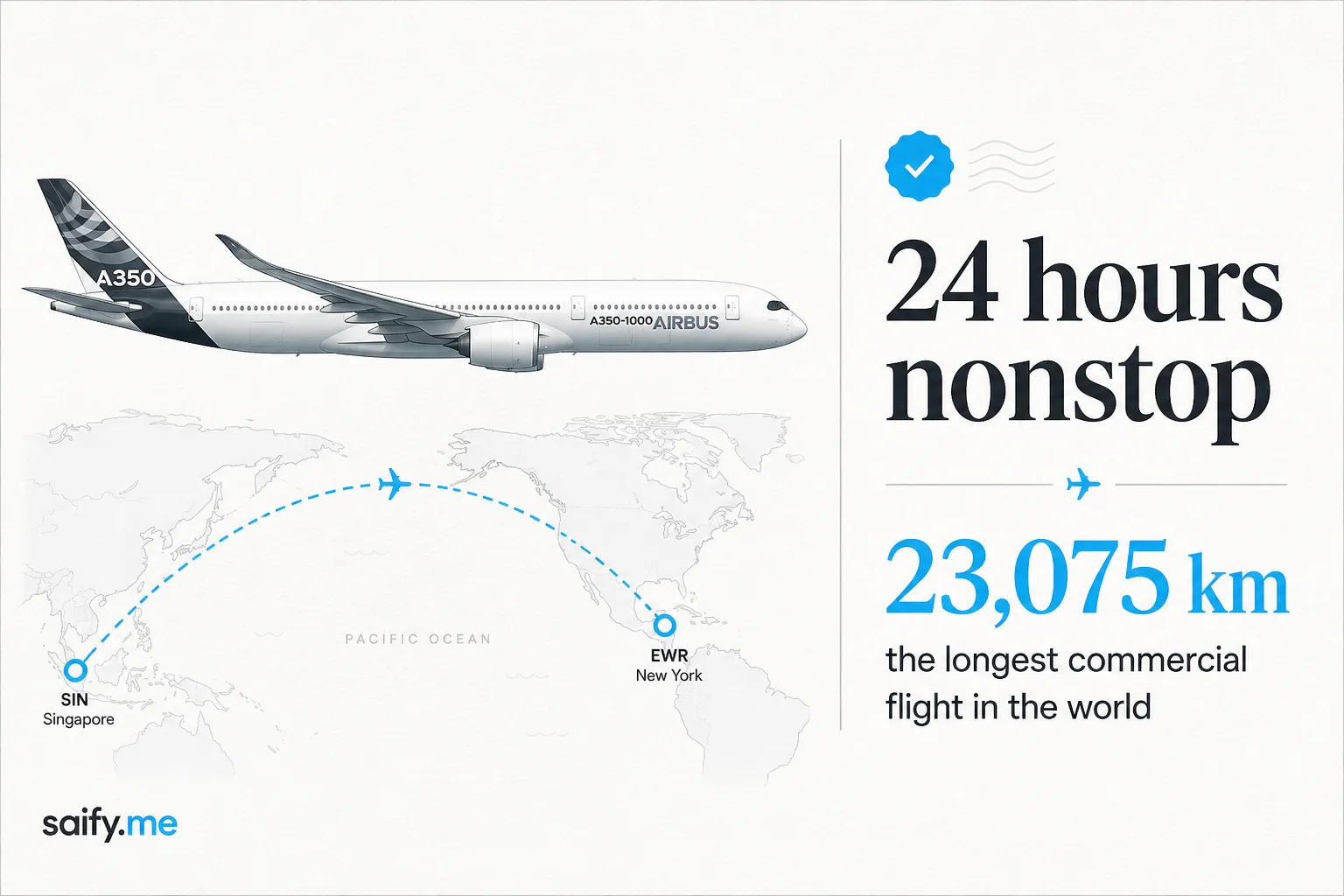
More than 3.6 million people tracked a test flight live on Flightradar24 in July 2026. It was not a royal funeral route. It was an Airbus A350-1000ULR proving it could stay airborne long enough for Qantas to sell Sydney-London without a fuel stop in Singapore.
The aircraft, registered F-WULR and named Vega, left Melbourne and landed at Airbus headquarters in Toulouse after 24 hours and 24 minutes, covering 23,075.92 km (12,460 nautical miles). That beats the 2005 Boeing 777-200LR record that stood for two decades.
I fly economy like everyone else. I also spend my days thinking about systems that fail at the edge of their spec sheets. This flight is an edge-case test with a commercial product attached.
What Project Sunrise is trying to prove
Flightradar24's write-up frames the mission cleanly: Qantas wants nonstop Australia-to-Europe and Australia-to-North-America routes with block times up to roughly 21 hours 40 minutes, plus taxi, holding, and diversion margin.
The Melbourne-Toulouse leg was deliberately longer than the future Sydney-London schedule. Certification teams love over-margin tests. Pass a 24-hour block and a 20-hour passenger route looks less scary on paper.
Planned commercial beats:
| Route | Target era | Expected block time |
|---|---|---|
| Sydney–London | October 2027 | ~19–21 hours ( winds dependent ) |
| Sydney–New York | After London launch | similar ultra-long-haul class |
Qantas ordered 12 modified A350-1000ULRs. First delivery is slated around April 2027.
The hardware changes that make 24 hours possible
This is not a stock A350 with extra fuel drums in the hold.
AvioRadar reported the ULR variant adds a 20,000-liter rear center fuel tank and structural reinforcement for higher takeoff weight. Range for passenger operations lands around 18,500 km, with certification flights pushing beyond that.
The cabin is sparse by A350 standards: about 238 seats across four classes. Lower density means more space per passenger on routes where everyone will be awake for two sunsets.
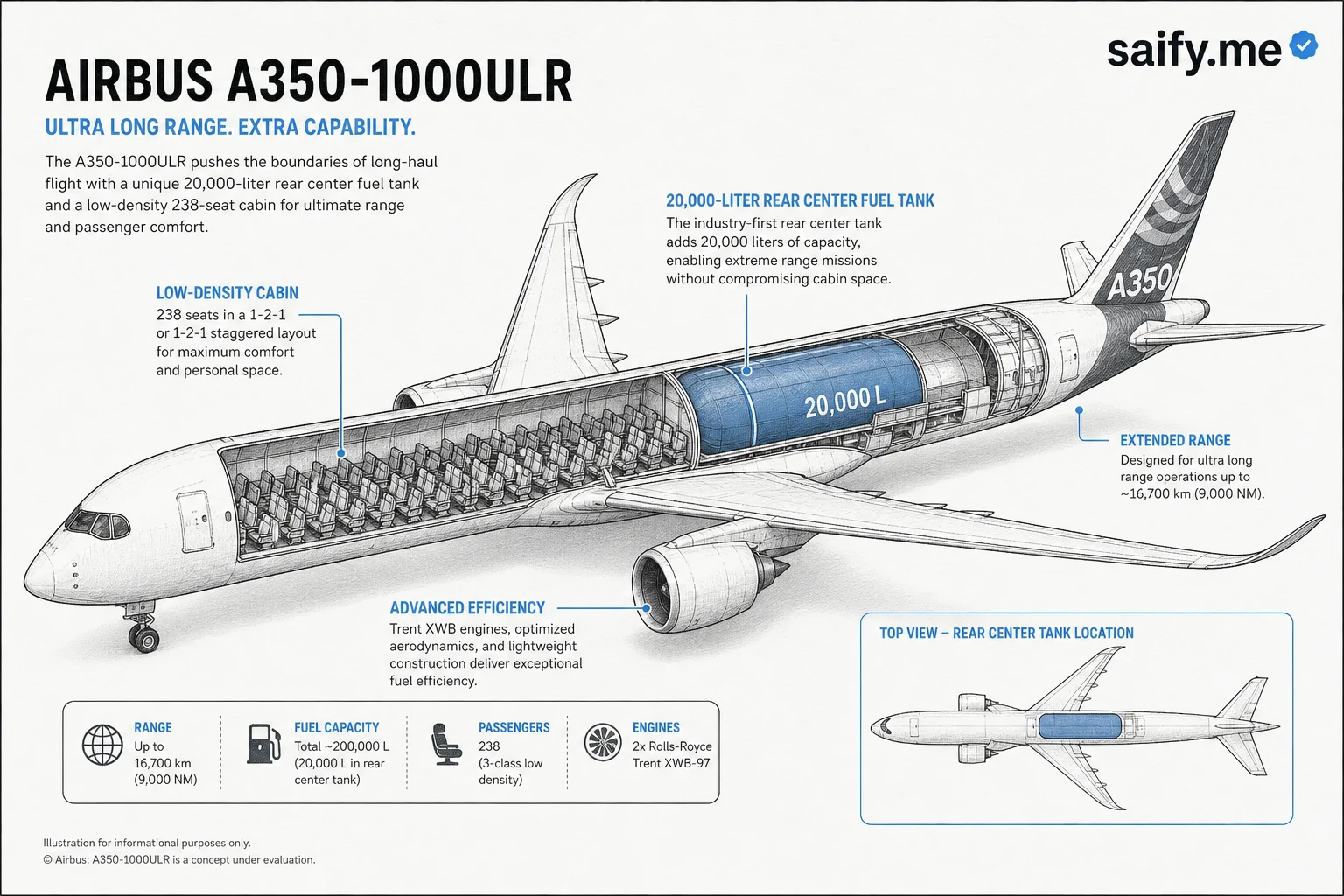
Power comes from two Rolls-Royce Trent XWB-97 engines. The July campaign included an outbound Toulouse-Melbourne sector (~20 hours) before the record return.
The route theater (and why Sydney got a flyover)
After departing Melbourne, the test route crossed Sydney Airport, the planned Project Sunrise origin for London service. Later segments passed London Heathrow, the destination airport for the commercial route.
That is not just cartographic poetry. It links certification telemetry to the actual terminals, alternates, and ETOPS planning Qantas will use when paying customers board.
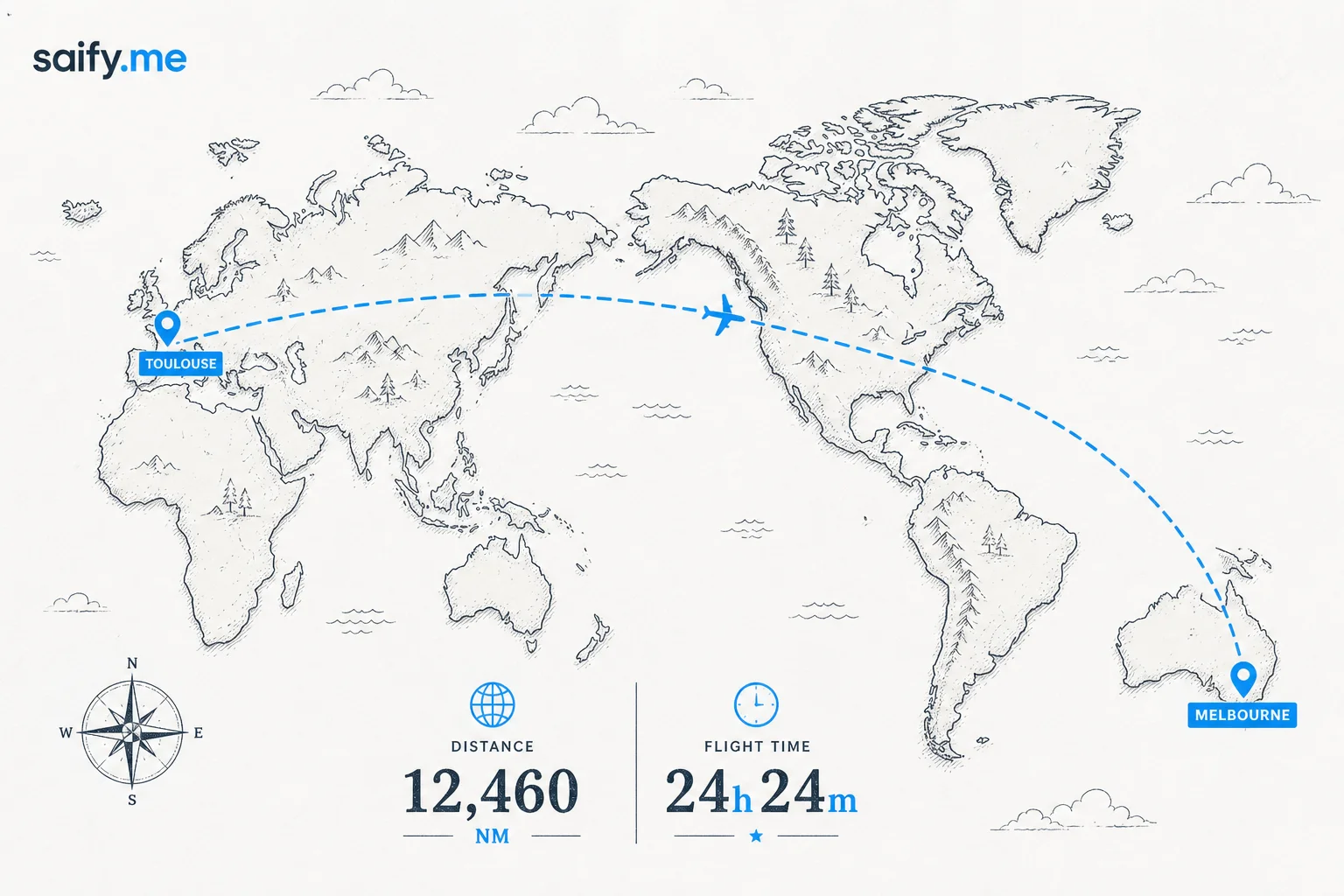
On board: eight Airbus flight-test crew, two Qantas pilots, and two Airbus design engineers. This was a development aircraft (MSN707), not a passenger-configured jet with fare-paying travelers.
Records, spectators, and what they do not prove
Flightradar24 ranked the flight the second most tracked ever, behind only Queen Elizabeth II's final aircraft journey. Aviation nerdery scales globally.
Records matter for marketing and certification binders. They do not by themselves prove:
- Crew fatigue rules for 20-hour duty cycles
- Passenger wellness product (sleep, hydration, cabin pressure cycling)
- Yield management on a 238-seat ultra-long-haul cabin
- Diversion airport coverage across polar and mid-Pacific segments
Boeing's 2005 record also involved a specially prepared 777-200LR. Records demonstrate aircraft capability. Airlines still have to demonstrate operationally boring daily service.
Why infra people should care about ultra-long-haul extremes
This is not an AI post. It rhymes with AI infra in one annoying way: margin is the product.
GPU clusters, orbital data centers, and 24-hour jets all sell on the same pitch: we handled the worst-case envelope in testing, so your nominal case is safe. Sometimes that is true. Sometimes the nominal case includes a Tuesday software patch nobody load-tested.
Ultra-long-haul pushes:
- Fuel system redundancy (more tanks, more failure modes)
- Maintenance cycles (hours per landing become a bottleneck)
- Human factors (crew and passenger endurance, not just metallurgy)
We covered launch-slot bottlenecks in orbital data center funding and chip fab pressure in Terafab. Aviation has the same "pre-buy capacity years ahead" smell. Qantas ordered a dozen ULRs years before October 2027 service because slot and delivery risk is part of the business model.
What to watch before booking Sydney-London in 2027
- EASA/FAA certification closure on A350-1000ULR block times ≥23 hours
- First Qantas delivery (~April 2027) and entry-into-service testing
- Crew rest rule approvals for planned schedules
- Published passenger experience specs (seat pitch, lighting, movement policies)
The July 2026 flight answered a narrow question: can this airframe stay aloft and cover the distance? Qantas still has to answer the human question: would you willingly do it twice a month for work?
If you are designing operator-facing systems where uptime and human fatigue collide (voice agents, 24/7 support bots, on-call rotations), the Project Sunrise playbook is worth stealing: test beyond spec, then design the nominal path so nobody heroics the edge case daily.
Planning automation or customer-facing AI with real operational margins? Book a free discovery call. I cannot get you a Project Sunrise seat. I can help you stop shipping software that only works on demo-day weather.