
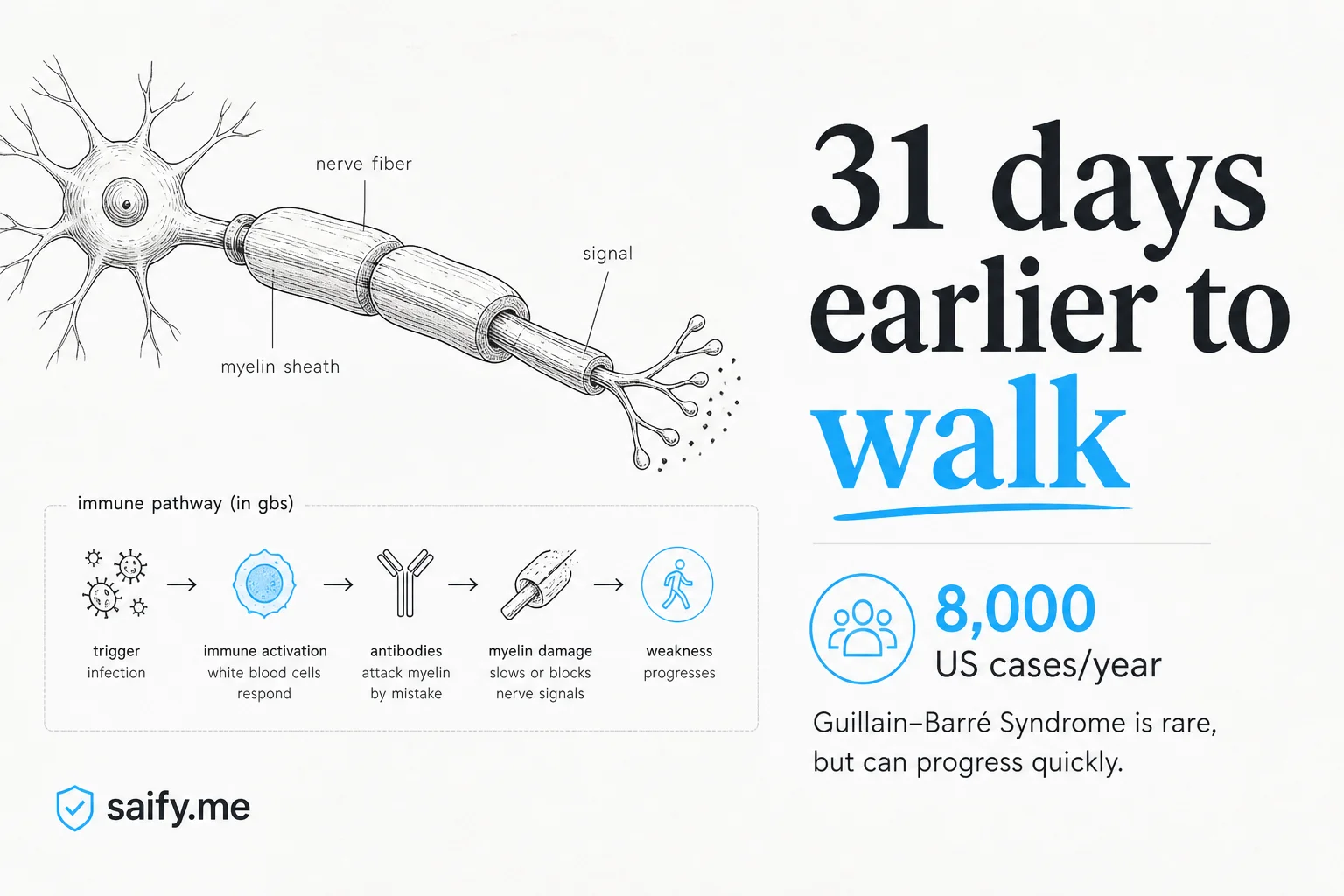
Guillain-Barré syndrome can turn a routine food poisoning recovery into paralysis within days. For thirty years, treatment meant blunt immune calming: plasma exchange or intravenous immunoglobulin. Helpful, not great.
New Scientist reported in July 2026 that tanruprubart, a monoclonal antibody from Annexon Biosciences, may become the first targeted therapy. A late-stage trial showed faster breathing recovery, shorter ICU stays, and earlier independent walking. The company submitted for European approval and plans a US FDA filing next.
I am not a neurologist. I am an applied AI engineer who reads clinical trial design the same way I read agent evals: what moved, what did not, and what still breaks in the real world.
What GBS does to the body
After infections like Campylobacter food poisoning or influenza, the immune system sometimes misfires and attacks the myelin sheaths around peripheral nerves. Weakness and tingling in limbs can progress to trouble walking, swallowing, speaking, or breathing.
Doug Love at Annexon, quoted by New Scientist, called it one of the most striking diseases he has seen in three decades in biotech: sudden, indiscriminate, immediately life-threatening.
Standard care today:
| Treatment | Mechanism | Limitation |
|---|---|---|
| Plasma exchange | Removes harmful antibodies from blood | Non-targeted, resource intensive |
| IV immunoglobulin | Modulates immune response | Non-targeted, variable response |
Stefan Blum at Princess Alexandra Hospital in Brisbane told New Scientist these options are useful but not fantastic. Nothing fundamentally new hit the market in 25 to 30 years.
Tanruprubart's mechanism: switch off C1q, not the whole immune system
Tanruprubart blocks C1q, a protein that triggers the classical complement pathway. In Guillain-Barré, that pathway attacks nerves. Block C1q and you aim at the misdirected branch instead of broadly suppressing immunity.
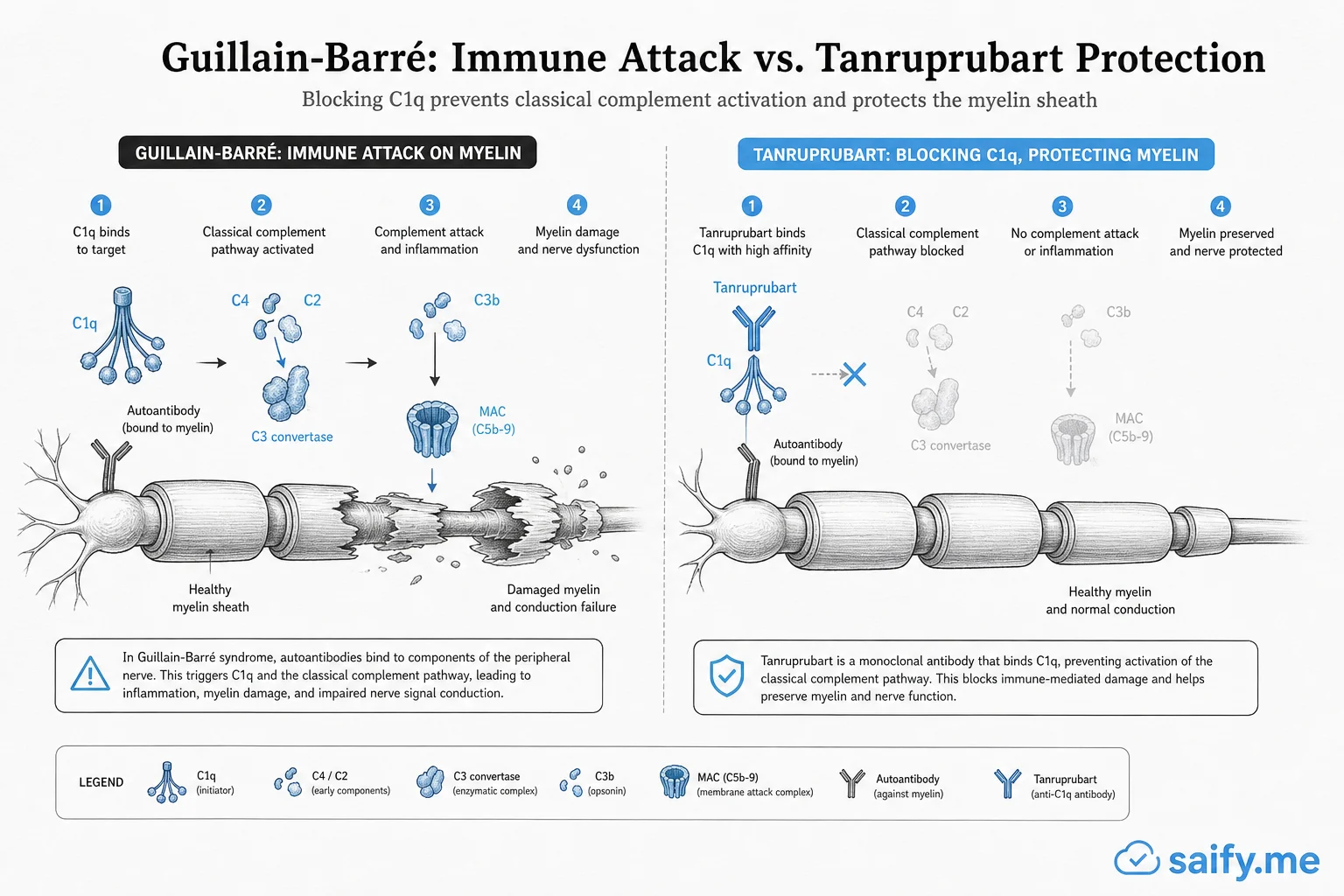
That specificity matters for safety narratives. Love told New Scientist the trial saw no serious side effects and, despite switching off part of the immune system, no obvious infection signal. A single IV infusion also avoids chronic immunosuppression risk.
Trial outcomes that actually moved patient timelines
Annexon ran a phase 3 study in Bangladesh and the Philippines with 241 recently diagnosed patients. One infusion of tanruprubart versus placebo.
Reported averages:
| Endpoint | Tanruprubart vs placebo |
|---|---|
| Mechanical ventilation | 28 fewer days |
| ICU stay | 7 fewer days |
| Independent walking | 31 days earlier |
| Patient-reported "very much improved" at 1 week | higher proportion on drug |
Results were presented at the European Academy of Neurology congress in Geneva in June 2026. At two months, quality of life and mobility scores still favored tanruprubart.
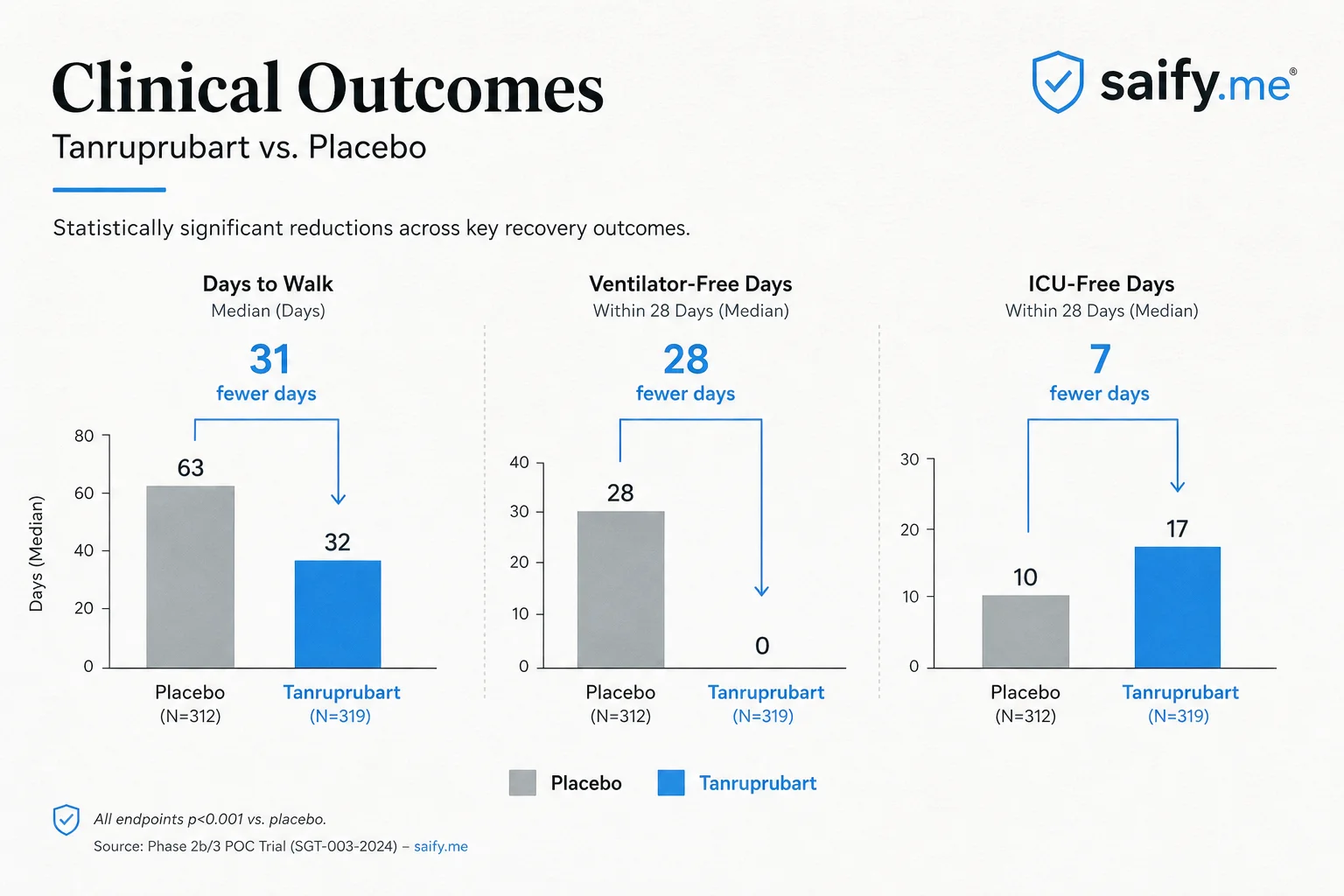
Those are calendar days returned to families, not p-values on a poster. In paralytic conditions, earlier walking often predicts long-term function.
Approval path and the geographic caveat
Annexon submitted tanruprubart to the European Medicines Agency and hopes for approval in the first part of 2027. A US FDA submission is planned within the next few months from the reporting date.
Blum raised an important generalization question. Guillain-Barré triggers differ by region: gastrointestinal infections like Campylobacter dominate in lower-income settings, while viral triggers dominate more in developed countries. Tanruprubart's trial geography means confirmatory data in high-income cohorts still matters.
That is not a dunk on the study. It is the normal post-phase-3 homework before payers and hospitals adopt a drug globally.
Where AI shows up (even when the headline drug is a antibody)
No one claimed an LLM discovered tanruprubart in this news cycle. The development stack still rhymes with applied AI workflows I see in biotech clients:
Target identification and pathway mapping. Complement biology is messy. Teams use graph models and literature mining to prioritize C1q versus broader immunosuppression.
Trial simulation and site selection. Phase 3 in Bangladesh and the Philippines reflects epidemiology and enrollment velocity modeling, not dart throwing.
Regulatory document assembly. EMA and FDA packages are thousands of pages. Human scientists sign off; AI drafting and QC tools accelerate repetitive sections.
If you are building clinical or ops AI, the lesson is boring: the moat is validated endpoints, not a chatbot that summarizes PubMed.
Risk notes a skeptical operator keeps in mind
- Single-infusion durability: GBS recovery lasts weeks. One dose helping early is strong; long-tail data will matter for label claims.
- Trigger heterogeneity: US/EU trials may show smaller or larger effects depending on infectious trigger mix.
- Access and price: Targeted monoclonals are rarely cheap. Health systems will ask for ICU-day savings math.
- Vaccine anxiety: GBS can rarely follow vaccination. New Scientist notes infections remain more common triggers than vaccines. Communication around new drugs must not fuel anti-vaccine myths.
Why I wrote this on an applied AI blog
Most posts here cover coding agents and inference stacks. Guillain-Barré is different. It is a reminder that model-driven discovery plus targeted molecules still produces step changes outside software.
The trial endpoints are human: breathing without a machine, walking out of ICU, reporting you feel much better after a week. If tanruprubart earns approval, it ends a three-decade drought of new mechanisms in a condition that hits about 8,000 Americans a year.
That is worth tracking even if your day job is RAG pipelines.
If you are building health-adjacent AI and need help drawing the line between decision support and reckless automation, book a free discovery call. I will not prescribe drugs. I will help you ship systems that respect clinical uncertainty.