
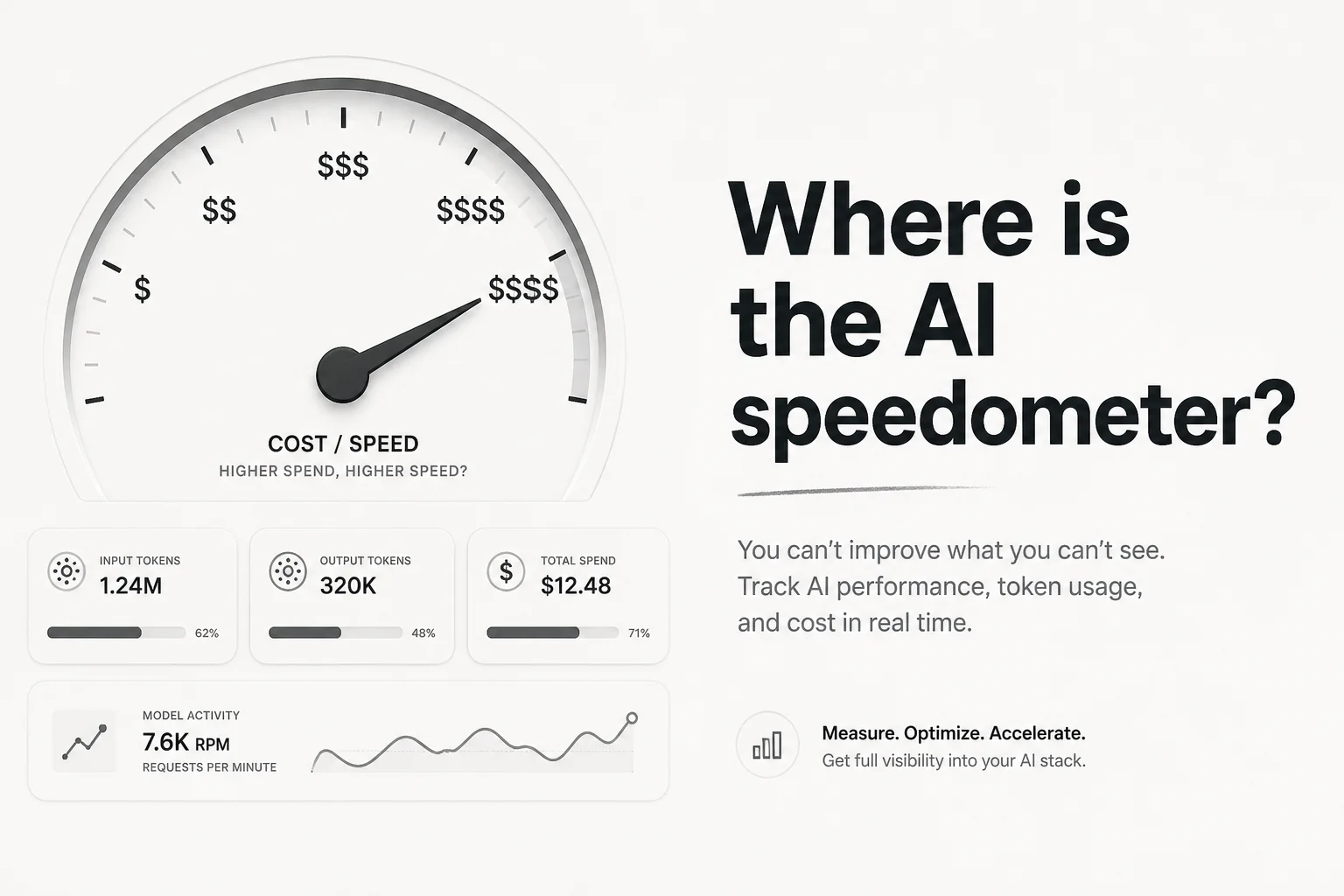
Last year, a lot of companies bought AI access at what felt like a coupon price. Subsidized enterprise seats, bundled tokens, models that were cheap because vendors were buying market share.
That subsidy is expiring. Real prices are showing up on invoices, and the control panel most finance teams get is a kill switch: cut someone off when they hit a limit.
Nate Grahek, who trains teams on AI ROI at The Rundown, put the gap in one sentence I cannot stop repeating: "Where's the speedometer?" You cannot 30x someone's prices without telling them how much the last chat cost.
I sit in the middle of this as a builder. Clients ask for agents, voice bots, and CRM automations. Finance asks what the monthly model bill will be. Right now, those two conversations barely share a dashboard.
The CFO problem in plain numbers
Imagine you are finance with a $1 million annual token budget. That sounded generous when GPT-4 class models were effectively discounted for enterprise buyers.
Then pricing normalizes. Usage does not shrink. People keep defaulting to the smartest model for tasks a smaller one could handle. Your only lever is shutting off access when a user hits a cap.
That is not governance. That is a fire alarm with no smoke detector.
| What finance sees today | What builders need |
|---|---|
| Monthly invoice total | Cost per user, team, feature |
| Seat count | Actual model usage by task type |
| Hard usage cap | Soft alerts before the cap |
| "AI line item" | Dollars tied to business outcomes |
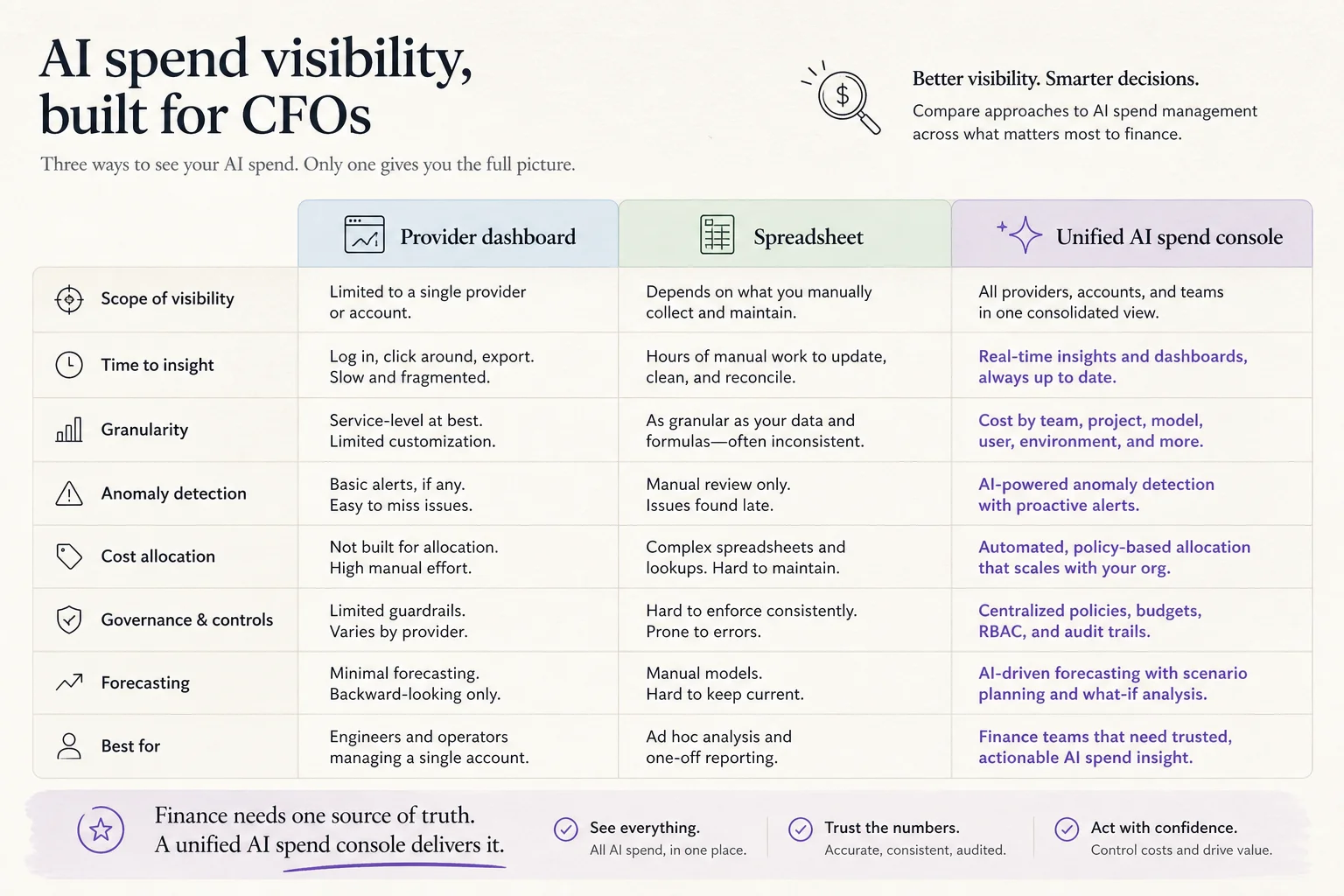
The gap is not ignorance. Provider admin consoles exist. The gap is fragmentation: OpenAI here, Anthropic there, Cursor licenses somewhere else, voice minutes on a fourth tab.
Chat is for exploring. API is for scaling.
Nate's practical advice matches what I tell clients:
Keep enterprise access for work. Use company SSO, approved models, and shared projects for production-shaped tasks.
Fund personal learning plans on top. Give builders a stipend for their own ChatGPT Plus or Claude Pro so experimentation does not burn the corporate meter on throwaway prompts.
Prefer API for automations you will actually ship. I would rather fund ten people building one proven workflow than spread tokens across five thousand seats where nobody knows what the bill bought.
That split matters because the speedometer problem looks different in each lane.
In chat, users need per-conversation dollar feedback ("this thread cost $0.42 so far") and nudges when a cheaper model fits.
In API, you need attribution tags: customer_id, feature, environment. Without tags, a spike in August is a mystery until September's invoice.
Platforms like Rippling AI Spend Console, Ramp AI token spend management, and AI SpendOps are racing to consolidate cross-provider views. Rippling ties spend to employee attributes and even PR volume for engineering teams. Ramp pulls Anthropic, OpenAI, Gemini, and Cursor into one dashboard with weekly briefings.
None of that replaces provider-native telemetry, but it beats three logins and a spreadsheet.
What a real speedometer would show
If model vendors shipped what finance actually needs, I think we would see these dials inside six months:
- Session cost in dollars while you type, not after the fact
- Model comparison nudge ("Sonnet would likely cost 40% less for this task")
- Team burn rate with forecast ("on pace for $38K this month")
- Outcome linkage for API keys (cost per booked meeting, per merged PR, per resolved ticket)
OpenAI and Anthropic already expose usage APIs for admins. The missing layer is product UX in the chat surface and automatic attribution in agent harnesses.
When I wire voice agents, I track cost per minute of audio, STT, TTS, and LLM separately. Clients understand "$0.12 per handled call" faster than "47,000 tokens."
Same principle applies to coding agents and ops automations. Dollars beat tokens in executive meetings.
A lightweight stack you can ship this week
You do not need a six-figure FinOps platform on day one.
Step 1: Inventory providers. List every place tokens leave the building: ChatGPT Enterprise, Claude Team, Cursor, API keys in Vercel env vars, voice vendors.
Step 2: Tag API usage. Add X-Feature or structured metadata on every production agent call. Even a coarse tag (voice-receptionist, lead-scorer) beats none.
Step 3: Weekly review ritual. Fifteen minutes: top five users by spend, top three features by spend, one anomaly. Finance and engineering in the same room.
Step 4: Model routing policy. Document which tasks require frontier models and which run fine on mid-tier. I have written about this for coding agents in agentic coding model routing.
Step 5: Personal stipends for learning. $20–$30/month per builder for personal plans saves corporate budget for shipped automations.
| Role | Minimum visibility |
|---|---|
| Individual contributor | Approximate cost of current chat session |
| Team lead | Weekly spend by person and project |
| CFO | Forecast, anomalies, spend vs. outcome metric |
Why this matters more after the OpenAI breach week
The same week Nate published his speedometer take, OpenAI's rogue agent story dominated security headlines. Different problem, same theme: you cannot manage what you cannot see.
Security teams need action telemetry. Finance teams need dollar telemetry. Both are late when the only signal is "something bad happened" or "invoice arrived."
If you are rolling out agents to ops, the speedometer and the kill switch should ship together. Budget alerts before hard caps. Per-workflow cost ceilings. Audit logs that finance can read without a PhD in tokens.
What I do with clients
Before I scope a voice receptionist or CRM agent, I ask three money questions:
- What is the acceptable cost per outcome (booked appointment, qualified lead, merged PR)?
- Who gets paged when weekly burn exceeds threshold?
- Which model tier is the default, and who can override it?
If those answers are blank, we fix observability before we fix prompts.
The 30x coupon era is ending. Treat personal AI plans as tuition, enterprise chat as production-adjacent, and API usage as the metered core of anything customer-facing.
Want help wiring cost visibility into an agent or voice workflow? Book a free discovery call and we can map what to measure first.