
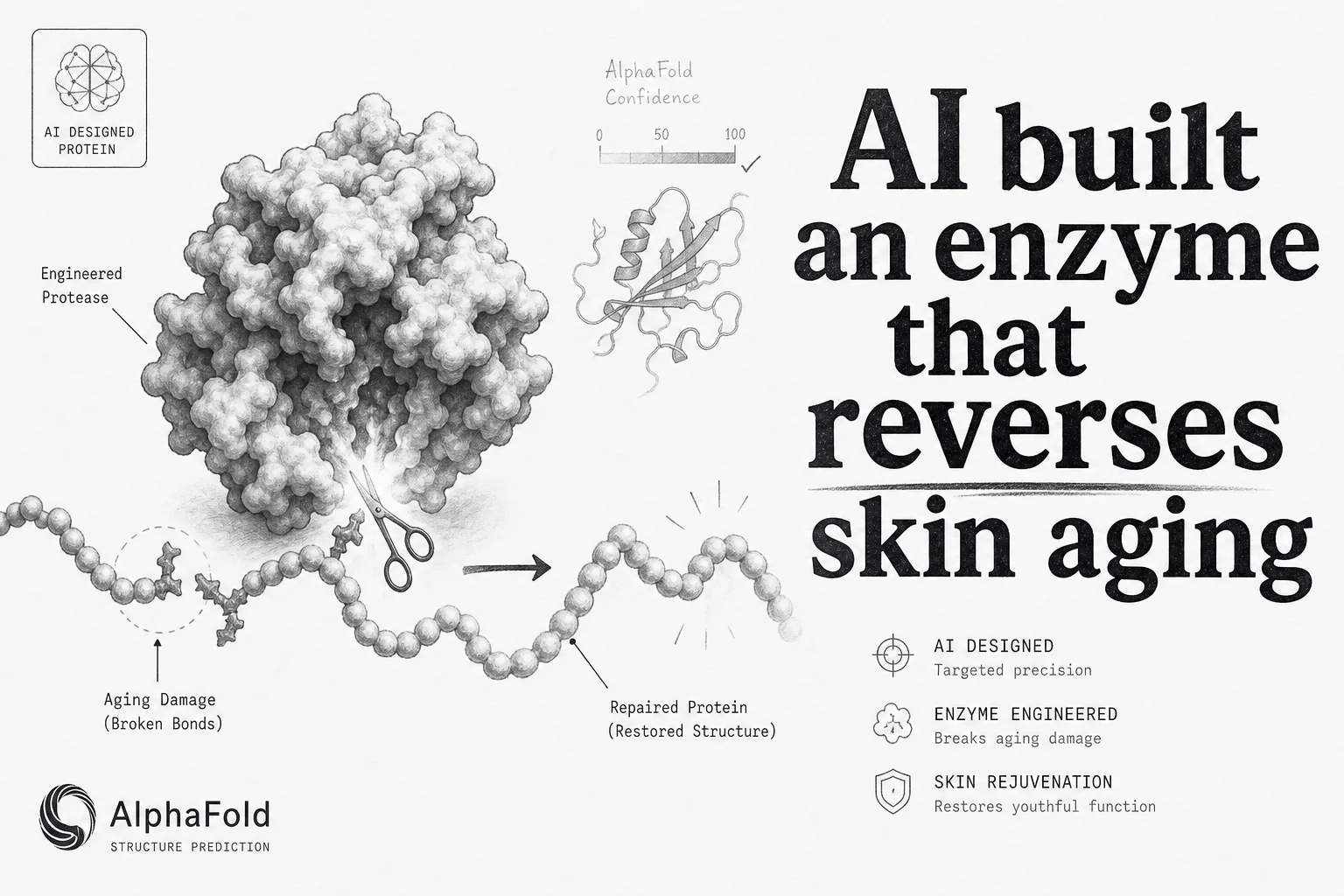
A 75-year-old skin sample sat in a lab dish. After an overnight soak with a new enzyme, its molecular aging markers looked younger than tissue from a 31-year-old.
That is not marketing copy from a skincare brand. It is what researchers reported in July 2026 after engineering an enzyme called CMLase to chew through a stubborn form of protein damage that builds up as we age.
I care about this story for a reason that has nothing to do with face creams. The enzyme did not exist in nature. The team had to invent it with AI structure models and a brutally large evolutionary search. That is applied AI shipping in biotech, not a chatbot demo.
What aging looks like at the molecular level
When sugars in your bloodstream react with proteins, they form advanced glycation end products, usually shortened to AGEs. One common member of that family is Nε-carboxymethyl-lysine, or CML.
CML sticks to long-lived proteins in skin, blood vessels, and the eye lens. Tissues stiffen. CML also binds to a receptor called RAGE, which kicks off inflammatory signaling. Chronic inflammation and oxidative stress follow.
Cook a steak and you get a similar chemistry. The Maillard reaction browns the crust and builds rich flavor. In a living body, the same class of reactions leaves damage that was long treated as permanent.
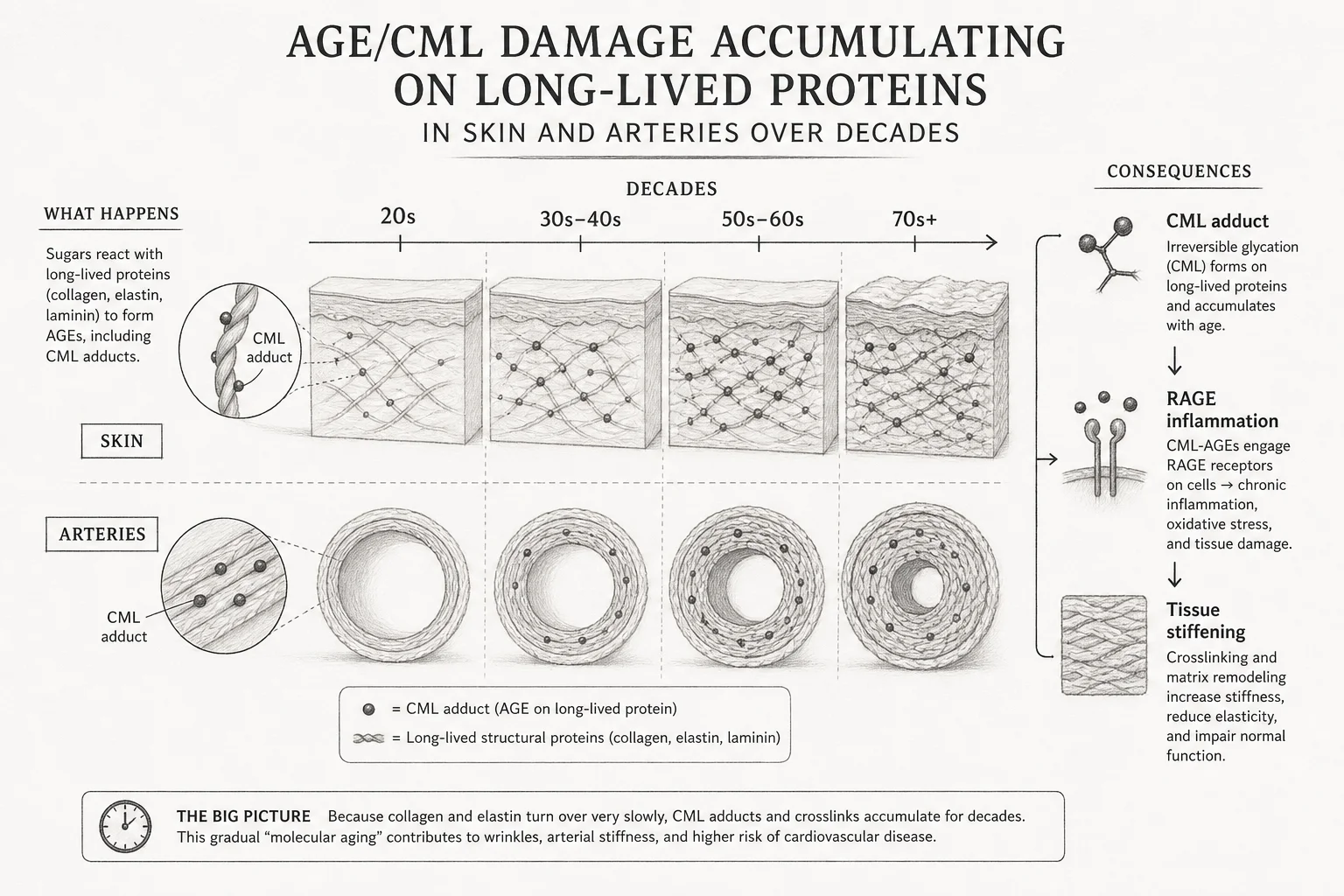
Nothing in nature was known to strip CML off a protein and put lysine back. You cannot order this enzyme from a catalog. The research team, including scientists affiliated with Calico (the longevity company Google founded in 2013), had to build one from scratch.
How AlphaFold and directed evolution built CMLase
The pipeline reads like a modern ML engineering playbook, except the output is a physical protein instead of a API endpoint.
-
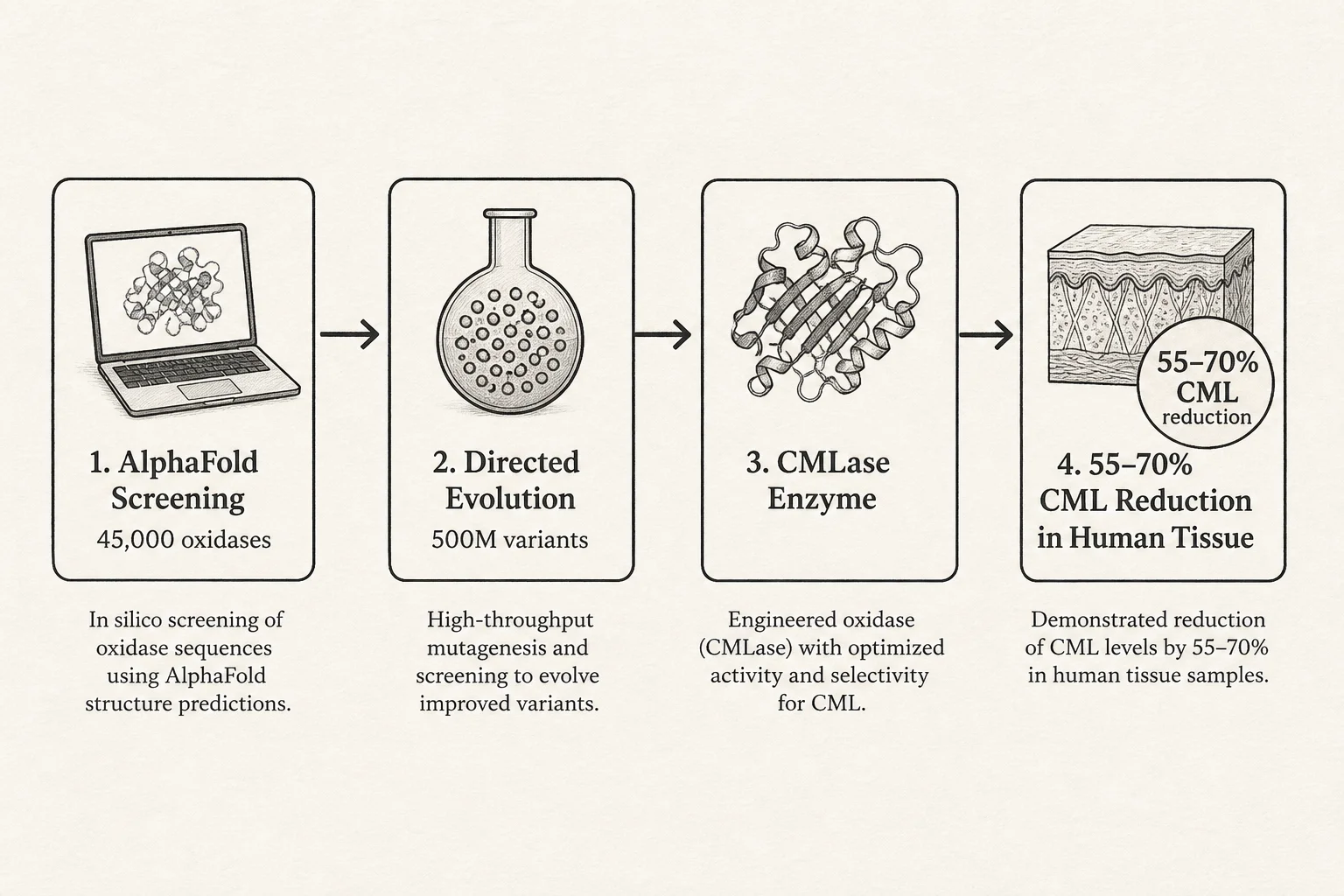
Structure screening. Researchers used AlphaFold to evaluate roughly 45,000 oxidase enzymes for structural features that might let them attack CML adducts on lysine side chains.
-
Directed evolution at scale. Starting from a microbial glycine oxidase, they evolved more than 500 million variants, selecting for activity against CML-modified substrates.
-
Validation on real human tissue. The winning enzyme, CMLase, was tested on model proteins, lens proteins from a 64-year-old donor, and preserved sections of elderly human arteries and skin.
The full methodology and data sit in a Nature Communications paper published July 14, 2026 (doi: 10.1038/s41467-026-75141-2). Coverage from Phys.org walks through the antibody staining and mass spectrometry results in plain language.
The numbers that matter
On synthetic damaged proteins, CMLase cut detectable CML by 52% in a short incubation and 97% overnight. Real tissue is messier.
| Tissue type | CML reduction reported | Context |
|---|---|---|
| Elderly arterial sections | >70% | Overnight incubation at 5 μM CMLase vs inactive control |
| Elderly human skin | >55% | Epidermal and dermal layers; levels fell below 31-year-old reference |
| 64-year-old lens proteins | ~45% | One quantitative assay on extracted proteins |
The skin result is the headline grabber. CML staining in 75-year-old tissue dropped below what researchers measured in 31-year-old skin. Arterial tissue saw more than 70% reduction. These are ex vivo sections in a dish, not a person rubbing serum on their face.
Still, the paper's core claim holds: damage previously labeled irreversible was enzymatically repaired in heterogeneous human extracellular matrix samples.
Why this is not a face cream yet
I want to be direct about the gap between lab proof and your bathroom shelf.
Regulatory framing. The moment a product claims to change body structure or reverse aging at the cellular level, regulators treat it as a drug, not a cosmetic. That path takes years and serious capital.
Delivery physics. Dermatology's rough 500 Dalton rule says molecules bigger than about 500 Daltons struggle to cross intact skin. CMLase is a protein enzyme, roughly 40,000 Daltons. A simple rub-on cream probably does not reach the damage layer without microneedle patches or other delivery hacks, which are slower and pricier to ship.
Immunogenicity. CMLase comes from a bacterial enzyme scaffold. Repeat dosing with a foreign protein can trigger immune reactions. The paper flags this openly. Solvable, but not solved.
Brian Johnson summarized the engineering stack in one line on social media: AlphaFold searched 45,000 oxidases, then the team screened more than 500 million engineered variants through directed evolution. That scale is why I file this under applied AI, not under "longevity influencer noise."
What applied AI engineers should steal from this
If you build agents, RAG pipelines, or coding tools, the pattern still rhymes.
| Biotech step | ML engineering analog |
|---|---|
| AlphaFold structure screen | Cheap model pass to filter a huge candidate space before expensive eval |
| 500M variant evolution | Iterative generate-and-test loops with automated scoring |
| Ex vivo tissue validation | Staging environment that mirrors production messiness |
| Honest limits on delivery | Shipping constraints (latency, cost, compliance) defined before the demo |
The team did not train one giant model and call it done. They chained structure prediction, evolutionary search, and wet-lab validation. That is how serious applied AI projects should look when the stakes are high.
The platform angle beyond one enzyme
CMLase targets one AGE adduct on one amino acid context. The authors argue the same bioengineering platform could aim at other age-related protein damage marks if the chemistry allows an enzymatic reversal.
For longevity research, that is the deeper prize. A single anti-wrinkle story gets clicks. A general method for repairing accumulated molecular damage is a research program.
Calico's involvement also signals where Google-adjacent longevity money is betting: not on another supplement stack, but on computationally designed enzymes validated in human tissue.
Where I land on this
I am not pitching CMLase as something you should buy next month. I am noting that July 2026 gave us a concrete example of AI-accelerated protein engineering producing measurable reversal of a aging-associated damage marker in human tissue samples.
That is a stronger applied-AI story than most product launches I read in my inbox.
If you are exploring how structure models, evolutionary search, or custom ML pipelines could compress R&D timelines in your domain, that is the kind of workflow design I help teams map before they burn a year on the wrong abstraction.
Book a free discovery call if you want to talk through where a similar screen-evolve-validate loop might fit your stack.