
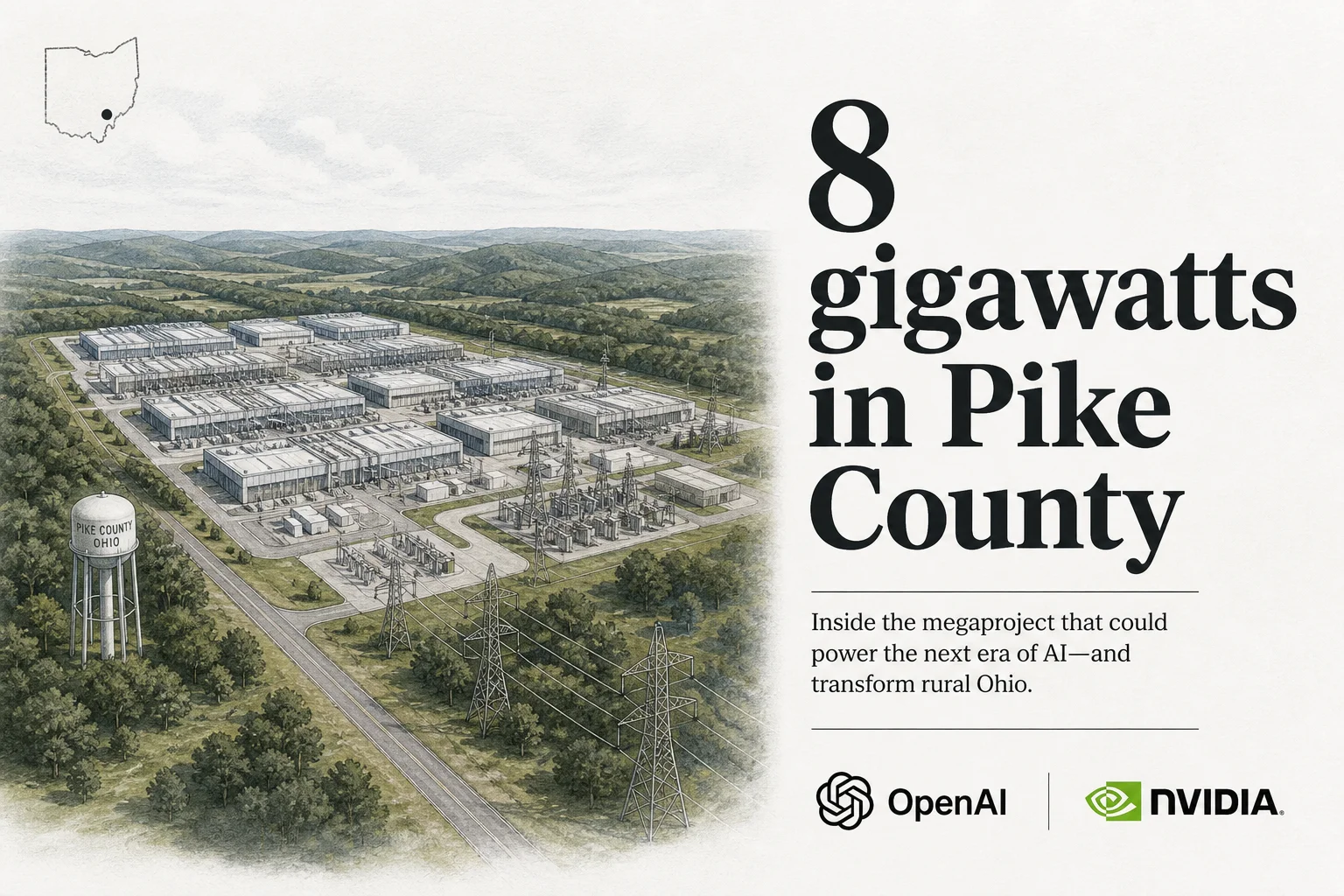
OpenAI, Nvidia, and SB Energy announced the PORTS-Pike Technology Campus on August 17, 2026. The site sits on remediated federal land and private property around the former Portsmouth Gaseous Diffusion Plant in Pike County, Ohio. OpenAI signed for roughly 8 gigawatts of IT capacity. Nvidia will be the exclusive AI compute provider. SB Energy builds, owns, and operates under a 20-year lease.
This is not a modest colo expansion. It is one of the largest single-campus AI infrastructure plays announced in the U.S., and it landed outside the Stargate umbrella that has had a rocky 2026.
The deal structure
From OpenAI's announcement and Nvidia's press release , the numbers look like this:
| Party | Role |
|---|---|
| OpenAI | Tenant leasing up to ~8 GW-IT over 20 years |
| Nvidia | Exclusive compute stack (DSX AI factory platform); credit support on initial 4.25 GW LPS |
| SB Energy | Developer/operator; SoftBank-backed |
| U.S. DOE | Federal land partner on remediated site |
Nvidia also invested $1.5 billion in SB Energy, joining existing backers SoftBank and OpenAI. The initial deployment targets 4.25 GW of AI factory capacity, with an option on the remaining 3.75 GW. First 800 MW is slated for 2028, largely on existing AEP Ohio infrastructure.
Nvidia's blog frames each generation of systems at PORTS-Pike as potentially 1.5 million GPUs and $150–200 billion in chip revenue over upgrade cycles. That is vendor math, but it signals how they think about multi-decade site value, not a single build-and-exit.
Jobs, water, and community money
OpenAI committed to project-specific energy and infrastructure costs without shifting grid upgrades to Ohio ratepayers, per their public principles. SB Energy says it will fund transmission and grid work tied to the campus. The data center plans closed-loop, air-cooled systems that recirculate water.
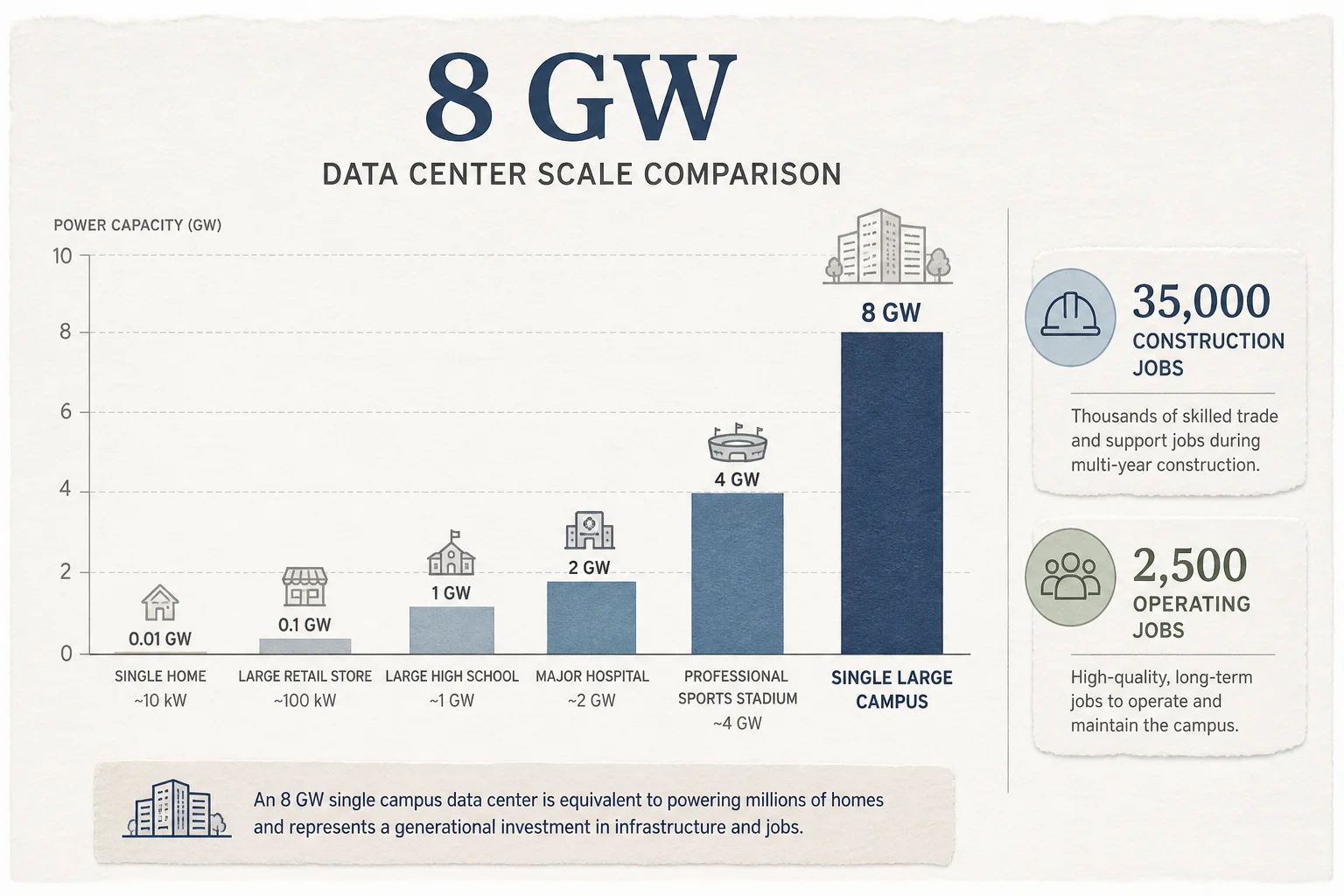
On jobs, the companies cite roughly 35,000 construction roles through a six-year buildout to 2032 and about 2,500 long-term operating jobs. Community benefits include an $80 million fund (OpenAI $40M plus SB Energy's prior $40M commitment) and $84 million in Codex credits for eligible Ohio college students in the 2026–2027 academic year.
Local reporting from WOSU notes ongoing concern about data center power and water across Ohio. PORTS-Pike's pitch leans on on-site generation (SB Energy has discussed multi-gigawatt gas plants in earlier announcements) and paying its own way on grid upgrades. Residents will watch the meters.
Why Nvidia guarantees the shell
Jensen Huang's line in the release is worth quoting: "AI is becoming infrastructure." Nvidia is not just selling GPUs here. They are securing land, power, and shell (LPS) so OpenAI can deploy repeatable AI factories that upgrade each hardware generation.
The credit support covers roughly 4 GW over 20 years, phased as data centers come online between 2028 and 2030. As OpenAI pays lease and capacity ramps, Nvidia's exposure shrinks. Huang also pushed back on "circular financing" narratives in companion commentary, insisting OpenAI will pay the lease.
Broader context from Nvidia's blog: OpenAI's existing and planned commitments already point to about 12 GW of Nvidia compute through 2030, with room to reach ~16 GW if PORTS-Pike expands beyond the first 4.25 GW tranche.
Stargate vs PORTS-Pike
The Rundown and others have noted Stargate's stalled momentum in 2026. PORTS-Pike is a parallel track: SoftBank-linked SB Energy, OpenAI tenancy, Nvidia exclusivity, DOE land. Same macro theme (American AI industrial policy), different corporate wiring.
Whether that helps or hurts circular-deal allegations depends on your priors. What is clear is frontier labs are constrained by power and financing as much as model architecture. Sites like this are the new fabs.
What applied AI builders should take from this
You will not provision PORTS-Pike capacity for a clinic voice agent. This story matters indirectly:
- Inference pricing and availability trace back to these campuses. More dedicated GW eventually eases peak-hour pressure on API tiers.
- Regional investment (Ohio credits, trades programs) signals where talent pipelines may grow outside coastal hubs.
- Vendor concentration rises. OpenAI + Nvidia + SB Energy is a tight triangle. Multi-cloud strategies stay relevant for enterprises that fear lock-in.
When I scope client projects, I still assume API models first and self-host only with a clear cost curve. Megaprojects like PORTS-Pike shift that curve over years, not weeks.
Bottom line
PORTS-Pike turns a Cold War uranium site into a bet that AI compute is the next century's baseline utility. The headline is 8 GW. The subtext is twenty-year leases, exclusive Nvidia stacks, and community money trying to buy local consent.
Watch 2028 for the first 800 MW tranche. That is when abstract gigawatts become transformers in the ground.
If you are planning AI capacity for a product roadmap and want a sanity check on what infra headlines actually mean for your stack, book a free discovery call.