
The English demo always works. Then a customer pastes a normal WhatsApp line in Spanish Spanglish, Gulf Arabic, or Arabizi numerals, and the bot replies with confident nonsense or stiff translated English that no local would send.
I have watched the same failure in US bilingual markets (English + Spanish) and in MENA or South Asian shops that live on WhatsApp. The model can "speak" the language. The system cannot. That gap is engineering, not a bigger base model.
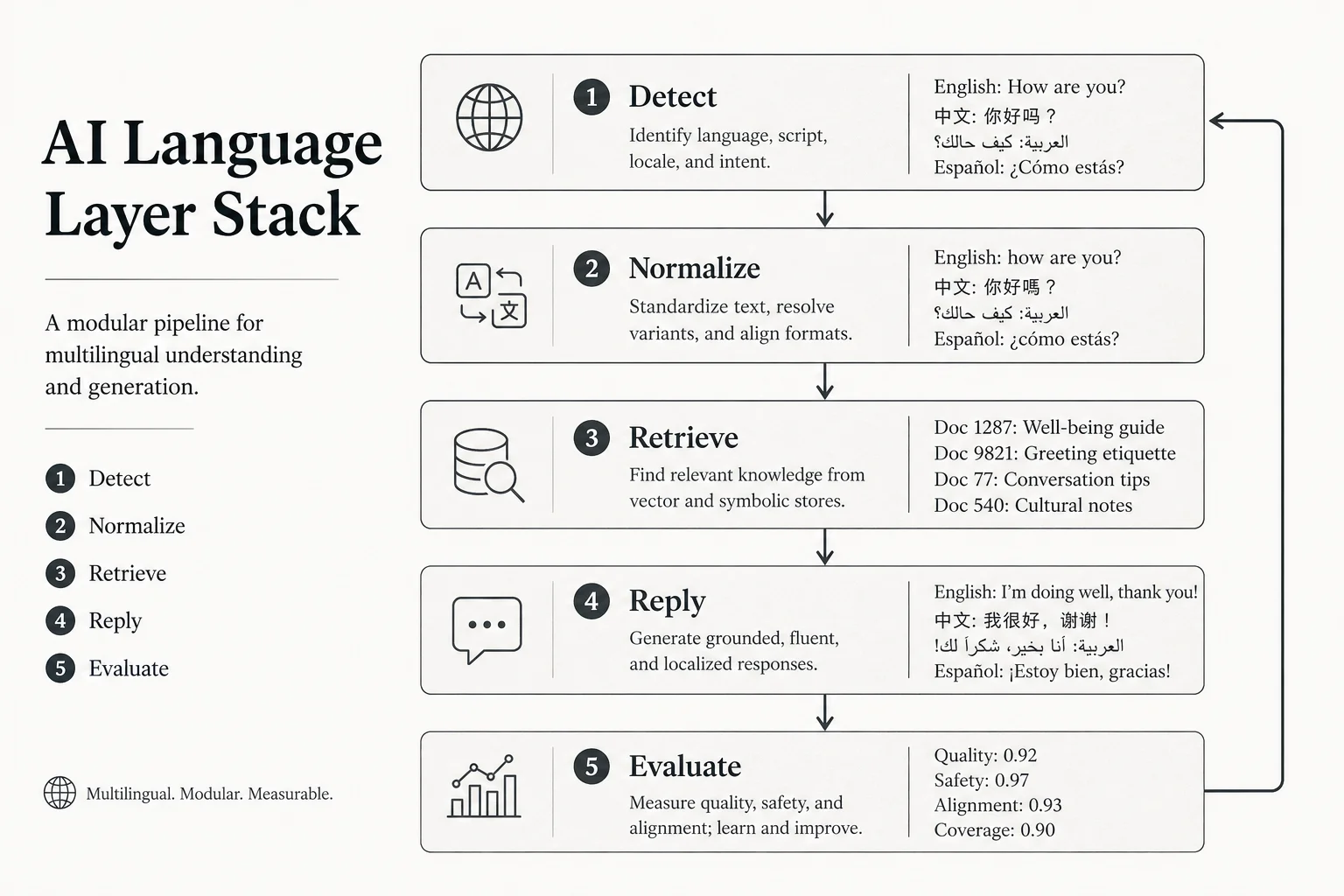
This post is the stack I actually ship for multilingual voice and messaging agents: detect → normalize → retrieve native → reply native → evaluate per language. No UAE-only brochure. Same mechanics if your inbox is Houston Spanish, Toronto French, or Dubai Khaleeji.
The Language Layer Stack (LLS)
Direct answer: treat language as a per-message property, not a site-wide toggle. Every turn runs five layers. Skip one and quality drops in ways demos never show.
| Layer | Job | Failure if skipped |
|---|---|---|
| Detect | Language + script + code-switch hint | Locked into first-language, menu prompts customers hate |
| Normalize | Orthography, digits, light dialect cleanup before search | Retrieval misses the right doc |
| Retrieve native | Embeddings + chunks in source language(s) | Hallucinated answers when dialect recall is weak |
| Reply native | Generate in customer register, not MT round-trip | Stiff tone, wrong politeness, broken names |
| Evaluate per language | Separate metrics and human review | English looks fine while L2 burns trust |
This is the same discipline as grounding for RAG (see what is RAG for business), applied to language instead of "just add Spanish to the model dropdown."
Why naive bots break (four stacked problems)
These stack. Fixing only the model does not fix the pipeline.
Token tax. Mainstream tokenizers were trained heavy on English. Arabic, and to a lesser degree other scripts, often burns more tokens for the same meaning. Cost goes up. Context windows fill faster. Silent truncation is common: the model loses the top of the thread and answers from a partial history. Size your budgets on the expensive language, not the English demo.
Morphology and matching. Languages with rich morphology (Arabic roots and clitics, Spanish conjugation, agglutinated forms elsewhere) break naive keyword search. "The invoice" with particles attached will not hit an index that stored the bare noun. Normalize and segment before you embed, or use embeddings you have actually tested on paraphrases in that language.
Diglossia and dialect. "Arabic" is not one customer language. Formal MSA shows up in training data. Customers type dialect. Spanish has similar gaps between textbook and what someone texts a clinic. Models rarely crash on dialect. They misread it and answer confidently. That is worse.
Code-switching and Latinized script. Real inboxes mix languages mid-sentence. Arabizi (3 for ع, 7 for ح) and Spanglish are normal. A language dropdown cannot catch that. Detect from the text every turn.
Right-to-left and mixed-direction UI is a fifth trap for Arabic and Hebrew surfaces: phone numbers reverse, punctuation jumps, Latin brand names land in the wrong place. That is a front-end and channel problem. The WhatsApp Cloud API handles a lot of bidi for you. Custom web widgets do not. Test them with real mixed strings.
The translation tax (do not build the English core)
The shortcut everyone reaches for: translate inbound → run English RAG → translate outbound.
It looks like reuse. In production it is a tax:
- Dialect and register get flattened
- Names, addresses, and negations get mangled twice
- You pay two extra model calls per turn on top of the token tax
- Tone reads like translated marketing copy
I use translation for ops, not for the customer path. Example: an English-speaking manager reviews a Spanish transcript with a translation overlay, while the bot answered the customer in Spanish from Spanish (or bilingual) source docs.
Anthropic and OpenAI both document multilingual generation in their model guides. That does not mean your retrieval index is multilingual. You still have to build and test that part. Start from Anthropic multilingual support and your own eval set, not from a vendor checkbox.
What I ship on WhatsApp and voice
Channel choice matters as much as the model. Local operators often convert on WhatsApp or phone, not on a website chat bubble. Patterns I reuse:
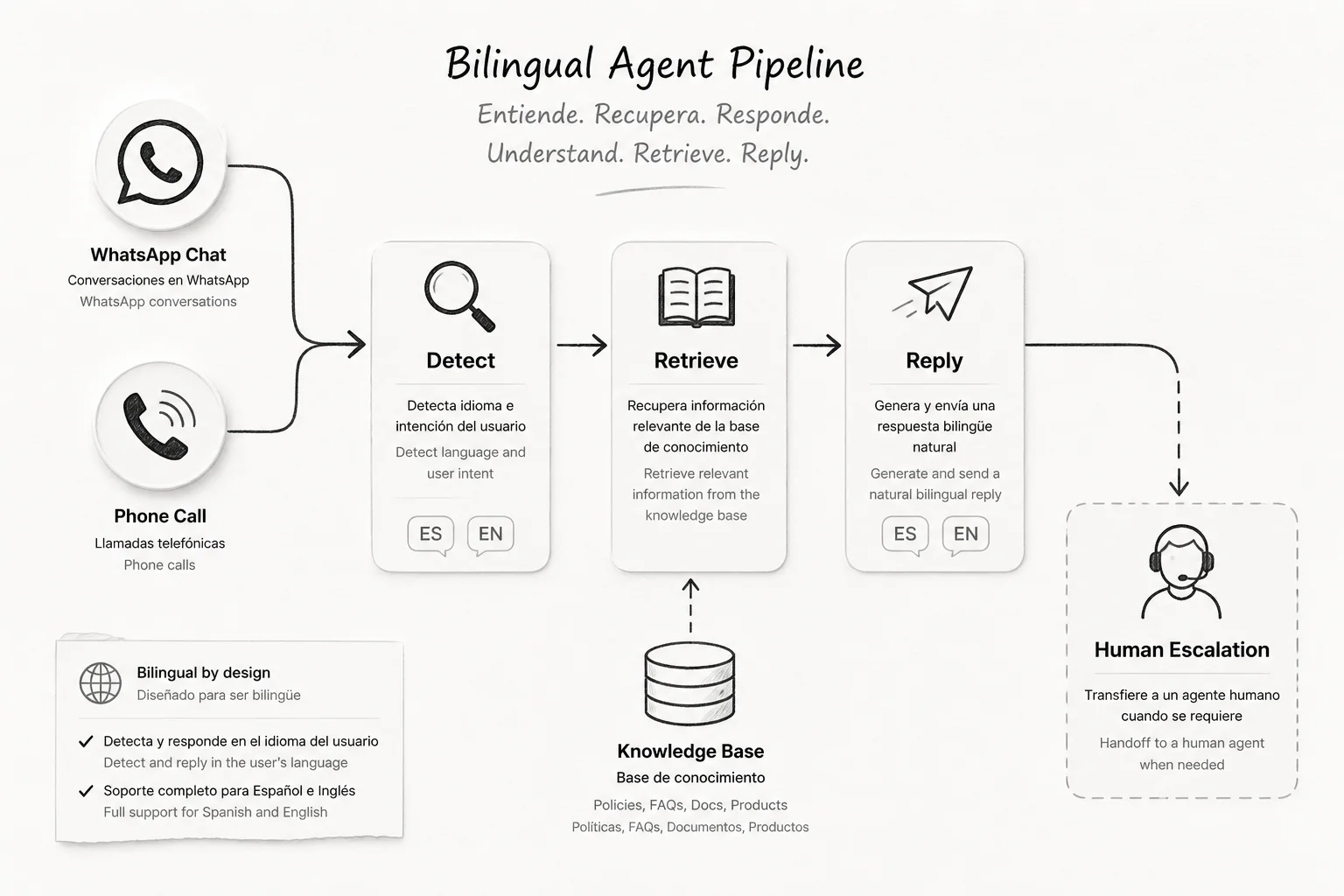
WhatsApp. Cloud API webhooks into n8n, then GoHighLevel or HubSpot. Language detection on each inbound message. Knowledge chunks stored in both languages (or one authoritative language with native generation only when you have verified quality). Escalation to a human tagged with language so the right person picks up. Details in WhatsApp Business API automation.
Voice. Speech recognition must survive accent, line noise, and dialect before the LLM sees text. TTS must not sound like a newsreader. I keep voice on structured jobs first: confirm appointment, reschedule, capture callback, basic FAQ. Clinics and dental fronts are a good fit; see AI receptionists for clinics. Chat first, voice second, is still the sane sequence for most bilingual SMBs: the knowledge base you build for WhatsApp becomes the voice grounding later.
Web. Next.js lead sites with language-aware widgets are fine when traffic is web-first. Do not assume web chat is where your customers already are.
Tooling I reach for in the middle: n8n for orchestration, pgvector or a managed vector store for bilingual chunks, and explicit confidence thresholds that force handoff instead of guessing.
A test pack you can run before you buy or launch
Never accept "supports Arabic / Spanish / 95 languages." Run this on a live number or widget:
- Formal question in language A (accurate + natural answer?)
- Dialect or informal phrasing your real customers use
- Latinized / Arabizi / Spanglish style if your market uses it
- One mid-sentence language mix
- Numbers, dates, addresses, and a brand name inside the other script
- Ask for a human; confirm escalation works and preserves context
Then ask who scored the answers: a native speaker reviewing real conversations, or a translation API and hope?
After launch, track resolution rate and escalation rate by language. If Spanish escalates 2× English, you have a measurable bug, not a vibe. Review failed transcripts monthly. New phrasings show up in the inbox, not in the original test plan.
Cost note: budget inference and WhatsApp conversation fees assuming the secondary language is more expensive per turn. For ballpark channel costs, see AI chatbot and voice cost in 2026.
Operator story (compressed)
A dual-location service business had an English-only FAQ bot on the site and a chaotic WhatsApp inbox in two languages. We did not "add Spanish to the widget." We built LLS on WhatsApp first: detect, bilingual rate cards and FAQs in the store, native replies, GHL contact language tag, and a human queue for low confidence.
First-response on money questions dropped from "whenever someone saw the phone" to under a minute after hours. Escalation on the secondary language started ugly (about 40% of threads). After two rounds of transcript review and three missing FAQ chunks, it sat near the English rate. The model did not change. The layers did.
Soft close
If your English demo is beautiful and your bilingual inbox is embarrassing, you do not need another chatbot logo. You need language treated as a first-class pipeline.
Bring sample messages (or call notes) in both languages to a free discovery call on cal.com/saifyxpro. We can map which LLS layers you are missing and whether WhatsApp, voice, or web should go first.