
Four states walked into a federal courtroom in Oakland on Tuesday and said Meta did not accidentally let kids get hooked on Instagram. They said the company studied young brains, then tuned the product to exploit what it found.
That framing matters for anyone who ships engagement loops with AI layered on top. This is the first big trial where product mechanics (scroll, notifications, ranking) sit in the same docket as privacy and mental health.
What opened in Oakland
California, Colorado, Kentucky, and New Jersey are the first four of 29 states that sued Meta in 2023 over child safety and privacy. The other 25 will trial later. Meta also faces parallel cases, including one underway in Tennessee.
The states want billions in damages and structural changes to how Meta runs Facebook and Instagram. Judge Yvonne Gonzalez Rogers oversees the case. Proceedings are expected to run about six weeks, with testimony from CEO Mark Zuckerberg and other executives and former employees.
AP News opening-day coverage captured the tone: states argue Meta designed apps to "hook the users, hold them for as long as they can, harvest their data and hide the truth from the public."
The product design claims, not just policy slides
Deputy California AG Megan O'Neill told jurors Meta researched how kids seek rewards, crave social feedback, and struggle with impulse control compared to adults. She cited internal studies, including one titled "The young ones are the best ones."
The complaint also alleges:
| Claim | Why product teams should care |
|---|---|
| Under-13 users despite bans | Age gates treated as compliance theater if cross-app accounts stay live |
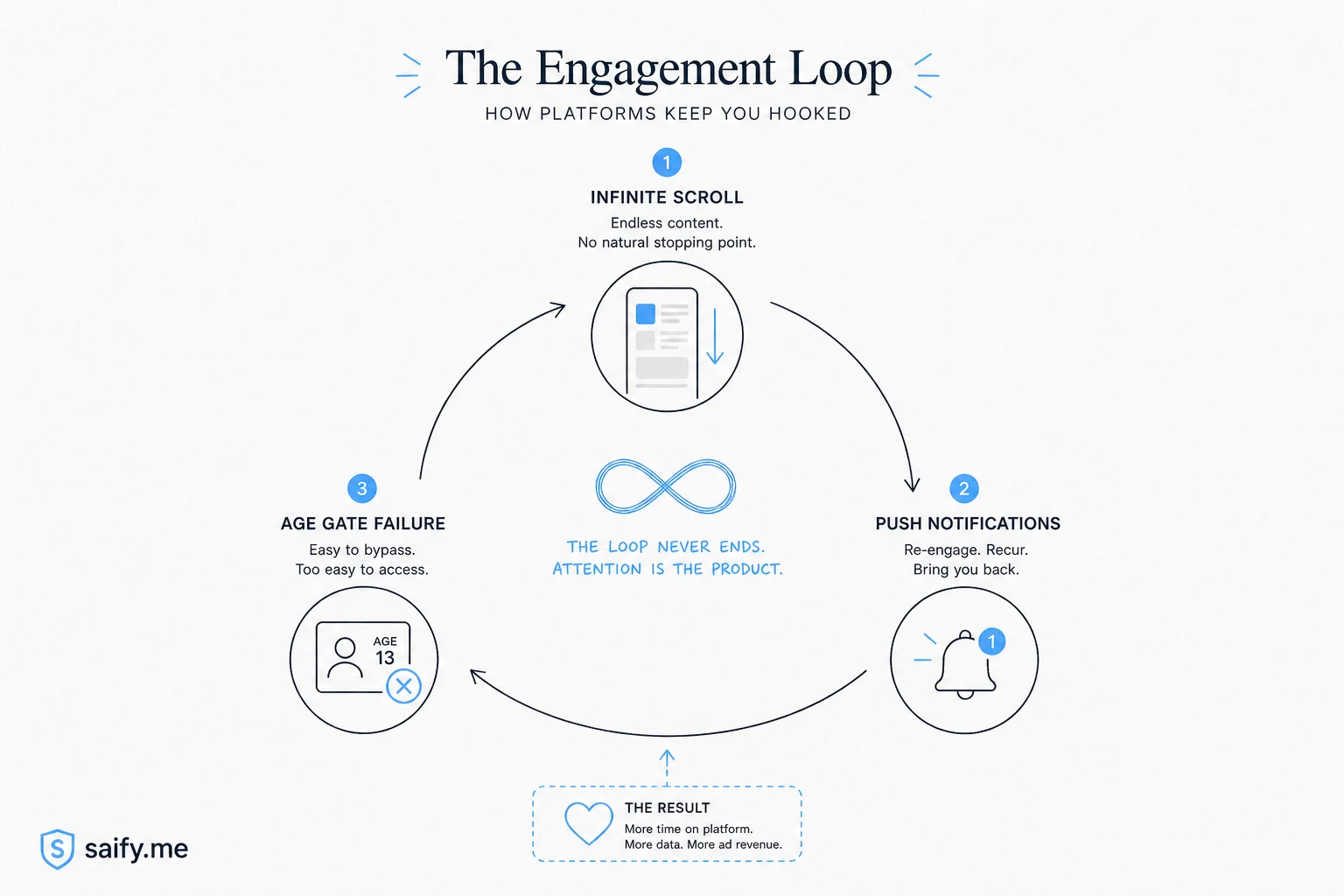
| Addictive design features | Infinite scroll and alerts are not neutral UX defaults |
| Data collection on minors | Training pipelines may inherit illegal inputs |
| Hidden harms | Safety research that never ships is a liability surface |
Former Meta executive Arturo Béjar, who worked on bullying and safety, testified that good engineering ideas on harmful content were "whittled down to a little pebble" after review. That is the sentence I keep coming back to. Research without enforcement is evidence for plaintiffs.
Meta's defense: we tried, you would do it differently
Meta attorney Paul Schmidt argued the undisputed facts are narrower: some kids lie about age, some teens struggle with time management, and negative content exists on open platforms. His case is that Meta invested in safety and disagrees with how states characterize incremental improvement.
That defense works in press releases. It gets harder when jurors hear internal study titles and witness testimony about ideas killed in review.
Remedies that reach into the stack
The Rundown Tech digest highlighted remedies that sound like a product requirements doc written by a court:
- Harder age verification and account linking across apps
- Limits on infinite scroll and push notifications for minors
- Deletion of models trained on children's data
If any of that sticks, it is not a fine Meta can book and forget. It is ongoing architecture. Recommendation systems, notification schedulers, and fine-tuning datasets all get audited.
For applied AI teams, the parallel is obvious. When your RAG corpus or fine-tune set includes user content, who opted in and at what age becomes a design question, not a legal footnote.
Why this trial is bigger than one company
Thousands of lawsuits are stacking against Meta, YouTube, TikTok, and Snap over youth harm and data practices. Meta already lost two youth-harm cases in 2026 before this trial started. Another loss here gives regulators and private plaintiffs a playbook aimed at engagement machinery itself, not just content moderation headcount.
Outside the courthouse, parents held photos of children who died after social media harms. Mary Rodee, whose 15-year-old son Riley died after sextortion on Facebook Messenger, said advocates added 39 new names to a memorial banner since March.
That human context is why "we have parental controls" rings hollow in court.
Lessons if you build AI on top of feeds
I work with clients adding AI summaries, agents, and voice on products that already optimize for time-on-site. Three takeaways from this docket:
1. Treat engagement metrics as regulated surfaces. If your model increases session length for teens, you inherit the same theories Meta is fighting.
2. Separate safety research from safety shipping. Béjar's testimony is a template for discovery: internal decks that never became diffs.
3. Model governance includes deletion orders. States want models trained on kids' data removed. Your MLOps playbook needs a court-order deletion path, not just retention policies.
The takeaway
Meta's Oakland trial is a stress test on whether courts can order how products feel, not just what they allow. Zuckerberg on the stand and Instagram's core mechanics on the record make this the clearest fight yet over engagement design.
If you are redesigning notifications, ranking, or training data for a consumer app, assume plaintiffs' lawyers have read your Notion docs. Book a free call if you want a blunt audit on where your AI layer amplifies retention risk.