
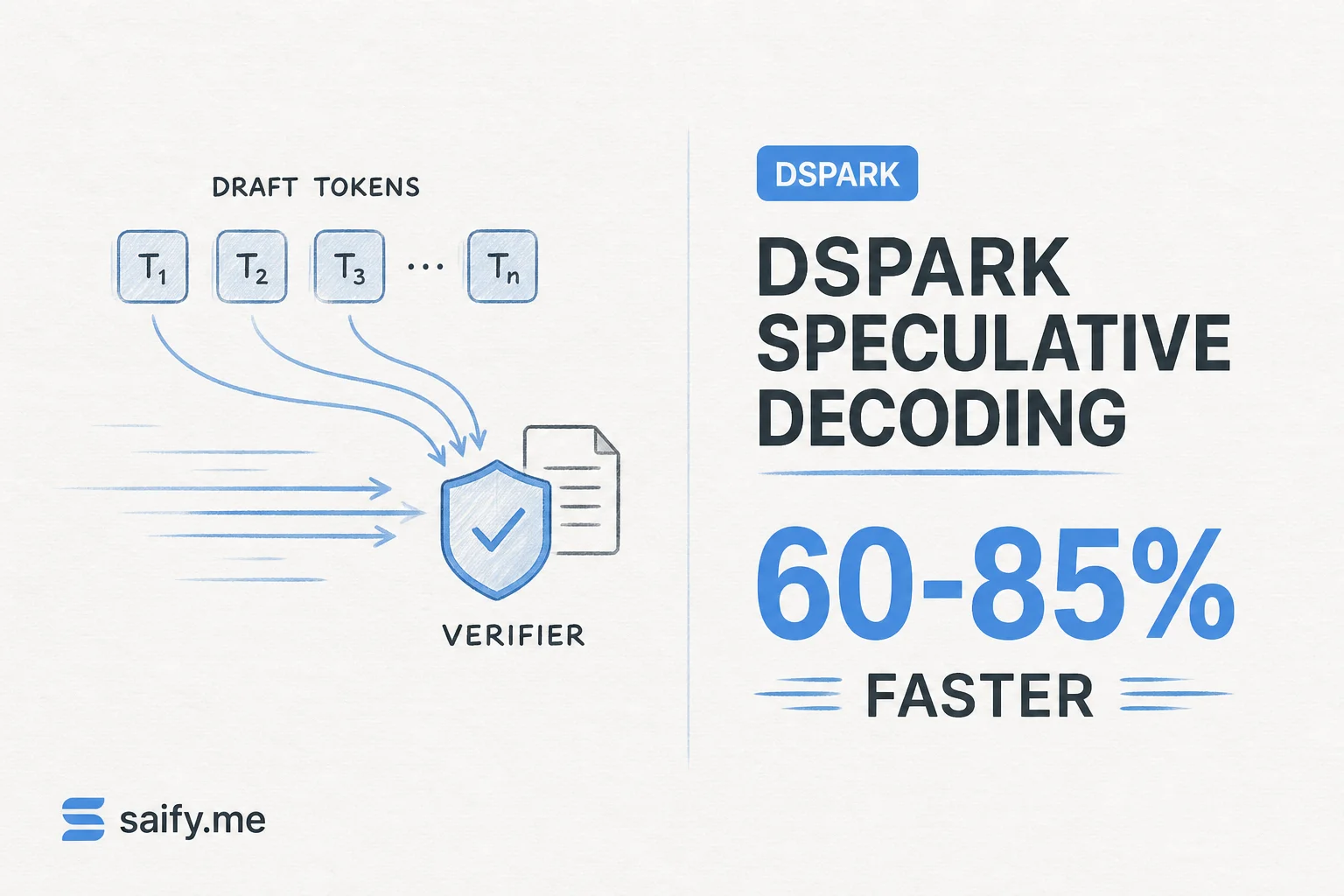
LLM inference bottlenecks are almost always decoding: one token at a time, GPU cycles waiting on serial steps. Speculative decoding is the standard fix. Train a small drafter, verify in batches, keep output identical to the target model.
DeepSeek's DSpark is the production-grade version they shipped on V4-Flash and V4-Pro serving in June 2026. It is not a new foundation model. It is an attachable draft stack with open training code that pushed per-user speed 60-85% at matched throughput.
Why parallel drafters stall
Classic speculative decoding uses a small model to guess the next k tokens, then the big model verifies them in one forward pass. Recent parallel drafters (Medusa-style) propose long blocks in a single pass. Fast, but acceptance decays toward the suffix because tokens lack interdependencies.
Under load, another problem appears: verifying long draft blocks wastes batch capacity on tokens likely to be rejected.
DSpark targets both failure modes.
Semi-autoregressive drafting
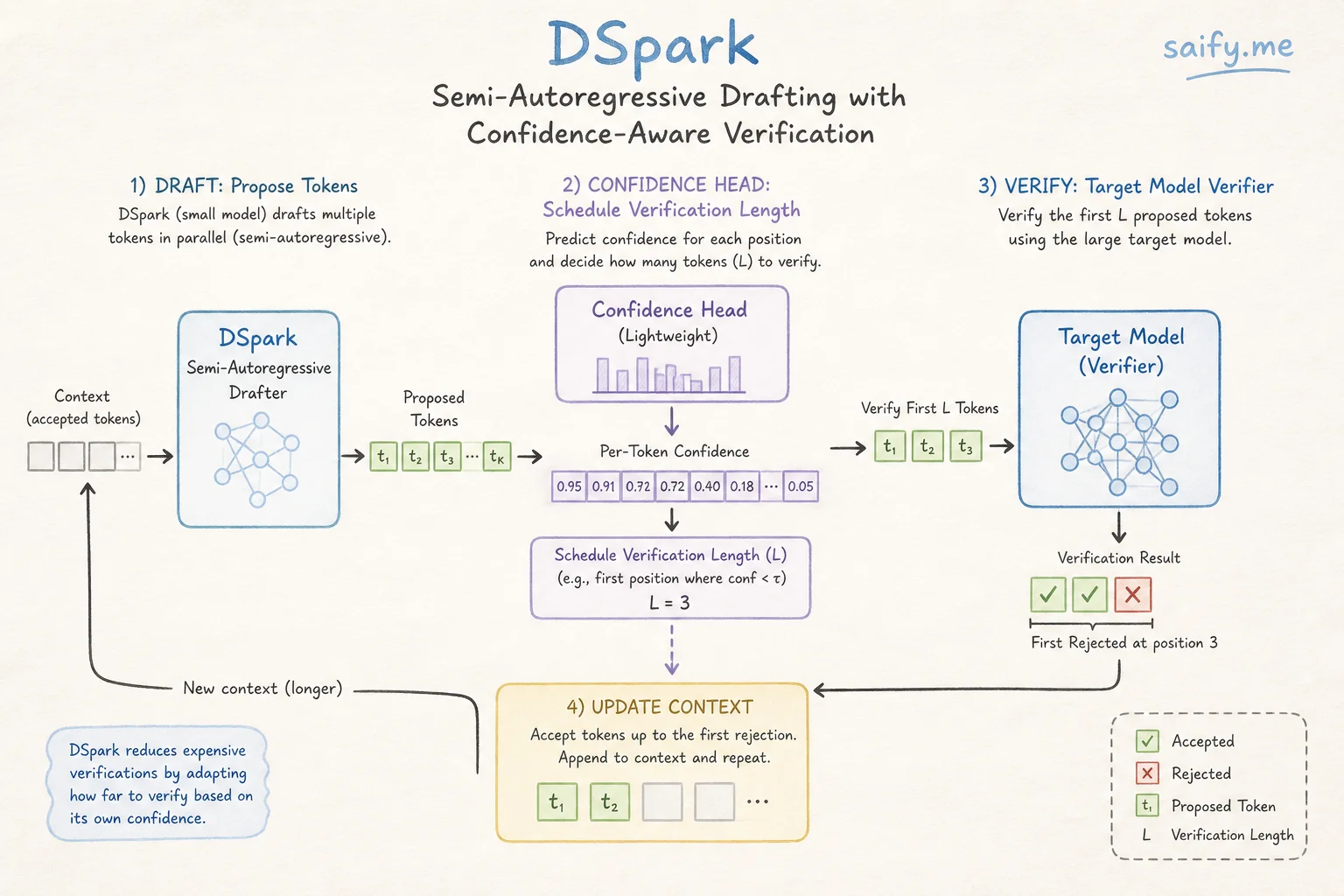
DSpark's drafter is semi-autoregressive:
- A parallel backbone proposes candidate tokens cheaply
- A lightweight sequential head adds intra-block dependencies (Markov-style)
- A confidence head estimates prefix survival probability
That kills suffix decay without giving up parallel speed. Offline, DeepSeek reports 26-31% higher accepted length vs Eagle3 and 16-18% vs DFlash in their benchmarks.
Confidence-scheduled verification
In high-concurrency serving, not every draft block deserves full verification. DSpark's scheduler:
- Profiles a throughput curve
SPS(B)at startup - Adjusts verification length per request from confidence scores
- Drafts longer when GPUs are idle, shorter when saturated
Result: less wasted verification on doomed tail tokens. Production tests on live V4 traffic show 60-85% faster per-user generation vs MTP-1 at matched aggregate throughput.
The headline "up to 400% throughput" you see in social posts is a corner case on the Pareto frontier. DeepSeek's own blog frames 57-85% per-user speedup as the conservative typical range.
Lossless is the contract
DSpark output is byte-identical to standard autoregressive decoding on the target model. No retraining the base weights. No quality regression trade hidden in the marketing.
Shipped checkpoints like DeepSeek-V4-Flash-DSpark reuse existing V4 weights with the draft module attached. Hugging Face cards include minimal inference examples.
Training and eval live in the open DeepSpec repo (MIT license). Configs cover DSpark, DFlash, Eagle3 comparisons.
Production numbers that matter
| Deployment | vs MTP-1 baseline |
|---|---|
| V4-Flash live traffic | 60-85% faster per user |
| V4-Pro live traffic | 57-78% faster per user |
| Shipped config | DSpark-5 (five-token draft block + Markov head) |
DeepSeek also reports up to ~6.6x throughput while holding a 120 tokens/second latency floor on V4-Pro and V4-Flash in some configurations. Read that as "better Pareto curve," not "every request is 6x."
Who should care
Agent workloads benefit disproportionately. Long tool loops, streaming chat, and batch eval traces are throughput-bound before they are IQ-bound. A 60% per-user speedup on the same hardware changes how many concurrent agents you can serve without new GPUs.
Self-hosters running vLLM or SGLang should watch DeepSpec integration paths. Community guides mention vllm serve on DSpark checkpoints.
Not a fit when:
- Prompts are wildly out-of-distribution (acceptance rates collapse)
- You are already memory-bound on the target model (draft weights add overhead)
- You need the absolute lowest tail latency on tiny prompts (draft setup has fixed cost)
Relation to JetSpec and other signals
The same digest highlighted JetSpec (9.64x on Qwen3 with smarter speculative decoding). DSpark and JetSpec sit in the same solution class: decoding engineering, not bigger models.
I would benchmark both on your prompt distribution. Marketing tops from Qwen3 runs do not predict agent trace acceptance.
Risks
- Worst case can be slower than baseline if drafts reject constantly (verification tax).
- Hardware-specific tuning for the confidence scheduler means copy-paste configs may underperform.
- MoE models add draft memory on top of already heavy targets (V4-Pro is 1.6T total / 49B activated).
Bottom line
DSpark is speculative decoding with production scheduling discipline: semi-autoregressive drafts that stay coherent deep in the block, plus verification that respects GPU load.
For teams serving DeepSeek V4 or training draft heads on Qwen/Gemma, the open DeepSpec repo is the actionable artifact. The 60-85% per-user speedup is the number I would put in a capacity plan.
If you are sizing inference for agent products and want help modeling throughput vs cost, book a free discovery call.