
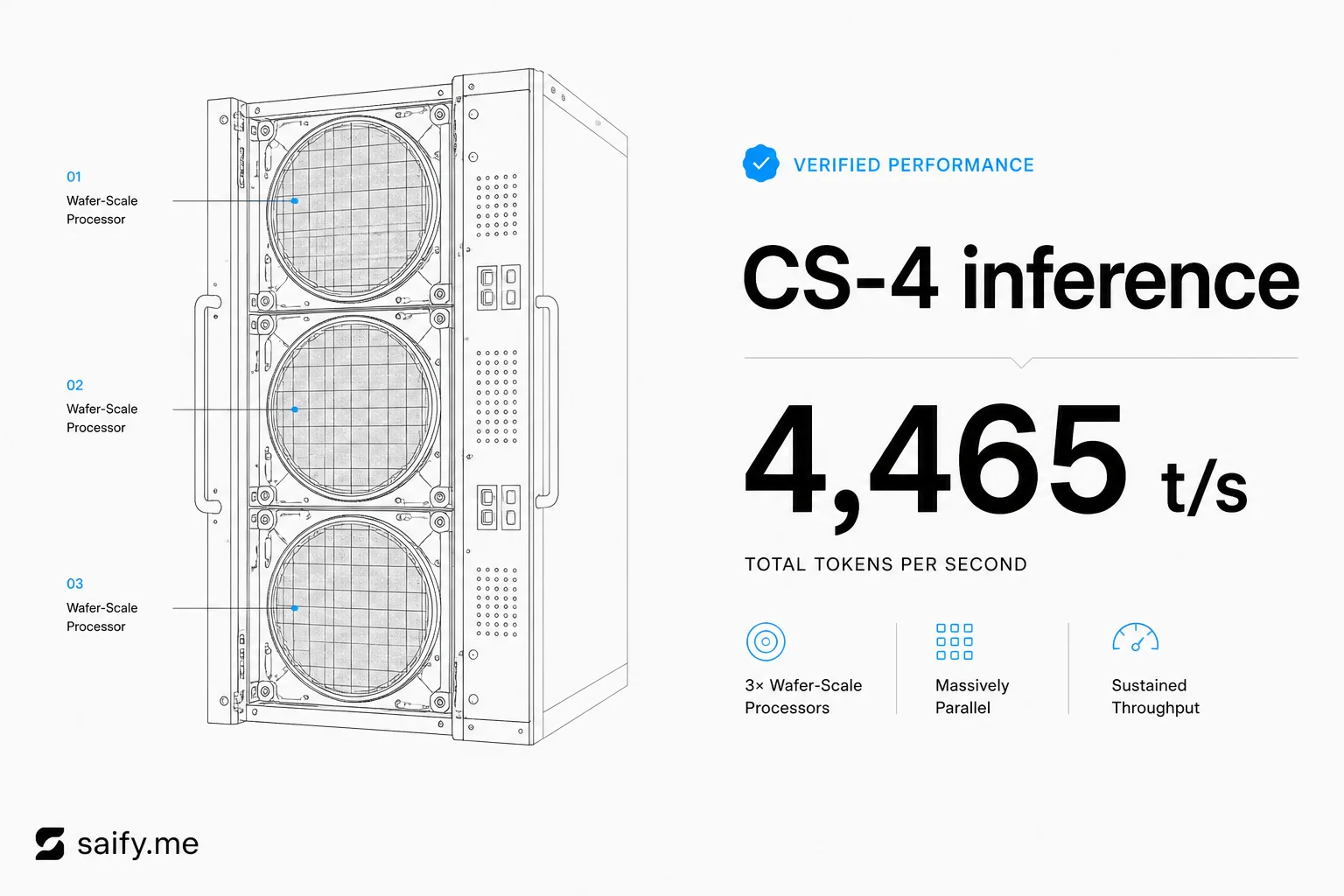
4,465 tokens per second on a 120B open-weight model is not a typo. That is what Cerebras claims its new CS-4 rack hits on GPT-OSS-120B in internal testing.
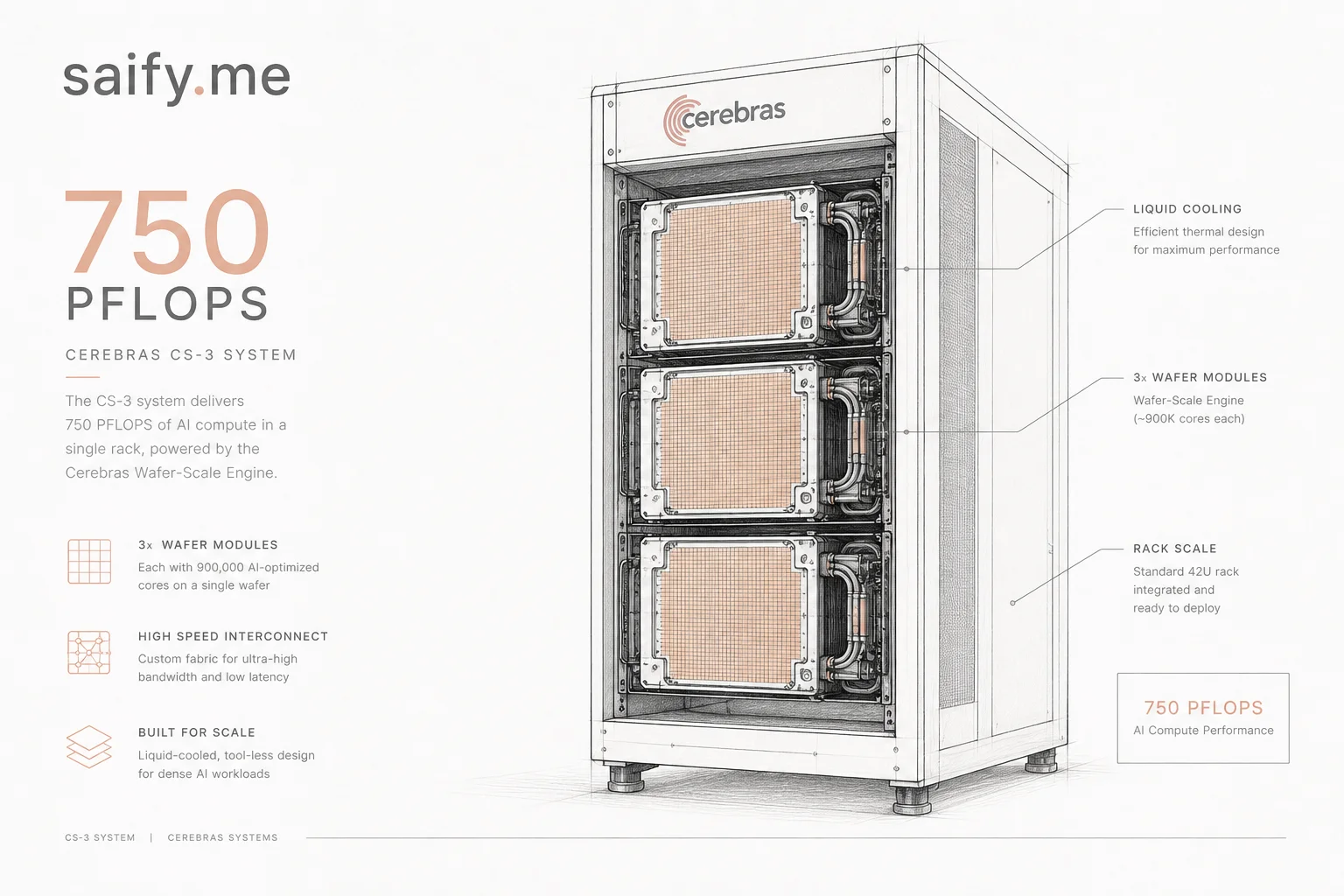
On August 18, 2026, the company unveiled CS-4: three overclocked Wafer Scale Engine 3 Turbo chips in one rack, 750 PFLOPS of sparse FP16 compute, and up to 30x faster inference than the GPU configurations Cerebras benchmarked against. The silicon is not a mystery new process node. It is the same wafer-scale die, pushed harder through power delivery, cooling, and a modular rack called Nexus.
I build agent workflows for clients who measure ROI in seconds between tool calls. CS-4 is infrastructure news. But for applied engineers, it is also a product signal: inference speed is becoming a tier you can buy, not a trade-off you accept.
What CS-4 actually ships
Cerebras's CS-4 announcement frames the system as a coordinated stack, not a chip swap.
| Component | CS-4 spec (per Cerebras) |
|---|---|
| Processors | 3× WSE-3 Turbo per rack |
| AI compute | 750 PFLOPS (sparse FP16) |
| Memory bandwidth | 129.6 PB/s aggregate |
| Fabric bandwidth | 160.5 PB/s |
| External I/O | 7.2 Tbps |
| Wafer-to-wafer latency | As low as 2 μs |
| GPT-OSS-120B throughput | 4,465 tokens/sec per user (Cerebras testing) |
| vs GPUs | Up to 30× faster inference (Cerebras claim) |
| Ship date | First units this quarter (Q3 2026) |
Each WSE-3 Turbo (WSE-3T) keeps the WSE-3 footprint: 4 trillion transistors, 900,000 AI cores, 44 GB of on-wafer SRAM on a full 300 mm wafer. The Turbo variant doubles rated compute to 250 PFLOPS per wafer and memory bandwidth to 43.2 PB/s. Same die, higher clocks, enabled by moving power conversion closer to the wafer and feeding it more watts through redesigned liquid cooling.
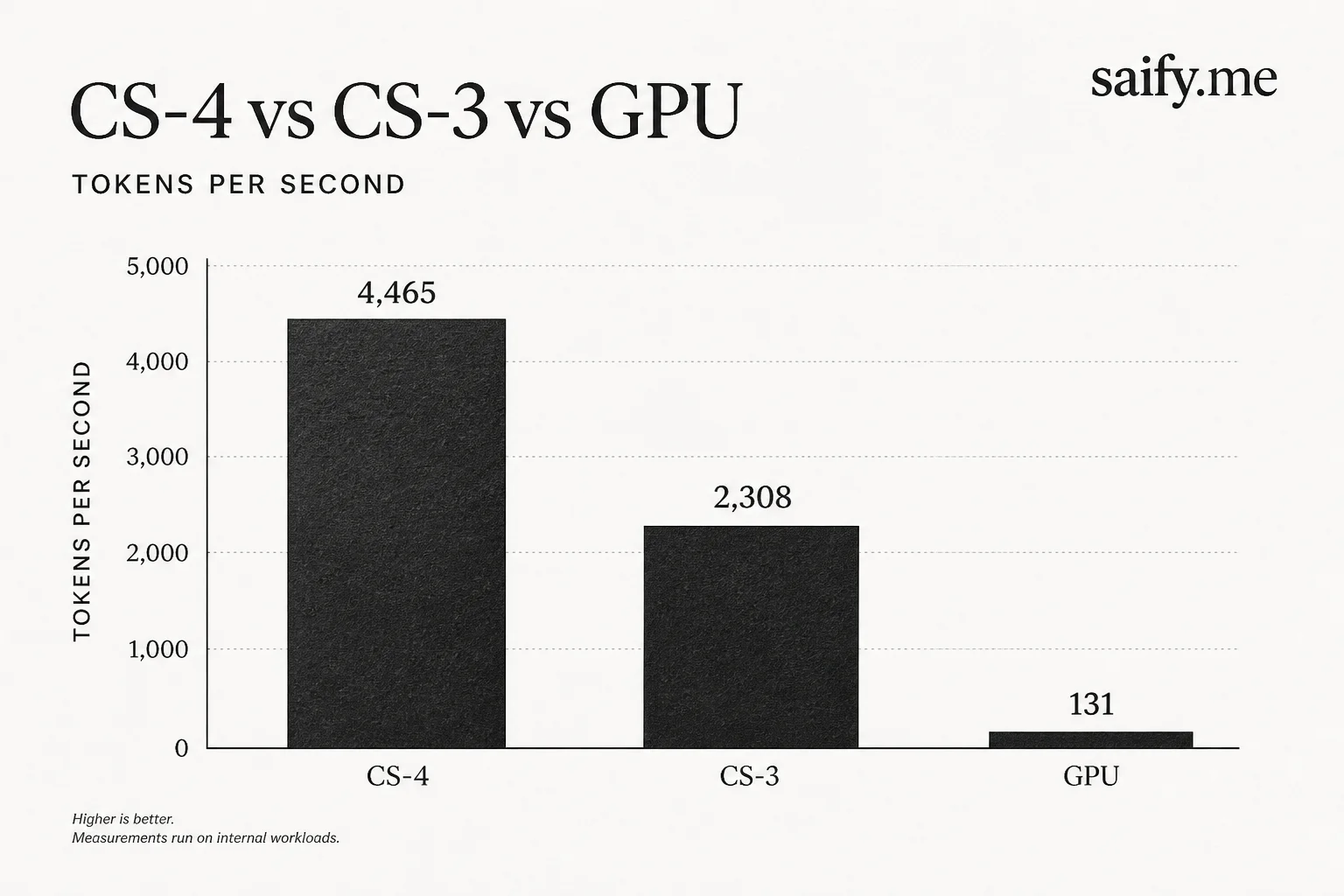
CS-4 is also roughly twice as fast as CS-3 at the rack level, with Cerebras quoting up to 10× more throughput per watt than the previous generation.
Nexus: the rack is the product
The bigger architectural move is Nexus, Cerebras's new rack-scale platform. Instead of one tightly coupled assembly, Nexus splits compute, power, and I/O into modular "backpack" units that ship and upgrade independently.
Cerebras says Nexus cuts rack components by about 50% compared to prior designs. Direct Wafer Links connect wafers with switchless paths and 2 microsecond latency (down from 5 μs on CS-3). RoCE v2 RDMA over Ethernet handles heterogeneous clusters. The pitch is hyperscale deployability: factory to datacenter faster, clusters that can serve models above 10 trillion parameters at more than 1,000 tokens per second.
For operators, modularity matters because inference capacity is now a rolling upgrade problem. When clocks and power delivery improve without a new fab cycle, you want to swap modules, not rewire a whole facility.
Why 4,465 t/s changes the agent math
Cerebras measures tokens per second per user: how fast one interactive session gets its next chunk of output. That is the right metric for coding agents, security triage, and voice stacks where humans wait on the model between steps.
Compare the numbers Cerebras published:
| Workload framing | Slow path | CS-4-class speed |
|---|---|---|
| GPT-OSS-120B decode | ~150 t/s (GPU baseline in Cerebras tests) | 4,465 t/s per user |
| Multi-step agent loop (20 turns, 500 tokens each) | ~67 seconds of pure generation | ~2.2 seconds of pure generation |
| OpenAI Ultrafast preview (Sol) | Standard tier | ~750 t/s peaks |
The agent loop row is illustrative math, not a Cerebras benchmark. It shows why I care about this hardware even when I cannot buy a rack.
When I wrote about OpenAI's Ultrafast preview on Cerebras, the story was API access: frontier Sol at ~750 tokens per second for invite-only customers. CS-4 is the rack behind that capacity curve. More wafers, more clocks, more modular racks rolling out this quarter.
What I would test before rewriting architecture
Cerebras's 30× and 4,465 t/s figures come from its own comparisons against unnamed GPU inference setups. Third-party API measurements on Cerebras cloud for gpt-oss-120b have landed closer to ~1,700 t/s in public leaderboards. Different conditions, different numbers. Both can be true.
Before I tell a client to depend on ultrafast inference, I would profile:
- Your actual prompt shapes. Long context prefill may still run on AMD Instinct or AWS Trainium in Cerebras's heterogeneous stack. CS-4 is positioned heavily as the decode accelerator.
- Batching under load. Per-user speed and datacenter throughput can diverge when concurrency spikes.
- Cost per completed task. Rack power draw is quoted around 120 to 140 kW. Speed without $/outcome is a vanity metric.
- Availability path. OpenAI Ultrafast preview, Cerebras Cloud, or on-prem enterprise contracts are different doors into similar silicon.
None of that diminishes the engineering. Doubling a wafer's clocks without a new process is a power delivery story, and Nexus is a credible answer to "how do you ship 750 PFLOPS without a year-long integration project?"
The consulting angle on latency
In client work, latency shows up in places benchmarks ignore:
- A voice agent that loses trust after a 2-second gap mid-sentence
- A security playbook where analysts abandon the model between log lines
- A coding agent that burns its retry budget because each self-correction takes 8 seconds
Faster inference does not fix bad prompts or flaky tools. It changes how many refinement loops fit inside a human's patience window.
When CS-4-class throughput lands in production APIs, the harness decisions shift: more parallel sub-agents, more "re-read the whole file" passes, fewer brittle summarization shortcuts. Routing still matters. I have written about model routing for agent loops before. Speed tiers add another axis: frontier intelligence at workhorse latency.
What I am watching next
Three signals would make CS-4 a planning input, not just a headline:
- OpenAI Ultrafast pricing and rate limits as CS-4 capacity ramps
- Independent throughput tests on identical prompts, context lengths, and concurrency
- Whether WSE-4 arrives with more SRAM, or Cerebras keeps riding Turbo clocks on Nexus modules
Cerebras bet that inference, not training FLOPS, is where hyperscale money flows next. OpenAI's multi-year Cerebras deployment commitment suggests that bet has buyers. For applied engineers, the actionable takeaway is smaller: add wall-clock time to your eval harness next to accuracy. The fastest model on a leaderboard is not always the fastest model for a 40-step agent run at 2 a.m.
Building agent workflows where latency shows up in user trust or analyst throughput? Book a free discovery call and we can map where inference speed actually moves your numbers.