
Local models only matter if they are fast enough to stay in your loop.
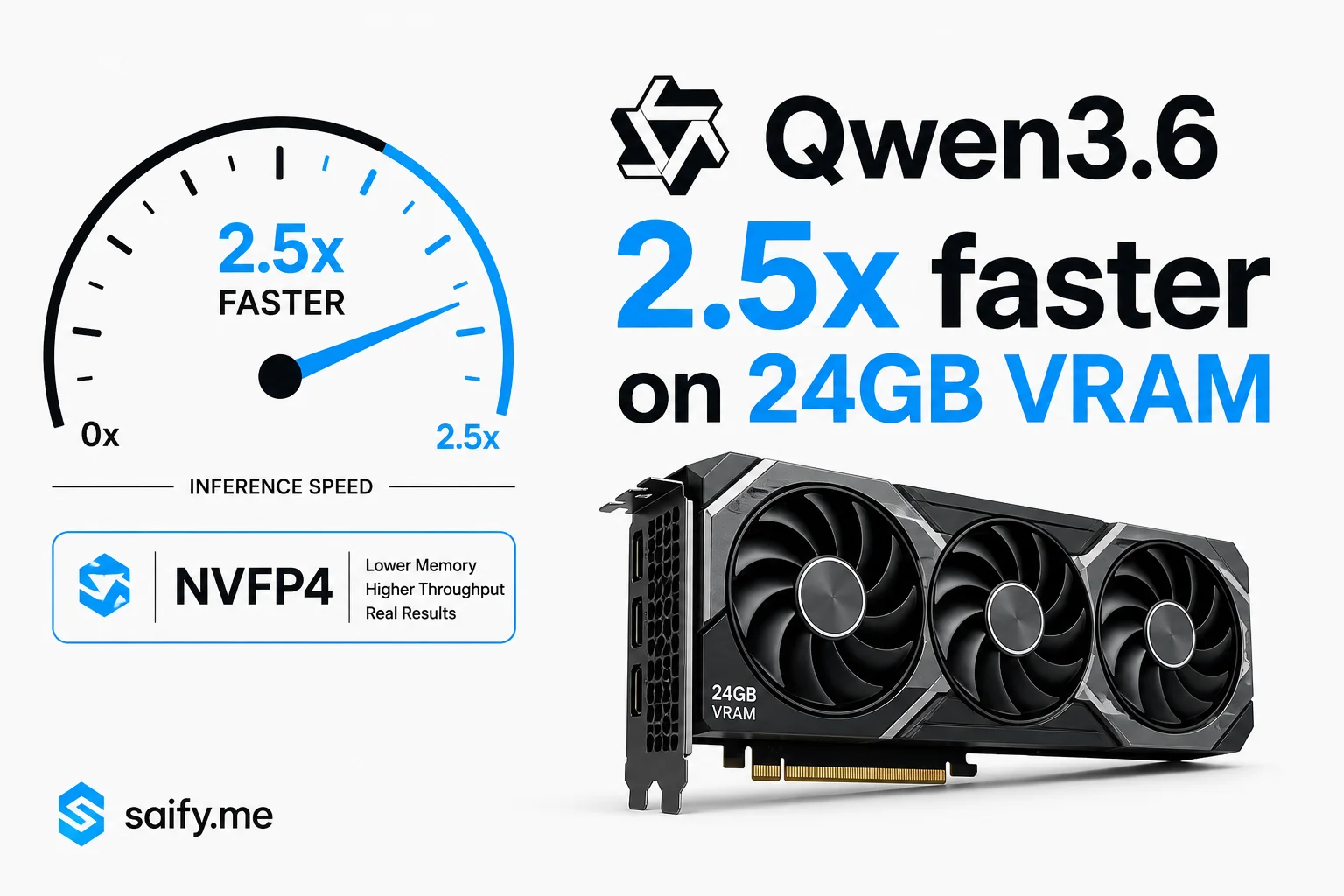
On July 10, 2026, Unsloth released dynamic NVFP4 Qwen3.6 quants that report up to 2.5x faster inference than standard NVFP4 builds, with Qwen3.6-27B fitting on a single 24GB card. The 35B-A3B MoE variant targets 32GB while keeping tool-calling behavior intact.
I have been running Qwen family models for client agent prototypes since the Qwen3.8-27B Unsloth guide. The 3.6 NVFP4 drop is the first time Unsloth explicitly optimizes both weights and activations for Blackwell FP4 tensor cores, not just smaller weight files.
What changed in the quant
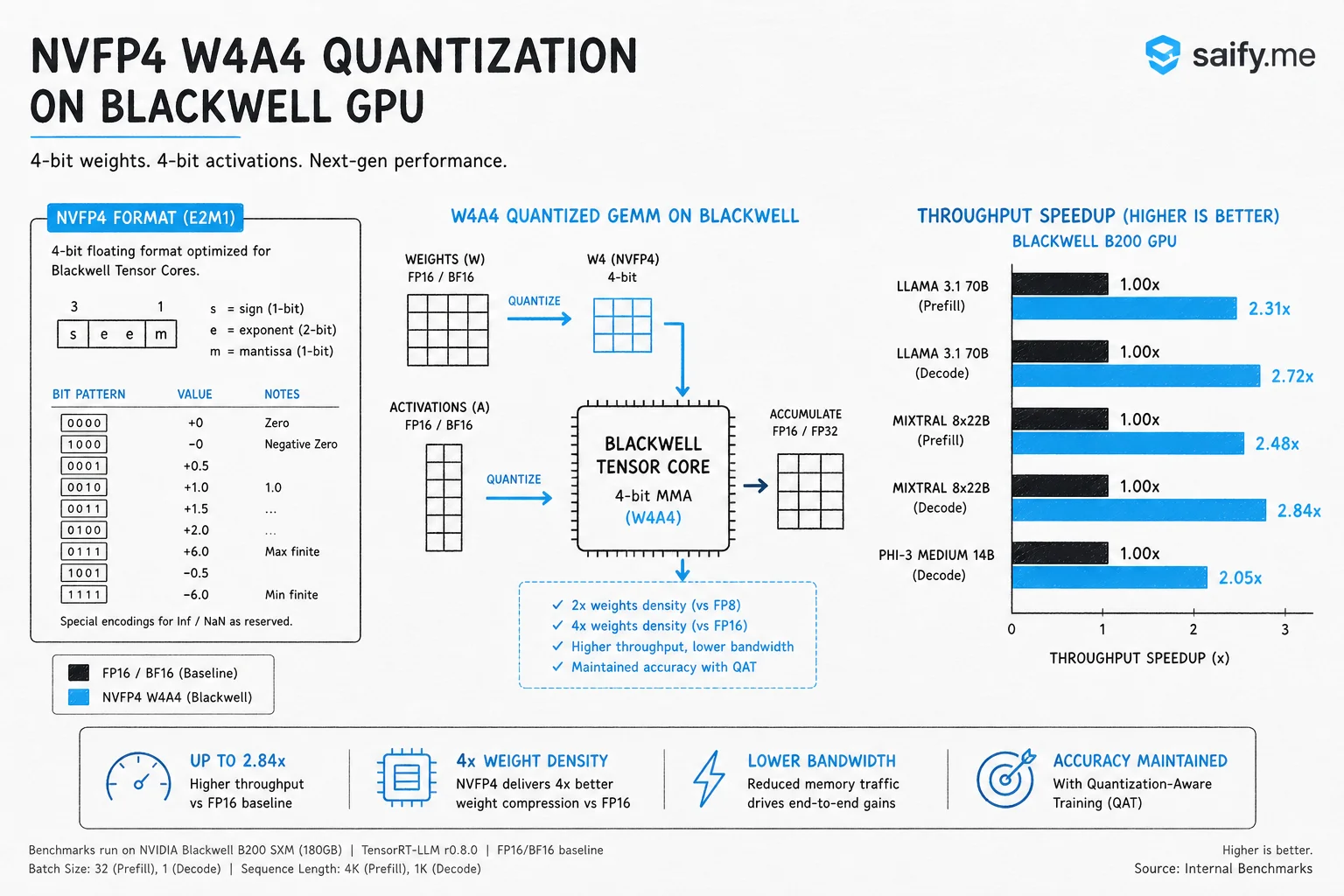
Traditional NVFP4 often quantizes weights to 4-bit while activations stay wider. Unsloth's dynamic NVFP4 uses a W4A4 scheme: weights and activations compress to 4-bit so Blackwell can compute natively without a dequant bottleneck.
| Checkpoint | VRAM target | Speedup vs other NVFP4 | Notes |
|---|---|---|---|
| Qwen3.6-27B-NVFP4 | 24GB | ~2.5x | Best headline for consumer cards |
| Qwen3.6-35B-A3B-NVFP4 | 32GB | ~1.56x | Slightly larger, more accurate |
| Qwen3.6-35B-A3B-NVFP4-Fast | 32GB | ~1.79x | Full W4A4, fastest 35B variant |
Unsloth also baked MTP (multi-token prediction) tensors into the checkpoints for extra speculative decoding gains. Their docs cite another 1.4x to 2.2x when MTP is enabled with the right server flags.
Accuracy did not collapse
Speedups are useless if tool calling falls apart. Unsloth published MMLU-Pro, GPQA, and AIME 2025 comparisons between BF16, FP8, NVIDIA NVFP4, and their NVFP4 builds. The faster quants land within roughly one point of FP8/BF16 on those suites.
They also tuned chat templates and calibration data (Unsloth dataset + UltraChat) to reduce looping and improve tool-call consistency. That matters more in agent harnesses than single-shot trivia prompts.
The backend choice is not optional
This is the gotcha that will waste your weekend. Unsloth's model card is explicit:
Do NOT use the Marlin backend since it is 2x slower. Use native vLLM or cute-DSL / CUTLASS / flashinfer_trtllm backends.
Example serve command from the card:
export CUTE_DSL_ARCH=sm_121a
vllm serve unsloth/Qwen3.6-27B-NVFP4 \
  --moe-backend flashinfer_b12x \
  --speculative-config '{"method": "mtp", "num_speculative_tokens": 2}'
If you swap checkpoints but keep Marlin defaults, you can erase the entire 2.5x win. Match the backend to your GPU generation and read the card for your exact variant.
Hardware reality check
NVFP4 is a Blackwell story. RTX 50-series, DGX Spark, B200, and B300 class hardware get the native FP4 path. If you are on Ampere or Ada, stay on Unsloth's Dynamic GGUF quants (still strong with MTP on Ollama or llama.cpp).
| GPU class | Recommended Qwen3.6 path |
|---|---|
| Blackwell (RTX 50xx, Spark) | Unsloth NVFP4 + vLLM/SGLang |
| Ada / Ampere 24GB | Dynamic GGUF Q4/Q5 from Unsloth |
| CPU-only dev | Smaller Qwen3.6 dense or cloud API fallback |
Community forum threads note B200 benchmark tables in Unsloth's launch post. Translate those numbers to your card honestly. A 2.5x win on paper becomes 1.3x if your backend autoselects Marlin.
When I would route agents to Qwen3.6 NVFP4
Good fits:
- Local agent loops where latency per tool call dominates cost
- Privacy-sensitive prototypes on a 24GB workstation
- A/B testing open-weight tool calling before you commit API spend
Poor fits:
- Production coding on huge monorepos where frontier models still win hard cases
- Teams without someone who can debug vLLM flags
- Non-Blackwell GPUs (use GGUF instead)
Pair this with the economics frame in specialized models for agentic coding. Open weights are not free if your harness burns hours on the wrong backend.
Quick start path
- Confirm Blackwell-class GPU and 24GB+ VRAM free
- Pull Unsloth's Qwen3.6 NVFP4 collection
- Serve with vLLM using cute-DSL or flashinfer backends (not Marlin)
- Enable MTP speculative config from the model card
- Benchmark your agent task, not MMLU alone
Useful references:
Unsloth turned Qwen3.6 from "fits on paper" into "fits and keeps up with my agent loop" on consumer Blackwell boxes. The speedup is real, but only if you respect the serving stack.
If you want help picking local vs API routing for an agent product, book a free discovery call.