
A 27-billion-parameter vision-language model that runs on the GPU you probably already own. That is the pitch behind Qwen3.8-27B, which Alibaba dropped as open weights in August 2026.
The tooling caught up fast. Unsloth shipped day-zero support in v0.1.800-beta: Dynamic GGUF quants at 17GB, NVFP4 variants for Blackwell GPUs, and fine-tuning on a single card.
I run local models for client prototypes, red-team evals, and workflows where API costs or data residency matter. This release is the most practical "frontier-class model on one GPU" moment I have seen in months.
Why 17GB matters
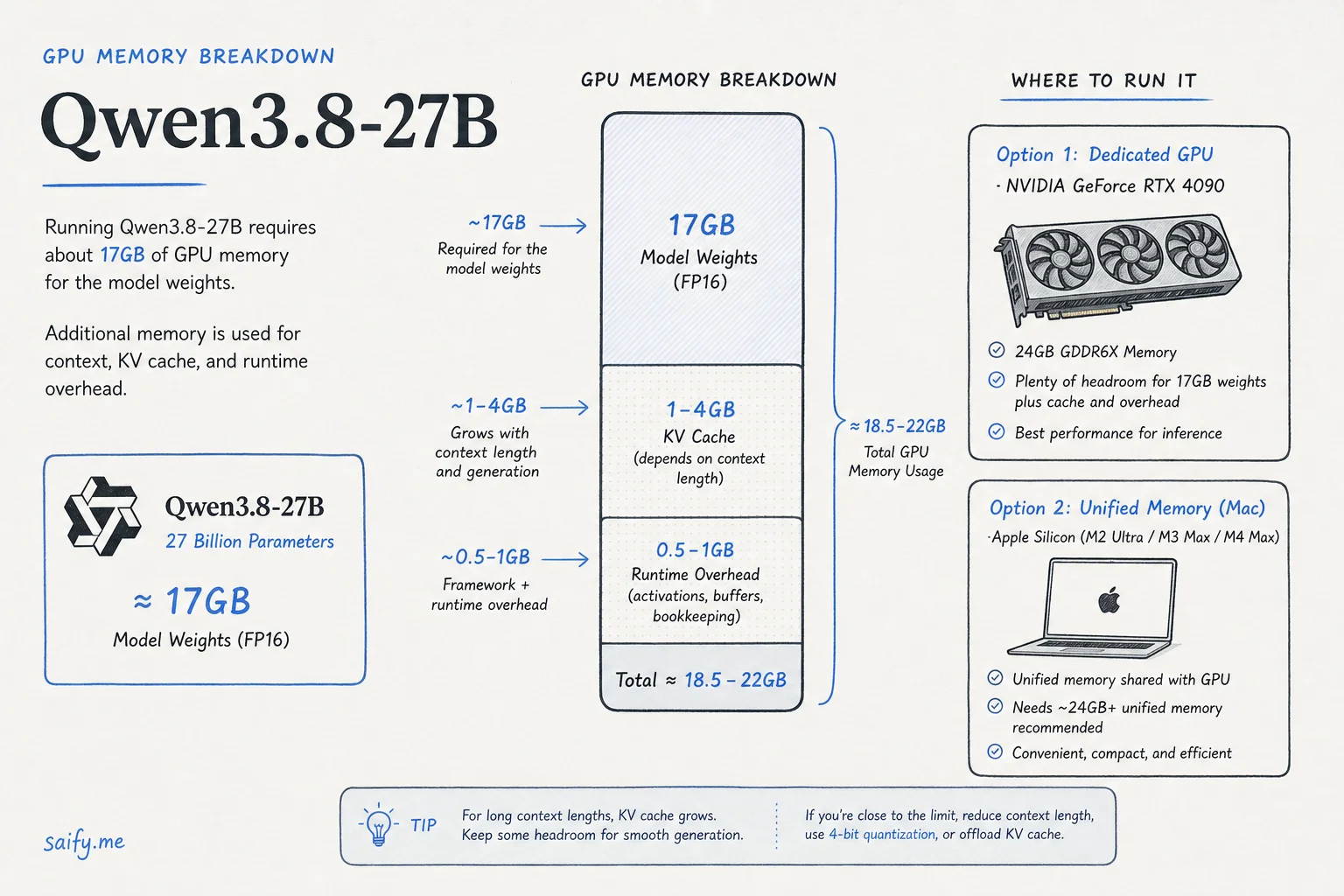
Most 27B models need datacenter hardware or awkward multi-GPU setups. Qwen3.8-27B's hybrid attention keeps only 16 of 64 layers in full attention. That shrinks memory footprint without gutting capability.
Unsloth's 4-bit Dynamic GGUF quants land at 17-19GB total (RAM plus VRAM, or unified memory):
| Hardware | Fit? | Notes |
|---|---|---|
| RTX 4090 (24GB) | Yes | Comfortable for inference |
| RTX 5080 (24GB) | Yes | NVFP4 quants ~1.5x faster on Blackwell |
| Mac 24GB unified | Yes | Unsloth Desktop auto-offloads to RAM |
| 48GB workstation | Yes | Room for QLoRA fine-tuning with longer context |
No datacenter required. That changes who can run serious local agents: solo developers, small agencies, and teams with data that cannot leave the building.
What you get in the box
Qwen3.8-27B is not a text-only chat model. Key specs:
- 27B dense parameters with vision encoder (images and video)
- 256K native context, extensible toward 1M tokens
- Thinking mode for slow, deep reasoning vs fast chat mode in one model
- Apache 2.0 license (commercial use friendly)
- Agentic coding improvements: better tool calling, nested object parsing, developer role support for Codex-style tools
Unsloth packages it three ways:
- GGUF quants for local inference (
unsloth/Qwen3.8-27B-GGUF) - NVFP4 quants for RTX 50-series (~1.5x faster than BF16)
- Full safetensors for fine-tuning (
unsloth/Qwen3.8-27B)
Fine-tuning on one card
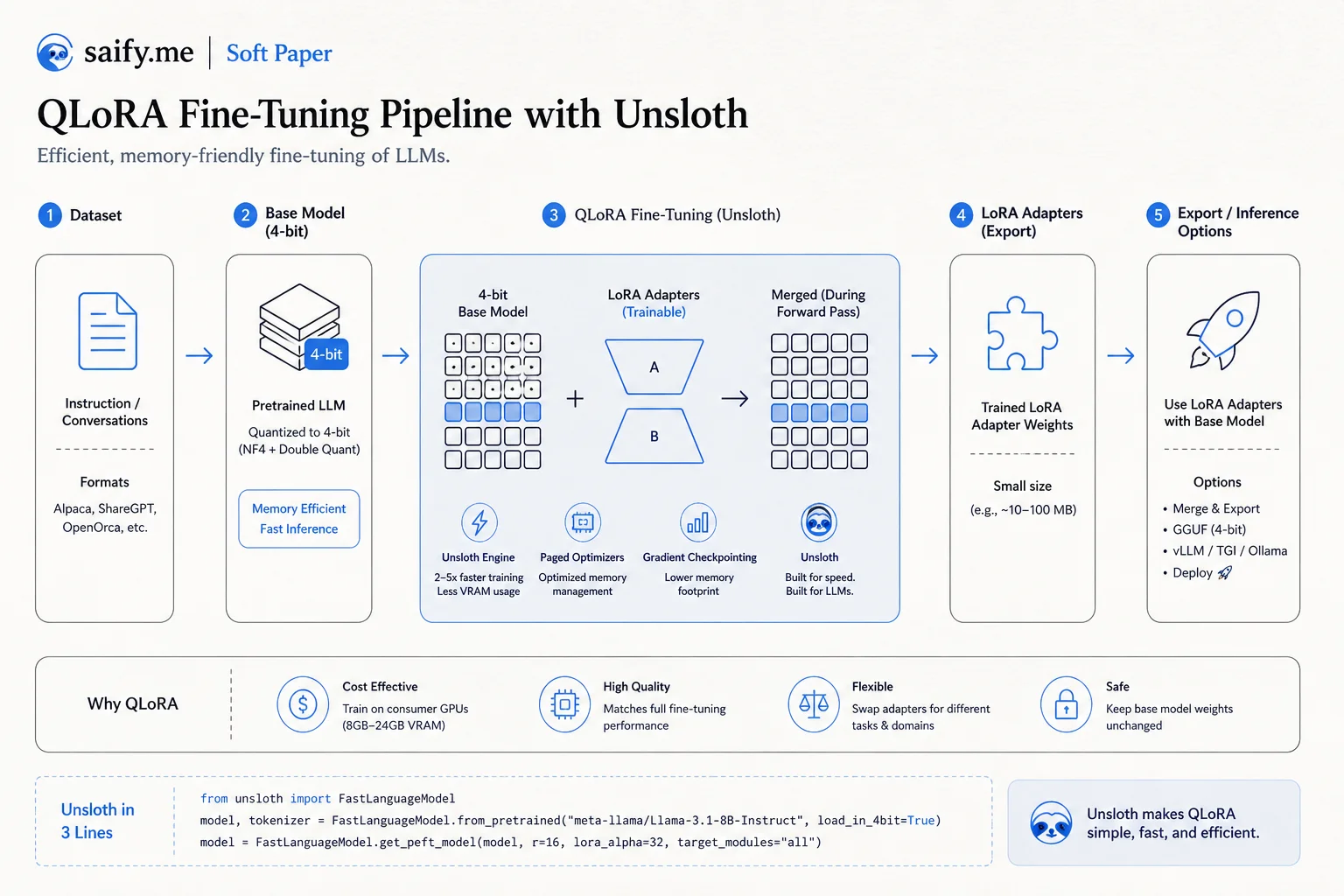
Inference is the headline. Fine-tuning is where Unsloth earns its reputation: roughly 2x faster training with 70% less VRAM than stock Transformers plus PEFT.
The standard QLoRA pattern:
from unsloth import FastLanguageModel

model, tokenizer = FastLanguageModel.from_pretrained(
    "unsloth/Qwen3.8-27B",
    max_seq_length=4096,
    load_in_4bit=True,
)
model = FastLanguageModel.get_peft_model(model, r=16)
Practical memory notes from people who have run it:
max_seq_lengthdrives VRAM harder than anything else. Set it to your real data length, not the 256K ceiling.r=16LoRA rank is a sane default. Higher rank costs more VRAM and overfits faster on small datasets.load_in_4bit=Trueis what makes single-card training possible. Drop it only on 80GB+ cards.
When I would use this vs API models
Local 27B is not a replacement for GPT-5.6 or Claude Opus on every task. It is a strong fit when:
Data cannot leave your network. Clinical notes, internal repos, client contracts. Run inference on hardware you control.
You need a custom fine-tune. Domain-specific coding style, internal API patterns, company tone. QLoRA on 27B beats prompt engineering after a few hundred examples.
API costs add up. A high-volume internal agent burning tokens 24/7 might be cheaper on owned hardware within months.
You want an offline fallback. Internet goes down, API rate limits hit, provider has an outage. Local model keeps working.
I still route production client workloads to managed APIs when latency SLAs, multimodal quality, or compliance certifications demand it. But the local option stopped being a toy.
Quick start paths
Unsloth Desktop (Mac, Windows, Linux): search "Qwen3.8-27B", pick UD-Q4_K_XL quant, chat in under a minute. Connects to Claude Code, Codex, web search, and MCP.
CLI / notebook:
# Inference via llama.cpp or Unsloth's llama-server integration
# Fine-tune via Unsloth notebooks (check unsloth.ai/docs for latest)
vLLM / SGLang: NVFP4 quants work in vLLM on Blackwell GPUs. GGUF works everywhere else.
Useful links:
The bottom line
A powerful local model just got accessible to anyone with a decent GPU. Day-zero Unsloth support means you are not waiting six weeks for tooling to catch up.
If you want help scoping a local agent stack (model choice, fine-tune data, deployment path) for your ops or product, book a free discovery call. I would rather benchmark on your actual workload than argue about leaderboard scores.