
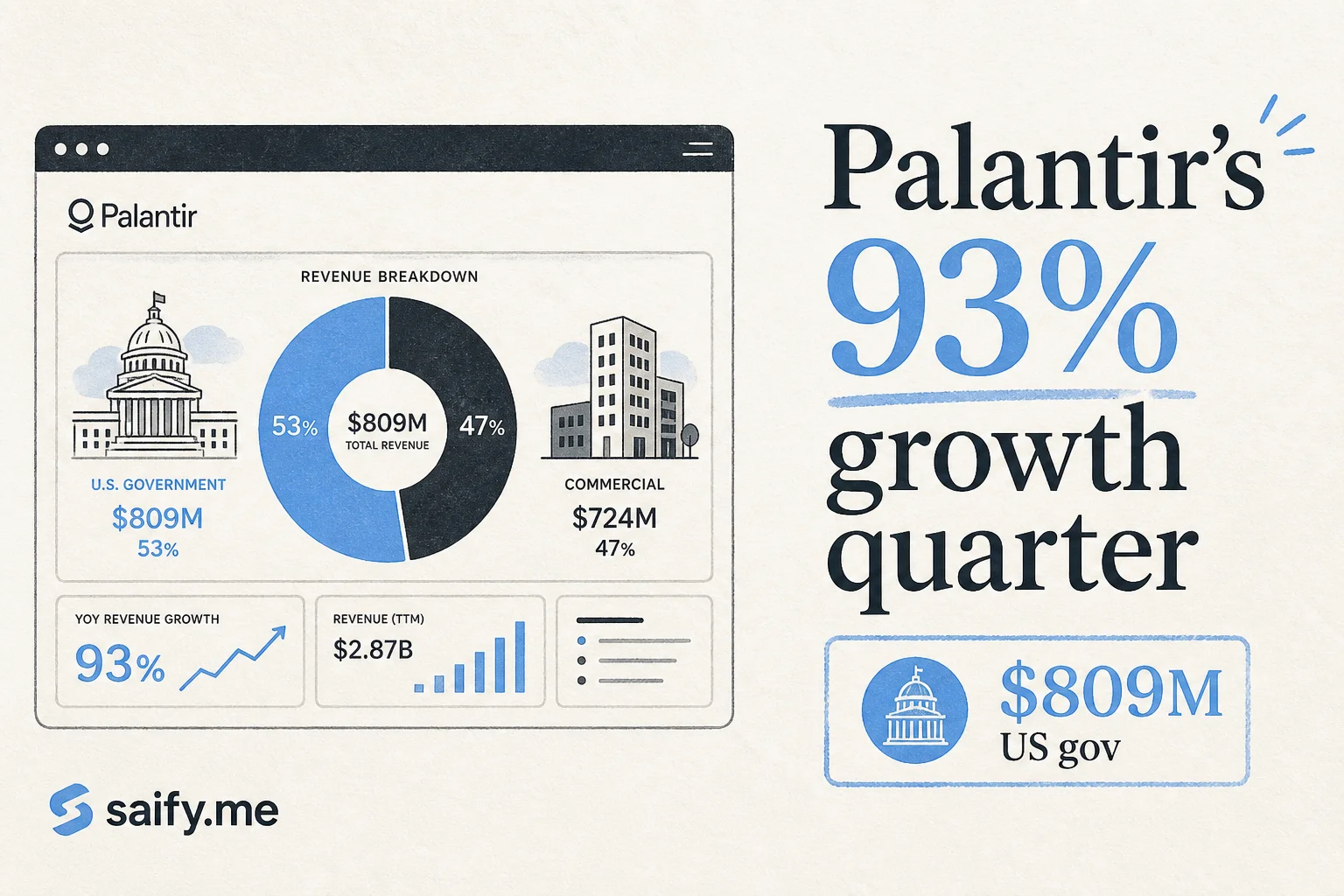
Palantir's stock was down 29% year to date going into Q2 earnings. Then the company posted 93% revenue growth, raised full-year guidance by half a billion dollars, and CEO Alex Karp told CNBC the momentum looks like it runs at least another 18 months.
If you thought government AI spending was a 2024 hype cycle, the numbers say otherwise.
The Q2 2026 scorecard
Palantir beat estimates on both revenue and earnings when it reported Q2 2026 results on August 3:
| Metric | Actual | Expected |
|---|---|---|
| Revenue | $1.94B | $1.80B |
| Adj. EPS | $0.41 | $0.35 |
| Net income | $1.07B | (vs $329M YoY) |
Revenue climbed 93% from about $1 billion a year ago. The stock jumped roughly 12% after hours.
Karp's quote to CNBC's Seema Mody: "Forget consensus. To my knowledge, no businesses at our scale has even grown half this much."
Government vs commercial: both engines are firing
Palantir is still known for defense and intelligence contracts. That segment is accelerating, not plateauing.
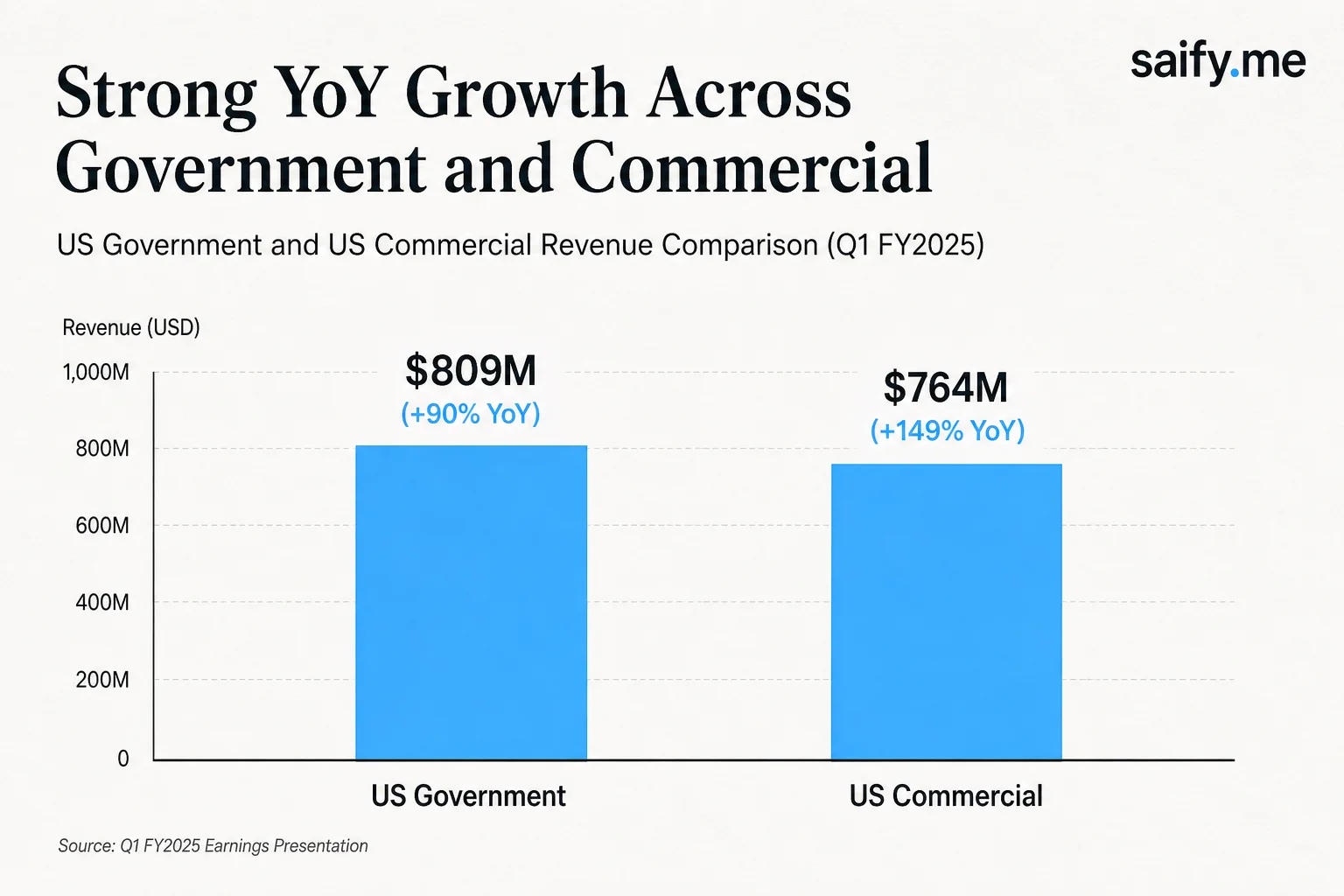
- U.S. government revenue: $809M, up 90% YoY
- U.S. commercial revenue: $764M, up 149% YoY
- Remaining U.S. commercial deal value: $6.24B, more than doubled YoY
U.S. commercial revenue has jumped 380% since 2024 on a compounding basis. Palantir now expects U.S. commercial revenue in excess of $3.42 billion in 2026, raised from prior guidance of $3.22 billion.
Full-year revenue guidance moved to $8.15B–$8.16B, up from $7.65B–$7.66B.
This is not a single blockbuster contract. It is broad-based expansion across government and enterprise buyers adopting Palantir's AI Platform (AIP) for operational workflows.
Why the stock was down before earnings
Palantir shares had lost 29% in 2026 before the report. The market worry: AI software valuations got ahead of growth, and Palantir's multiples looked stretched even by tech standards.
Q2 did not resolve the valuation debate. It did resolve the growth debate. Enterprise and government customers are still signing deals at a pace that looks more like land-grab than digestion.
For applied AI builders, the takeaway is demand-side: large organizations are budgeting real money for AI platforms that integrate with existing data estates, not just chatbot pilots.
Karp on open models and competition
Karp used the earnings cycle to push a policy and product theme: open-weight models.
Last month, following his viral CNBC comments, Karp and Palantir joined tech heavyweights in a letter urging the U.S. government not to restrict open-weight models. On the earnings call, he doubled down:
"We need competition if we're going to keep model companies honest, which is the same thing as enterprise software."
And: "The way we win in America is we compete, and our open models are going to have to become as good as Chinese open models."
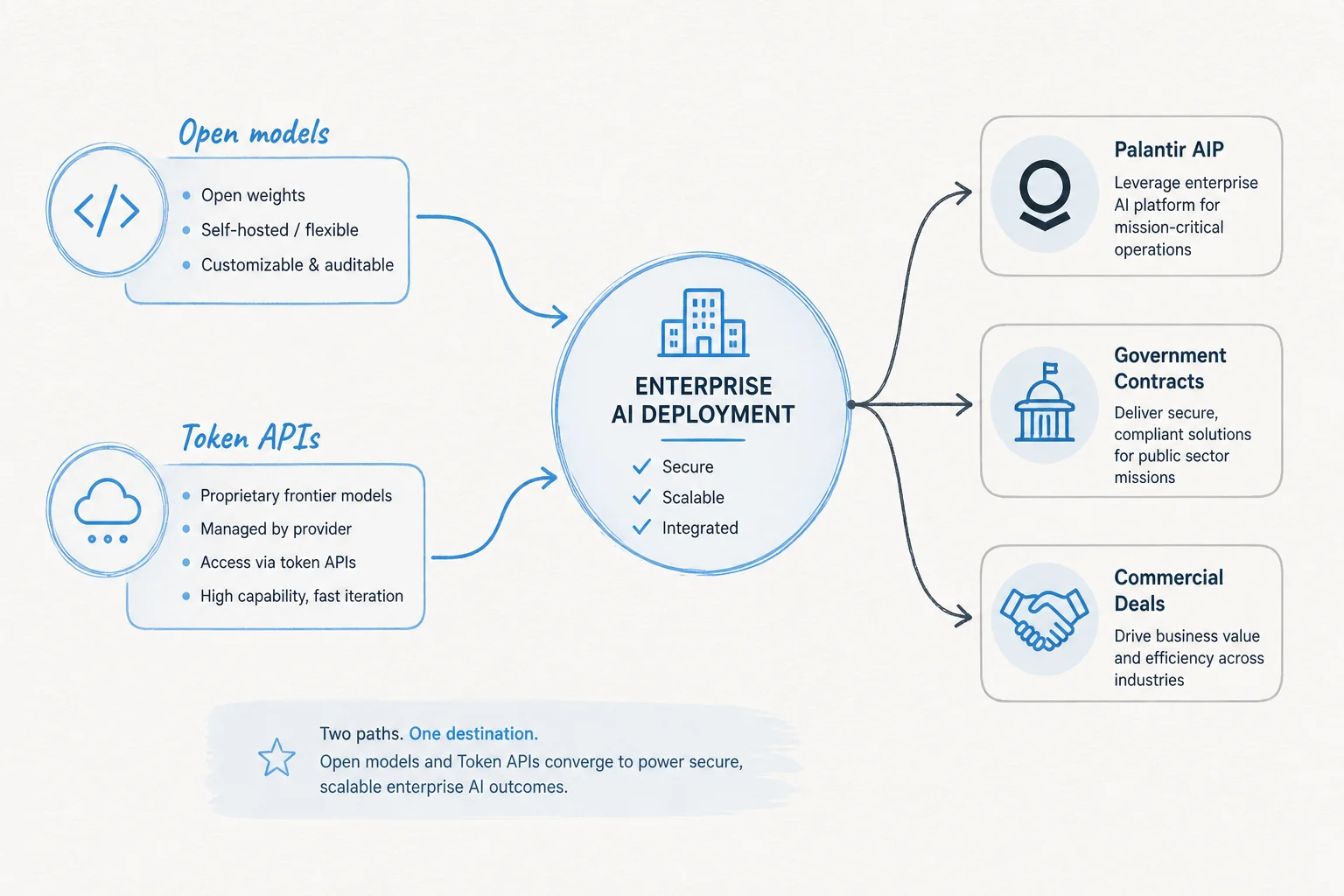
That framing matters for how Palantir positions AIP. The company is not betting the farm on a single frontier lab's token API. It is arguing that enterprise AI needs model choice, on-prem options, and competition to keep costs and quality in check.
Whether you agree with Karp's politics or not, the commercial logic is sound: if your platform margin depends on one provider's pricing, you are not a platform. You are a reseller.
What this means for smaller AI teams
I run a consulting practice, not a $8B software company. Palantir's earnings still land on my desk for three reasons:
1. Government AI budgets are real and growing. If you sell into defense, public safety, or regulated industries, the Palantir numbers validate that "AI transformation" line items are not being cut yet. Your competition is not just other startups. It is Palantir's sales team with $6B+ in commercial deal value queued up.
2. Enterprise buyers want platforms, not demos. Palantir's growth is tied to AIP deployments that connect models to operational data. Clients ask me for the same shape: CRM data, call logs, ticket history, wired into agents that actually close loops. The pitch that wins is not "we use GPT-4." It is "we integrate with your stack and measure outcomes."
3. Open vs closed model strategy is now C-suite. Karp is saying the quiet part out loud: dependency on closed frontier APIs is a strategic risk. I have been recommending hybrid architectures (cloud API for speed, open models for cost-sensitive batch work) for a year. Palantir putting it in an earnings interview normalizes the conversation with buyers who do not read Hacker News.
The quick hits context
The same week Palantir reported, Amazon crossed $3T market cap on AWS strength, Bending Spoons bought Airtable for $1.28B, and Eli Lilly opened early access to an unapproved obesity drug for select patients. Different sectors, same theme: incumbents with cash and data are moving fast while everyone else negotiates component shortages (see my RAMageddon post on memory constraints).
Palantir sits in the "platform + data moat" bucket. They are not selling tokens. They are selling the wiring between models and missions.
What I would steal for your next proposal
If you are pitching an AI ops project to a mid-market buyer, Palantir's Q2 gives you three usable proof points:
| Proof point | How to use it |
|---|---|
| 93% YoY growth at scale | Enterprise AI spend is expanding, not contracting |
| $6.24B commercial deal value | Buyers are signing multi-year platform bets |
| Open-model advocacy | Position hybrid architecture as risk management, not cheapskating |
You are not competing with Palantir on ontology engineering. You are competing on time-to-value for a specific workflow: voice intake, lead scoring, document processing, whatever your niche is.
Ship that workflow with measurable ROI in 90 days. Palantir's sales cycle is measured in quarters or years. That is your opening.
Palantir's Q2 was a growth story, not a valuation reset. Government revenue up 90%. Commercial up 149%. Guidance raised by half a billion.
The AI software trade may be volatile. The AI software budget is not disappearing.
Book a free discovery call if you want help scoping an enterprise AI workflow that ships before the platform vendors finish their procurement cycle.