
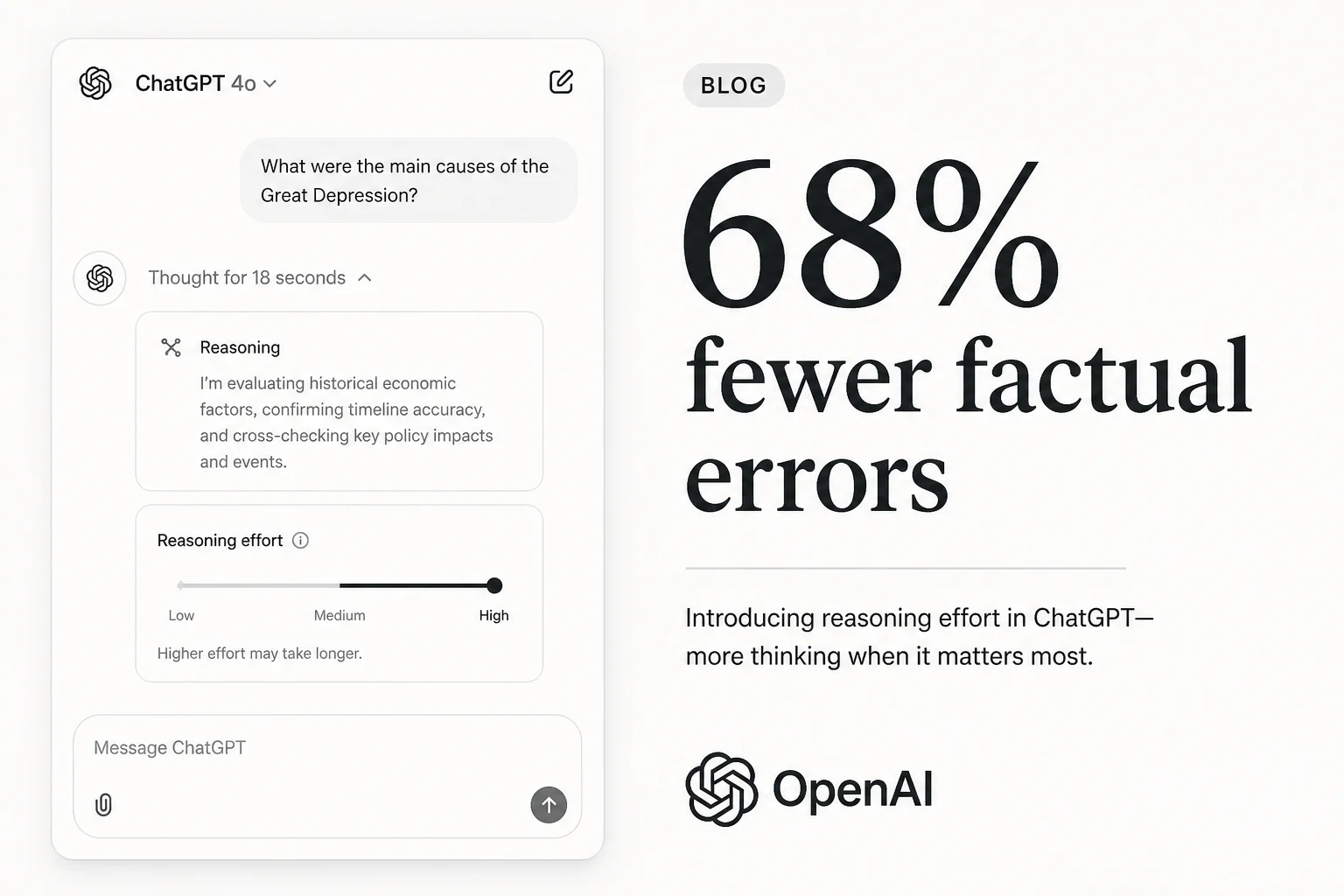
OpenAI shipped a quiet but important ChatGPT update on August 6, 2026: GPT-5.6 Sol got sharper for paid users, GPT-5.6 Luna became the free default, and both models claim big factuality gains. The headline number is 68% fewer factual errors for Sol versus GPT-5.5 Instant.
I build agents for clients in regulated-ish domains (finance ops, clinic intake, legal-adjacent workflows). That number is the first thing they will paste into Slack. The second thing they should ask is what OpenAI actually measured.
What changed in ChatGPT this week
OpenAI's August update post frames three user-facing shifts:
| Audience | Model | What's new |
|---|---|---|
| Plus / Pro | GPT-5.6 Sol | More reliable facts, more focused answers, unified quick + deep reasoning |
| Plus / Pro | Reasoning slider | You choose how much thinking Sol applies per message |
| Free / Go | GPT-5.6 Luna | Unlimited text chats, Think button for harder prompts |
Plus and Pro no longer flip between separate "Instant" and "Thinking" modes manually. One Sol model, one slider. That is a product simplification as much as a model upgrade.
Free users are not stuck on a crippled tier. Luna gets unlimited text and a Think button that buys extra reasoning time on hard questions. Separate limits still apply to files, images, voice, and image generation.
Codex and ChatGPT Work are unchanged. This wave targets everyday chat inside ChatGPT, not the coding or enterprise agent surfaces.
How to read the 68% figure without fooling yourself
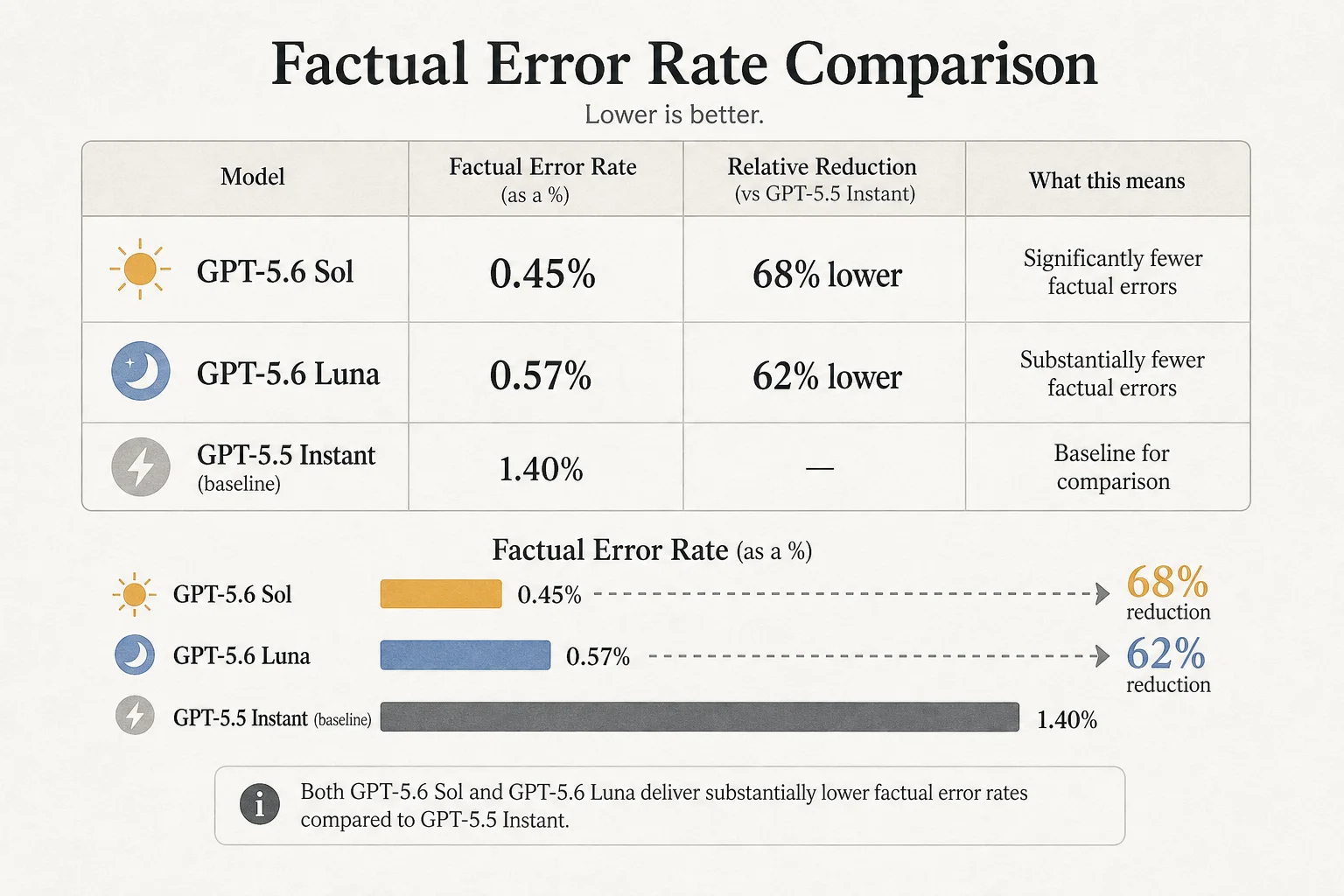
OpenAI's internal evaluation used financial, medical, and legal prompts that demand precise factual detail. They counted responses containing at least one factual error and compared Sol to GPT-5.5 Instant.
On that benchmark:
- GPT-5.6 Sol: about 68% fewer error-containing responses
- GPT-5.6 Luna: about 62% fewer
That is a real direction. It is not a guarantee that your next production answer is correct.
OpenAI's Deployment Safety Hub is explicit: these prompt sets are difficult on purpose. They stress dates, numbers, sources, rules, and assumptions. They include user-flagged failure cases from prior releases. The published rates do not reflect average production prevalence across all ChatGPT traffic.
A useful mental model: if the old model produced at least one factual error in 10 out of 100 hard prompts, Sol might land around 3 out of 100 on the same set. OpenAI has not published absolute error rates, so you cannot back-solve a single "accuracy percentage" from the press line.
For client work I treat this as: fewer obvious hallucinations on high-stakes prompts, not "ship without verification."
The reasoning slider is the feature I would actually use
Benchmarks are abstract. The slider is tactile.
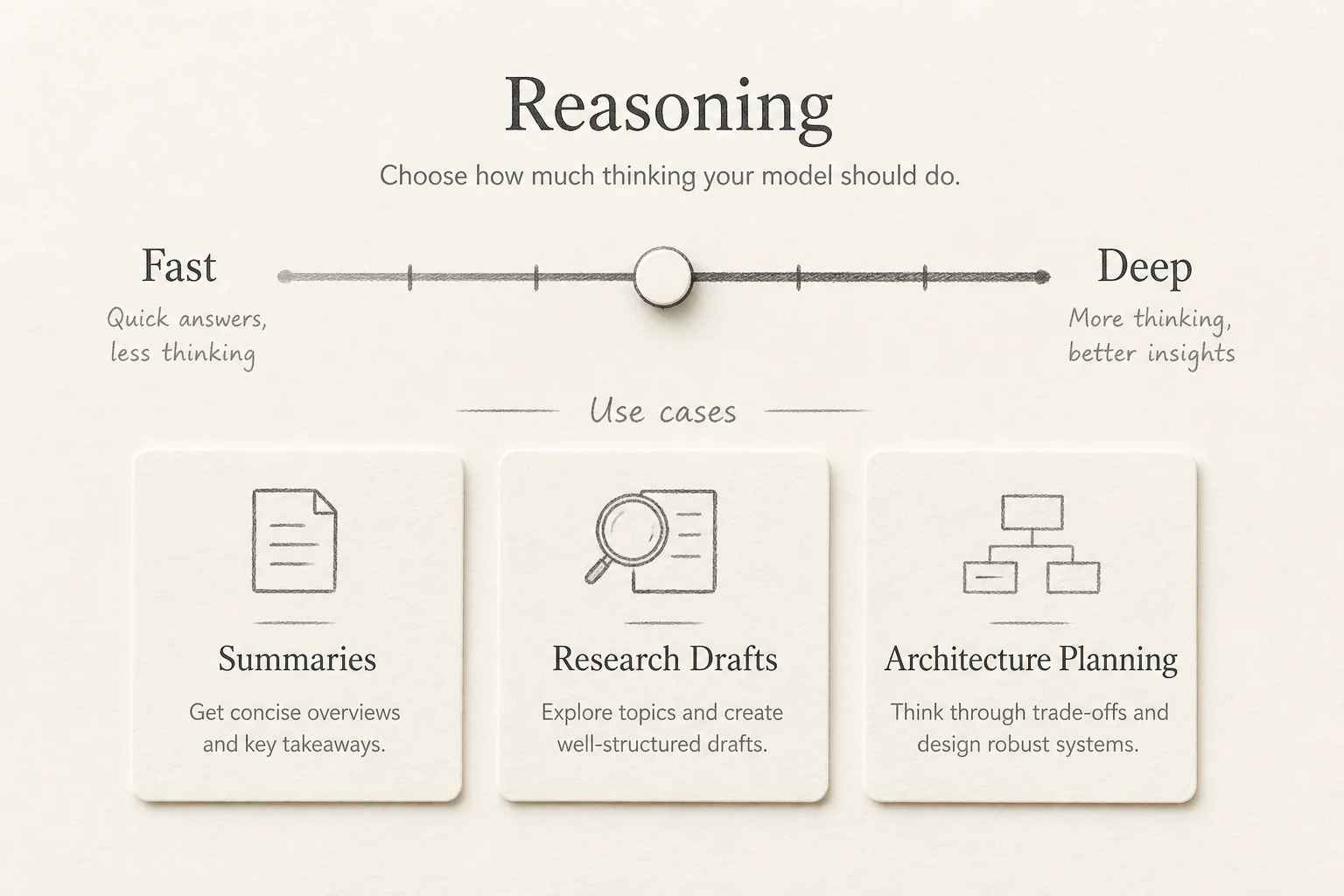
Paid users can dial Sol from fast replies to deeper analysis on the same thread. That matches how I already route agent work: cheap passes for drafts, expensive passes for architecture and edge cases. Folding that into ChatGPT's default UX is overdue.
Practical pattern I expect teams to adopt:
- Low slider: status summaries, rewrites, lightweight Q&A
- Mid slider: research drafts with citations to double-check
- High slider: multi-step planning, code design, anything where a wrong assumption compounds
The model is also tuned to push back when agreement would be wrong. That matters more than another half-point on a leaderboard for finance and legal users who need friction, not flattery.
What I would still verify in production
Even with better factuality training, I would not change my shipping checklist:
| Risk | Mitigation |
|---|---|
| Stale training cutoff | Ground with retrieval, live APIs, or attached docs |
| Confident wrong numbers | Require citations; spot-check primary sources |
| Domain-specific rules | System prompts + eval sets from real user failures |
| Compliance exposure | Human review on outbound client-facing text |
OpenAI added safety training aimed at users identified as under 18. That is separate from the factuality story but relevant if you deploy ChatGPT-family models in education or family products.
Luna for free tier: good news, same skepticism
Unlimited text on Luna is a meaningful free-tier upgrade. The Think button gives free users a taste of deeper reasoning without a full Pro subscription.
The 62% Luna improvement is slightly below Sol's 68% on the same evaluation framing. That gap is expected: Sol is the paid flagship. For awareness-stage users testing AI for the first time, Luna plus Think is probably enough to form a habit. For anything that touches money, health, or legal outcomes, I would still treat outputs as drafts.
Bottom line for applied AI teams
GPT-5.6 Sol in ChatGPT is a retune, not a new model family launch. The product moves (unified Sol, reasoning slider, Luna default for free) are as important as the benchmark line.
If you evaluate models for client work:
- Re-run your own eval set on finance, medical, or legal prompts you actually see in production.
- Compare cost per task, not just error rates, if you route through APIs instead of ChatGPT UI.
- Keep human or automated verification on anything customer-facing.
The 68% figure is a strong signal that OpenAI is optimizing for trust on hard prompts. It is not permission to turn off your guardrails.
If you are wiring ChatGPT-class models into ops workflows and want a second pair of eyes on eval design, book a free discovery call.