
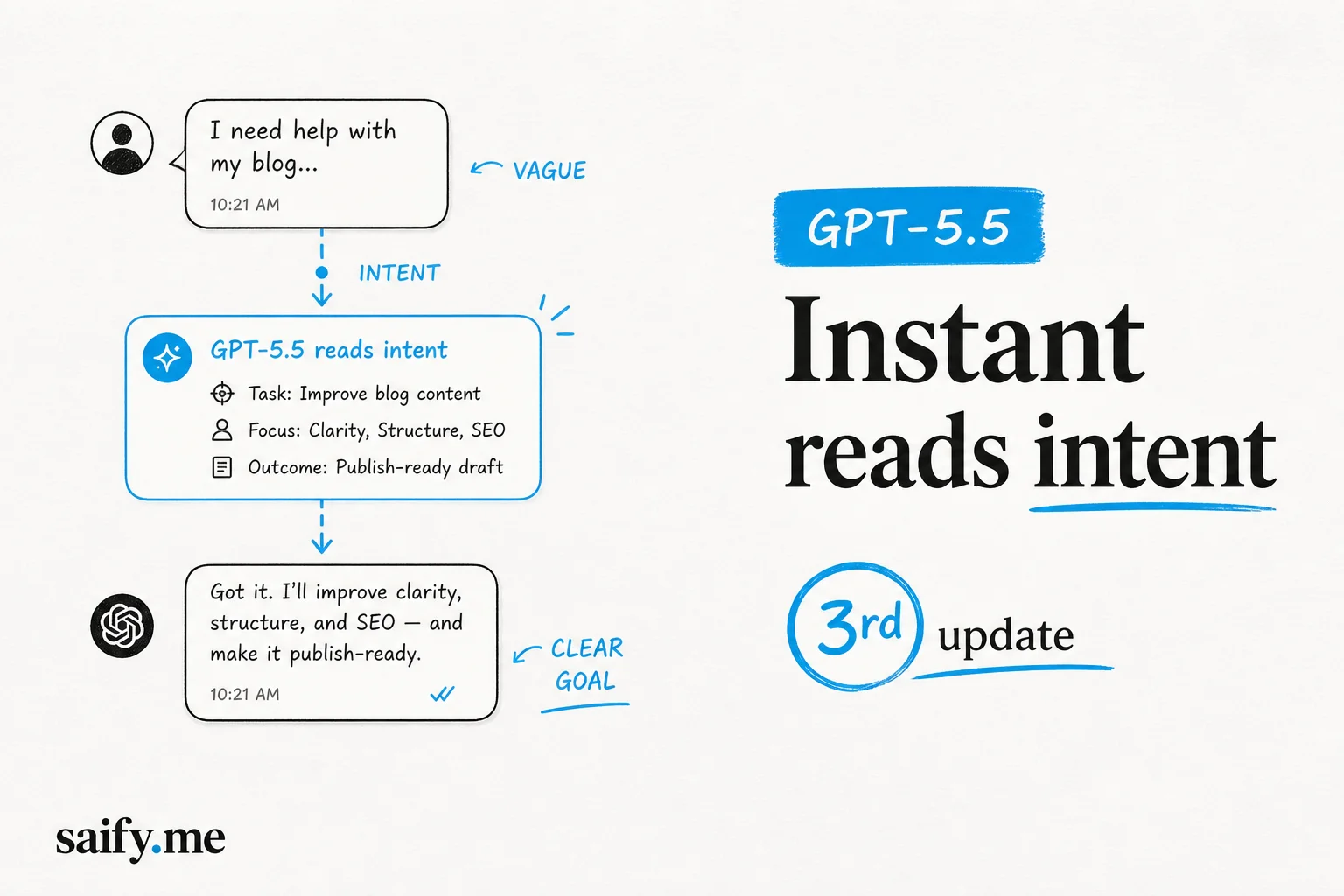
OpenAI did not ship a new frontier model on June 24, 2026. It shipped a better conversational partner.
GPT-5.5 Instant got its third behavioral update since the tier launched in May. No benchmark press release. No new parameter count. Just the model that powers most ChatGPT sessions getting sharper at reading what you meant, not only what you typed.
OpenAI's own social post called it "much more fun to talk to." Under the marketing line are three changes that matter for builders routing real user traffic.
What actually improved
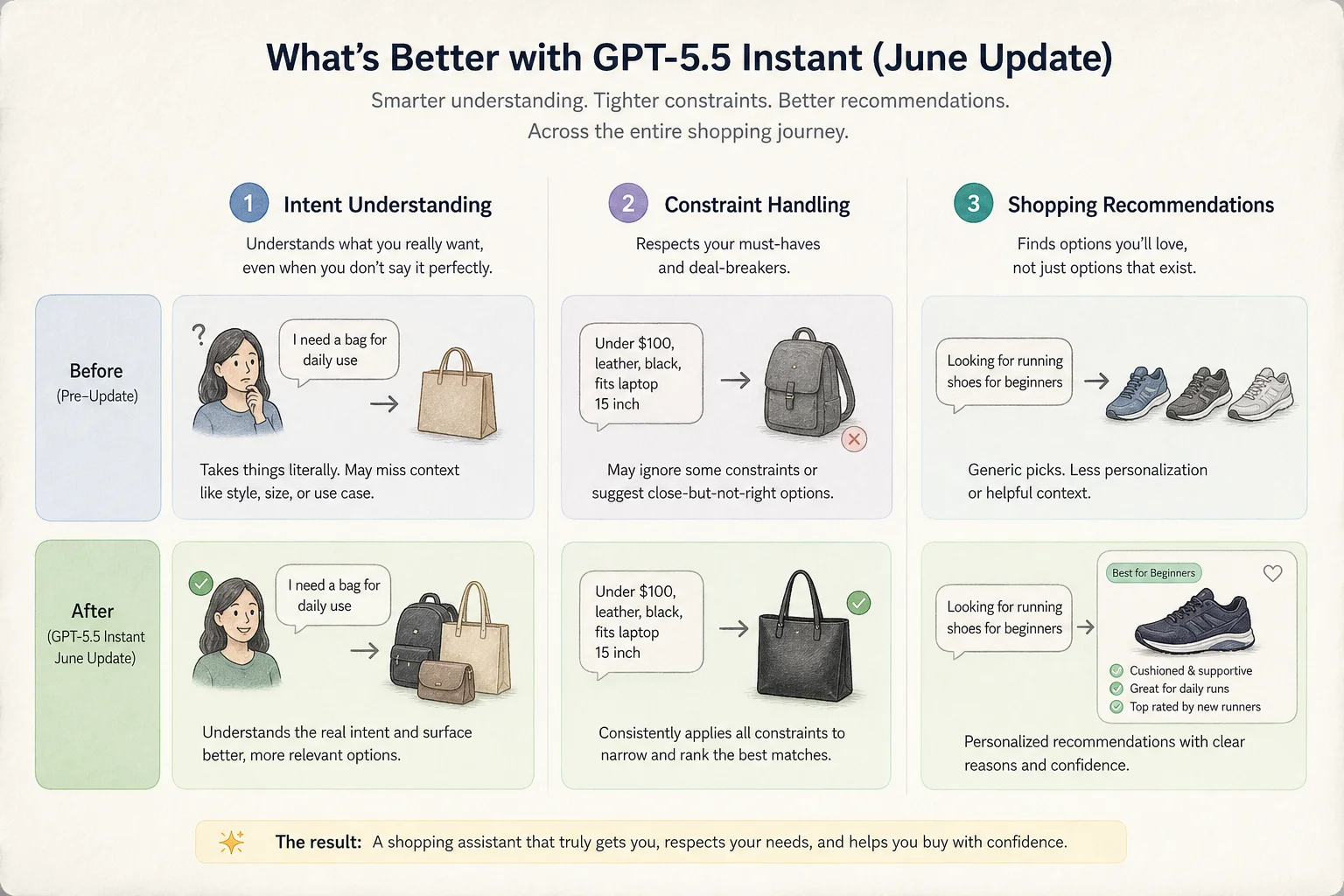
Intent understanding. The model is better at identifying the goal behind a vague question. Planning a trip, comparing vendors, asking for advice, or researching options should produce answers aligned with the underlying task, not a literal misread of the first sentence.
Constraint handling. Nested instructions are the failure mode every product team knows. "Write this in bullet points, under 200 words, no jargon, and include pricing." Older Instant builds would satisfy two rules and ignore the rest, or repeat the first answer when you pushed back. The June build is supposed to adapt when you clarify, contradict, or add rules mid-thread.
Shopping and local recommendations. OpenAI says results are more cohesive: product details, business context, location signals, and images stitched into answers that feel like one recommendation, not a search results paste.
Rollout and who gets it
| Tier | Access date |
|---|---|
| ChatGPT Plus, Pro, Team, Enterprise | June 24, 2026 |
| ChatGPT Free | June 25, 2026 |
Rollout is gradual inside accounts. If you do not feel a difference on day one, check again after a few sessions. Instant updates do not always flip globally at midnight.
API implications (read the aliases carefully)
Developers get the same behavioral shift through OpenAI's updated chat-latest alias, which tracks the Instant build currently serving ChatGPT.
Important distinction from VentureBeat's API coverage:
chat-latest= moving target aligned with ChatGPT Instantgpt-5.5= production slug OpenAI recommends for stable API deployments
Use chat-latest when you want to preview ChatGPT behavior in your app. Pin gpt-5.5 when you need reproducible regression tests across releases.
curl https://api.openai.com/v1/chat/completions \
  -H "Authorization: Bearer $OPENAI_API_KEY" \
  -H "Content-Type: application/json" \
  -d '{
    "model": "chat-latest",
    "messages": [
      {"role": "user", "content": "Plan a 3-day Tokyo trip. Vegetarian. No museums. Under $2k total. Reply as a table."}
    ]
  }'
If constraint following improved in your account, this prompt should return a table that respects all four constraints without you restating them.
How this fits the Instant iteration pattern
GPT-5.5 Instant launched May 5, 2026. Weeks later, OpenAI adjusted pacing and tone. Now June brings intent and constraint work.
That cadence tells you three things:
- Behavioral tuning ships faster than major version bumps. Product teams should plan eval suites that run weekly, not quarterly.
- Consumer experience is the optimization target for Instant. Fun, natural, recommendation quality beat math benchmark bragging.
- Thinking tier still owns hard reasoning. For agentic coding and multi-hour research, I still route to Thinking or Codex-class models, not Instant.
If you already run voice or ops agents on ChatGPT-class models, compare Instant against GPT-Live full-duplex voice and your Codex routing. Instant updates do not automatically propagate to every surface.
What I would test before trusting the hype
OpenAI published no numbers for this release. Qualitative "more fun" is not a regression suite.
Run your own golden prompts:
| Test | Pass signal |
|---|---|
| Ambiguous intent | Asks one clarifying question instead of guessing wrong |
| 4+ constraints | All constraints visible in the answer |
| Mid-thread pushback | Changes approach without repeating paragraph 1 |
| Local search | Uses location context without inventing businesses |
| Tone stability | Stays concise when you asked for concise |
Log outputs under chat-latest weekly. When OpenAI moves the alias, your logs tell you whether user satisfaction moved with it.
Practical takeaway
This update is easy to dismiss because it has no leaderboard score. That is exactly why it matters.
Most ChatGPT traffic is not solving IMO problems. It is planning, shopping, writing, and arguing with a model that should understand what you want.
For applied teams, the lever is not "switch models." It is re-run your intent-heavy evals and see if support tickets about "it ignored my instructions" drop.
If you are routing user-facing agents across OpenAI tiers and want help designing eval prompts that catch intent failures before users do, book a free discovery call.