
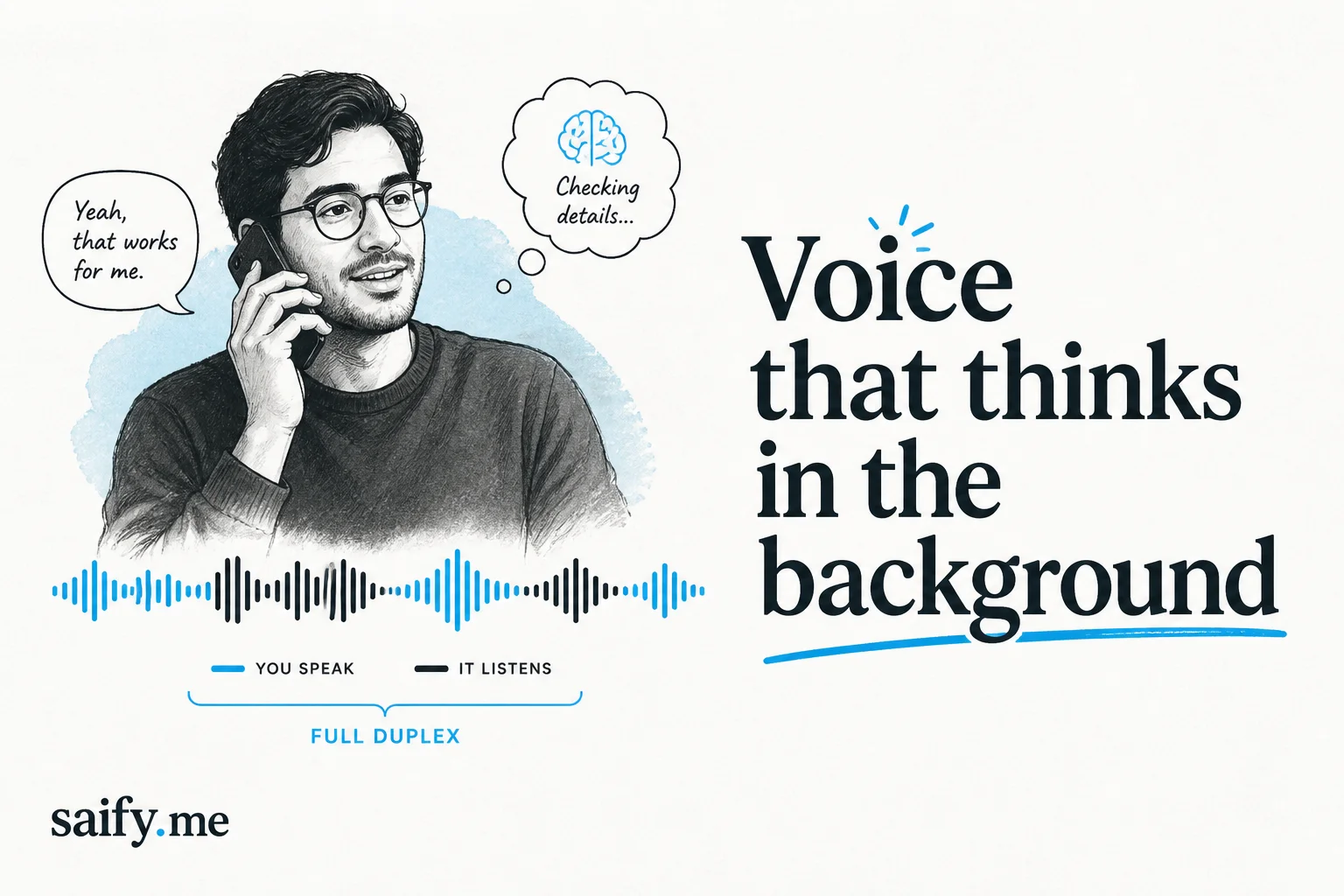
You know that awkward pause in ChatGPT Voice? You stop talking. The app guesses your turn is over. Then it thinks. Then it answers. One side at a time, like a walkie-talkie.
GPT-Live, which shipped July 8, 2026, removes that pattern entirely. OpenAI rebuilt ChatGPT Voice around a full-duplex architecture: the model listens and speaks at the same time. No turn detector in the audio path.
I build voice agents for clinics, trades, and service businesses. This is the kind of architecture shift that changes what callers expect from every voice product, including the ones I ship.
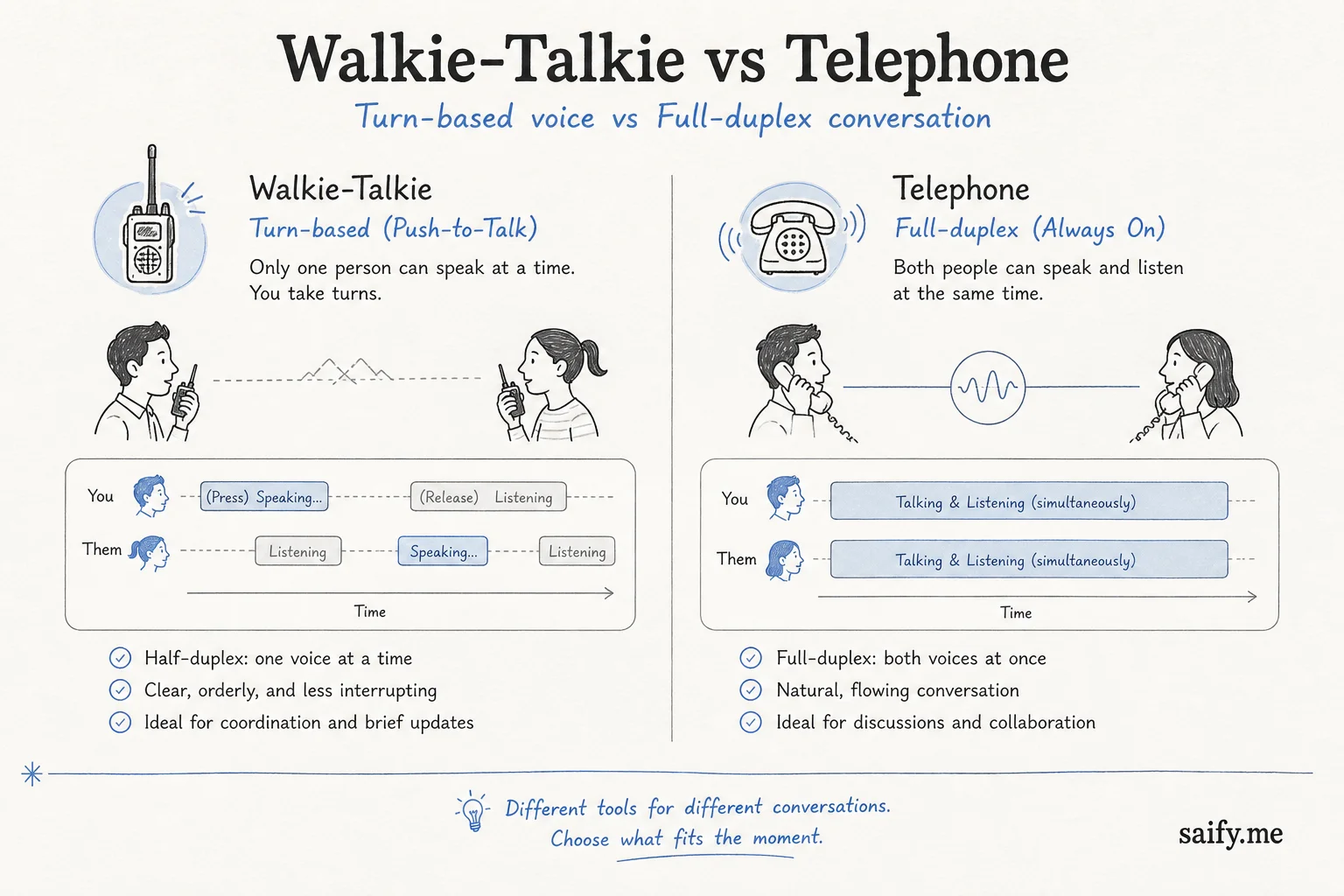
Walkie-talkie vs phone call
Turn-based voice AI processes input and output in sequence. You finish a sentence. The system detects end-of-turn. It generates a response. You wait.
Full-duplex works like a telephone. Audio flows both directions continuously. The model can say "mhmm" while you are still talking. It can interrupt when appropriate. It can stay quiet while you think.
| Pattern | Behavior | User feel |
|---|---|---|
| Turn-based (old AVM) | Listen, then think, then speak | Stilted, high latency |
| Full-duplex (GPT-Live) | Listen and speak simultaneously | Natural conversation |
That difference sounds cosmetic until you try live translation, quick back-and-forth clarification, or handling a caller who trails off mid-sentence. Turn detectors guess wrong constantly in noisy environments.
Two layers: talk now, think later
GPT-Live's load-bearing design choice is splitting interaction from reasoning.
The voice layer (GPT-Live-1 or GPT-Live-1 mini) handles continuous interaction: listening, speaking, backchanneling ("yeah", "got it"), and managing interruptions.
The reasoning layer (GPT-5.5 at launch) handles harder work asynchronously: web search, multi-step reasoning, tool use. Results weave back into the conversation without killing the flow.
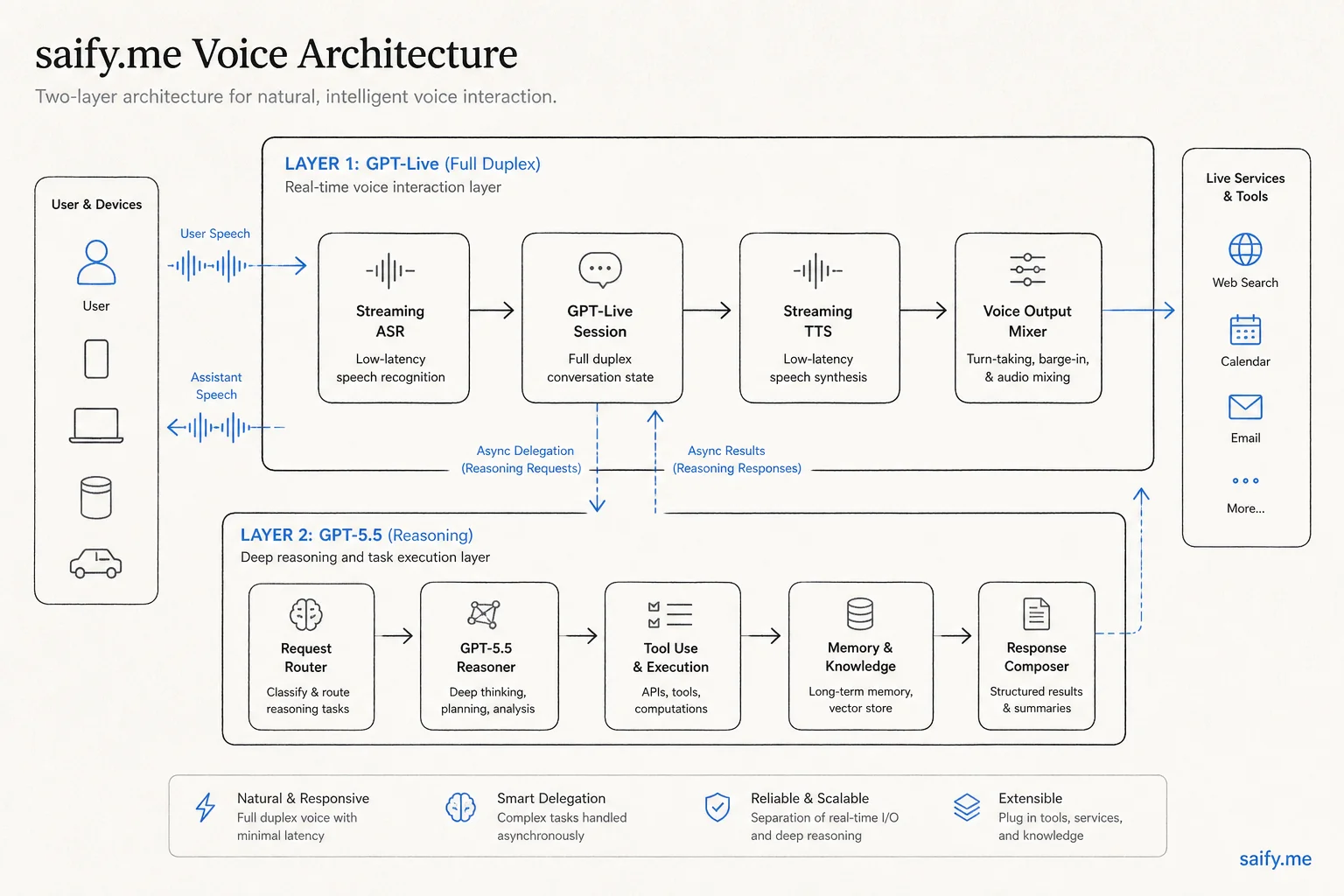
OpenAI calls this decoupling "talking" from "thinking." In practice:
- Easy questions get instant voice responses.
- Hard questions trigger background delegation while GPT-Live keeps the conversation alive.
- Session startup dropped from six network round trips to one, so the first word feels faster.
You pick reasoning depth on GPT-Live-1: Instant, Medium, or High. Each maps to a different GPT-5.5 tier in the background. GPT-Live-1 mini only supports Instant.
What shipped (and what did not)
GPT-Live rolled out globally to ChatGPT users on Free, Plus, Pro, and Go tiers. Human evaluators strongly preferred it over Advanced Voice Mode.
What is in:
- Nine remastered voices (predefined only, with safeguards against voice cloning)
- Live translation potential (no need to wait for a complete sentence)
- Visual cards for weather, stocks, and sports in voice mode
- Better handling of noisy environments and mid-thought pauses
What is not in at launch:
- Video and screen sharing in voice mode
- Full multilingual parity
- Public API (announced as upcoming)
OpenAI positions GPT-Live as a platform for realtime interaction across devices. The reported donut-shaped home speaker is expected to run an advanced version. I covered that hardware angle in OpenAI's $400 AI donut.
What this means for business voice agents
Most of my client voice work is not ChatGPT in a pocket. It is after-hours booking, lead qualification, CRM logging, and WhatsApp handoffs. But the UX bar moves when consumers experience full-duplex at home.
Here is what I am adapting:
Kill the dead air. Callers interpret silence as a dropped call. GPT-Live's backchanneling ("still looking that up") is a pattern worth stealing even on a phone line. A quick "one moment" beats three seconds of nothing.
Split fast ack from slow work. Route simple intents to a fast path. Delegate RAG lookups, calendar checks, and multi-step CRM writes to a background worker. The voice surface should never go silent while the database query runs.
Drop brittle turn detection where you can. If your stack supports streaming duplex (Vapi, Retell, OpenAI Realtime API), stop guessing end-of-turn from silence timers alone. Use semantic cues and partial transcripts.
Expose reasoning depth when it matters. Not every caller needs deep thinking. A booking agent should be Instant. A triage nurse line might warrant Medium. Match compute to stakes.
Useful stack references:
The latency budget is the product
Howard Owen's writeup on GPT-Live architecture highlights what matters at scale: pre-warmed inference sessions, session affinity, prompt caching. The voice model is not just a smaller LLM. It is a realtime system with a latency budget measured in milliseconds.
That is the gap between a demo and production. A full-duplex model that stutters under load is worse than a turn-based one that is reliable.
If you are building voice for ops (front desk, lead chase, appointment booking) and want help designing the fast-path vs slow-path split, book a free discovery call. The architecture lesson from GPT-Live applies whether you use OpenAI's stack or roll your own.