
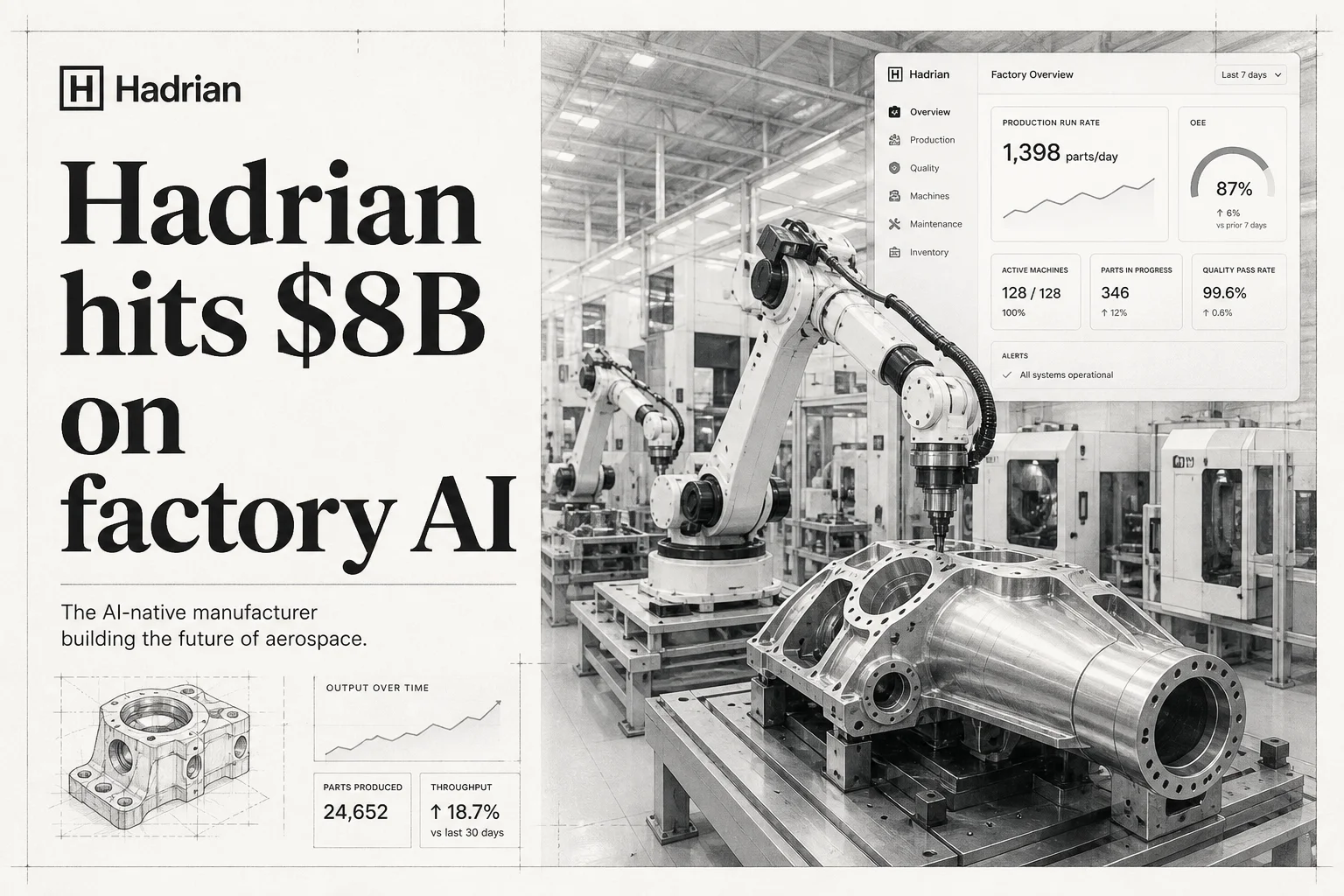
Hadrian does not sell an API. It sells missile parts, submarine components, and factory capacity, powered by software that most of the defense industrial base still runs in spreadsheets and tribal knowledge.
On August 6, 2026, the company closed nearly $1.4 billion in funding at a $7.9 billion valuation. CEO Chris Power told CNBC the capital will scale Hadrian's workforce, expand its Opus software platform, and accelerate production in areas like submarines, munitions, and the drone industrial base.
I spend most of my time on voice agents and CRM automation. Hadrian is a useful counterexample: applied AI that ships atoms, not chat transcripts. If you care about what "agents in production" looks like outside SaaS, this is one of the clearest cases in 2026.
The problem Hadrian is solving
US defense and aerospace manufacturing has a capacity crisis and a skills crisis at the same time.
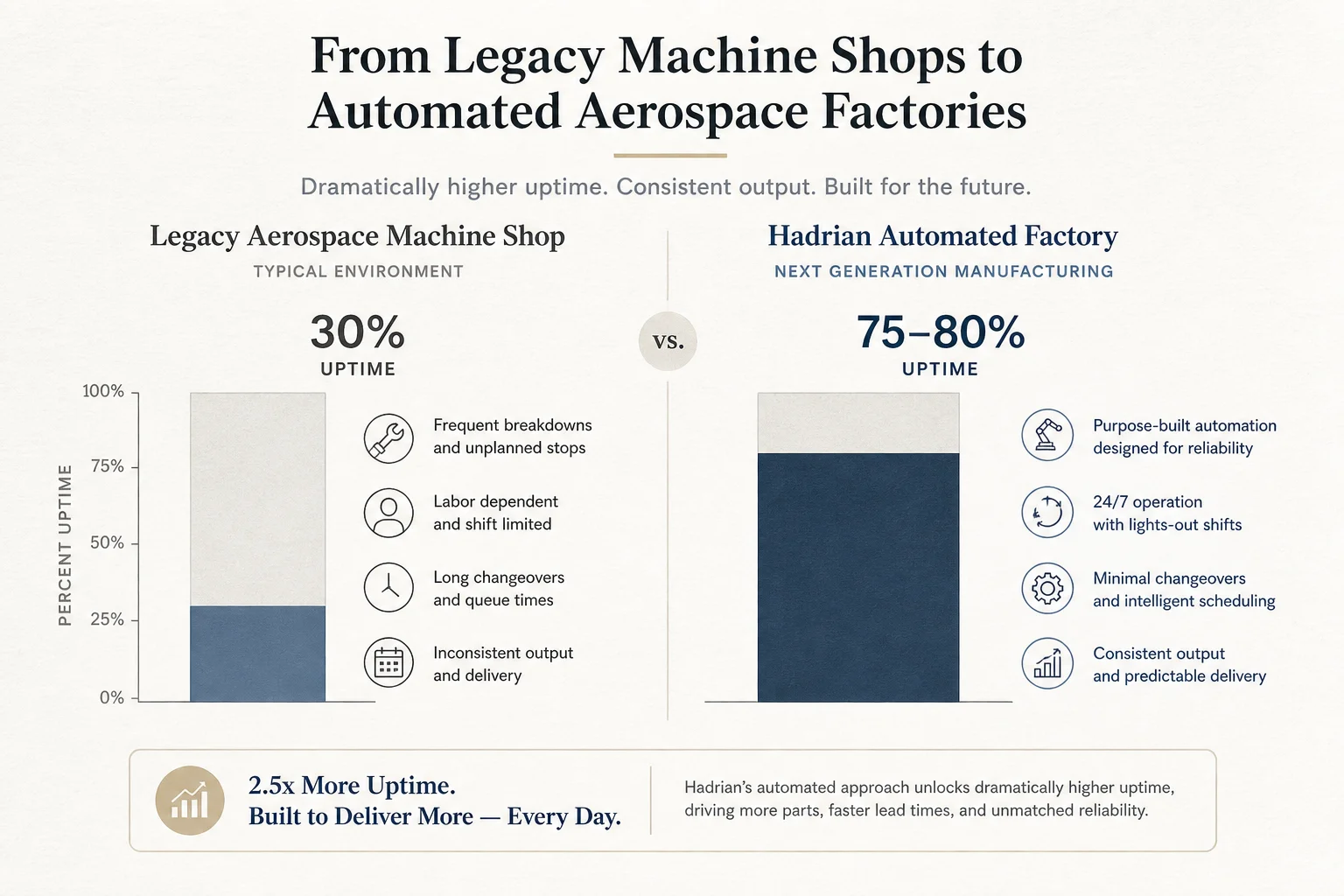
Prime contractors need more parts faster for programs like Virginia-class and Columbia-class submarines. Legacy machine shops run at roughly 30 percent equipment uptime, according to industry analyses cited in startup diligence reports. Skilled CNC programmers are retiring faster than apprentices replace them.
Hadrian's bet is that those bottlenecks are software problems disguised as labor problems. Put the lost manufacturing know-how into Opus, automate the repetitive workflow around machining and inspection, and a new operator can be productive in 30 days instead of years.
Power put it plainly on CNBC: "With physical AI sweeping the physical economy, which is 100 times larger than the digital economy, everyone's going to need to rebase their software to adapt and compete in this new world."
What Opus actually automates
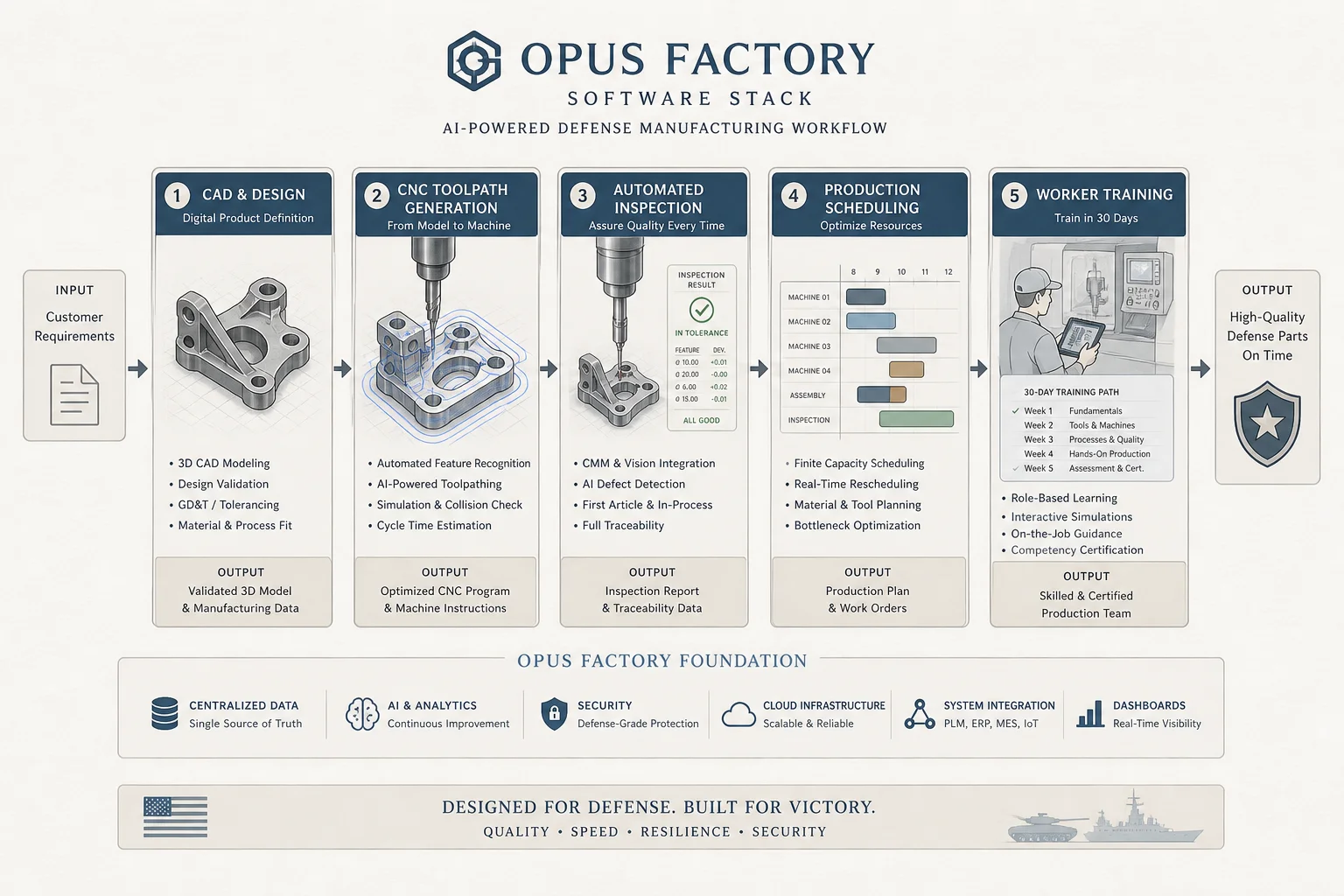
Opus is not a chatbot on a factory floor. It is a full-stack factory autonomy platform that Hadrian built for its own operations.
| Opus capability | What it replaces |
|---|---|
| Autonomous CAM generation | Manual CNC programming from CAD files |
| Embedded inspection | Separate QA steps bolted onto production |
| Real-time capacity optimization | Manual scheduling across machines |
| Operator acceleration | Years-long machinist apprenticeships |
The result, per Hadrian's own metrics: 75 to 80 percent equipment uptime versus roughly 30 percent at legacy aerospace shops, and new workers trained to production speed in 30 days or less.
Hadrian operates multiple sites: Factory 2 and Factory X in Torrance, California; Factory 3 in Mesa, Arizona (290,000 square feet, lease to production in about six months); and Factory 4 in Alabama focused on naval programs.
The commercial model has three tiers:
- Precision components on demand (prototype to production)
- Manufacturing-as-a-Service (dedicated cells for one customer)
- Factories-as-a-Service (Hadrian designs and runs entire facilities for defense priorities)
Opus stays internal. You buy parts and capacity, not a SDK.
Why the valuation jumped 4x in seven months
Hadrian's January 2026 valuation and its August 2026 round are not the same company on paper.
Defense tech funding is running hot on the back of increased US military spending and reshoring pressure. Shield AI hit a $12.7 billion valuation in March. Anduril doubled to over $60 billion two months later. Hadrian sits in the same wave, but with a factory-first story rather than autonomous drones.
The August round was led by Baillie Gifford and J.P. Morgan Strategic Investment Group, with Washington Harbour Partners among the participants. Power said Opus is already used by the Army and Navy, with more defense prime announcements coming.
That matters because Hadrian's revenue is tied to real unit output: flight-grade parts, submarine components, munitions supply chains. When the Pentagon scales procurement, factories that can spin up in six months become strategic assets, not just startups with a pitch deck.
Lessons for applied AI builders (even outside defense)
I am not suggesting you pivot to machining torpedo parts. I am suggesting Hadrian encodes patterns worth stealing:
Close the loop. Opus does not just generate toolpaths. It inspects, schedules, and reassigns idle machines. Agentic systems that only generate text without closing the operational loop are demos. Hadrian's loop ends in a physical part that either passes spec or does not.
Encode expertise, do not just assist it. The value is not "AI helps a machinist work faster." It is "a person with no prior manufacturing background can run advanced CNC equipment in a month because the skills live in software."
Sell outcomes, not models. Hadrian never marketed Opus as a horizontal platform. It built factories, proved throughput, then raised on the strength of delivered capacity. That is the same commercial logic I use on voice projects: sell booked appointments and logged leads, not "we integrated GPT."
Uptime is the metric. In software we talk about latency and error rates. In factories it is utilization. Going from 30 percent to 80 percent uptime on expensive machines is a financial transformation, not a productivity tweak.
The risks and limits
Hadrian is not open source. You cannot download Opus and replicate the model in your garage. Defense manufacturing also carries program risk: a single contract delay can whipsaw factory utilization.
Power himself has framed the mission in national-security terms ("reindustrialize America," compete with China's manufacturing scale). That narrative attracts capital. It also raises the bar for execution when geopolitics shift.
And 30-day operator training is a claim, not a law of physics. Exception handling on exotic materials and tight-tolerance aerospace work still needs humans who know when the machine is wrong.
But the direction is clear. Physical AI is where a lot of 2026 capital is landing, and Hadrian is one of the few companies showing a repeatable factory playbook rather than a one-off pilot.
Where this connects to my work
Most of my clients are not building submarines. They are trying to make operations teams 2x faster without hiring 2x headcount. The mechanism is different (CRM automations, voice agents, RAG over internal docs), but the shape is similar:
- Capture expert workflow
- Automate the repetitive middle
- Keep humans on exceptions
- Measure throughput, not token count
Hadrian just does it with titanium instead of tickets.
Useful links:
- Hadrian homepage
- Hadrian Series C announcement (2025 expansion)
- CNBC coverage of the $7.9B valuation
- Related reading: where AI saves ops hours first
The bottom line
Hadrian raised $1.37 billion because investors believe factory autonomy is defense-critical infrastructure, not a nice-to-have efficiency tool. Opus is the moat: software that turns lost machining skills into repeatable production at scale.
If you build applied AI, watch companies like this for what "production" actually means. It is not a leaderboard score. It is parts out the door, on spec, on schedule, with workers you trained in weeks.
That is the bar more of us should be aiming at, even if our output is appointments and invoices instead of aero components.
Mapping AI automation for ops or production workflows? Book a free discovery call and we can find the highest-leverage loop to close first.