
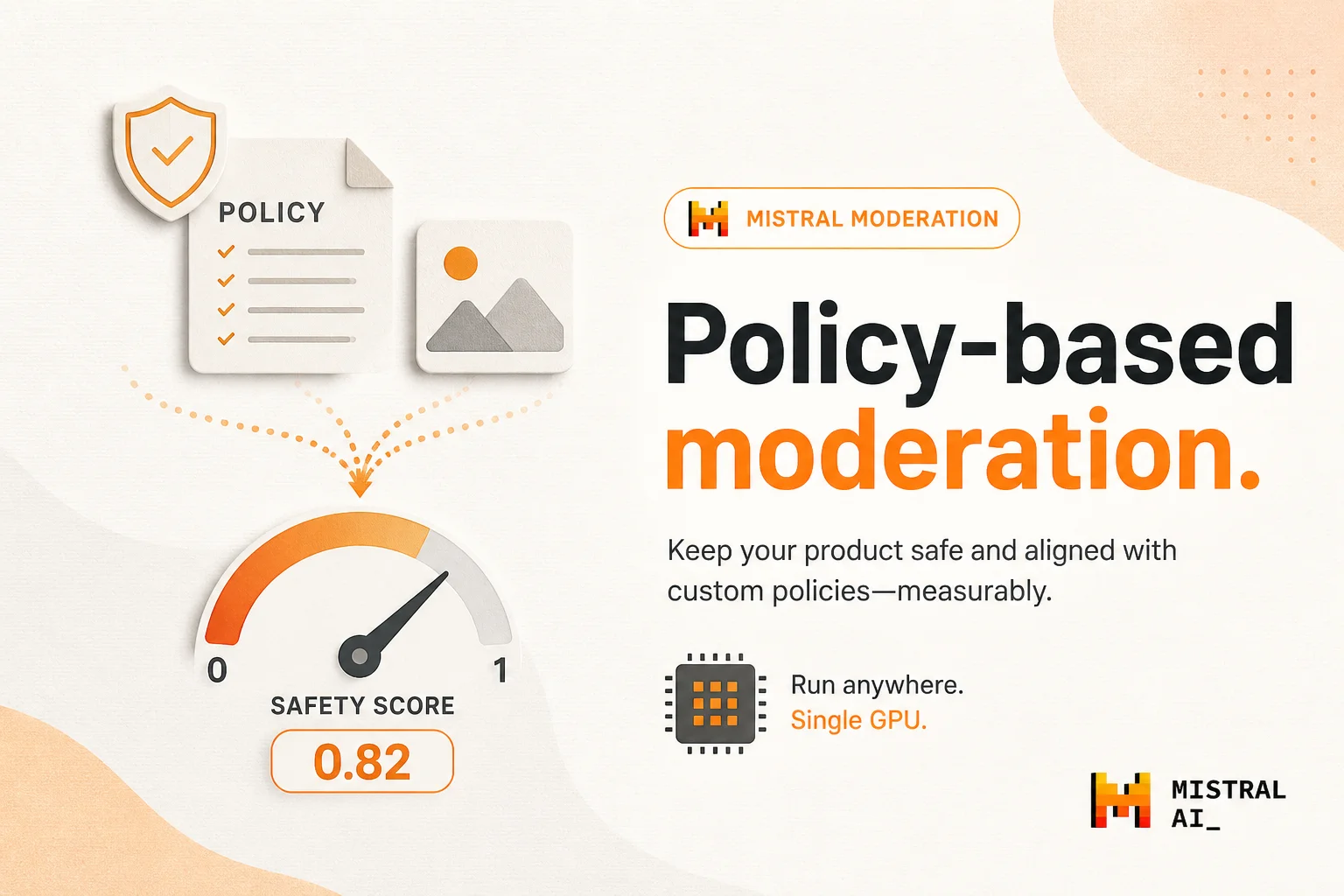
Fixed-category guardrails age badly. The moment your product policy says "no medical advice unless sourced" or "block competitor logos in uploads," you are either retraining or duct-taping regex. Mistral Shieldstral bets on a simpler interface: write the rule in English at inference time, get a score back.
Released August 4, 2026 under Apache 2.0, Shieldstral 1.0 3B is a multimodal safety classifier that runs on one 16GB GPU and reportedly matches open guard models up to 7x its size on text safety benchmarks.
I ship agents for clinics, contractors, and ops teams with real moderation requirements. A 3B self-hosted filter you can steer with prose is more interesting than another cloud API that only understands a vendor's harm taxonomy.
Policy as a prompt, not a retrain
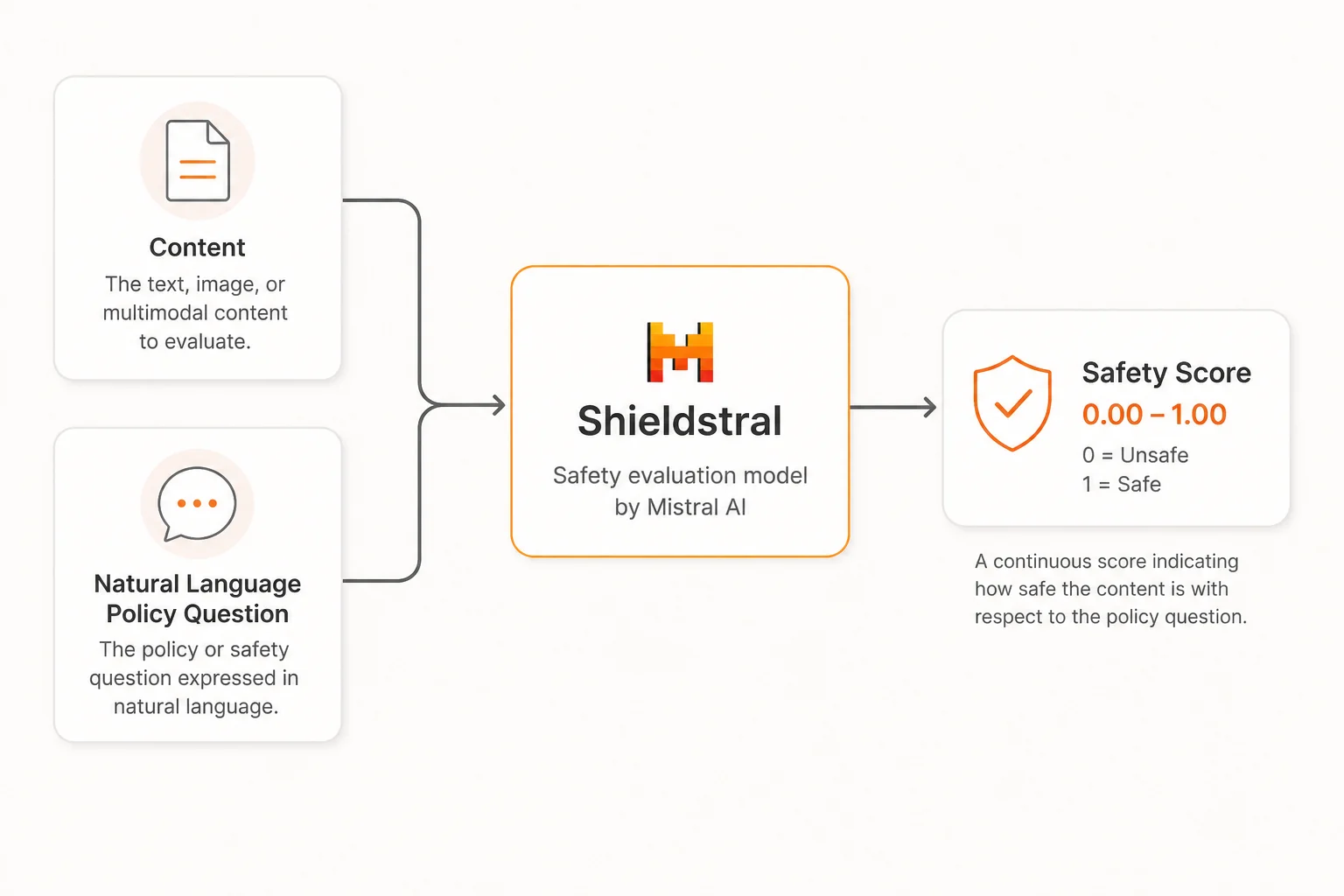
Mistral's launch post frames moderation as policy-adaptive question answering:
- You supply content (text, image, or both)
- You supply a natural-language policy question ("Does this violate our no-PII rule?")
- The model emits a single-token yes/no answer
- You normalize logits into a continuous 0-1 safety score
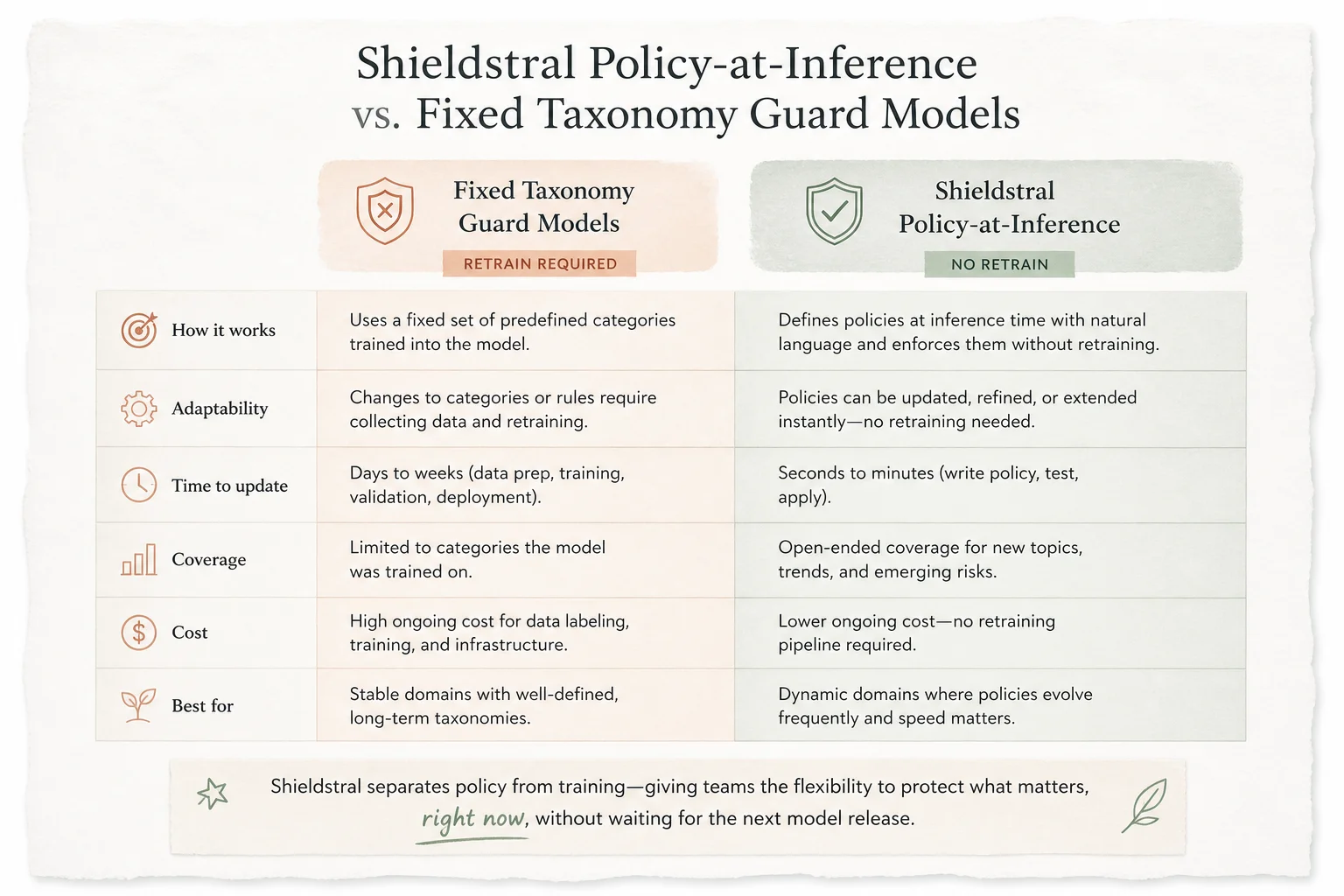
No fine-tune per policy. No frozen category list baked into weights.
That is a meaningful shift from models like Llama Guard that encode a fixed taxonomy. Product teams change policies weekly. Shieldstral lets the checkpoint stay stable while the question string changes.
What is under the hood
Shieldstral builds on Mistral's compact Ministral 3B base with a Pixtral vision encoder for multimodal input. Key properties from the model card and community writeups:
| Property | Detail |
|---|---|
| Parameters | 3B |
| License | Apache 2.0 |
| Modalities | Text, image, text+image |
| Output | Single-token yes/no, scored 0-1 |
| VRAM (BF16) | ~16GB on one GPU |
| Hosting | Self-hosted only (no Mistral API endpoint) |
Mistral positions it as part of the Open Secure AI Alliance push alongside NVIDIA and other partners. Weights live on Hugging Face as mistralai/Shieldstral-1.0-3B.
Benchmark claims are vendor-run. Treat them as directional. In production I would still run your policy set and measure false positives on real user content.
Serving Shieldstral in production
The Mistral moderation cookbook documents two paths:
Transformers (dev / Colab):
from transformers import AutoModelForCausalLM, AutoTokenizer
import torch

MODEL = "mistralai/Shieldstral-1.0-3B"
tokenizer = AutoTokenizer.from_pretrained(MODEL)
model = AutoModelForCausalLM.from_pretrained(
    MODEL, device_map="cuda", dtype=torch.bfloat16
).eval()
vLLM (production):
vllm serve mistralai/Shieldstral-1.0-3B \
  --max-model-len 32768 \
  --host 127.0.0.1 \
  --port 8000
Mistral recommends vLLM 0.26.0+ with mistral-common >= 1.11.5. llama.cpp and SGLang are also supported. Quantized GGUF builds (Q8_0, Q5_K_M, Q4_K_M) trade accuracy for smaller footprints on test hardware.
Where I would wire it in an agent stack
Shieldstral is a classifier, not a replacement for your main LLM. Typical insertion points:
| Stage | Use |
|---|---|
| Inbound user message | Block or flag before the agent sees PII or abuse |
| Tool output | Scan fetched HTML or uploaded images |
| Outbound reply | Final gate before customer-facing text sends |
| Batch review | Score historical logs when policies change |
Because policies are plain language, legal or ops can draft the question string. Engineering owns the threshold (e.g., score > 0.85 → block, 0.6-0.85 → human review).
Example policy questions I have used in similar systems:
- "Does this message request specific medical diagnosis or dosage advice?"
- "Does this image contain visible credit card numbers or government ID numbers?"
- "Does this response disclose unreleased pricing from our internal doc?"
One 3B model, many policies, no redeploy when wording tightens.
Costs and trade-offs
Self-hosted 3B on a single GPU pushes the marginal cost per classification toward electricity, not per-token API fees. For high-volume chat products that is attractive.
Trade-offs to plan for:
- You operate the GPU. No serverless magic; you patch vLLM and monitor VRAM.
- Multimodal paths need the vision stack. Quantization helps language weights; images still add encoder cost.
- False positives hurt UX. Calibrate thresholds on your traffic, not Mistral's benchmarks.
- Policies can be gamed. Natural-language rules need red-team passes like any other guard.
Shieldstral does not solve agent alignment. It gives you a cheap, adaptable filter at the edges.
Bottom line
Mistral Shieldstral is the most practical open moderation release I have seen this quarter for teams that need custom policies without training runs. The 3B size makes it feasible on a single 16GB card. The policy-as-prompt API makes it feasible for product teams that change rules often.
If you run user-generated content through agents (voice transcripts, uploaded job photos, chat widgets), add a self-hosted moderation stage before you scale traffic.
Want help designing policy questions and thresholds for an agent deployment? Book a free discovery call.